
Navigating the Future
AI, Data & Competition
OECD COMPETITION COMMITTEE
BEST PRACTICE ROUNDTABLES ON COMPETITION POLICY
JUNE 12, 2024
http://sapi.co.kr
YONG LIM
SEOUL NATIONAL UNIVERSITY
SCHOOL OF LAW
#Future
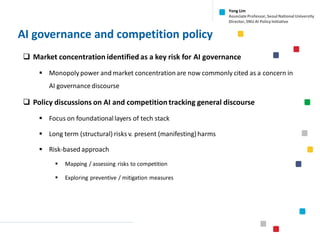
AI governance and competition policy
❑ Market concentration identified as a key risk for AI governance
▪ Monopoly power and market concentrationare now commonly cited as a concern in
AI governance discourse
❑ Policy discussions on AI and competition tracking general discourse
▪ Focus on foundational layers of tech stack
▪ Long term (structural) risks v. present (manifesting)harms
▪ Risk-based approach
▪ Mapping / assessing risks to competition
▪ Exploring preventive / mitigation measures
Yong Lim
Associate Professor,Seoul National University
Director,SNU AI Policy Initiative
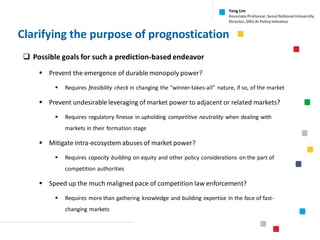
Clarifying the purpose of prognostication
❑ Possible goals for such a prediction-based endeavor
▪ Prevent the emergence of durable monopoly power?
▪ Requires feasibility check in changing the “winner-takes-all” nature, if so, of the market
▪ Prevent undesirable leveraging of market power to adjacent or related markets?
▪ Requires regulatory finesse in upholding competitive neutrality when dealing with
markets in their formation stage
▪ Mitigate intra-ecosystem abuses of market power?
▪ Requires capacity building on equity and other policy considerations on the part of
competition authorities
▪ Speed up the much maligned pace of competition law enforcement?
▪ Requires more than gathering knowledge and building expertise in the face of fast-
changing markets
Yong Lim
Associate Professor,Seoul National University
Director,SNU AI Policy Initiative
Learning from the past
Yong Lim
Associate Professor,Seoul National University
Director,SNU AI Policy Initiative
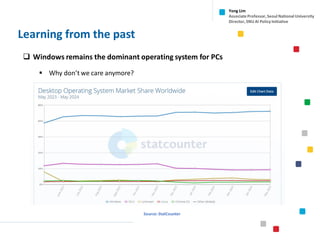
❑ Windows remains the dominant operating system for PCs
▪ Why don’t we care anymore?
Source:StatCounter
Learning from the past (cont’d)
Yong Lim
Associate Professor,Seoul National University
Director,SNU AI Policy Initiative
❑ Lessons from Microsoft
▪ In Microsoft, regulatory intervention failed to restore competition in the subject
market
▪ Difficult to dilute existing market power through enforcement
▪ But one can argue that it marginally contributed to fostering the true catalyst of next
era of competition (shift from PC to mobile)
▪ Shows importance of ensuring the arrival of the next wave of destructive innovation
▪ Prognosticationsabout “middleware” competition failed to materialize
Prognosticating about AI and competition
❑ Keep in mind we are dealing with a target that continues to morph and evolve
▪ Difficulties in designing reasonably future-proof definitionsfor regulatory purposes
▪ OECD’s updated definition of an AI system (Mar. 2024)
▪ Complications caused by technological integration (e.g., AI + XR)
❑ Fight the temptation to lean on broad classifications and generalizations
▪ AI-related concerns will differ according to the relevant model, use case (domain),
and layer in the AI tech stack
▪ e.g., algorithmic self-preferencing: discriminative AI models
▪ Firms are also currently competing based on an array of business models that differ
in terms of depth of integration (layer penetration),openness, third party offerings,
and strategic alliancesand partnerships
Yong Lim
Associate Professor,Seoul National University
Director,SNU AI Policy Initiative
Prognosticating about AI and competition (cont’d)
❑ Maintain humility in the face of a convulsing market that easily defies
predictions
▪ A few examples…
▪ Significance of “compute” as a critical input to AI-related competition now being
challenged by efforts to control costs (efficiency)
▪ On-device AI as a mitigating factor for the significance of “hyperscaler” infrastructure
(cloud v. edge)
▪ Emergence of AI agent layer that could later upend inter-layer relationships within the
relevant tech stack
❑ Avoid confirmation bias
▪ e.g., network effects: both theory and experience caution against easy
prognosticationsfor markets that are experiencing rapid growth (Yoo 2020)
Yong Lim
Associate Professor,Seoul National University
Director,SNU AI Policy Initiative
#Navigation
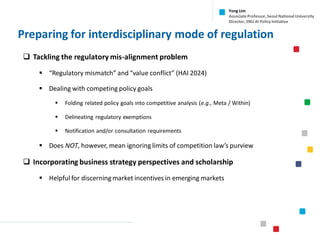
Preparing for interdisciplinary mode of regulation
❑ Tackling the regulatory mis-alignment problem
▪ “Regulatory mismatch” and “value conflict” (HAI 2024)
▪ Dealing with competing policy goals
▪ Folding related policy goals into competitive analysis (e.g., Meta / Within)
▪ Delineating regulatory exemptions
▪ Notification and/or consultation requirements
▪ Does NOT, however, mean ignoring limits of competition law’s purview
❑ Incorporating business strategy perspectives and scholarship
▪ Helpful for discerning market incentives in emerging markets
Yong Lim
Associate Professor,Seoul National University
Director,SNU AI Policy Initiative
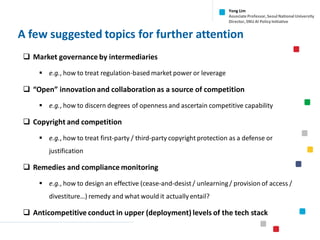
A few suggested topics for further attention
❑ Market governance by intermediaries
▪ e.g., how to treat regulation-based market power or leverage
❑ “Open” innovation and collaboration as a source of competition
▪ e.g., how to discern degrees of openness and ascertain competitive capability
❑ Copyright and competition
▪ e.g., how to treat first-party / third-party copyright protection as a defense or
justification
❑ Remedies and compliance monitoring
▪ e.g., how to design an effective (cease-and-desist / unlearning/ provision of access /
divestiture…) remedy and what would it actually entail?
❑ Anticompetitive conduct in upper (deployment) levels of the tech stack
Yong Lim
Associate Professor,Seoul National University
Director,SNU AI Policy Initiative
Q&A
THANK YOU

Artificial Intelligence, Data and Competition – LIM – June 2024 OECD discussion

  • 1.
    Navigating the Future AI,Data & Competition OECD COMPETITION COMMITTEE BEST PRACTICE ROUNDTABLES ON COMPETITION POLICY JUNE 12, 2024 http://sapi.co.kr YONG LIM SEOUL NATIONAL UNIVERSITY SCHOOL OF LAW
  • 2.
  • 3.
    AI governance andcompetition policy ❑ Market concentration identified as a key risk for AI governance ▪ Monopoly power and market concentrationare now commonly cited as a concern in AI governance discourse ❑ Policy discussions on AI and competition tracking general discourse ▪ Focus on foundational layers of tech stack ▪ Long term (structural) risks v. present (manifesting)harms ▪ Risk-based approach ▪ Mapping / assessing risks to competition ▪ Exploring preventive / mitigation measures Yong Lim Associate Professor,Seoul National University Director,SNU AI Policy Initiative
  • 4.
    Clarifying the purposeof prognostication ❑ Possible goals for such a prediction-based endeavor ▪ Prevent the emergence of durable monopoly power? ▪ Requires feasibility check in changing the “winner-takes-all” nature, if so, of the market ▪ Prevent undesirable leveraging of market power to adjacent or related markets? ▪ Requires regulatory finesse in upholding competitive neutrality when dealing with markets in their formation stage ▪ Mitigate intra-ecosystem abuses of market power? ▪ Requires capacity building on equity and other policy considerations on the part of competition authorities ▪ Speed up the much maligned pace of competition law enforcement? ▪ Requires more than gathering knowledge and building expertise in the face of fast- changing markets Yong Lim Associate Professor,Seoul National University Director,SNU AI Policy Initiative
  • 5.
    Learning from thepast Yong Lim Associate Professor,Seoul National University Director,SNU AI Policy Initiative ❑ Windows remains the dominant operating system for PCs ▪ Why don’t we care anymore? Source:StatCounter
  • 6.
    Learning from thepast (cont’d) Yong Lim Associate Professor,Seoul National University Director,SNU AI Policy Initiative ❑ Lessons from Microsoft ▪ In Microsoft, regulatory intervention failed to restore competition in the subject market ▪ Difficult to dilute existing market power through enforcement ▪ But one can argue that it marginally contributed to fostering the true catalyst of next era of competition (shift from PC to mobile) ▪ Shows importance of ensuring the arrival of the next wave of destructive innovation ▪ Prognosticationsabout “middleware” competition failed to materialize
  • 7.
    Prognosticating about AIand competition ❑ Keep in mind we are dealing with a target that continues to morph and evolve ▪ Difficulties in designing reasonably future-proof definitionsfor regulatory purposes ▪ OECD’s updated definition of an AI system (Mar. 2024) ▪ Complications caused by technological integration (e.g., AI + XR) ❑ Fight the temptation to lean on broad classifications and generalizations ▪ AI-related concerns will differ according to the relevant model, use case (domain), and layer in the AI tech stack ▪ e.g., algorithmic self-preferencing: discriminative AI models ▪ Firms are also currently competing based on an array of business models that differ in terms of depth of integration (layer penetration),openness, third party offerings, and strategic alliancesand partnerships Yong Lim Associate Professor,Seoul National University Director,SNU AI Policy Initiative
  • 8.
    Prognosticating about AIand competition (cont’d) ❑ Maintain humility in the face of a convulsing market that easily defies predictions ▪ A few examples… ▪ Significance of “compute” as a critical input to AI-related competition now being challenged by efforts to control costs (efficiency) ▪ On-device AI as a mitigating factor for the significance of “hyperscaler” infrastructure (cloud v. edge) ▪ Emergence of AI agent layer that could later upend inter-layer relationships within the relevant tech stack ❑ Avoid confirmation bias ▪ e.g., network effects: both theory and experience caution against easy prognosticationsfor markets that are experiencing rapid growth (Yoo 2020) Yong Lim Associate Professor,Seoul National University Director,SNU AI Policy Initiative
  • 9.
  • 10.
    Preparing for interdisciplinarymode of regulation ❑ Tackling the regulatory mis-alignment problem ▪ “Regulatory mismatch” and “value conflict” (HAI 2024) ▪ Dealing with competing policy goals ▪ Folding related policy goals into competitive analysis (e.g., Meta / Within) ▪ Delineating regulatory exemptions ▪ Notification and/or consultation requirements ▪ Does NOT, however, mean ignoring limits of competition law’s purview ❑ Incorporating business strategy perspectives and scholarship ▪ Helpful for discerning market incentives in emerging markets Yong Lim Associate Professor,Seoul National University Director,SNU AI Policy Initiative
  • 11.
    A few suggestedtopics for further attention ❑ Market governance by intermediaries ▪ e.g., how to treat regulation-based market power or leverage ❑ “Open” innovation and collaboration as a source of competition ▪ e.g., how to discern degrees of openness and ascertain competitive capability ❑ Copyright and competition ▪ e.g., how to treat first-party / third-party copyright protection as a defense or justification ❑ Remedies and compliance monitoring ▪ e.g., how to design an effective (cease-and-desist / unlearning/ provision of access / divestiture…) remedy and what would it actually entail? ❑ Anticompetitive conduct in upper (deployment) levels of the tech stack Yong Lim Associate Professor,Seoul National University Director,SNU AI Policy Initiative
  • 12.
  • 13.