READER RESPONSE
THEORY
BY :
MAIZATUL
INTRODUCTION
•Emerged in 1930
•Primary focus on reading
•It is text based not author based
•“text and text alone”
•Also called as “Affective fallacy”
LEADING PROPONENTS
•Stanley Fish
•Wayne Booth
•Louise Rosenblatt
Theoretical Assumption
•Literature is a per formative art and each
reading is a performance.
•The literary text possess no fixed and final
meaning literary meaning is created by the
interaction of the text and reader
•Reader is not passive but active
•Role of reader cannot be ignored
Salient features
•Acknowledged importance of text and reader
•Text relationship with reader
•Reader is 3rd party
•Reality exist in readers mind
•Work is fully created when readers assimilate it
•Text has not one inherent meaning but it
depend on individual interpretation.
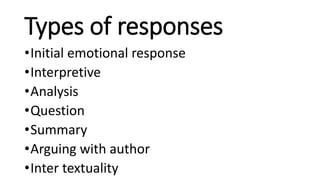
Types of responses
•Initial emotional response
•Interpretive
•Analysis
•Question
•Summary
•Arguing with author
•Inter textuality
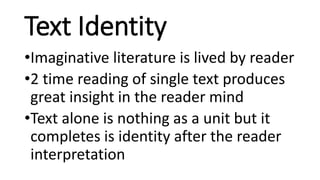
Text Identity
•Imaginative literature is lived by reader
•2 time reading of single text produces
great insight in the reader mind
•Text alone is nothing as a unit but it
completes is identity after the reader
interpretation
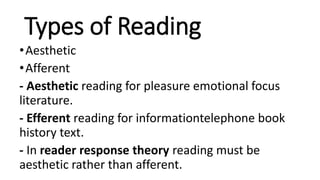
Types of Reading
•Aesthetic
•Afferent
- Aesthetic reading for pleasure emotional focus
literature.
- Efferent reading for informationtelephone book
history text.
- In reader response theory reading must be
aesthetic rather than afferent.
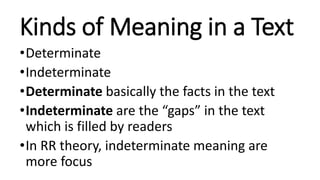
Kinds of Meaning in a Text
•Determinate
•Indeterminate
•Determinate basically the facts in the text
•Indeterminate are the “gaps” in the text
which is filled by readers
•In RR theory, indeterminate meaning are
more focus
Kinds of Reader
•Implied Reader
•Actual Reader
- Implied reader finds out the determinate
meaning of the text
- Actual reader fills the gap in the text and
find out the indeterminate meaning of the
text
Techniques of Reading
Reader extracts the meaning through
•Experiencing
•Hypothesizing
•Exploring
•Synthesizing
Benefits
•Broaden the horizon of mind
•Multiple interpretation
•Cultural study
•Encourage the students to make
interpretations
•Dependence on the teachers is
discouraged
•Students trust on their own Responses
•Students ability of responsibility and
authority is increased
•Personal responses are valued
•Help reader to become better critical
reader
Limitations
•Not every interpretation may be valid.
•Students can also go beyond the
interpretation levels.
•Students can also disagree and argue
with each others interpretations.
Enhancement of RR
Theory
•Literature circles
•General writing
•Peer writing group
•Open ended discussion

Reader response theory

  • 1.
  • 2.
    INTRODUCTION •Emerged in 1930 •Primaryfocus on reading •It is text based not author based •“text and text alone” •Also called as “Affective fallacy”
  • 3.
  • 4.
    Theoretical Assumption •Literature isa per formative art and each reading is a performance. •The literary text possess no fixed and final meaning literary meaning is created by the interaction of the text and reader •Reader is not passive but active •Role of reader cannot be ignored
  • 5.
    Salient features •Acknowledged importanceof text and reader •Text relationship with reader •Reader is 3rd party •Reality exist in readers mind •Work is fully created when readers assimilate it •Text has not one inherent meaning but it depend on individual interpretation.
  • 6.
    Types of responses •Initialemotional response •Interpretive •Analysis •Question •Summary •Arguing with author •Inter textuality
  • 7.
    Text Identity •Imaginative literatureis lived by reader •2 time reading of single text produces great insight in the reader mind •Text alone is nothing as a unit but it completes is identity after the reader interpretation
  • 8.
    Types of Reading •Aesthetic •Afferent -Aesthetic reading for pleasure emotional focus literature. - Efferent reading for informationtelephone book history text. - In reader response theory reading must be aesthetic rather than afferent.
  • 9.
    Kinds of Meaningin a Text •Determinate •Indeterminate •Determinate basically the facts in the text •Indeterminate are the “gaps” in the text which is filled by readers •In RR theory, indeterminate meaning are more focus
  • 10.
    Kinds of Reader •ImpliedReader •Actual Reader - Implied reader finds out the determinate meaning of the text - Actual reader fills the gap in the text and find out the indeterminate meaning of the text
  • 11.
    Techniques of Reading Readerextracts the meaning through •Experiencing •Hypothesizing •Exploring •Synthesizing
  • 12.
    Benefits •Broaden the horizonof mind •Multiple interpretation •Cultural study •Encourage the students to make interpretations
  • 13.
    •Dependence on theteachers is discouraged •Students trust on their own Responses •Students ability of responsibility and authority is increased •Personal responses are valued •Help reader to become better critical reader
  • 14.
    Limitations •Not every interpretationmay be valid. •Students can also go beyond the interpretation levels. •Students can also disagree and argue with each others interpretations.
  • 15.
    Enhancement of RR Theory •Literaturecircles •General writing •Peer writing group •Open ended discussion