The Russian
                           Revolution
                              Katey Hanes


Saturday, April 13, 2013
Reign of Czars Alexander II
                        and Alexander III
                          (1861–1881)


Saturday, April 13, 2013
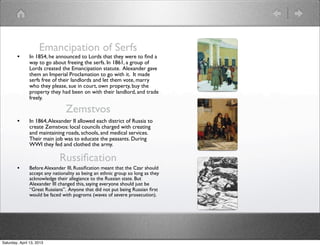
Emancipation of Serfs
        •      In 1854, he announced to Lords that they were to find a
               way to go about freeing the serfs. In 1861, a group of
               Lords created the Emancipation statute. Alexander gave
               them an Imperial Proclamation to go with it. It made
               serfs free of their landlords and let them vote, marry
               who they please, sue in court, own property, buy the
               property they had been on with their landlord, and trade
               freely.

                                Zemstvos
        •      In 1864, Alexander II allowed each district of Russia to
               create Zemstvos: local councils charged with creating
               and maintaining roads, schools, and medical services.
               Their main job was to educate the peasants. During
               WWI they fed and clothed the army.

                             Russification
        •      Before Alexander III, Russification meant that the Czar should
               accept any nationality as being an ethnic group so long as they
               acknowledge their allegiance to the Russian state. But
               Alexander III changed this, saying everyone should just be
               “Great Russians”. Anyone that did not put being Russian first
               would be faced with pogroms (waves of severe prosecution).


Saturday, April 13, 2013
The Early Reign of
                            Czar Nicholas II
                             (1895–1905)

Saturday, April 13, 2013
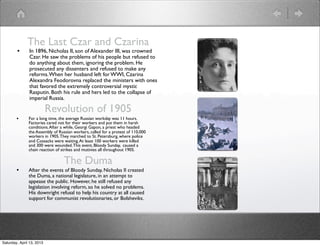
The Last Czar and Czarina
        •      In 1896, Nicholas II, son of Alexander III, was crowned
               Czar. He saw the problems of his people but refused to
               do anything about them, ignoring the problem. He
               prosecuted any dissenters and refused to make any
               reforms. When her husband left for WWI, Czarina
               Alexandra Feodorovna replaced the ministers with ones
               that favored the extremely controversial mystic
               Rasputin. Both his rule and hers led to the collapse of
               imperial Russia.

                           Revolution of 1905
        •      For a long time, the average Russian workday was 11 hours.
               Factories cared not for their workers and put them in harsh
               conditions. After a while, Georgi Gapon, a priest who headed
               the Assembly of Russian workers, called for a protest of 110,000
               workers in 1905. They marched to St. Petersburg, where police
               and Cossacks were waiting. At least 100 workers were killed
               and 300 were wounded. This event, Bloody Sunday, caused a
               chain reaction of strikes and mutinies all throughout 1905.

                                  The Duma
        •      After the events of Bloody Sunday, Nicholas II created
               the Duma, a national legislature, in an attempt to
               appease the public. However, he still refused any
               legislation involving reform, so he solved no problems.
               His downright refusal to help his country at all caused
               support for communist revolutionaries, or Bolsheviks.


Saturday, April 13, 2013
World War I and the Fall of
                          the Czar
                    (1906–March 15, 1917)


Saturday, April 13, 2013
Murder of Rasputin
        •      On December 16-17, 1916, several people related to or
               friends of the Czar and Czarina murdered the Czarina’s
               advisor Rasputin. The higher-ups did not like the fact that
               he, a peasant, had such a high influence. After being shot
               three times, poisoned, and beaten brutally with a barbell,
               the mystic remained alive. He did not finally die until he
               was drowned in a hole in the Malaya Nevka River’s ice.
               Later the body was found and autopsied, and the
               murders were punished in a variety of ways.

                  WWI Causes Problems
        •      By 1917, over one million Russians had died in World
               War I. Over four million had been wounded. The public
               blamed the Czar for the defeat. The Czar had mobilized
               Russia’s armies and caused a chain reaction that started
               WWI. People began to revolt against him. Workers
               once again united to protest the Czar’s ignorance.

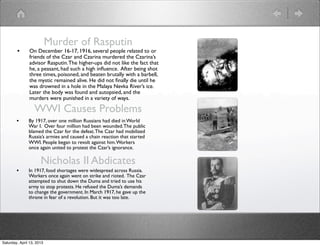
                      Nicholas II Abdicates
        •      In 1917, food shortages were widespread across Russia.
               Workers once again went on strike and rioted. The Czar
               attempted to shut down the Duma and tried to use his
               army to stop protests. He refused the Duma’s demands
               to change the government. In March 1917, he gave up the
               throne in fear of a revolution. But it was too late.


Saturday, April 13, 2013
The Provisional Government
                 and the Bolshevik Revolution
                (March 16, 1917–March 1918)


Saturday, April 13, 2013
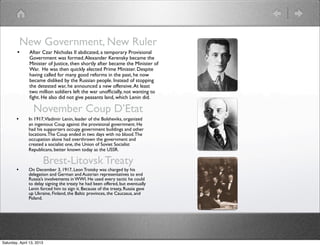
New Government, New Ruler
        •      After Czar Nicholas II abdicated, a temporary Provisional
               Government was formed. Alexander Kerensky became the
               Minister of Justice, then shortly after became the Minister of
               War. He was then quickly elected Prime Minister. Despite
               having called for many good reforms in the past, he now
               became disliked by the Russian people. Instead of stopping
               the detested war, he announced a new offensive. At least
               two million soldiers left the war unofficially, not wanting to
               fight. He also did not give peasants land, which Lenin did.

                  November Coup D’Etat
        •      In 1917,Vladimir Lenin, leader of the Bolsheviks, organized
               an ingenious Coup against the provisional government. He
               had his supporters occupy government buildings and other
               locations. The Coup ended in two days with no blood. The
               occupation alone had overthrown the government and
               created a socialist one, the Union of Soviet Socialist
               Republicans, better known today as the USSR.

                       Brest-Litovsk Treaty
        •      On December 3, 1917, Leon Trotsky was charged by his
               delegation and German and Austrian representatives to end
               Russia’s involvements in WWI. He used every tactic he could
               to delay signing the treaty he had been offered, but eventually
               Lenin forced him to sign it. Because of the treaty, Russia gave
               up Ukraine, Finland, the Baltic provinces, the Caucasus, and
               Poland.


Saturday, April 13, 2013
Civil War Ensues in Russia
                              (March 1918–1921)


Saturday, April 13, 2013
Red vs White
        •      The signing of the Brest-Litovsk treaty eventually led to a war
               between Bolsheviks (Reds) and anti-Bolsheviks (Whites). The
               Whites began attacking in 1919, coming up the Volga, into Ukraine,
               and into a town just 250 miles from Moscow. One army division
               even made it to the edges of Petrograd twice. But the Reds
               counterattacked, and pushed them back past the Black Sea, the
               Baltic, and the Pacific. The Reds quickly organized themselves, as the
               Whites continued to be spread out. The Reds used their resources
               more readily, made sure their army stayed loyal, and used terror
               without mercy. The Whites were brutal and disorganized, lacking
               any direction.

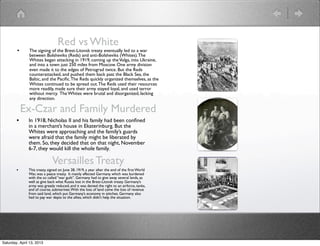
            Ex-Czar and Family Murdered
        •      In 1918, Nicholas II and his family had been confined
               in a merchant’s house in Ekaterinburg. But the
               Whites were approaching and the family’s guards
               were afraid that the family might be liberated by
               them. So, they decided that on that night, November
               6-7, they would kill the whole family.

                              Versailles Treaty
        •      This treaty, signed on June 28, 1919, a year after the end of the first World
               War, was a peace treaty. It mainly affected Germany. which was burdened
               with the so called “war guilt”. Germany had to give away several lands, as
               well as give back what Russia lost in the Brest-Litovsk treaty. Germany’s
               army was greatly reduced, and it was denied the right to an airforce, tanks,
               and of course, submarines. With the loss of land came the loss of revenue
               from said land, which put Germany’s economy in stitches. Germany also
               had to pay war depts to the allies, which didn’t help the situation.


Saturday, April 13, 2013
Works Cited
                      •    http://www.historytoday.com/michael-lynch/emancipation-russian-serfs-1861-charter-freedom-or-act-betrayal

                      •    http://www.spartacus.schoolnet.co.uk/RUSzemstvos.htm

                      •    http://quizlet.com/10445077/ap-european-history-unit-eleven-russian-revolution-and-the-soviet-union-page-one-and-two-flash-cards/

                      •    http://www.historylearningsite.co.uk/russification.htm

                      •    http://www.biography.com/people/alexandra-feodorovna-37295

                      •    http://www.spartacus.schoolnet.co.uk/RUS1905.htm

                      •    http://history1900s.about.com/od/famouscrimesscandals/a/rasputin_2.htm

                      •    http://www.sascurriculumpathways.com/portal/Launch?id=1294&bhcp=1

                      •    http://www.historylearningsite.co.uk/alexander_kerensky.htm

                      •    http://www.history.com/this-day-in-history/bolsheviks-revolt-in-russia

                      •    http://www.spartacus.schoolnet.co.uk/FWWbrest.htm

                      •    http://www.bbc.co.uk/history/worldwars/wwone/eastern_front_01.shtml

                      •    http://www.theroyalforums.com/9781-ninety-years-ago-murder-of-tsar-nicholas-ii-and-his-family/

                      •    http://www.historylearningsite.co.uk/treaty_of_versailles.htm


Saturday, April 13, 2013

Russian revolution

  • 1.
    The Russian Revolution Katey Hanes Saturday, April 13, 2013
  • 2.
    Reign of CzarsAlexander II and Alexander III (1861–1881) Saturday, April 13, 2013
  • 3.
    Emancipation of Serfs • In 1854, he announced to Lords that they were to find a way to go about freeing the serfs. In 1861, a group of Lords created the Emancipation statute. Alexander gave them an Imperial Proclamation to go with it. It made serfs free of their landlords and let them vote, marry who they please, sue in court, own property, buy the property they had been on with their landlord, and trade freely. Zemstvos • In 1864, Alexander II allowed each district of Russia to create Zemstvos: local councils charged with creating and maintaining roads, schools, and medical services. Their main job was to educate the peasants. During WWI they fed and clothed the army. Russification • Before Alexander III, Russification meant that the Czar should accept any nationality as being an ethnic group so long as they acknowledge their allegiance to the Russian state. But Alexander III changed this, saying everyone should just be “Great Russians”. Anyone that did not put being Russian first would be faced with pogroms (waves of severe prosecution). Saturday, April 13, 2013
  • 4.
    The Early Reignof Czar Nicholas II (1895–1905) Saturday, April 13, 2013
  • 5.
    The Last Czarand Czarina • In 1896, Nicholas II, son of Alexander III, was crowned Czar. He saw the problems of his people but refused to do anything about them, ignoring the problem. He prosecuted any dissenters and refused to make any reforms. When her husband left for WWI, Czarina Alexandra Feodorovna replaced the ministers with ones that favored the extremely controversial mystic Rasputin. Both his rule and hers led to the collapse of imperial Russia. Revolution of 1905 • For a long time, the average Russian workday was 11 hours. Factories cared not for their workers and put them in harsh conditions. After a while, Georgi Gapon, a priest who headed the Assembly of Russian workers, called for a protest of 110,000 workers in 1905. They marched to St. Petersburg, where police and Cossacks were waiting. At least 100 workers were killed and 300 were wounded. This event, Bloody Sunday, caused a chain reaction of strikes and mutinies all throughout 1905. The Duma • After the events of Bloody Sunday, Nicholas II created the Duma, a national legislature, in an attempt to appease the public. However, he still refused any legislation involving reform, so he solved no problems. His downright refusal to help his country at all caused support for communist revolutionaries, or Bolsheviks. Saturday, April 13, 2013
  • 6.
    World War Iand the Fall of the Czar (1906–March 15, 1917) Saturday, April 13, 2013
  • 7.
    Murder of Rasputin • On December 16-17, 1916, several people related to or friends of the Czar and Czarina murdered the Czarina’s advisor Rasputin. The higher-ups did not like the fact that he, a peasant, had such a high influence. After being shot three times, poisoned, and beaten brutally with a barbell, the mystic remained alive. He did not finally die until he was drowned in a hole in the Malaya Nevka River’s ice. Later the body was found and autopsied, and the murders were punished in a variety of ways. WWI Causes Problems • By 1917, over one million Russians had died in World War I. Over four million had been wounded. The public blamed the Czar for the defeat. The Czar had mobilized Russia’s armies and caused a chain reaction that started WWI. People began to revolt against him. Workers once again united to protest the Czar’s ignorance. Nicholas II Abdicates • In 1917, food shortages were widespread across Russia. Workers once again went on strike and rioted. The Czar attempted to shut down the Duma and tried to use his army to stop protests. He refused the Duma’s demands to change the government. In March 1917, he gave up the throne in fear of a revolution. But it was too late. Saturday, April 13, 2013
  • 8.
    The Provisional Government and the Bolshevik Revolution (March 16, 1917–March 1918) Saturday, April 13, 2013
  • 9.
    New Government, NewRuler • After Czar Nicholas II abdicated, a temporary Provisional Government was formed. Alexander Kerensky became the Minister of Justice, then shortly after became the Minister of War. He was then quickly elected Prime Minister. Despite having called for many good reforms in the past, he now became disliked by the Russian people. Instead of stopping the detested war, he announced a new offensive. At least two million soldiers left the war unofficially, not wanting to fight. He also did not give peasants land, which Lenin did. November Coup D’Etat • In 1917,Vladimir Lenin, leader of the Bolsheviks, organized an ingenious Coup against the provisional government. He had his supporters occupy government buildings and other locations. The Coup ended in two days with no blood. The occupation alone had overthrown the government and created a socialist one, the Union of Soviet Socialist Republicans, better known today as the USSR. Brest-Litovsk Treaty • On December 3, 1917, Leon Trotsky was charged by his delegation and German and Austrian representatives to end Russia’s involvements in WWI. He used every tactic he could to delay signing the treaty he had been offered, but eventually Lenin forced him to sign it. Because of the treaty, Russia gave up Ukraine, Finland, the Baltic provinces, the Caucasus, and Poland. Saturday, April 13, 2013
  • 10.
    Civil War Ensuesin Russia (March 1918–1921) Saturday, April 13, 2013
  • 11.
    Red vs White • The signing of the Brest-Litovsk treaty eventually led to a war between Bolsheviks (Reds) and anti-Bolsheviks (Whites). The Whites began attacking in 1919, coming up the Volga, into Ukraine, and into a town just 250 miles from Moscow. One army division even made it to the edges of Petrograd twice. But the Reds counterattacked, and pushed them back past the Black Sea, the Baltic, and the Pacific. The Reds quickly organized themselves, as the Whites continued to be spread out. The Reds used their resources more readily, made sure their army stayed loyal, and used terror without mercy. The Whites were brutal and disorganized, lacking any direction. Ex-Czar and Family Murdered • In 1918, Nicholas II and his family had been confined in a merchant’s house in Ekaterinburg. But the Whites were approaching and the family’s guards were afraid that the family might be liberated by them. So, they decided that on that night, November 6-7, they would kill the whole family. Versailles Treaty • This treaty, signed on June 28, 1919, a year after the end of the first World War, was a peace treaty. It mainly affected Germany. which was burdened with the so called “war guilt”. Germany had to give away several lands, as well as give back what Russia lost in the Brest-Litovsk treaty. Germany’s army was greatly reduced, and it was denied the right to an airforce, tanks, and of course, submarines. With the loss of land came the loss of revenue from said land, which put Germany’s economy in stitches. Germany also had to pay war depts to the allies, which didn’t help the situation. Saturday, April 13, 2013
  • 12.
    Works Cited • http://www.historytoday.com/michael-lynch/emancipation-russian-serfs-1861-charter-freedom-or-act-betrayal • http://www.spartacus.schoolnet.co.uk/RUSzemstvos.htm • http://quizlet.com/10445077/ap-european-history-unit-eleven-russian-revolution-and-the-soviet-union-page-one-and-two-flash-cards/ • http://www.historylearningsite.co.uk/russification.htm • http://www.biography.com/people/alexandra-feodorovna-37295 • http://www.spartacus.schoolnet.co.uk/RUS1905.htm • http://history1900s.about.com/od/famouscrimesscandals/a/rasputin_2.htm • http://www.sascurriculumpathways.com/portal/Launch?id=1294&bhcp=1 • http://www.historylearningsite.co.uk/alexander_kerensky.htm • http://www.history.com/this-day-in-history/bolsheviks-revolt-in-russia • http://www.spartacus.schoolnet.co.uk/FWWbrest.htm • http://www.bbc.co.uk/history/worldwars/wwone/eastern_front_01.shtml • http://www.theroyalforums.com/9781-ninety-years-ago-murder-of-tsar-nicholas-ii-and-his-family/ • http://www.historylearningsite.co.uk/treaty_of_versailles.htm Saturday, April 13, 2013