Russian Revolution
“Peace, Land, and Bread”
Introduction
Russian Monarchy
 Alexander III clung to the principles of
autocracy.
 Censorship codes were enforced to restrict
printed material.
 Teachers were to write detailed reports on every
student.
 Other ethnic groups were oppressed to establish
a uniform culture.
 Alexander made Jews the target of persecution.
 Pogroms broke out in many parts of Russia.
Nicholas II
 Became Czar in 1894.
 Maintained principles of
autocracy.
 Built up Russian industry
through high taxes and
foreign investment.
 Completed the Trans-
Siberian Railway in 1904.
 Trade unions were
outlawed.
 The gap between rich
and poor grew. Click Picture
Russian Marxists
 In 1903, split into two groups.
 Mensheviks: Wanted a broad base of popular
support.
 Bolsheviks: Supported a small number of
committed revolutionaries.
 Lenin became the major leader of the
Bolsheviks.
 Lenin fled to Western Europe to avoid
arrest by the czarist regime.
Bolsheviks
Regime
 ancient or old regime
 old order
 monarchical system of government
legally privileged orders or estates (nobility, clergy)
peasant agriculture (serfdom) and state-regulated
markets and industry
(mercantilism)
government bureaucracy reserved largely for the
nobility
culture dominated by Catholic Church and courtly life
Marxism
 Defined by Karl Marx
in The Communist
Manifesto.
Crises which led to Revolution
 Russo-Japanese War
 Bloody Sunday
 World War I
Russo-Japanese War
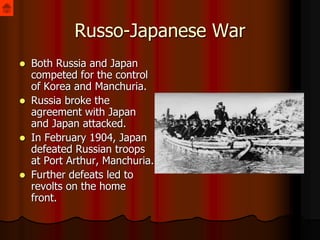
 Both Russia and Japan
competed for the control
of Korea and Manchuria.
 Russia broke the
agreement with Japan
and Japan attacked.
 In February 1904, Japan
defeated Russian troops
at Port Arthur, Manchuria.
 Further defeats led to
revolts on the home
front.
Bloody Sunday
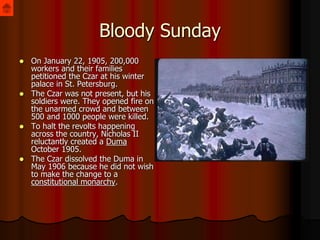
 On January 22, 1905, 200,000
workers and their families
petitioned the Czar at his winter
palace in St. Petersburg.
 The Czar was not present, but his
soldiers were. They opened fire on
the unarmed crowd and between
500 and 1000 people were killed.
 To halt the revolts happening
across the country, Nicholas II
reluctantly created a Duma
October 1905.
 The Czar dissolved the Duma in
May 1906 because he did not wish
to make the change to a
constitutional monarchy.
World War I
 Russia’s weak generals and poorly equipped
troops were no match for the German Army.
 Russia’s involvement in WWI revealed the Czar’s
weaknesses of rule and military leadership.
 The war destroyed morale and soldiers mutinied,
deserted, or ignored orders.
 Food and fuel supplies on the home front were
low and people were clamoring for a new leader.
Rasputin
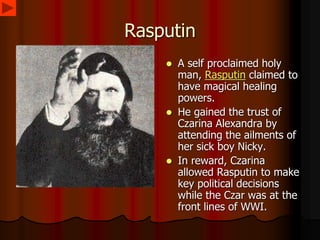
 A self proclaimed holy
man, Rasputin claimed to
have magical healing
powers.
 He gained the trust of
Czarina Alexandra by
attending the ailments of
her sick boy Nicky.
 In reward, Czarina
allowed Rasputin to make
key political decisions
while the Czar was at the
front lines of WWI.
Who Is Rasputin
Death of Rasputin
The March Revolution
 In March 1917, the women textile workers
in Petrograd led a city wide strike.
 Riots later appeared because of a
shortage in bread and fuel.
 At first soldiers obey their orders to shoot
the rioters but, later sided with the
workers.
 Crowds shouted “down with autocracy!”
and “down with the war!”
Czar Steps Down
 Czar Nicholas II
abdicated his thrown
to stop the violence.
 A year later the Czar
and his family were
murdered by the
revolutionaries.
The End of the Romanov
Provisional Government
 Leaders of the Duma set up a provisional
government.
 Its leader was Alexander Kerensky.
 His decision to continue fighting the war cost
him his support of the soldiers and civilians.
 Social revolutionaries, competing for power,
formed soviets.
 In most cities, soviets had more power that the
provisional government.
Bolshevik Revolution
 Once Lenin returned from exile in Europe he led
the Bolsheviks in the take over of the Petrograd
soviet.
 Lenin rallied the people and gave them the
slogan “peace, land, and bread”.
 In November 1917, the Bolsheviks stormed the
Winter Palace in Petrograd and arrested the
provisional government.
 The Bolshevik revolution was over in matter of
hours.
Bolsheviks in Power
 Lenin ordered all the farmland distributed
among the peasants and control of the
factories given to the workers.
 In March 1918, Russia and Germany
signed the Treaty of Brest-Litovsk which
ended World War I for Russia.
 The humiliating terms of the treaty turned
some Russians against the Bolsheviks.
Russian Civil War
 From 1918 to 1920 a civil war raged between
the White Army (counterrevolutionaries) and the
Red Army (Bolsheviks).
 The Red Army was led by Leon Trotsky.
 The White Army was aided by the U.S. and
other Western nations.
 The Bolsheviks eventually destroyed the White
Army and proved they could seize power and
maintain it.
 Approximately 15 million Russians died during
the Civil War.
Civil War
Lenin in Power
 After the revolution, Lenin shifted his
energy to reviving the Russian economy
and restructuring the government.
 In March 1921, he launched the New
Economic Policy.
 Under the NEP, peasants could sell their
crops instead of turning them over to the
state. Individuals could buy and sell goods
for profit.
A New Government
Political Reforms
 Lenin organized Russia into several self-
governing republics under one central
government.
 In 1922, the country was named the Union of
Soviet Socialists Republic (USSR).
 The Bolsheviks renamed their party the
Communist Party.
 In 1924, the Communists created a constitution
based on socialist and democratic principles.
 Lenin had created a dictatorship of the
Communist Party, not a “dictatorship of the
proletariat” as Marx had promoted.
Death of Lenin
 Lenin had several strokes and spent 18 months
as a semi-invalid.
 In 1924, Lenin died.
 Lenin’s death left a void in the Communist
power structure which created a power struggle
for control of the party.
Lenin

Russian Revlution

  • 1.
  • 2.
  • 3.
    Russian Monarchy  AlexanderIII clung to the principles of autocracy.  Censorship codes were enforced to restrict printed material.  Teachers were to write detailed reports on every student.  Other ethnic groups were oppressed to establish a uniform culture.  Alexander made Jews the target of persecution.  Pogroms broke out in many parts of Russia.
  • 4.
    Nicholas II  BecameCzar in 1894.  Maintained principles of autocracy.  Built up Russian industry through high taxes and foreign investment.  Completed the Trans- Siberian Railway in 1904.  Trade unions were outlawed.  The gap between rich and poor grew. Click Picture
  • 5.
    Russian Marxists  In1903, split into two groups.  Mensheviks: Wanted a broad base of popular support.  Bolsheviks: Supported a small number of committed revolutionaries.  Lenin became the major leader of the Bolsheviks.  Lenin fled to Western Europe to avoid arrest by the czarist regime.
  • 6.
  • 7.
    Regime  ancient orold regime  old order  monarchical system of government legally privileged orders or estates (nobility, clergy) peasant agriculture (serfdom) and state-regulated markets and industry (mercantilism) government bureaucracy reserved largely for the nobility culture dominated by Catholic Church and courtly life
  • 8.
    Marxism  Defined byKarl Marx in The Communist Manifesto.
  • 9.
    Crises which ledto Revolution  Russo-Japanese War  Bloody Sunday  World War I
  • 10.
    Russo-Japanese War  BothRussia and Japan competed for the control of Korea and Manchuria.  Russia broke the agreement with Japan and Japan attacked.  In February 1904, Japan defeated Russian troops at Port Arthur, Manchuria.  Further defeats led to revolts on the home front.
  • 11.
    Bloody Sunday  OnJanuary 22, 1905, 200,000 workers and their families petitioned the Czar at his winter palace in St. Petersburg.  The Czar was not present, but his soldiers were. They opened fire on the unarmed crowd and between 500 and 1000 people were killed.  To halt the revolts happening across the country, Nicholas II reluctantly created a Duma October 1905.  The Czar dissolved the Duma in May 1906 because he did not wish to make the change to a constitutional monarchy.
  • 12.
    World War I Russia’s weak generals and poorly equipped troops were no match for the German Army.  Russia’s involvement in WWI revealed the Czar’s weaknesses of rule and military leadership.  The war destroyed morale and soldiers mutinied, deserted, or ignored orders.  Food and fuel supplies on the home front were low and people were clamoring for a new leader.
  • 13.
    Rasputin  A selfproclaimed holy man, Rasputin claimed to have magical healing powers.  He gained the trust of Czarina Alexandra by attending the ailments of her sick boy Nicky.  In reward, Czarina allowed Rasputin to make key political decisions while the Czar was at the front lines of WWI.
  • 14.
  • 15.
  • 16.
    The March Revolution In March 1917, the women textile workers in Petrograd led a city wide strike.  Riots later appeared because of a shortage in bread and fuel.  At first soldiers obey their orders to shoot the rioters but, later sided with the workers.  Crowds shouted “down with autocracy!” and “down with the war!”
  • 17.
    Czar Steps Down Czar Nicholas II abdicated his thrown to stop the violence.  A year later the Czar and his family were murdered by the revolutionaries.
  • 18.
    The End ofthe Romanov
  • 19.
    Provisional Government  Leadersof the Duma set up a provisional government.  Its leader was Alexander Kerensky.  His decision to continue fighting the war cost him his support of the soldiers and civilians.  Social revolutionaries, competing for power, formed soviets.  In most cities, soviets had more power that the provisional government.
  • 20.
    Bolshevik Revolution  OnceLenin returned from exile in Europe he led the Bolsheviks in the take over of the Petrograd soviet.  Lenin rallied the people and gave them the slogan “peace, land, and bread”.  In November 1917, the Bolsheviks stormed the Winter Palace in Petrograd and arrested the provisional government.  The Bolshevik revolution was over in matter of hours.
  • 21.
    Bolsheviks in Power Lenin ordered all the farmland distributed among the peasants and control of the factories given to the workers.  In March 1918, Russia and Germany signed the Treaty of Brest-Litovsk which ended World War I for Russia.  The humiliating terms of the treaty turned some Russians against the Bolsheviks.
  • 22.
    Russian Civil War From 1918 to 1920 a civil war raged between the White Army (counterrevolutionaries) and the Red Army (Bolsheviks).  The Red Army was led by Leon Trotsky.  The White Army was aided by the U.S. and other Western nations.  The Bolsheviks eventually destroyed the White Army and proved they could seize power and maintain it.  Approximately 15 million Russians died during the Civil War.
  • 23.
  • 24.
    Lenin in Power After the revolution, Lenin shifted his energy to reviving the Russian economy and restructuring the government.  In March 1921, he launched the New Economic Policy.  Under the NEP, peasants could sell their crops instead of turning them over to the state. Individuals could buy and sell goods for profit.
  • 25.
  • 26.
    Political Reforms  Leninorganized Russia into several self- governing republics under one central government.  In 1922, the country was named the Union of Soviet Socialists Republic (USSR).  The Bolsheviks renamed their party the Communist Party.  In 1924, the Communists created a constitution based on socialist and democratic principles.  Lenin had created a dictatorship of the Communist Party, not a “dictatorship of the proletariat” as Marx had promoted.
  • 27.
    Death of Lenin Lenin had several strokes and spent 18 months as a semi-invalid.  In 1924, Lenin died.  Lenin’s death left a void in the Communist power structure which created a power struggle for control of the party.
  • 28.