Russian History
Ancient History – The Romanov’s
• Ancient Russia
– Settlement of Russia
– Kievan Rus' - loose federation of East
Slavic tribes in Europe from the late
9th to the mid-13th century
– Mongol Invasion of Russia
• Retaking Russia
– Ivan the Great
– Ivan the Terrible
• Romanov Dynasty
– Peter the Great
– Catherine the Great
Ancient Russia
 850 A.D.
 Russia settled by Scandinavians
 People from Norway, Sweden, Finland
 Main city is Novgorod
 Major Rulers:
 Oleg
 Vladimir I
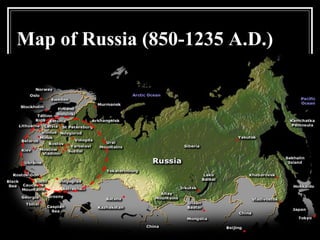
Map of Russia (850-1235 A.D.)
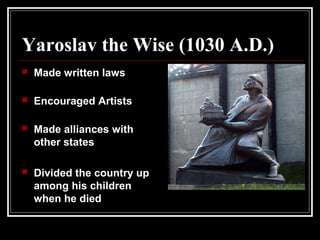
Yaroslav the Wise (1030 A.D.)
 Made written laws
 Encouraged Artists
 Made alliances with
other states
 Divided the country up
among his children
when he died
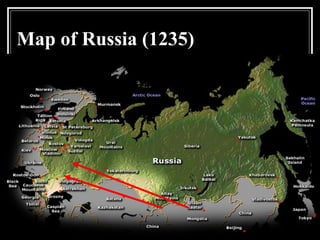
Map of Russia (1235)
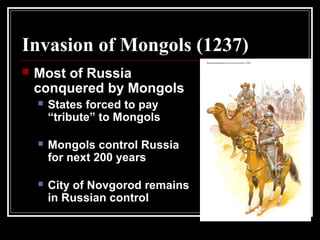
Invasion of Mongols (1237)
 Most of Russia
conquered by Mongols
 States forced to pay
“tribute” to Mongols
 Mongols control Russia
for next 200 years
 City of Novgorod remains
in Russian control
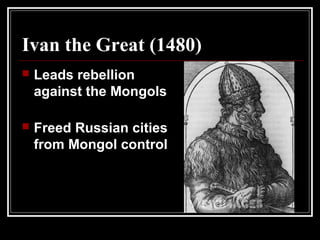
Ivan the Great (1480)
 Leads rebellion
against the Mongols
 Freed Russian cities
from Mongol control
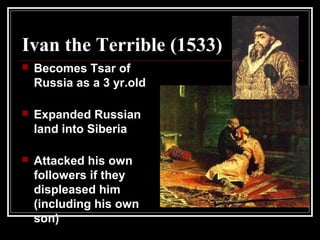
Ivan the Terrible (1533)
 Becomes Tsar of
Russia as a 3 yr.old
 Expanded Russian
land into Siberia
 Attacked his own
followers if they
displeased him
(including his own
son)
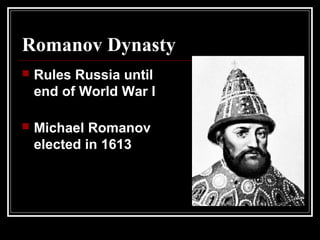
Romanov Dynasty
 Rules Russia until
end of World War I
 Michael Romanov
elected in 1613
Peter the Great (1689)
 Moved capital to St.
Petersburg
 Made Russia more like
Europe
 Military
 Technology
 Clothing (even facial hair!)
 Laws
 Established feudal system in
Russia
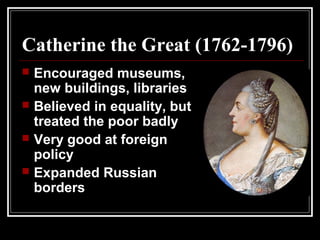
Catherine the Great (1762-1796)
 Encouraged museums,
new buildings, libraries
 Believed in equality, but
treated the poor badly
 Very good at foreign
policy
 Expanded Russian
borders
Russian History
Napoleon's Invasion – Russian
Revolution
Napoleon Invades Russia
 Who was Napoleon?
 Emperor of France
 Conquered nearly all of Europe
 Why he invaded Russia?
 To teach other countries a
lesson
 Result?
 Disastrous defeat for Napoleon
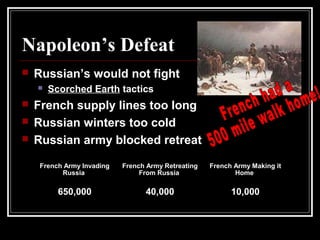
Napoleon’s Defeat
 Russian’s would not fight
 Scorched Earth tactics
 French supply lines too long
 Russian winters too cold
 Russian army blocked retreat
French Army Invading
Russia
French Army Retreating
From Russia
French Army Making it
Home
650,000 40,000 10,000
Feudal System (Serfdom)
 3 classes of people
 Ruling class
 Tsar and family
 Nobles
 Land owners, Barons &
Knights
 Need serfs to work the
land
 Serfs (peasants)
 Land workers (farmers)
 Need nobles to protect
them from invaders,
criminals
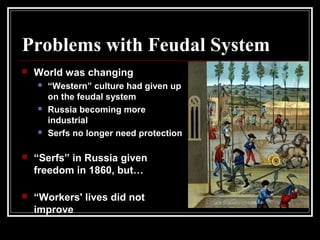
Problems with Feudal System
 World was changing
 “Western” culture had given up
on the feudal system
 Russia becoming more
industrial
 Serfs no longer need protection
 “Serfs” in Russia given
freedom in 1860, but…
 “Workers' lives did not
improve
Map of Russia
Russo-Japanese War (1904-05)
 Russia expanded
borders east to
Pacific Ocean
(Vladivostok)
 Japanese expanding
West towards Russia
 Russia is defeated
 Russian people
demoralized, hungry,
poorer than ever
World War I (1914)
 After Russo-
Japanese War,
Russian working
class tired of war
 Not prepared for war
 Russia could not
avoid WWI alliances
Russian Revolution (1917)
 Working class upset
about another costly war
 Economy is collapsing
 Tsar Nicholas II
“abdicated” the throne
 New government formed
 Lead by Bolshevik
(Workers') political party
and Vladimir Lenin
 Changes?
•Bolsheviks become “Communist
Party”
•Russia quits WWI
•All people declared equal
•Peasants seize land from the rich,
give it back, to EVERYONE!
Russian History
Cold War Background &
Beginnings
1945 - 1973
Early Cold War - Background
 What is a “Cold War?”
 A struggle to limit and
oppose the power of
your opponent
 Everything short of
open warfare (a “hot
war”)
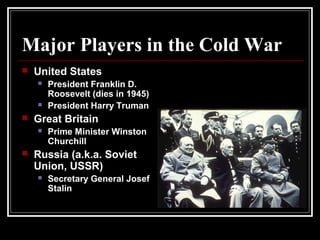
Major Players in the Cold War
 United States
 President Franklin D.
Roosevelt (dies in 1945)
 President Harry Truman
 Great Britain
 Prime Minister Winston
Churchill
 Russia (a.k.a. Soviet
Union, USSR)
 Secretary General Josef
Stalin
Causes of the Cold War
BELIEFS
 Soviet Union
 Communist Dictatorship
 What is communism? What is a dictatorship?
 United States
 Capitalist Democracy
 What is capitalism? What is democracy?
AIMS
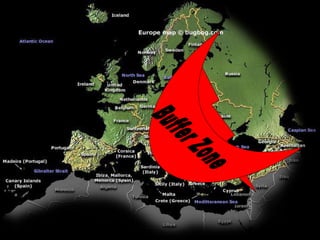
 Stalin wants large “reparations” from Germany
and a buffer zone of friendly states to protect
Russia from future invasions
 USA and Great Britain want to protect democracy
and help Germany recover from WWII
 Worried that large areas of Eastern Europe would become
communist
 What happens to countries that are poor and controlled by
dictators?
RESENTMENT About History
 Soviet Union
 Could not forget that USA and Great Britain tried to
interfere in the Russian Revolution
 Believed USA and Great Britain waited too long to enter
WWII
 Great Britain & USA
 Could not forget that Russia pulled out of WWI after Russia
Revolution
 Could not forget (or forgive!) that Stalin signed Non-
Aggression Pact with Hitler in 1939.
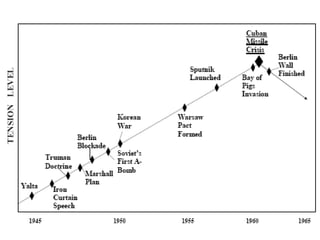
Events
 Yalta Conference
 USA Atomic Bomb
 Iron Curtain Speech
 Truman Doctrine
 Marshall Plan
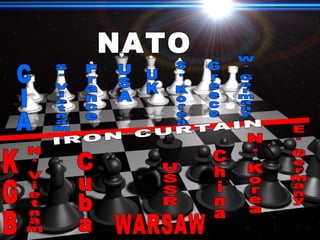
 NATO formed
 Berlin Blockade
 Soviet Atomic Bomb
 Korean War
 Warsaw Pact
 Vietnam War
 Sputnik Launched
 Bay of Pigs Invasion
 Cuban Missile Crisis
 Berlin Wall built
 JFK Assassination
 USA Moon landing
 End of Cold War events
Russian History
Cold War Events
1945 - 1991
Events of the Cold
War
 Yalta Conference
 USA Atomic Bomb
 Iron Curtain Speech
 Truman Doctrine
 Marshall Plan
 NATO formed
 Berlin Blockade
 Soviet Atomic Bomb
 Korean War
 Warsaw Pact
 Vietnam War
 Sputnik Launched
 Bay of Pigs Invasion
 Cuban Missile Crisis
 Berlin Wall built
 JFK Assassination
 USA Moon landing
 End of Cold War events
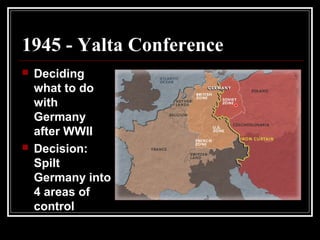
1945 - Yalta Conference
 Deciding
what to do
with
Germany
after WWII
 Decision:
Spilt
Germany into
4 areas of
control
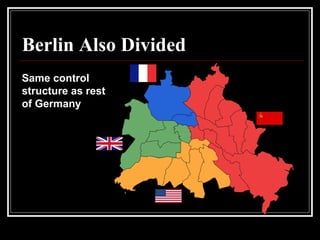
Berlin Also Divided
Same control
structure as rest
of Germany
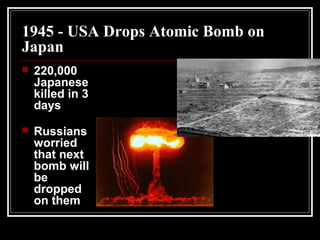
1945 - USA Drops Atomic Bomb on
Japan
 220,000
Japanese
killed in 3
days
 Russians
worried
that next
bomb will
be
dropped
on them
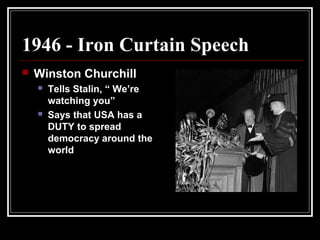
1946 - Iron Curtain Speech
 Winston Churchill
 Tells Stalin, “ We’re
watching you”
 Says that USA has a
DUTY to spread
democracy around the
world
1947 – Truman Doctrine
 “Containment”
of
Communism
 Wants to stop
the spread of
communism to
new countries
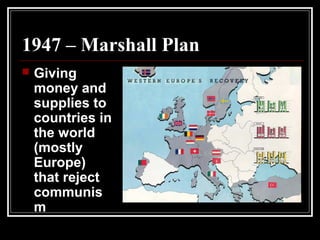
1947 – Marshall Plan
 Giving
money and
supplies to
countries in
the world
(mostly
Europe)
that reject
communis
m
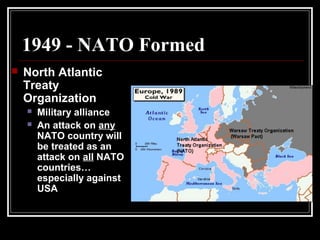
1949 - NATO Formed
 North Atlantic
Treaty
Organization
 Military alliance
 An attack on any
NATO country will
be treated as an
attack on all NATO
countries…
especially against
USA
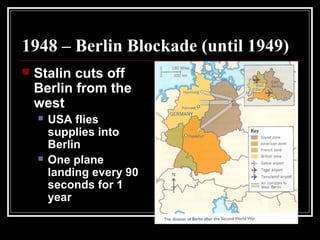
1948 – Berlin Blockade (until 1949)
 Stalin cuts off
Berlin from the
west
 USA flies
supplies into
Berlin
 One plane
landing every 90
seconds for 1
year
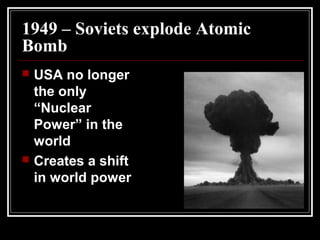
1949 – Soviets explode Atomic
Bomb
 USA no longer
the only
“Nuclear
Power” in the
world
 Creates a shift
in world power
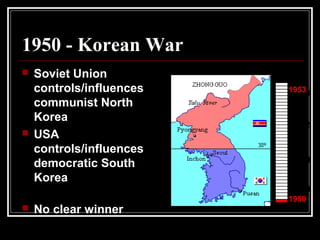
1950 - Korean War
 Soviet Union
controls/influences
communist North
Korea
 USA
controls/influences
democratic South
Korea
 No clear winner
1953
1950
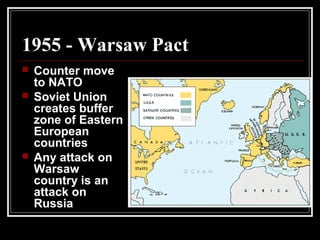
1955 - Warsaw Pact
 Counter move
to NATO
 Soviet Union
creates buffer
zone of Eastern
European
countries
 Any attack on
Warsaw
country is an
attack on
Russia
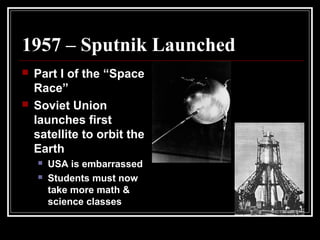
1957 – Sputnik Launched
 Part I of the “Space
Race”
 Soviet Union
launches first
satellite to orbit the
Earth
 USA is embarrassed
 Students must now
take more math &
science classes
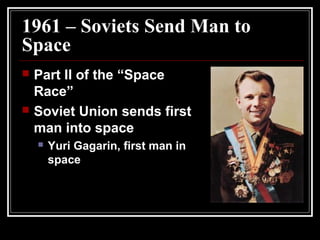
1961 – Soviets Send Man to
Space
 Part II of the “Space
Race”
 Soviet Union sends first
man into space
 Yuri Gagarin, first man in
space
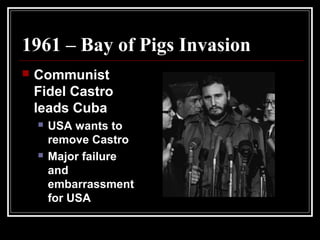
1961 – Bay of Pigs Invasion
 Communist
Fidel Castro
leads Cuba
 USA wants to
remove Castro
 Major failure
and
embarrassment
for USA
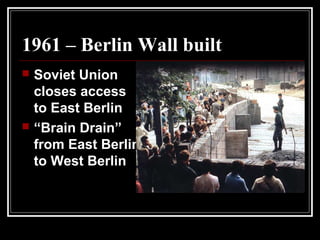
1961 – Berlin Wall built
 Soviet Union
closes access
to East Berlin
 “Brain Drain”
from East Berlin
to West Berlin
1962 – Cuban Missile Crisis
 Most tense moment of
Cold War
 Soviet Union places
nuclear missiles in
Cuba, 90 miles from
USA
 USA cannot except this
 13 days of
really
REALLY
REALLY
tense negotiations
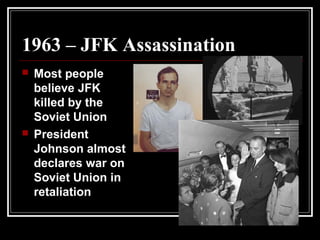
1963 – JFK Assassination
 Most people
believe JFK
killed by the
Soviet Union
 President
Johnson almost
declares war on
Soviet Union in
retaliation
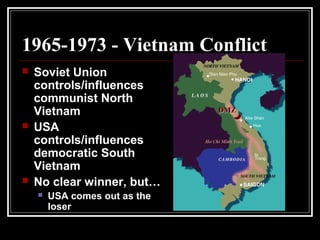
1965-1973 - Vietnam Conflict
 Soviet Union
controls/influences
communist North
Vietnam
 USA
controls/influences
democratic South
Vietnam
 No clear winner, but…
 USA comes out as the
loser
1969 – USA Lands on the Moon
 Part III of the “Space
Race”
 Neil Armstrong first
man on the moon
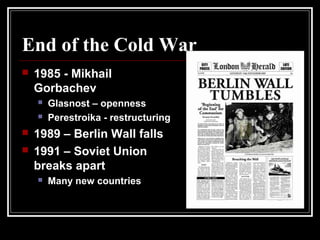
End of the Cold War
 1985 - Mikhail
Gorbachev
 Glasnost – openness
 Perestroika - restructuring
 1989 – Berlin Wall falls
 1991 – Soviet Union
breaks apart
 Many new countries

Russian history ppt

  • 1.
  • 2.
    • Ancient Russia –Settlement of Russia – Kievan Rus' - loose federation of East Slavic tribes in Europe from the late 9th to the mid-13th century – Mongol Invasion of Russia • Retaking Russia – Ivan the Great – Ivan the Terrible • Romanov Dynasty – Peter the Great – Catherine the Great
  • 3.
    Ancient Russia  850A.D.  Russia settled by Scandinavians  People from Norway, Sweden, Finland  Main city is Novgorod  Major Rulers:  Oleg  Vladimir I
  • 4.
    Map of Russia(850-1235 A.D.)
  • 5.
    Yaroslav the Wise(1030 A.D.)  Made written laws  Encouraged Artists  Made alliances with other states  Divided the country up among his children when he died
  • 6.
  • 7.
    Invasion of Mongols(1237)  Most of Russia conquered by Mongols  States forced to pay “tribute” to Mongols  Mongols control Russia for next 200 years  City of Novgorod remains in Russian control
  • 8.
    Ivan the Great(1480)  Leads rebellion against the Mongols  Freed Russian cities from Mongol control
  • 9.
    Ivan the Terrible(1533)  Becomes Tsar of Russia as a 3 yr.old  Expanded Russian land into Siberia  Attacked his own followers if they displeased him (including his own son)
  • 10.
    Romanov Dynasty  RulesRussia until end of World War I  Michael Romanov elected in 1613
  • 11.
    Peter the Great(1689)  Moved capital to St. Petersburg  Made Russia more like Europe  Military  Technology  Clothing (even facial hair!)  Laws  Established feudal system in Russia
  • 12.
    Catherine the Great(1762-1796)  Encouraged museums, new buildings, libraries  Believed in equality, but treated the poor badly  Very good at foreign policy  Expanded Russian borders
  • 13.
  • 14.
    Napoleon Invades Russia Who was Napoleon?  Emperor of France  Conquered nearly all of Europe  Why he invaded Russia?  To teach other countries a lesson  Result?  Disastrous defeat for Napoleon
  • 15.
    Napoleon’s Defeat  Russian’swould not fight  Scorched Earth tactics  French supply lines too long  Russian winters too cold  Russian army blocked retreat French Army Invading Russia French Army Retreating From Russia French Army Making it Home 650,000 40,000 10,000
  • 16.
    Feudal System (Serfdom) 3 classes of people  Ruling class  Tsar and family  Nobles  Land owners, Barons & Knights  Need serfs to work the land  Serfs (peasants)  Land workers (farmers)  Need nobles to protect them from invaders, criminals
  • 17.
    Problems with FeudalSystem  World was changing  “Western” culture had given up on the feudal system  Russia becoming more industrial  Serfs no longer need protection  “Serfs” in Russia given freedom in 1860, but…  “Workers' lives did not improve
  • 18.
  • 19.
    Russo-Japanese War (1904-05) Russia expanded borders east to Pacific Ocean (Vladivostok)  Japanese expanding West towards Russia  Russia is defeated  Russian people demoralized, hungry, poorer than ever
  • 20.
    World War I(1914)  After Russo- Japanese War, Russian working class tired of war  Not prepared for war  Russia could not avoid WWI alliances
  • 21.
    Russian Revolution (1917) Working class upset about another costly war  Economy is collapsing  Tsar Nicholas II “abdicated” the throne  New government formed  Lead by Bolshevik (Workers') political party and Vladimir Lenin  Changes? •Bolsheviks become “Communist Party” •Russia quits WWI •All people declared equal •Peasants seize land from the rich, give it back, to EVERYONE!
  • 22.
    Russian History Cold WarBackground & Beginnings 1945 - 1973
  • 23.
    Early Cold War- Background  What is a “Cold War?”  A struggle to limit and oppose the power of your opponent  Everything short of open warfare (a “hot war”)
  • 25.
    Major Players inthe Cold War  United States  President Franklin D. Roosevelt (dies in 1945)  President Harry Truman  Great Britain  Prime Minister Winston Churchill  Russia (a.k.a. Soviet Union, USSR)  Secretary General Josef Stalin
  • 26.
    Causes of theCold War
  • 27.
    BELIEFS  Soviet Union Communist Dictatorship  What is communism? What is a dictatorship?  United States  Capitalist Democracy  What is capitalism? What is democracy?
  • 28.
    AIMS  Stalin wantslarge “reparations” from Germany and a buffer zone of friendly states to protect Russia from future invasions  USA and Great Britain want to protect democracy and help Germany recover from WWII  Worried that large areas of Eastern Europe would become communist  What happens to countries that are poor and controlled by dictators?
  • 29.
    RESENTMENT About History Soviet Union  Could not forget that USA and Great Britain tried to interfere in the Russian Revolution  Believed USA and Great Britain waited too long to enter WWII  Great Britain & USA  Could not forget that Russia pulled out of WWI after Russia Revolution  Could not forget (or forgive!) that Stalin signed Non- Aggression Pact with Hitler in 1939.
  • 31.
    Events  Yalta Conference USA Atomic Bomb  Iron Curtain Speech  Truman Doctrine  Marshall Plan  NATO formed  Berlin Blockade  Soviet Atomic Bomb  Korean War  Warsaw Pact  Vietnam War  Sputnik Launched  Bay of Pigs Invasion  Cuban Missile Crisis  Berlin Wall built  JFK Assassination  USA Moon landing  End of Cold War events
  • 33.
    Russian History Cold WarEvents 1945 - 1991
  • 34.
    Events of theCold War  Yalta Conference  USA Atomic Bomb  Iron Curtain Speech  Truman Doctrine  Marshall Plan  NATO formed  Berlin Blockade  Soviet Atomic Bomb  Korean War  Warsaw Pact  Vietnam War  Sputnik Launched  Bay of Pigs Invasion  Cuban Missile Crisis  Berlin Wall built  JFK Assassination  USA Moon landing  End of Cold War events
  • 35.
    1945 - YaltaConference  Deciding what to do with Germany after WWII  Decision: Spilt Germany into 4 areas of control
  • 36.
    Berlin Also Divided Samecontrol structure as rest of Germany
  • 37.
    1945 - USADrops Atomic Bomb on Japan  220,000 Japanese killed in 3 days  Russians worried that next bomb will be dropped on them
  • 38.
    1946 - IronCurtain Speech  Winston Churchill  Tells Stalin, “ We’re watching you”  Says that USA has a DUTY to spread democracy around the world
  • 39.
    1947 – TrumanDoctrine  “Containment” of Communism  Wants to stop the spread of communism to new countries
  • 40.
    1947 – MarshallPlan  Giving money and supplies to countries in the world (mostly Europe) that reject communis m
  • 41.
    1949 - NATOFormed  North Atlantic Treaty Organization  Military alliance  An attack on any NATO country will be treated as an attack on all NATO countries… especially against USA
  • 42.
    1948 – BerlinBlockade (until 1949)  Stalin cuts off Berlin from the west  USA flies supplies into Berlin  One plane landing every 90 seconds for 1 year
  • 43.
    1949 – Sovietsexplode Atomic Bomb  USA no longer the only “Nuclear Power” in the world  Creates a shift in world power
  • 44.
    1950 - KoreanWar  Soviet Union controls/influences communist North Korea  USA controls/influences democratic South Korea  No clear winner 1953 1950
  • 45.
    1955 - WarsawPact  Counter move to NATO  Soviet Union creates buffer zone of Eastern European countries  Any attack on Warsaw country is an attack on Russia
  • 46.
    1957 – SputnikLaunched  Part I of the “Space Race”  Soviet Union launches first satellite to orbit the Earth  USA is embarrassed  Students must now take more math & science classes
  • 47.
    1961 – SovietsSend Man to Space  Part II of the “Space Race”  Soviet Union sends first man into space  Yuri Gagarin, first man in space
  • 48.
    1961 – Bayof Pigs Invasion  Communist Fidel Castro leads Cuba  USA wants to remove Castro  Major failure and embarrassment for USA
  • 49.
    1961 – BerlinWall built  Soviet Union closes access to East Berlin  “Brain Drain” from East Berlin to West Berlin
  • 50.
    1962 – CubanMissile Crisis  Most tense moment of Cold War  Soviet Union places nuclear missiles in Cuba, 90 miles from USA  USA cannot except this  13 days of really REALLY REALLY tense negotiations
  • 51.
    1963 – JFKAssassination  Most people believe JFK killed by the Soviet Union  President Johnson almost declares war on Soviet Union in retaliation
  • 52.
    1965-1973 - VietnamConflict  Soviet Union controls/influences communist North Vietnam  USA controls/influences democratic South Vietnam  No clear winner, but…  USA comes out as the loser
  • 53.
    1969 – USALands on the Moon  Part III of the “Space Race”  Neil Armstrong first man on the moon
  • 54.
    End of theCold War  1985 - Mikhail Gorbachev  Glasnost – openness  Perestroika - restructuring  1989 – Berlin Wall falls  1991 – Soviet Union breaks apart  Many new countries