Rural-Urban Partnership for economic
development: rationale, geographies and
governance approaches
Joaquim Oliveira Martins
Head of the Regional Development Policy Division
OECD
Quito, 17 October 2016
Habitat III Conference
Outline
1. What is urban / what is rural
2. Demographic, economic and well-being profile of urban
and rural areas
3. Urban-rural interactions and regional performance
4. From linkages to partnerships
5. Building effective U-R partnerships
1. What is urban / what is rural
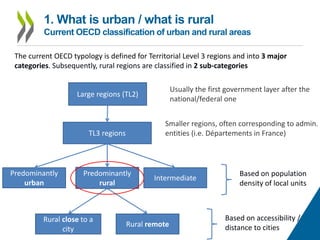
Current OECD classification of urban and rural areas
The current OECD typology is defined for Territorial Level 3 regions and into 3 major
categories. Subsequently, rural regions are classified in 2 sub-categories
TL3 regions
Intermediate
Predominantly
rural
Predominantly
urban
Rural close to a
city
Rural remote
Based on population
density of local units
Based on accessibility /
distance to cities
Large regions (TL2)
Usually the first government layer after the
national/federal one
Smaller regions, often corresponding to admin.
entities (i.e. Départements in France)
2. Demographic, economic and well-being profile
of urban and rural areas
In OECD countries, on average, almost 80% of rural population
live close to an urban area (2012)
2. Demographic, economic and well-being profile
of urban and rural areas
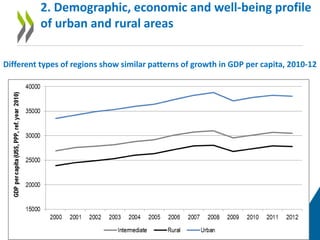
Different types of regions show similar patterns of growth in GDP per capita, 2010-12
0.005.01.015
AverageannualgrowthofrealGDPpercapita(2000-12)
Rural remote Intermediate Urban Rural close to a city
3. Urban-rural interactions and regional
performance
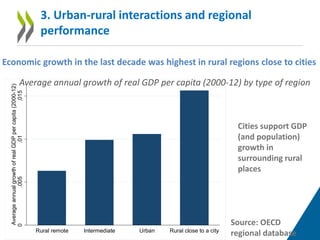
Economic growth in the last decade was highest in rural regions close to cities
Cities support GDP
(and population)
growth in
surrounding rural
places
Source: OECD
regional database
Average annual growth of real GDP per capita (2000-12) by type of region
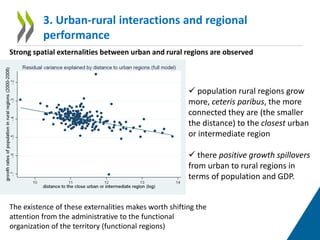
Strong spatial externalities between urban and rural regions are observed
 population rural regions grow
more, ceteris paribus, the more
connected they are (the smaller
the distance) to the closest urban
or intermediate region
 there positive growth spillovers
from urban to rural regions in
terms of population and GDP.
The existence of these externalities makes worth shifting the
attention from the administrative to the functional
organization of the territory (functional regions)
3. Urban-rural interactions and regional
performance
4. From linkages to partnerships
Definition
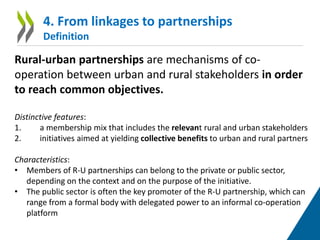
Rural-urban partnerships are mechanisms of co-
operation between urban and rural stakeholders in order
to reach common objectives.
Distinctive features:
1. a membership mix that includes the relevant rural and urban stakeholders
2. initiatives aimed at yielding collective benefits to urban and rural partners
Characteristics:
• Members of R-U partnerships can belong to the private or public sector,
depending on the context and on the purpose of the initiative.
• The public sector is often the key promoter of the R-U partnership, which can
range from a formal body with delegated power to an informal co-operation
platform
4. From linkages to partnerships
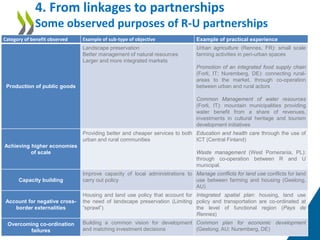
Some observed purposes of R-U partnerships
Category of benefit observed Example of sub-type of objective Example of practical experience
Production of public goods
Landscape preservation
Better management of natural resources
Larger and more integrated markets
Urban agriculture (Rennes, FR): small scale
farming activities in peri-urban spaces
Promotion of an integrated food supply chain
(Forli, IT; Nuremberg, DE): connecting rural-
areas to the market, through co-operation
between urban and rural actors
Common Management of water resources
(Forli, IT): mountain municipalities providing
water benefit from a share of revenues,
investments in cultural heritage and tourism
development initiatives
Achieving higher economies
of scale
Providing better and cheaper services to both
urban and rural communities
Education and health care through the use of
ICT (Central Finland)
Waste management (West Pomerania, PL):
through co-operation between R and U
municipal.
Capacity building
Improve capacity of local administrations to
carry out policy
Manage conflicts for land use conflicts for land
use between farming and housing (Geelong,
AU)
Account for negative cross-
border externalities
Housing and land use policy that account for
the need of landscape preservation (Limiting
“sprawl”)
Integrated spatial plan: housing, land use
policy and transportation are co-ordinated at
the level of functional region (Pays de
Rennes)
Overcoming co-ordination
failures
Building a common vision for development
and matching investment decisions
Common plan for economic development
(Geelong, AU; Nuremberg, DE)
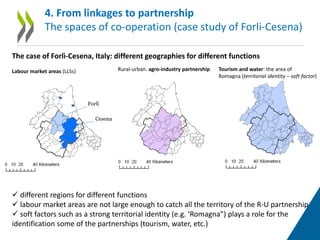
The case of Forlì-Cesena, Italy: different geographies for different functions
Labour market areas (LLSs) Rural-urban. agro-industry partnership Tourism and water: the area of
Romagna (territorial identity – soft factor)
Forli
Cesena
 different regions for different functions
 labour market areas are not large enough to catch all the territory of the R-U partnership
 soft factors such as a strong territorial identity (e.g. ‘Romagna”) plays a role for the
identification some of the partnerships (tourism, water, etc.)
4. From linkages to partnership
The spaces of co-operation (case study of Forli-Cesena)
4. From linkages to partnership
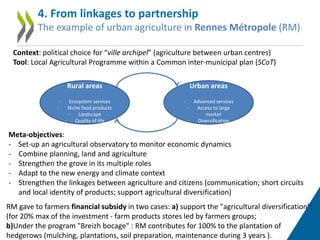
The example of urban agriculture in Rennes Métropole (RM)
Context: political choice for “ville archipel” (agriculture between urban centres)
Tool: Local Agricultural Programme within a Common inter-municipal plan (SCoT)
Rural areas
- Ecosystem services
- Niche food products
- Landscape
- Quality of life
Urban areas
- Advanced services
- Access to large
market
- Diversification
Meta-objectives:
- Set-up an agricultural observatory to monitor economic dynamics
- Combine planning, land and agriculture
- Strengthen the grove in its multiple roles
- Adapt to the new energy and climate context
- Strengthen the linkages between agriculture and citizens (communication; short circuits
and local identity of products; support agricultural diversification)
RM gave to farmers financial subsidy in two cases: a) support the "agricultural diversification":
(for 20% max of the investment - farm products stores led by farmers groups;
b)Under the program "Breizh bocage" : RM contributes for 100% to the plantation of
hedgerows (mulching, plantations, soil preparation, maintenance during 3 years ).
4. From linkages to partnership
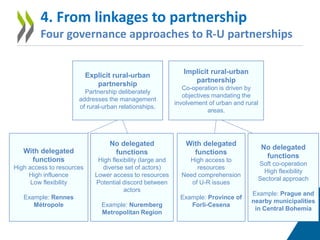
Four governance approaches to R-U partnerships
Explicit rural-urban
partnership
Partnership deliberately
addresses the management
of rural-urban relationships.
Implicit rural-urban
partnership
Co-operation is driven by
objectives mandating the
involvement of urban and rural
areas.
No delegated
functions
High flexibility (large and
diverse set of actors)
Lower access to resources
Potential discord between
actors
Example: Nuremberg
Metropolitan Region
With delegated
functions
High access to resources
High influence
Low flexibility
Example: Rennes
Métropole
With delegated
functions
High access to
resources
Need comprehension
of U-R issues
Example: Province of
Forlì-Cesena
No delegated
functions
Soft co-operation
High flexibility
Sectoral approach
Example: Prague and
nearby municipalities
in Central Bohemia
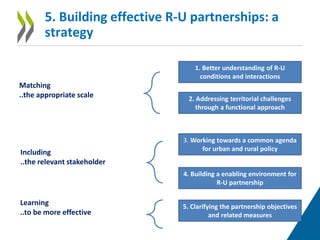
5. Building effective R-U partnerships: a
strategy
Matching
..the appropriate scale
Including
..the relevant stakeholder
Learning
..to be more effective
1. Better understanding of R-U
conditions and interactions
2. Addressing territorial challenges
through a functional approach
3. Working towards a common agenda
for urban and rural policy
4. Building a enabling environment for
R-U partnership
5. Clarifying the partnership objectives
and related measures

Rural urban-partnership-for-economic-development

  • 1.
    Rural-Urban Partnership foreconomic development: rationale, geographies and governance approaches Joaquim Oliveira Martins Head of the Regional Development Policy Division OECD Quito, 17 October 2016 Habitat III Conference
  • 2.
    Outline 1. What isurban / what is rural 2. Demographic, economic and well-being profile of urban and rural areas 3. Urban-rural interactions and regional performance 4. From linkages to partnerships 5. Building effective U-R partnerships
  • 3.
    1. What isurban / what is rural Current OECD classification of urban and rural areas The current OECD typology is defined for Territorial Level 3 regions and into 3 major categories. Subsequently, rural regions are classified in 2 sub-categories TL3 regions Intermediate Predominantly rural Predominantly urban Rural close to a city Rural remote Based on population density of local units Based on accessibility / distance to cities Large regions (TL2) Usually the first government layer after the national/federal one Smaller regions, often corresponding to admin. entities (i.e. Départements in France)
  • 4.
    2. Demographic, economicand well-being profile of urban and rural areas In OECD countries, on average, almost 80% of rural population live close to an urban area (2012)
  • 5.
    2. Demographic, economicand well-being profile of urban and rural areas Different types of regions show similar patterns of growth in GDP per capita, 2010-12
  • 6.
    0.005.01.015 AverageannualgrowthofrealGDPpercapita(2000-12) Rural remote IntermediateUrban Rural close to a city 3. Urban-rural interactions and regional performance Economic growth in the last decade was highest in rural regions close to cities Cities support GDP (and population) growth in surrounding rural places Source: OECD regional database Average annual growth of real GDP per capita (2000-12) by type of region
  • 7.
    Strong spatial externalitiesbetween urban and rural regions are observed  population rural regions grow more, ceteris paribus, the more connected they are (the smaller the distance) to the closest urban or intermediate region  there positive growth spillovers from urban to rural regions in terms of population and GDP. The existence of these externalities makes worth shifting the attention from the administrative to the functional organization of the territory (functional regions) 3. Urban-rural interactions and regional performance
  • 8.
    4. From linkagesto partnerships Definition Rural-urban partnerships are mechanisms of co- operation between urban and rural stakeholders in order to reach common objectives. Distinctive features: 1. a membership mix that includes the relevant rural and urban stakeholders 2. initiatives aimed at yielding collective benefits to urban and rural partners Characteristics: • Members of R-U partnerships can belong to the private or public sector, depending on the context and on the purpose of the initiative. • The public sector is often the key promoter of the R-U partnership, which can range from a formal body with delegated power to an informal co-operation platform
  • 9.
    4. From linkagesto partnerships Some observed purposes of R-U partnerships Category of benefit observed Example of sub-type of objective Example of practical experience Production of public goods Landscape preservation Better management of natural resources Larger and more integrated markets Urban agriculture (Rennes, FR): small scale farming activities in peri-urban spaces Promotion of an integrated food supply chain (Forli, IT; Nuremberg, DE): connecting rural- areas to the market, through co-operation between urban and rural actors Common Management of water resources (Forli, IT): mountain municipalities providing water benefit from a share of revenues, investments in cultural heritage and tourism development initiatives Achieving higher economies of scale Providing better and cheaper services to both urban and rural communities Education and health care through the use of ICT (Central Finland) Waste management (West Pomerania, PL): through co-operation between R and U municipal. Capacity building Improve capacity of local administrations to carry out policy Manage conflicts for land use conflicts for land use between farming and housing (Geelong, AU) Account for negative cross- border externalities Housing and land use policy that account for the need of landscape preservation (Limiting “sprawl”) Integrated spatial plan: housing, land use policy and transportation are co-ordinated at the level of functional region (Pays de Rennes) Overcoming co-ordination failures Building a common vision for development and matching investment decisions Common plan for economic development (Geelong, AU; Nuremberg, DE)
  • 10.
    The case ofForlì-Cesena, Italy: different geographies for different functions Labour market areas (LLSs) Rural-urban. agro-industry partnership Tourism and water: the area of Romagna (territorial identity – soft factor) Forli Cesena  different regions for different functions  labour market areas are not large enough to catch all the territory of the R-U partnership  soft factors such as a strong territorial identity (e.g. ‘Romagna”) plays a role for the identification some of the partnerships (tourism, water, etc.) 4. From linkages to partnership The spaces of co-operation (case study of Forli-Cesena)
  • 11.
    4. From linkagesto partnership The example of urban agriculture in Rennes Métropole (RM) Context: political choice for “ville archipel” (agriculture between urban centres) Tool: Local Agricultural Programme within a Common inter-municipal plan (SCoT) Rural areas - Ecosystem services - Niche food products - Landscape - Quality of life Urban areas - Advanced services - Access to large market - Diversification Meta-objectives: - Set-up an agricultural observatory to monitor economic dynamics - Combine planning, land and agriculture - Strengthen the grove in its multiple roles - Adapt to the new energy and climate context - Strengthen the linkages between agriculture and citizens (communication; short circuits and local identity of products; support agricultural diversification) RM gave to farmers financial subsidy in two cases: a) support the "agricultural diversification": (for 20% max of the investment - farm products stores led by farmers groups; b)Under the program "Breizh bocage" : RM contributes for 100% to the plantation of hedgerows (mulching, plantations, soil preparation, maintenance during 3 years ).
  • 12.
    4. From linkagesto partnership Four governance approaches to R-U partnerships Explicit rural-urban partnership Partnership deliberately addresses the management of rural-urban relationships. Implicit rural-urban partnership Co-operation is driven by objectives mandating the involvement of urban and rural areas. No delegated functions High flexibility (large and diverse set of actors) Lower access to resources Potential discord between actors Example: Nuremberg Metropolitan Region With delegated functions High access to resources High influence Low flexibility Example: Rennes Métropole With delegated functions High access to resources Need comprehension of U-R issues Example: Province of Forlì-Cesena No delegated functions Soft co-operation High flexibility Sectoral approach Example: Prague and nearby municipalities in Central Bohemia
  • 13.
    5. Building effectiveR-U partnerships: a strategy Matching ..the appropriate scale Including ..the relevant stakeholder Learning ..to be more effective 1. Better understanding of R-U conditions and interactions 2. Addressing territorial challenges through a functional approach 3. Working towards a common agenda for urban and rural policy 4. Building a enabling environment for R-U partnership 5. Clarifying the partnership objectives and related measures