25-3-2025 2
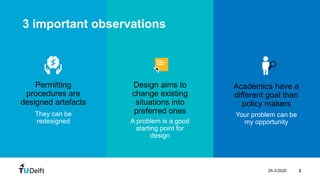
They canbe
redesigned
Permitting
procedures are
designed artefacts
A problem is a good
starting point for
design
Design aims to
change existing
situations into
preferred ones Your problem can be
my opportunity
Academics have a
different goal than
policy makers
Design Process | 7 steps
Design Process | 7 steps
3 important observations
3.
25-3-2025
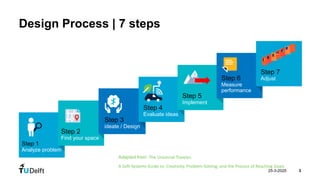
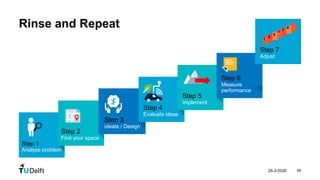
Design Process |7 steps
3
Step 1
Analyze problem
Step 2
Find your space
Step 3
ideate / Design
Step 3
ideate / Design
Step 4
Evaluate ideas
Step 5
Implement
Step 6
Measure
performance
Step 7
Adjust
Adapted from: The Universal Traveler,
A Soft-Systems Guide to: Creativity, Problem-Solving, and the Process of Reaching Goals
4.
25-3-2025 4
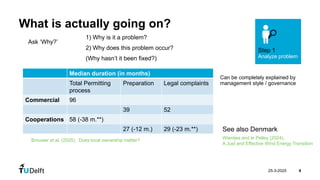
What isactually going on?
1) Why is it a problem?
2) Why does this problem occur?
(Why hasn’t it been fixed?)
Brouwer et al. (2025), Does local ownership matter?
Median duration (in months)
Total Permitting
process
Preparation Legal complaints
Commercial 96
39 52
Cooperations 58 (-38 m.**)
27 (-12 m.) 29 (-23 m.**)
Step 1
Analyze problem
Ask ‘Why?’
Can be completely explained by
management style / governance
See also Denmark
Wientjes and le Pelley (2024),
A Just and Effective Wind Energy Transition
5.
25-3-2025 5
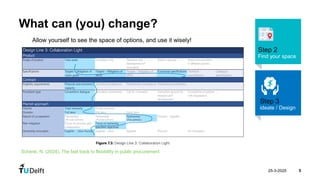
What can(you) change?
Step 1
Analyze problem
Step 2
Find your space
Allow yourself to see the space of options, and use it wisely!
Step 3
ideate / Design
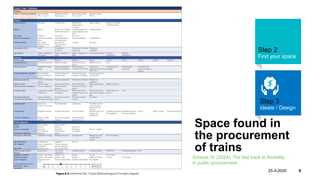
Schenk, N. (2024). The fast track to flexibility in public procurement
6.
25-3-2025 6
Space foundin
the procurement
of trains
Schenk, N. (2024). The fast track to flexibility
in public procurement
Step 2
Find your space
Step 3
ideate / Design
7.
25-3-2025 7
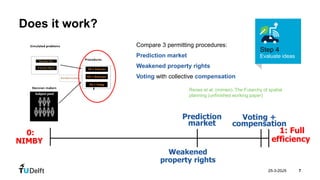
Does itwork?
Step 4
Evaluate ideas
Compare 3 permitting procedures:
Prediction market
Weakened property rights
Voting with collective compensation
0:
NIMBY
Weakened
property rights
Prediction
market
Voting +
compensation
1: Full
Efficiency
1: Full
efficiency
Renes et al. (mimeo). The Futarchy of spatial
planning (unfinished working paper)
8.
25-3-2025 8
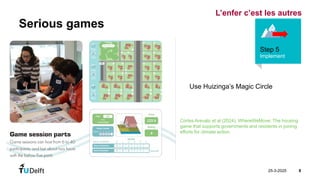
Serious games
Step5
Implement
L’enfer c’est les autres
Cortes Arevalo et al (2024). WhereWeMove: The housing
game that supports governments and residents in joining
efforts for climate action.
Use Huizinga’s Magic Circle
9.
25-3-2025
L’enfer, C’est LesAutres
9
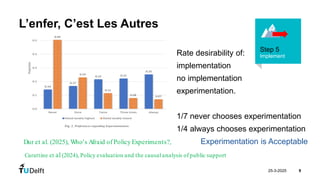
Dur et al. (2025), Who's Afraid of Policy Experiments?,
Step 5
Implement
Rate desirability of:
implementation
no implementation
experimentation.
1/7 never chooses experimentation
1/4 always chooses experimentation
Experimentation is Acceptable
Carattine et al (2024), Policy evaluation and the causal analysis of public support
10.
25-3-2025 10
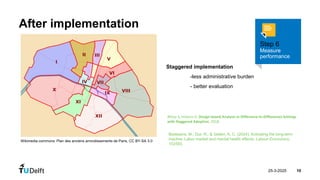
After implementation
AtheyS, Imbens G. Design-based Analysis in Difference-In-Differences Settings
with Staggered Adoption. 2018.
Wikimedia commons: Plan des anciens arrondissements de Paris, CC BY-SA 3.0
Bastiaans, M., Dur, R., & Gielen, A. C. (2024). Activating the long-term
inactive: Labor market and mental health effects. Labour Economics,
102593.
Step 6
Measure
performance
Staggered implementation
-less administrative burden
- better evaluation
25-3-2025 12
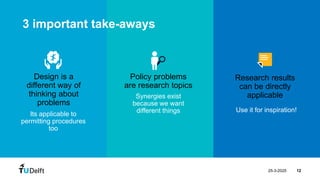
Its applicableto
permitting procedures
too
Design is a
different way of
thinking about
problems
Synergies exist
because we want
different things
Policy problems
are research topics
Use it for inspiration!
Research results
can be directly
applicable
Design Process | 7 steps
Design Process | 7 steps
3 important take-aways
13.
25-3-2025 13
Sander Renes
Assistantprofessor, Economics of Technology
and Innovation, Faculty of Technology, Policy and
management
Digital research portrait:
In search of the best rules of the game in a behavioural lab
s.renes-1@tudelft.nl
www.sanderrenes.com
Thank you for you attention!
14.
References with links
Slide3:
The Universal traveler:
The universal traveler : a soft-systems guide to creativity, problem-solving & process of reaching goals : Koberg, Don, 1930- : Free Download,
Borrow, and Streaming : Internet Archive
Slide 4
Brouwer, B., van Bergem, R., Renes, S., Kamp, L. M., & Hoppe, T. (2025). Does local ownership matter? A comparative analysis of fourteen
wind energy projects in the Netherlands. Energy Research & Social Science, 120, 103891.
https://www.sciencedirect.com/science/article/pii/S2214629624004821
Wientjes and le Pelley (2024), A Just and Effective Wind Energy Transition: Six Insights from Denmark and the Netherlands | Erasmus
University Rotterdam
15.
25-3-2025 15
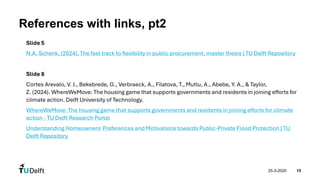
References withlinks, pt2
Slide 5
N.A. Schenk, (2024), The fast track to flexibility in public procurement, master thesis | TU Delft Repository
Slide 8
Cortes Arevalo, V. J., Bekebrede, G., Verbraeck, A., Filatova, T., Mutlu, A., Abebe, Y. A., & Taylor,
Z. (2024). WhereWeMove: The housing game that supports governments and residents in joining efforts for
climate action. Delft University of Technology.
WhereWeMove: The housing game that supports governments and residents in joining efforts for climate
action - TU Delft Research Portal
Understanding Homeowners' Preferences and Motivations towards Public-Private Flood Protection | TU
Delft Repository
16.
25-3-2025 16
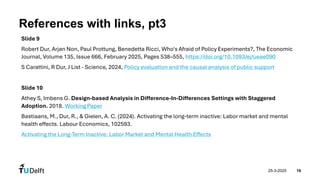
References withlinks, pt3
Slide 9
Robert Dur, Arjan Non, Paul Prottung, Benedetta Ricci, Who's Afraid of Policy Experiments?, The Economic
Journal, Volume 135, Issue 666, February 2025, Pages 538–555, https://doi.org/10.1093/ej/ueae090
S Carattini, R Dur, J List - Science, 2024, Policy evaluation and the causal analysis of public support
Slide 10
Athey S, Imbens G. Design-based Analysis in Difference-In-Differences Settings with Staggered
Adoption. 2018. Working Paper
Bastiaans, M., Dur, R., & Gielen, A. C. (2024). Activating the long-term inactive: Labor market and mental
health effects. Labour Economics, 102593.
Activating the Long-Term Inactive: Labor Market and Mental Health Effects