1
CITIES Forum 2015
An Urban Agenda for EuropeRegional and
Urban Policy
An Urban Agenda for Europe
CITIES Forum 2015
Cities in a regional context (urban-rural linkages)
Joaquim Oliveira Martins (OECD)
Brussels, 2 June 2015
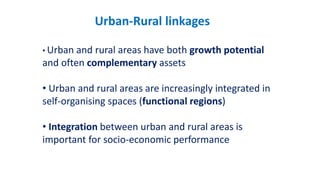
Urban-Rural linkages
• Urban and rural areas have both growth potential
and often complementary assets
• Urban and rural areas are increasingly integrated in
self-organising spaces (functional regions)
• Integration between urban and rural areas is
important for socio-economic performance
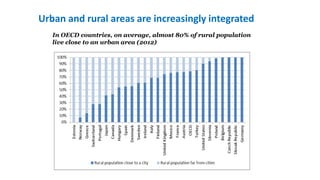
Urban and rural areas are increasingly integrated
In OECD countries, on average, almost 80% of rural population
live close to an urban area (2012)
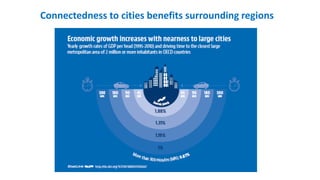
Connectedness to cities benefits surrounding regions
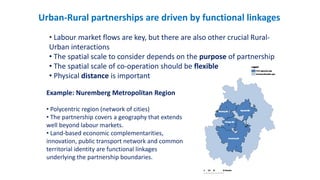
Urban-Rural partnerships are driven by functional linkages
• Labour market flows are key, but there are also other crucial Rural-
Urban interactions
• The spatial scale to consider depends on the purpose of partnership
• The spatial scale of co-operation should be flexible
• Physical distance is important
Example: Nuremberg Metropolitan Region
• Polycentric region (network of cities)
• The partnership covers a geography that extends
well beyond labour markets.
• Land-based economic complementarities,
innovation, public transport network and common
territorial identity are functional linkages
underlying the partnership boundaries.
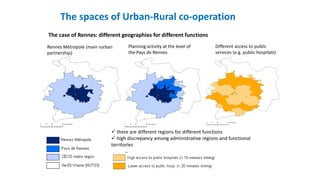
The spaces of Urban-Rural co-operation
Rennes Métropole (main rurban
partnership)
Planning activity at the level of
the Pays de Rennes
Different access to public
services (e.g. public hospitals)
 there are different regions for different functions
 high discrepancy among administrative regions and functional
territories
The case of Rennes: different geographies for different functions
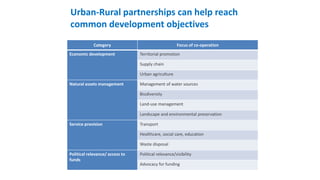
Urban-Rural partnerships can help reach
common development objectives
Category Focus of co-operation
Economic development Territorial promotion
Supply chain
Urban agriculture
Natural assets management Management of water sources
Biodiversity
Land-use management
Landscape and environmental preservation
Service provision Transport
Healthcare, social care, education
Waste disposal
Political relevance/ access to
funds
Political relevance/visibility
Advocacy for funding
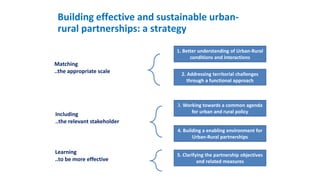
Building effective and sustainable urban-
rural partnerships: a strategy
Matching
..the appropriate scale
Including
..the relevant stakeholder
Learning
..to be more effective
1. Better understanding of Urban-Rural
conditions and interactions
2. Addressing territorial challenges
through a functional approach
3. Working towards a common agenda
for urban and rural policy
4. Building a enabling environment for
Urban-Rural partnerships
5. Clarifying the partnership objectives
and related measures
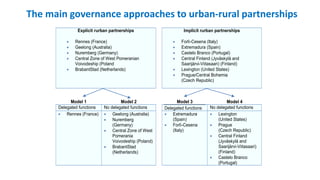
The main governance approaches to urban-rural partnerships
Explicit rurban partnerships
 Rennes (France)
 Geelong (Australia)
 Nuremberg (Germany)
 Central Zone of West Pomeranian
Voivodeship (Poland
 BrabantStad (Netherlands)
Implicit rurban partnerships
 Forlì-Cesena (Italy)
 Extremadura (Spain)
 Castelo Branco (Portugal)
 Central Finland (Jyväskylä and
Saarijärvi-Viitasaari) (Finland)
 Lexington (United States)
 Prague/Central Bohemia
(Czech Republic)
Model 1 Model 2 Model 3 Model 4
Delegated functions No delegated functions Delegated functions No delegated functions
 Rennes (France)  Geelong (Australia)
 Nuremberg
(Germany)
 Central Zone of West
Pomerania
Voivodeship (Poland)
 BrabantStad
(Netherlands)
 Extremadura
(Spain)
 Forlì-Cesena
(Italy)
 Lexington
(United States)
 Prague
(Czech Republic)
 Central Finland
(Jyväskylä and
Saarijärvi-Viitasaari)
(Finland)
 Castelo Branco
(Portugal)
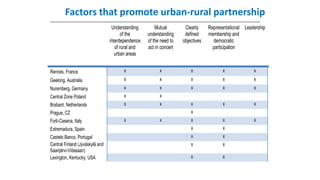
Factors that promote urban-rural partnership
Understanding
of the
interdependence
of rural and
urban areas
Mutual
understanding
of the need to
act in concert
Clearly
defined
objectives
Representational
membership and
democratic
participation
Leadership
Rennes, France x x x x x
Geelong, Australia x x x x x
Nuremberg, Germany x x x x x
Central Zone Poland x x
Brabant, Netherlands x x x x x
Prague, CZ x
Forli-Cesena, Italy x x x x x
Extremadura, Spain x x
Castelo Banco, Portugal x x
Central Finland (Jyväskylä and
Saarijärvi-Viitasaari)
x x
Lexington, Kentucky, USA x x
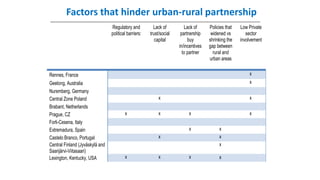
Factors that hinder urban-rural partnership
Regulatory and
political barriers:
Lack of
trust/social
capital
Lack of
partnership
buy
in/incentives
to partner
Policies that
widened vs
shrinking the
gap between
rural and
urban areas
Low Private
sector
involvement
Rennes, France x
Geelong, Australia x
Nuremberg, Germany
Central Zone Poland x x
Brabant, Netherlands
Prague, CZ x x x x
Forli-Cesena, Italy
Extremadura, Spain x x
Castelo Branco, Portugal x x
Central Finland (Jyväskylä and
Saarijärvi-Viitasaari)
x
Lexington, Kentucky, USA x x x x
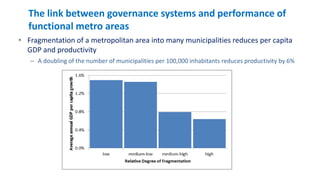
• Fragmentation of a metropolitan area into many municipalities reduces per capita
GDP and productivity
– A doubling of the number of municipalities per 100,000 inhabitants reduces productivity by 6%
The link between governance systems and performance of
functional metro areas
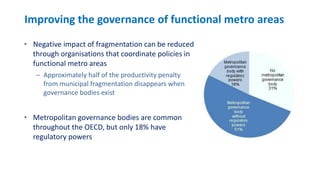
• Negative impact of fragmentation can be reduced
through organisations that coordinate policies in
functional metro areas
– Approximately half of the productivity penalty
from municipal fragmentation disappears when
governance bodies exist
• Metropolitan governance bodies are common
throughout the OECD, but only 18% have
regulatory powers
Improving the governance of functional metro areas
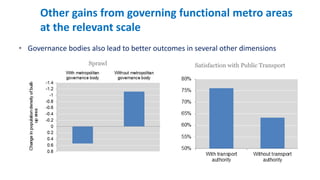
• Governance bodies also lead to better outcomes in several other dimensions
Other gains from governing functional metro areas
at the relevant scale
Sprawl Satisfaction with Public Transport
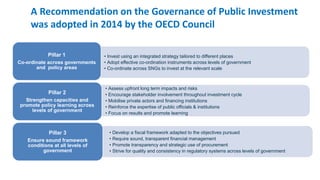
• Invest using an integrated strategy tailored to different places
• Adopt effective co-ordination instruments across levels of government
• Co-ordinate across SNGs to invest at the relevant scale
Pillar 1
Co-ordinate across governments
and policy areas
• Assess upfront long term impacts and risks
• Encourage stakeholder involvement throughout investment cycle
• Mobilise private actors and financing institutions
• Reinforce the expertise of public officials & institutions
• Focus on results and promote learning
Pillar 2
Strengthen capacities and
promote policy learning across
levels of government
• Develop a fiscal framework adapted to the objectives pursued
• Require sound, transparent financial management
• Promote transparency and strategic use of procurement
• Strive for quality and consistency in regulatory systems across levels of government
Pillar 3
Ensure sound framework
conditions at all levels of
government
A Recommendation on the Governance of Public Investment
was adopted in 2014 by the OECD Council
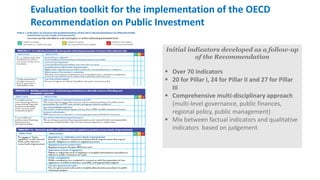
Evaluation toolkit for the implementation of the OECD
Recommendation on Public Investment
Initial indicators developed as a follow-up
of the Recommendation
 Over 70 indicators
 20 for Pillar I, 24 for Pillar II and 27 for Pillar
III
 Comprehensive multi-disciplinary approach
(multi-level governance, public finances,
regional policy, public management)
 Mix between factual indicators and qualitative
indicators based on judgement
THANK YOU
Joaquim.Oliveira@oecd.org
Some OECD references:
OECD (2013), Investing Together, OECD Publishing, Paris
OECD (2013), Rural-Urban Partnerships: An Integrated Approach to Economic Development,
OECD Publishing, Paris
OECD(2015), The Metropolitan Century, OECD Publishing, Paris
OECD(2015), Governing the City, OECD Publishing, Paris

Urban agenda-for-europe

  • 1.
    1 CITIES Forum 2015 AnUrban Agenda for EuropeRegional and Urban Policy An Urban Agenda for Europe CITIES Forum 2015 Cities in a regional context (urban-rural linkages) Joaquim Oliveira Martins (OECD) Brussels, 2 June 2015
  • 2.
    Urban-Rural linkages • Urbanand rural areas have both growth potential and often complementary assets • Urban and rural areas are increasingly integrated in self-organising spaces (functional regions) • Integration between urban and rural areas is important for socio-economic performance
  • 3.
    Urban and ruralareas are increasingly integrated In OECD countries, on average, almost 80% of rural population live close to an urban area (2012)
  • 4.
    Connectedness to citiesbenefits surrounding regions
  • 5.
    Urban-Rural partnerships aredriven by functional linkages • Labour market flows are key, but there are also other crucial Rural- Urban interactions • The spatial scale to consider depends on the purpose of partnership • The spatial scale of co-operation should be flexible • Physical distance is important Example: Nuremberg Metropolitan Region • Polycentric region (network of cities) • The partnership covers a geography that extends well beyond labour markets. • Land-based economic complementarities, innovation, public transport network and common territorial identity are functional linkages underlying the partnership boundaries.
  • 6.
    The spaces ofUrban-Rural co-operation Rennes Métropole (main rurban partnership) Planning activity at the level of the Pays de Rennes Different access to public services (e.g. public hospitals)  there are different regions for different functions  high discrepancy among administrative regions and functional territories The case of Rennes: different geographies for different functions
  • 7.
    Urban-Rural partnerships canhelp reach common development objectives Category Focus of co-operation Economic development Territorial promotion Supply chain Urban agriculture Natural assets management Management of water sources Biodiversity Land-use management Landscape and environmental preservation Service provision Transport Healthcare, social care, education Waste disposal Political relevance/ access to funds Political relevance/visibility Advocacy for funding
  • 8.
    Building effective andsustainable urban- rural partnerships: a strategy Matching ..the appropriate scale Including ..the relevant stakeholder Learning ..to be more effective 1. Better understanding of Urban-Rural conditions and interactions 2. Addressing territorial challenges through a functional approach 3. Working towards a common agenda for urban and rural policy 4. Building a enabling environment for Urban-Rural partnerships 5. Clarifying the partnership objectives and related measures
  • 9.
    The main governanceapproaches to urban-rural partnerships Explicit rurban partnerships  Rennes (France)  Geelong (Australia)  Nuremberg (Germany)  Central Zone of West Pomeranian Voivodeship (Poland  BrabantStad (Netherlands) Implicit rurban partnerships  Forlì-Cesena (Italy)  Extremadura (Spain)  Castelo Branco (Portugal)  Central Finland (Jyväskylä and Saarijärvi-Viitasaari) (Finland)  Lexington (United States)  Prague/Central Bohemia (Czech Republic) Model 1 Model 2 Model 3 Model 4 Delegated functions No delegated functions Delegated functions No delegated functions  Rennes (France)  Geelong (Australia)  Nuremberg (Germany)  Central Zone of West Pomerania Voivodeship (Poland)  BrabantStad (Netherlands)  Extremadura (Spain)  Forlì-Cesena (Italy)  Lexington (United States)  Prague (Czech Republic)  Central Finland (Jyväskylä and Saarijärvi-Viitasaari) (Finland)  Castelo Branco (Portugal)
  • 10.
    Factors that promoteurban-rural partnership Understanding of the interdependence of rural and urban areas Mutual understanding of the need to act in concert Clearly defined objectives Representational membership and democratic participation Leadership Rennes, France x x x x x Geelong, Australia x x x x x Nuremberg, Germany x x x x x Central Zone Poland x x Brabant, Netherlands x x x x x Prague, CZ x Forli-Cesena, Italy x x x x x Extremadura, Spain x x Castelo Banco, Portugal x x Central Finland (Jyväskylä and Saarijärvi-Viitasaari) x x Lexington, Kentucky, USA x x
  • 11.
    Factors that hinderurban-rural partnership Regulatory and political barriers: Lack of trust/social capital Lack of partnership buy in/incentives to partner Policies that widened vs shrinking the gap between rural and urban areas Low Private sector involvement Rennes, France x Geelong, Australia x Nuremberg, Germany Central Zone Poland x x Brabant, Netherlands Prague, CZ x x x x Forli-Cesena, Italy Extremadura, Spain x x Castelo Branco, Portugal x x Central Finland (Jyväskylä and Saarijärvi-Viitasaari) x Lexington, Kentucky, USA x x x x
  • 12.
    • Fragmentation ofa metropolitan area into many municipalities reduces per capita GDP and productivity – A doubling of the number of municipalities per 100,000 inhabitants reduces productivity by 6% The link between governance systems and performance of functional metro areas
  • 13.
    • Negative impactof fragmentation can be reduced through organisations that coordinate policies in functional metro areas – Approximately half of the productivity penalty from municipal fragmentation disappears when governance bodies exist • Metropolitan governance bodies are common throughout the OECD, but only 18% have regulatory powers Improving the governance of functional metro areas
  • 14.
    • Governance bodiesalso lead to better outcomes in several other dimensions Other gains from governing functional metro areas at the relevant scale Sprawl Satisfaction with Public Transport
  • 15.
    • Invest usingan integrated strategy tailored to different places • Adopt effective co-ordination instruments across levels of government • Co-ordinate across SNGs to invest at the relevant scale Pillar 1 Co-ordinate across governments and policy areas • Assess upfront long term impacts and risks • Encourage stakeholder involvement throughout investment cycle • Mobilise private actors and financing institutions • Reinforce the expertise of public officials & institutions • Focus on results and promote learning Pillar 2 Strengthen capacities and promote policy learning across levels of government • Develop a fiscal framework adapted to the objectives pursued • Require sound, transparent financial management • Promote transparency and strategic use of procurement • Strive for quality and consistency in regulatory systems across levels of government Pillar 3 Ensure sound framework conditions at all levels of government A Recommendation on the Governance of Public Investment was adopted in 2014 by the OECD Council
  • 16.
    Evaluation toolkit forthe implementation of the OECD Recommendation on Public Investment Initial indicators developed as a follow-up of the Recommendation  Over 70 indicators  20 for Pillar I, 24 for Pillar II and 27 for Pillar III  Comprehensive multi-disciplinary approach (multi-level governance, public finances, regional policy, public management)  Mix between factual indicators and qualitative indicators based on judgement
  • 17.
    THANK YOU Joaquim.Oliveira@oecd.org Some OECDreferences: OECD (2013), Investing Together, OECD Publishing, Paris OECD (2013), Rural-Urban Partnerships: An Integrated Approach to Economic Development, OECD Publishing, Paris OECD(2015), The Metropolitan Century, OECD Publishing, Paris OECD(2015), Governing the City, OECD Publishing, Paris