UNEMPLOYMENT
BY-VRINDA SHARMA
CONTENT
1. Introduction
2. Types
3. Causes
4. Impacts
5. Measurements
6. Initivates by the govt. To solve the problems
of unemployment
7. Solutions
8. Conclusion
What is unemployment ?
◦Unemployment refers to a situation in which
workers who are capable for working and
willing to work at the existing wage but do not
get employment
◦“A man is unemployed Only when he is without
a job or not employed and also desires to be
Employed
Types of unemployment ?
◦ There are basically four types of unemployment :
◦ (1) demand deficient Unemployment
◦ (2) frictional unemployment
◦ (3) Structural unemployment
◦ (4) voluntary unemployment
1. DEMAND DEFICIT UNEMPLOYMENT
Demand deficient unemployment occurs when there is
insufficient demand in the economy to maintain full
employment.
◦In a recession (a period of negative economic growth)
consumers will be buying fewer goods and services.
◦Selling fewer goods, firms sell less and so reduce
production
AD/AS diagram for Demand deficient
unemployment
Diagram showing a fall in aggregate demand
AD leading to lower GDP and hence higher
unemployment
2 .Frictional unemployment
Frictional unemployment: refers to workers who are in
between jobs.
◦ Example : a worker who recently quit or was fired and
is looking for a job in an economy that is not
experiencing a recession. It is not an unhealthy thing
because it is usually caused by workers looking for a
job that is most suitable to their skills.
Another name for Friticional
unemployment : “SEARCH
UNEMPLOYMENT”
3. Structural unemployment
Structural unemployment :happens when the skills set of
a worker does not match the skills demands of the jobs
available or if the worker cannot reach the geographical
location of a job.
◦ Example : a teaching job that requires relocation to
China, but the worker cannot secure a work visa due to
certain visa restrictions. It can also happen when there is
a technological change in the organization, such as
workflow automation
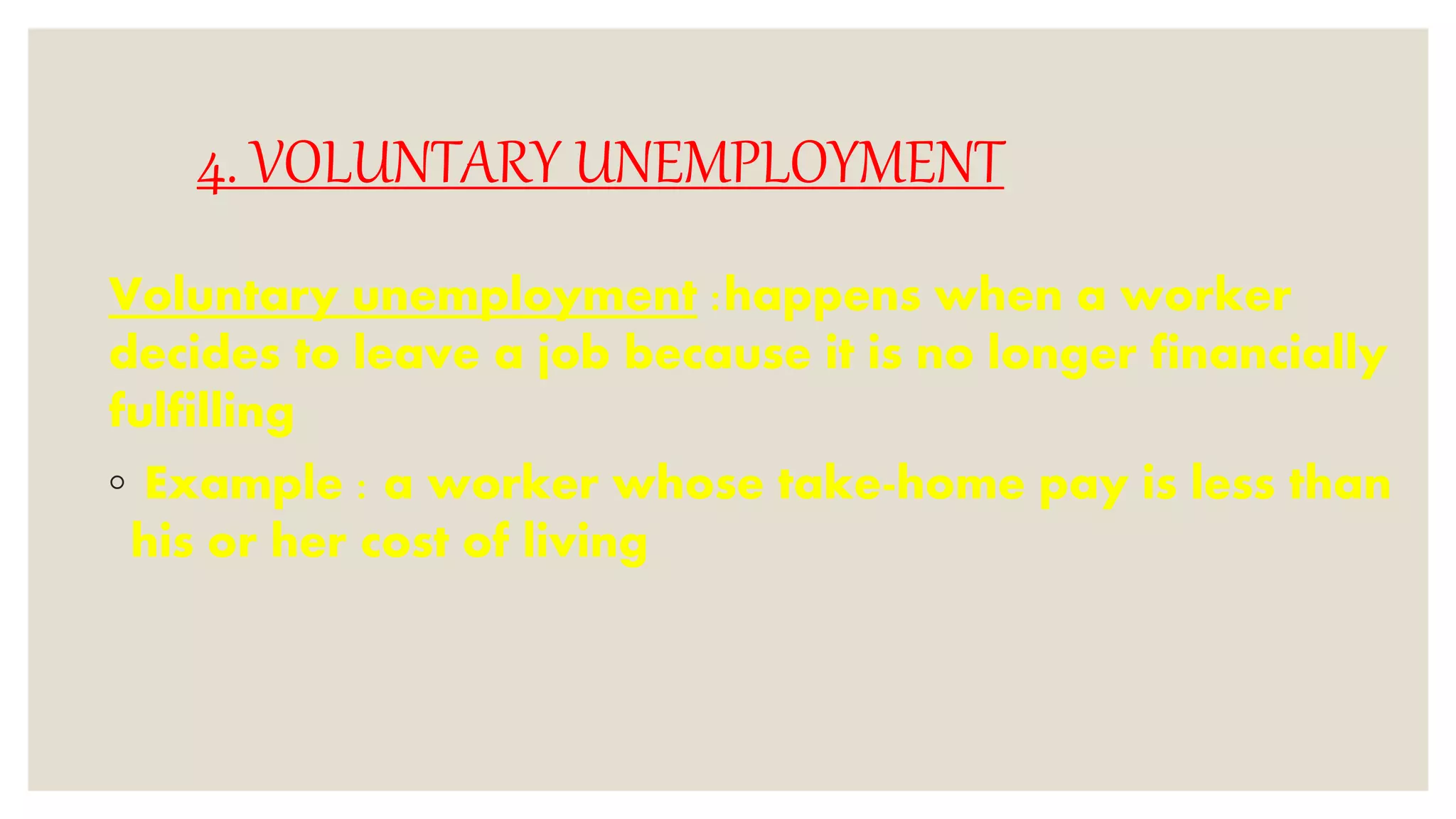
4. VOLUNTARY UNEMPLOYMENT
Voluntary unemployment :happens when a worker
decides to leave a job because it is no longer financially
fulfilling
◦ Example : a worker whose take-home pay is less than
his or her cost of living
Causes of unemployment
The major causes of unemployment in India are as mentioned below:
◦ Large population.
◦ Lack of vocational skills or low educational levels of the working
population.
◦ Labour-intensive sectors suffering from the slowdown in private
investment particularly after demonetisation
◦ The low productivity in the agriculture sector plus the lack of alternative
opportunities for agricultural workers that makes transition among the
three sectors difficult.
◦ legal complexities, Inadequate state support, low infrastructural,
financial and market linkages to small businesses making such
enterprises unviable with cost and compliance overruns.
◦ Inadequate growth of infrastructure and low investments in
the manufacturing sector, hence restricting the employment
potential of the secondary sector.
◦ The huge workforce of the country is associated with the
informal sector because of a lack of required education or
skills, and this data is not captured in employment statistics.
◦ The main cause of structural unemployment is the education
provided in schools and colleges are not as per the current
requirements of the industries.
◦ Regressive social norms that deter women from
taking/continuing employmenThe huge workforce of the
country is associated with the informal sector because of a
lack of required education or skills, and this data is not
captured in employment statistics.
Impacts of unemployment
The unemployment in any nation have the following
effects on the economy:
◦The problem of unemployment gives rise to the
problem of poverty.
◦The government suffers extra borrowing burden
because unemployment causes a decrease in the
production and less consumption of goods and
services by the people.
◦Unemployed persons can easily be enticed by
antisocial elements. This makes them lose faith in the
democratic values of the country.
◦ People unemployed for a long time may indulge in illegal
and wrong activities for earning money which increases
crime in the country.
◦ Unemployment affects the economy of the country as the
workforce that could have been gainfully employed to
generate resources actually gets dependent on the
remaining working population, thus escalating socio-
economic costs for the state. For instance, a 1 % increase in
unemployment reduces the GDP by 2 %.
◦ It is often seen that unemployed people end up getting
addicted to drugs and alcohol or attempts suicide,
leading losses to the human resources of the country.
Measurement of unemployment
UNEMPLOYMENT RATE :Number of Unemployed Persons /
Labor Force.
In order to find the rate of unemployment, four methods are used:
1. Labor Force Sample Surveys
2. Official Estimates
3. Social Insurance Statistics
4. Employment Office Statistics
Initiatives by
the government to solve the
problem of unemployment
Indiahasbeenacountrywithalargemasspopulation,andthus,employmenthasbeena
constantissue.Owingtothefactoroflargeeducatedmasses,findingjobshasbecomea
difficulttasktobedealtwith.SinceourIndependence,theGovernmenthastakenstepsto
provideasolutiontothisissue,buttherehasneverbeenareliablesolution.someactives
initiativestakenbytheGovernmentofIndiatocurbunemployment:
1. FactorsResponsibleforUnemployment
2. Initiativesbythegovernmenttosolvetheproblemofunemployment
FACTORS RESPONSIBLE FOR UNEMPLOYMENT
Unemployment is defined as a condition when an adult
falling under the working age who wants full-time
employment is not able to get the job.
Certain factors responsible for Unemployment are listed
below:
◦ a) Backward Agriculture
◦ b) High Population Growth
◦ c) Defective Education System
◦ d) Exploitation of Resources
◦ e) Low means of Self-Employment
Initiatives by the government to solve
the problem of unemployment
◦ Integrated Rural Development Programme (IRDP)
The Government of India introduced IRDP in 1978-79, intending to
create full employment opportunities in the rural areas. This program
included agriculture, forests, fisheries, animal husbandry, cottage
industries, construction of canals, roads, and so on. To provide
employment, a sum of INR 312 crores was also spent in the
Seventh plan, which benefited 182 families.
◦Training for Self–Employment
The program was launched on August 15th, 1979, and is called the
National Scheme of Training of Rural Youth for Self Employment
(TRYSEM). Its main objective is to reduce unemployment among the
youth. Under this, during the seventh plan, around 11.6 lakh youth
given training, which gave young men financial assistance from
banks, which varies from INR 3000 to INR 5000 to start any
work.Composite Rural Training and Technical Centres were set up to
give training to 2.8 lakh rural youth during 1995-96.
◦Jawahar Rozgar Yojana
This started on April 28th, 1989, intending to employ one
member of every rural family. The job is provided for around 50
to 100 days per year at a workplace, which is nearby the place
of residence. 30% of the employment generated is reserved for
women. The Central Government has the duty to finance around
80% of the program, which reduces the burden of the state
government to only 20%. National Rural Landless Employment
Guarantee Programmes were merged with the Jawahar Rozgar
Yojana in the year 1989
• Nehru Rozgar Yojana (NRY)
The Yojana was started in the year 1989 and included three
schemes under itself :
◦ a) The first scheme provides a subsidy to urban poor so that they
can set up micro-enterprises. Under this program, in the year
1995, 1.25 lakh families were benefitted.
◦ b) The second scheme ensures arrangements for wage-
employment to laborers in the cities with less than 10 lakh
population is by the means of providing Indian Economic
Development and Elementary Static facilities. In the year 1995,
under this scheme, 93 lakhs days of employment have been
provided.
◦ c) The third scheme provides urban poor with employment
opportunities like house repairing, etc
• The Swaran Jayanti Rozgar Yojana
The plan, which started on 1st December, is meant for providing
employment to unemployed in urban areas. It aims at providing self or
wage employment to unemployed youth of urban areas. It works upon
two plans:
a) Urban Self- Employment Programme
b) Urban Wage Employment Programme
75% of the expenditure is incurred by the Central Government, and the
rest is upon state governments. A sum of INR 125 crore was spent
upon this during 1997-98.
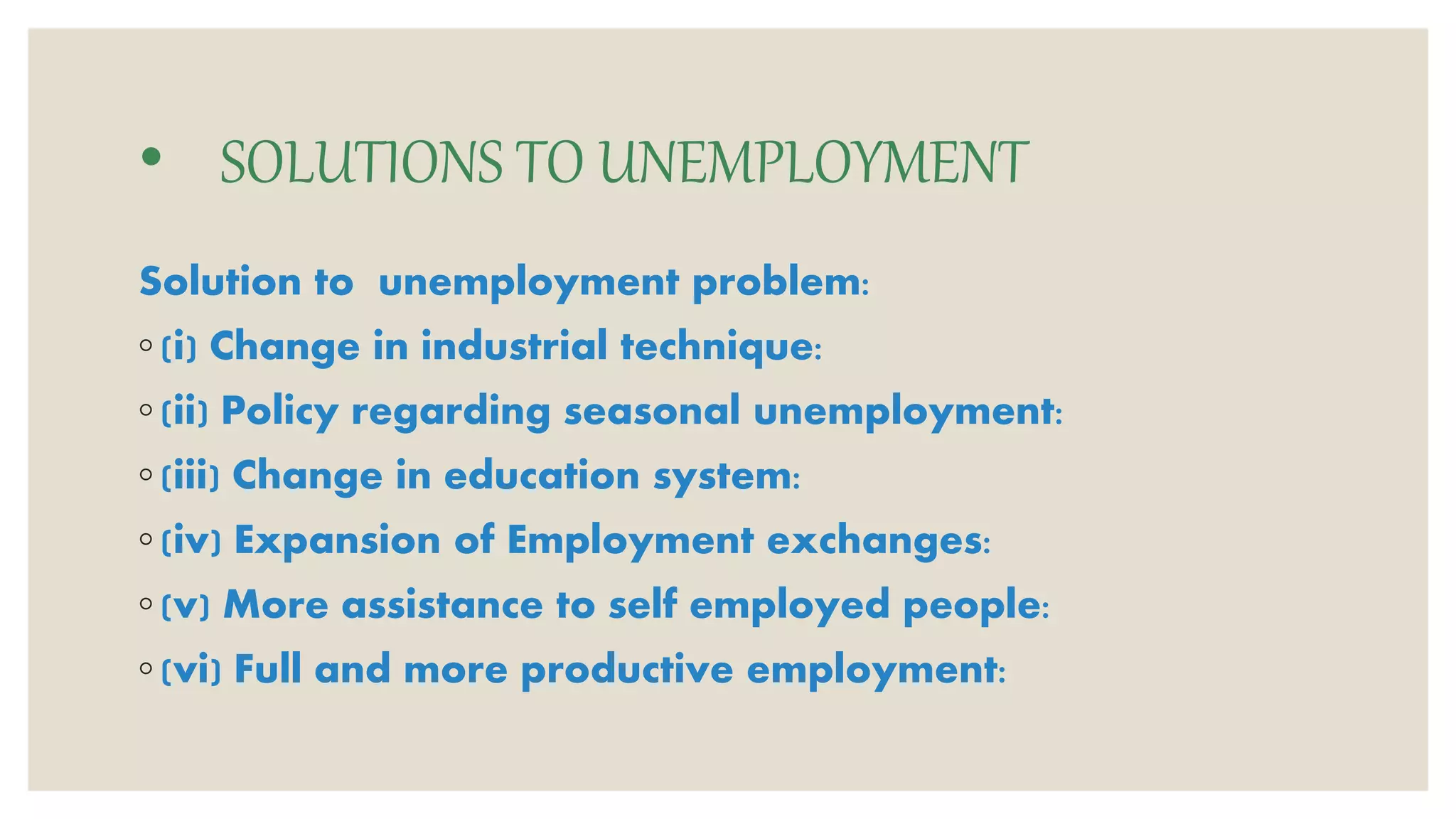
• SOLUTIONS TO UNEMPLOYMENT
Solution to unemployment problem:
◦ (i) Change in industrial technique:
◦ (ii) Policy regarding seasonal unemployment:
◦ (iii) Change in education system:
◦ (iv) Expansion of Employment exchanges:
◦ (v) More assistance to self employed people:
◦ (vi) Full and more productive employment:
• Conclusion
Unemployment is a serious issue for any economy.
It creates negative affects to unemployed as they
are jobless and suffer from worse prospects to find
new job and those who are employed feel less
secure to keep their jobs in future. However for
overall development of economy, government and
individuals has to take initiative steps in increasing
the productivity and improving the standard of
living.
Unemployment

Unemployment

  • 1.
  • 2.
    CONTENT 1. Introduction 2. Types 3.Causes 4. Impacts 5. Measurements 6. Initivates by the govt. To solve the problems of unemployment 7. Solutions 8. Conclusion
  • 3.
    What is unemployment? ◦Unemployment refers to a situation in which workers who are capable for working and willing to work at the existing wage but do not get employment ◦“A man is unemployed Only when he is without a job or not employed and also desires to be Employed
  • 4.
    Types of unemployment? ◦ There are basically four types of unemployment : ◦ (1) demand deficient Unemployment ◦ (2) frictional unemployment ◦ (3) Structural unemployment ◦ (4) voluntary unemployment
  • 5.
    1. DEMAND DEFICITUNEMPLOYMENT Demand deficient unemployment occurs when there is insufficient demand in the economy to maintain full employment. ◦In a recession (a period of negative economic growth) consumers will be buying fewer goods and services. ◦Selling fewer goods, firms sell less and so reduce production
  • 6.
    AD/AS diagram forDemand deficient unemployment Diagram showing a fall in aggregate demand AD leading to lower GDP and hence higher unemployment
  • 7.
    2 .Frictional unemployment Frictionalunemployment: refers to workers who are in between jobs. ◦ Example : a worker who recently quit or was fired and is looking for a job in an economy that is not experiencing a recession. It is not an unhealthy thing because it is usually caused by workers looking for a job that is most suitable to their skills.
  • 8.
    Another name forFriticional unemployment : “SEARCH UNEMPLOYMENT”
  • 9.
    3. Structural unemployment Structuralunemployment :happens when the skills set of a worker does not match the skills demands of the jobs available or if the worker cannot reach the geographical location of a job. ◦ Example : a teaching job that requires relocation to China, but the worker cannot secure a work visa due to certain visa restrictions. It can also happen when there is a technological change in the organization, such as workflow automation
  • 12.
    4. VOLUNTARY UNEMPLOYMENT Voluntaryunemployment :happens when a worker decides to leave a job because it is no longer financially fulfilling ◦ Example : a worker whose take-home pay is less than his or her cost of living
  • 14.
    Causes of unemployment Themajor causes of unemployment in India are as mentioned below: ◦ Large population. ◦ Lack of vocational skills or low educational levels of the working population. ◦ Labour-intensive sectors suffering from the slowdown in private investment particularly after demonetisation ◦ The low productivity in the agriculture sector plus the lack of alternative opportunities for agricultural workers that makes transition among the three sectors difficult. ◦ legal complexities, Inadequate state support, low infrastructural, financial and market linkages to small businesses making such enterprises unviable with cost and compliance overruns.
  • 15.
    ◦ Inadequate growthof infrastructure and low investments in the manufacturing sector, hence restricting the employment potential of the secondary sector. ◦ The huge workforce of the country is associated with the informal sector because of a lack of required education or skills, and this data is not captured in employment statistics. ◦ The main cause of structural unemployment is the education provided in schools and colleges are not as per the current requirements of the industries. ◦ Regressive social norms that deter women from taking/continuing employmenThe huge workforce of the country is associated with the informal sector because of a lack of required education or skills, and this data is not captured in employment statistics.
  • 17.
    Impacts of unemployment Theunemployment in any nation have the following effects on the economy: ◦The problem of unemployment gives rise to the problem of poverty. ◦The government suffers extra borrowing burden because unemployment causes a decrease in the production and less consumption of goods and services by the people. ◦Unemployed persons can easily be enticed by antisocial elements. This makes them lose faith in the democratic values of the country.
  • 18.
    ◦ People unemployedfor a long time may indulge in illegal and wrong activities for earning money which increases crime in the country. ◦ Unemployment affects the economy of the country as the workforce that could have been gainfully employed to generate resources actually gets dependent on the remaining working population, thus escalating socio- economic costs for the state. For instance, a 1 % increase in unemployment reduces the GDP by 2 %. ◦ It is often seen that unemployed people end up getting addicted to drugs and alcohol or attempts suicide, leading losses to the human resources of the country.
  • 20.
    Measurement of unemployment UNEMPLOYMENTRATE :Number of Unemployed Persons / Labor Force. In order to find the rate of unemployment, four methods are used: 1. Labor Force Sample Surveys 2. Official Estimates 3. Social Insurance Statistics 4. Employment Office Statistics
  • 21.
    Initiatives by the governmentto solve the problem of unemployment Indiahasbeenacountrywithalargemasspopulation,andthus,employmenthasbeena constantissue.Owingtothefactoroflargeeducatedmasses,findingjobshasbecomea difficulttasktobedealtwith.SinceourIndependence,theGovernmenthastakenstepsto provideasolutiontothisissue,buttherehasneverbeenareliablesolution.someactives initiativestakenbytheGovernmentofIndiatocurbunemployment: 1. FactorsResponsibleforUnemployment 2. Initiativesbythegovernmenttosolvetheproblemofunemployment
  • 22.
    FACTORS RESPONSIBLE FORUNEMPLOYMENT Unemployment is defined as a condition when an adult falling under the working age who wants full-time employment is not able to get the job. Certain factors responsible for Unemployment are listed below: ◦ a) Backward Agriculture ◦ b) High Population Growth ◦ c) Defective Education System ◦ d) Exploitation of Resources ◦ e) Low means of Self-Employment
  • 23.
    Initiatives by thegovernment to solve the problem of unemployment ◦ Integrated Rural Development Programme (IRDP) The Government of India introduced IRDP in 1978-79, intending to create full employment opportunities in the rural areas. This program included agriculture, forests, fisheries, animal husbandry, cottage industries, construction of canals, roads, and so on. To provide employment, a sum of INR 312 crores was also spent in the Seventh plan, which benefited 182 families.
  • 24.
    ◦Training for Self–Employment Theprogram was launched on August 15th, 1979, and is called the National Scheme of Training of Rural Youth for Self Employment (TRYSEM). Its main objective is to reduce unemployment among the youth. Under this, during the seventh plan, around 11.6 lakh youth given training, which gave young men financial assistance from banks, which varies from INR 3000 to INR 5000 to start any work.Composite Rural Training and Technical Centres were set up to give training to 2.8 lakh rural youth during 1995-96.
  • 25.
    ◦Jawahar Rozgar Yojana Thisstarted on April 28th, 1989, intending to employ one member of every rural family. The job is provided for around 50 to 100 days per year at a workplace, which is nearby the place of residence. 30% of the employment generated is reserved for women. The Central Government has the duty to finance around 80% of the program, which reduces the burden of the state government to only 20%. National Rural Landless Employment Guarantee Programmes were merged with the Jawahar Rozgar Yojana in the year 1989
  • 26.
    • Nehru RozgarYojana (NRY) The Yojana was started in the year 1989 and included three schemes under itself : ◦ a) The first scheme provides a subsidy to urban poor so that they can set up micro-enterprises. Under this program, in the year 1995, 1.25 lakh families were benefitted. ◦ b) The second scheme ensures arrangements for wage- employment to laborers in the cities with less than 10 lakh population is by the means of providing Indian Economic Development and Elementary Static facilities. In the year 1995, under this scheme, 93 lakhs days of employment have been provided. ◦ c) The third scheme provides urban poor with employment opportunities like house repairing, etc
  • 27.
    • The SwaranJayanti Rozgar Yojana The plan, which started on 1st December, is meant for providing employment to unemployed in urban areas. It aims at providing self or wage employment to unemployed youth of urban areas. It works upon two plans: a) Urban Self- Employment Programme b) Urban Wage Employment Programme 75% of the expenditure is incurred by the Central Government, and the rest is upon state governments. A sum of INR 125 crore was spent upon this during 1997-98.
  • 28.
    • SOLUTIONS TOUNEMPLOYMENT Solution to unemployment problem: ◦ (i) Change in industrial technique: ◦ (ii) Policy regarding seasonal unemployment: ◦ (iii) Change in education system: ◦ (iv) Expansion of Employment exchanges: ◦ (v) More assistance to self employed people: ◦ (vi) Full and more productive employment:
  • 29.
    • Conclusion Unemployment isa serious issue for any economy. It creates negative affects to unemployed as they are jobless and suffer from worse prospects to find new job and those who are employed feel less secure to keep their jobs in future. However for overall development of economy, government and individuals has to take initiative steps in increasing the productivity and improving the standard of living.