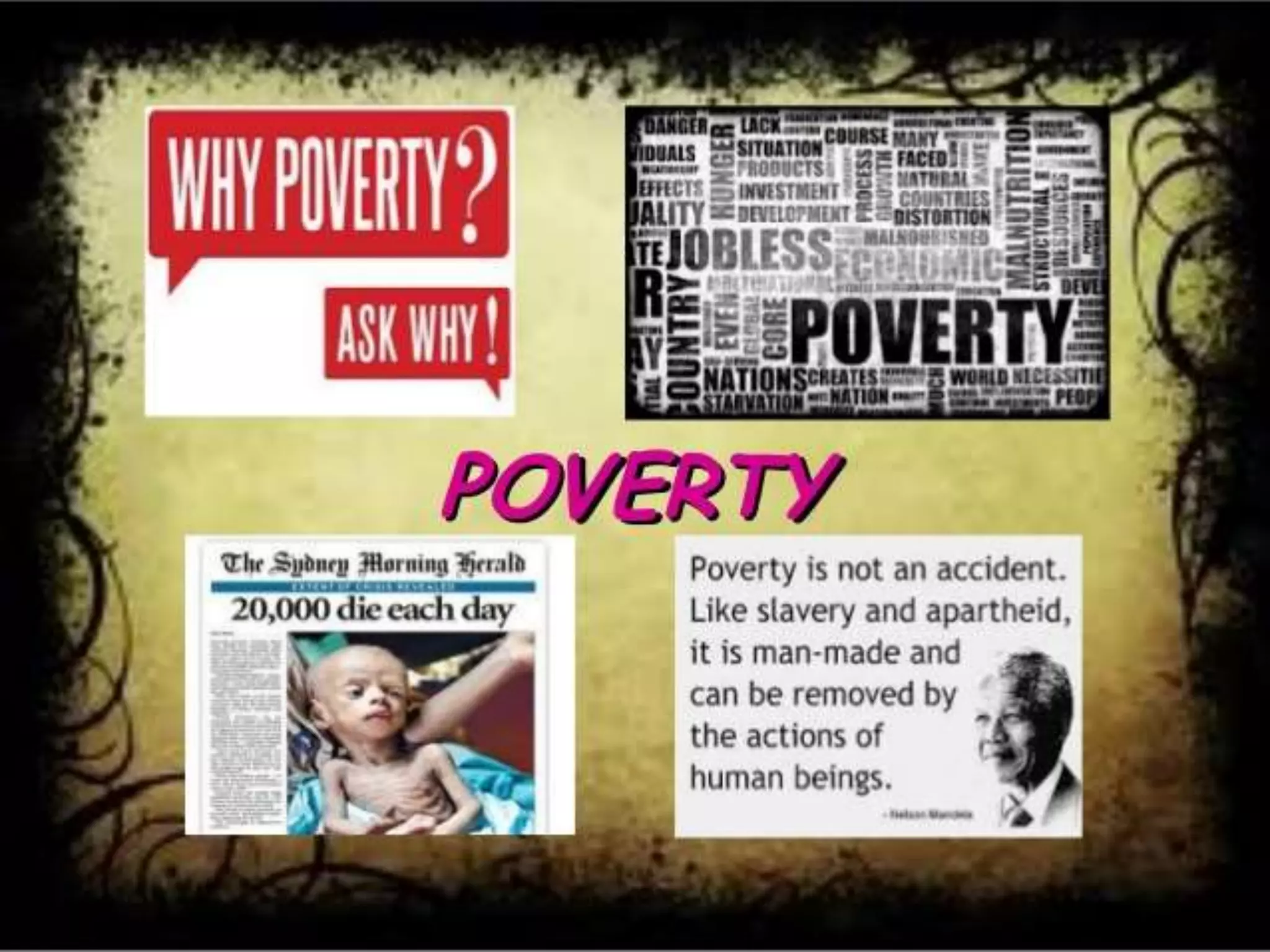
Dimension of poverty
• Hunger
• Lack of shelter and clothing
• Poverty is being sick and not able to see a
doctor.
• Not able to send the child to school.
• Lack of regular job
• illiteracy
• Poor sanitation and lack of clean water.
• Helplessness
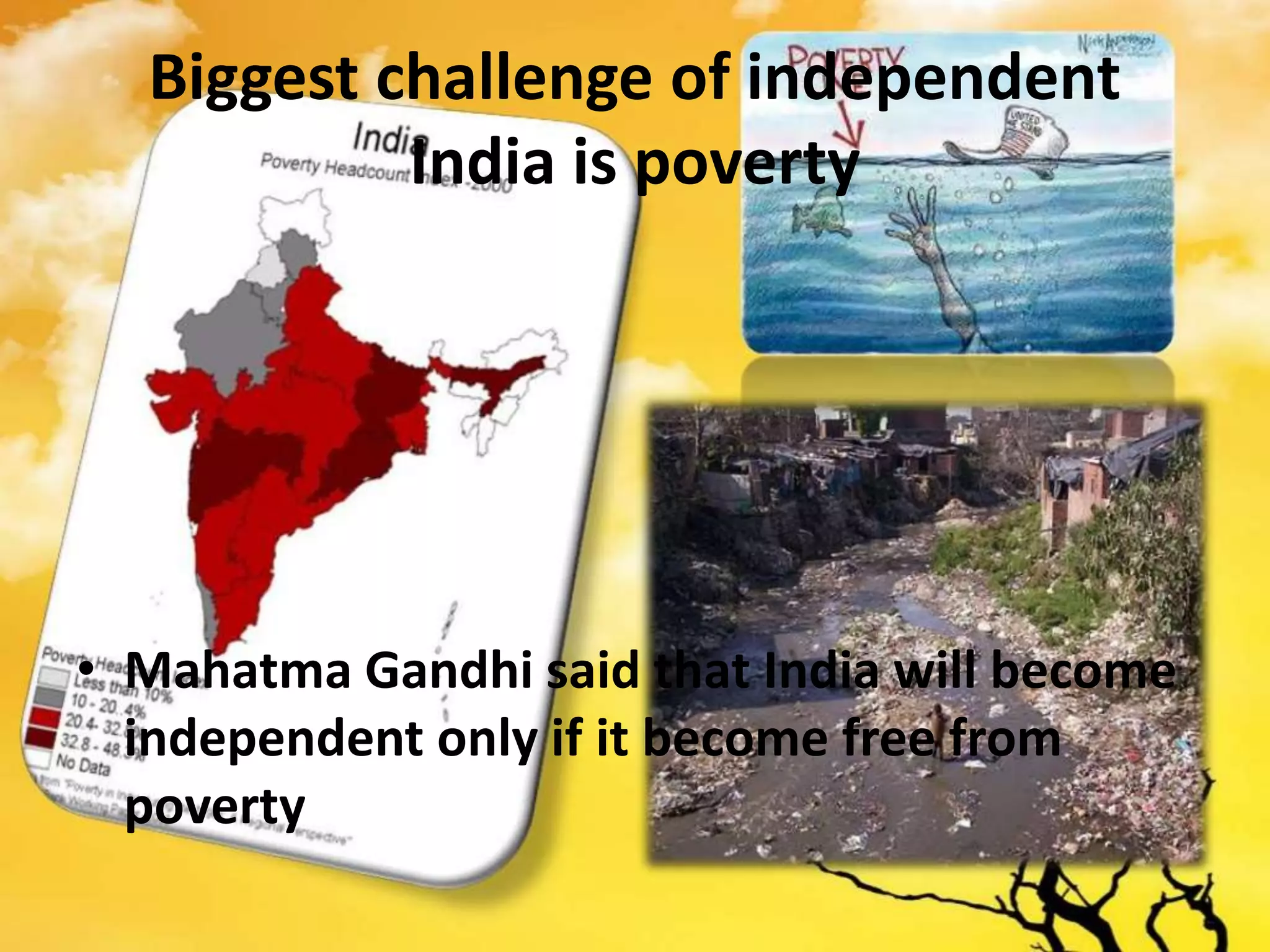
Biggest challenge of independent
India is poverty
• Mahatma Gandhi said that India will become
independent only if it become free from
poverty
• Income and level of consumption are usual
indicators of poverty but according to social
scientists:
• Literacy
• Lack of general resistance due to malnutrition,
• Lack of access to safe water and sanitation
Poverty as seen by social scientist
Analyses of poverty based on two:
1. Social exclusion a cause and result of poverty.
• Slum people having to live in a poor
surrounding with other poor people.
• Low caste people who were excluded from
the society, facilities, benefits and
opportunities that other enjoys.
Vulnerability to poverty
• when a person has the least capability of
withstanding various challenged towards his
economic relevance are called vulverability to
poor
• Communities- Schedule caste and tribes
• Individual – women, widow and handicapped.
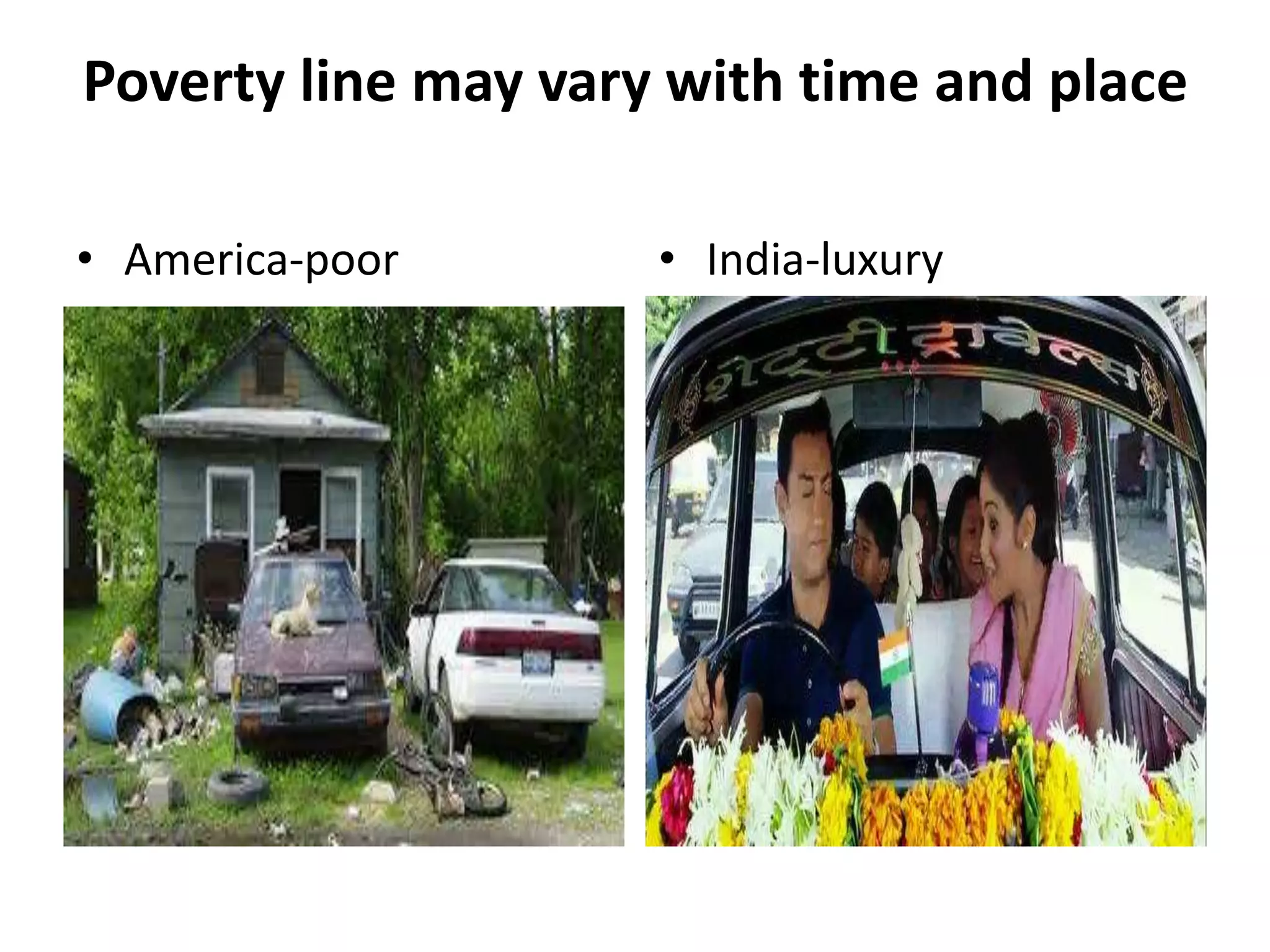
Poverty line may vary with time and place
• America-poor • India-luxury
Measurement of poverty
Expenditure Method
• Under this the minimum
food requirement for
survival estimated.
• The food value is converted
into calories.
• The caloric value of foods is
then converted into the
money value i.e. in rupees.
• The total equivalent
amount is considered as the
poverty line.
Income Method
• This method is used by the
government while
distributing food through
PDS at the local level.
• Under this a poverty line is
fixed by the government.
• All the families whose total
income is less than the
poverty line fixed by the
government are considered
as BPL.
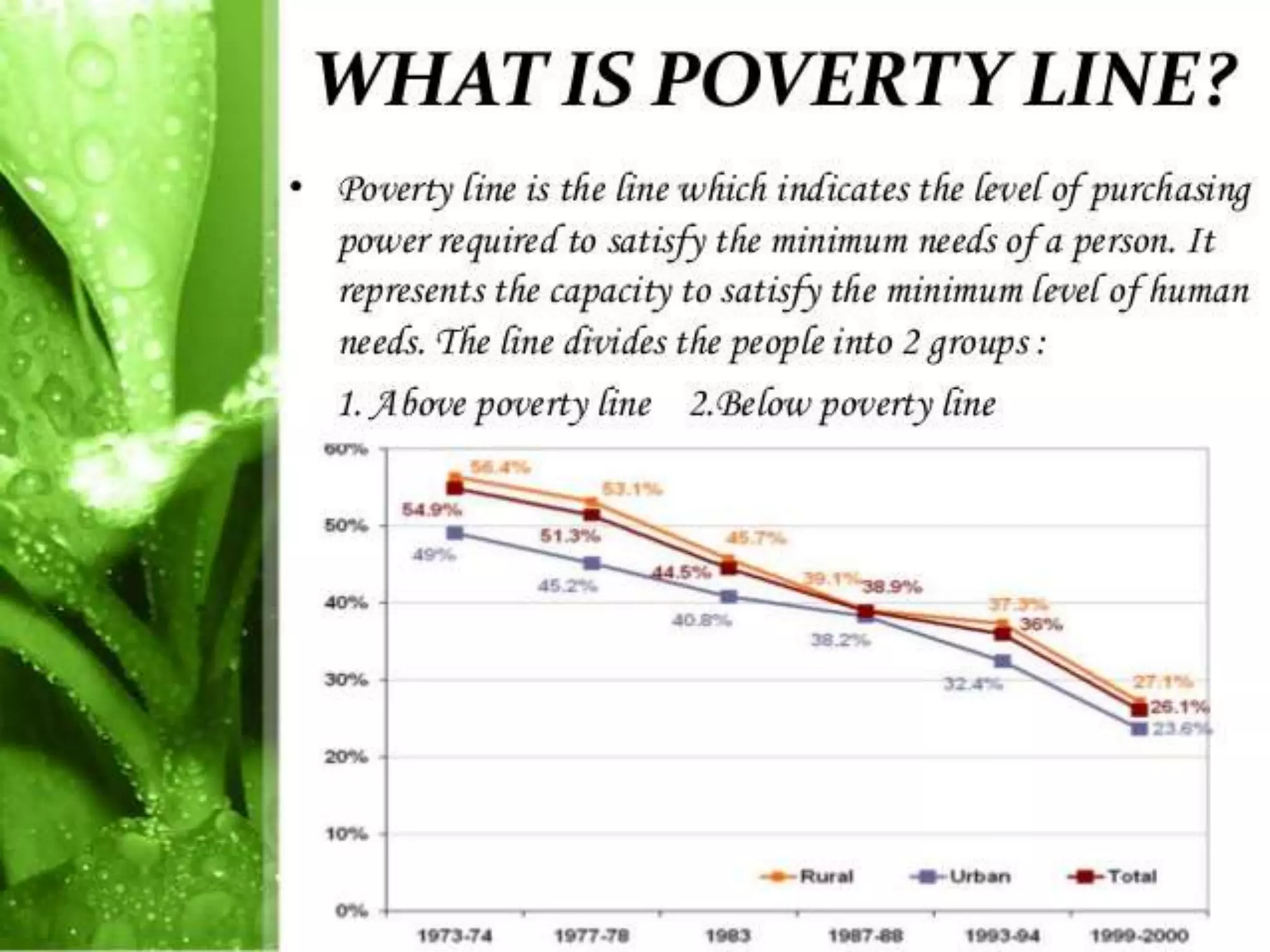
Poverty line estimated in India
1. Money earned
• A person is considered
as a poor if he earns Rs.
328 per month for rural
area and Rs. 454 for the
urban areas.
2. Calorie intake
• The expected calorie
intake has been fixed at
2400 calories per
person in rural areas
and 2100 calories in
urban areas. A person
consuming less than
this amount is
considered to be living
below poverty line.
Vulnerable Groups Of Poverty
1. Social groups vulnerable to poor
• Schedule Tribes
• Schedule castes
2. Economic groups vulnerable to poor
• Rural agriculture labour
• Urban casual labour
3. Poorest to poor- Women, Children, Female
infants and elderly people.
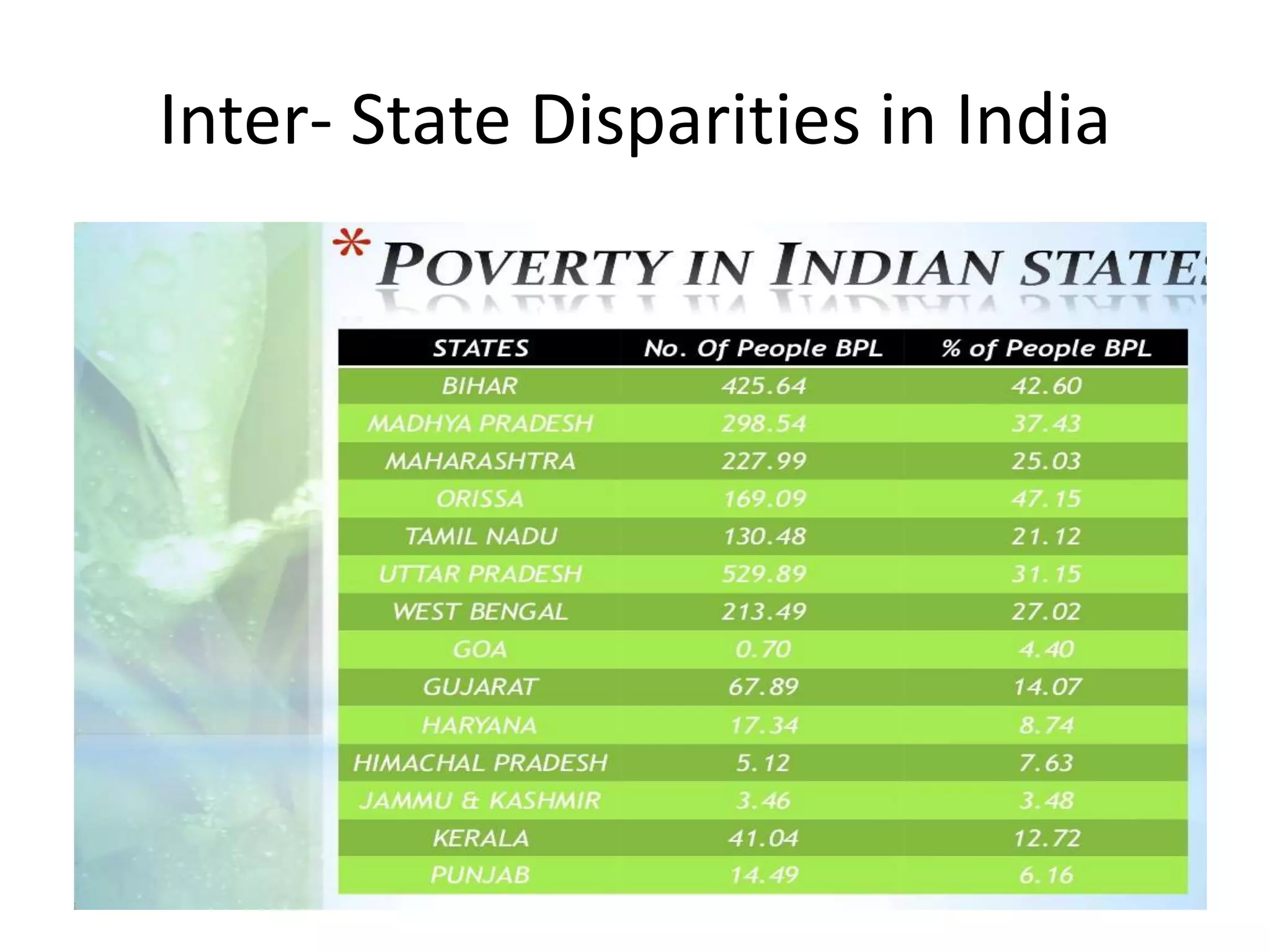
Inter- State Disparities in India
Global Poverty Scenario
1. China and southeast Asian-poverty declined
from 606 million in 1981to 212 million on
2001 because of rapid economic
development.
2. South Asian countries i.e.
India,Pakistan,Srilanka,Nepal,Bangladesh and
Bhutan- number of poor has declined
marginally.
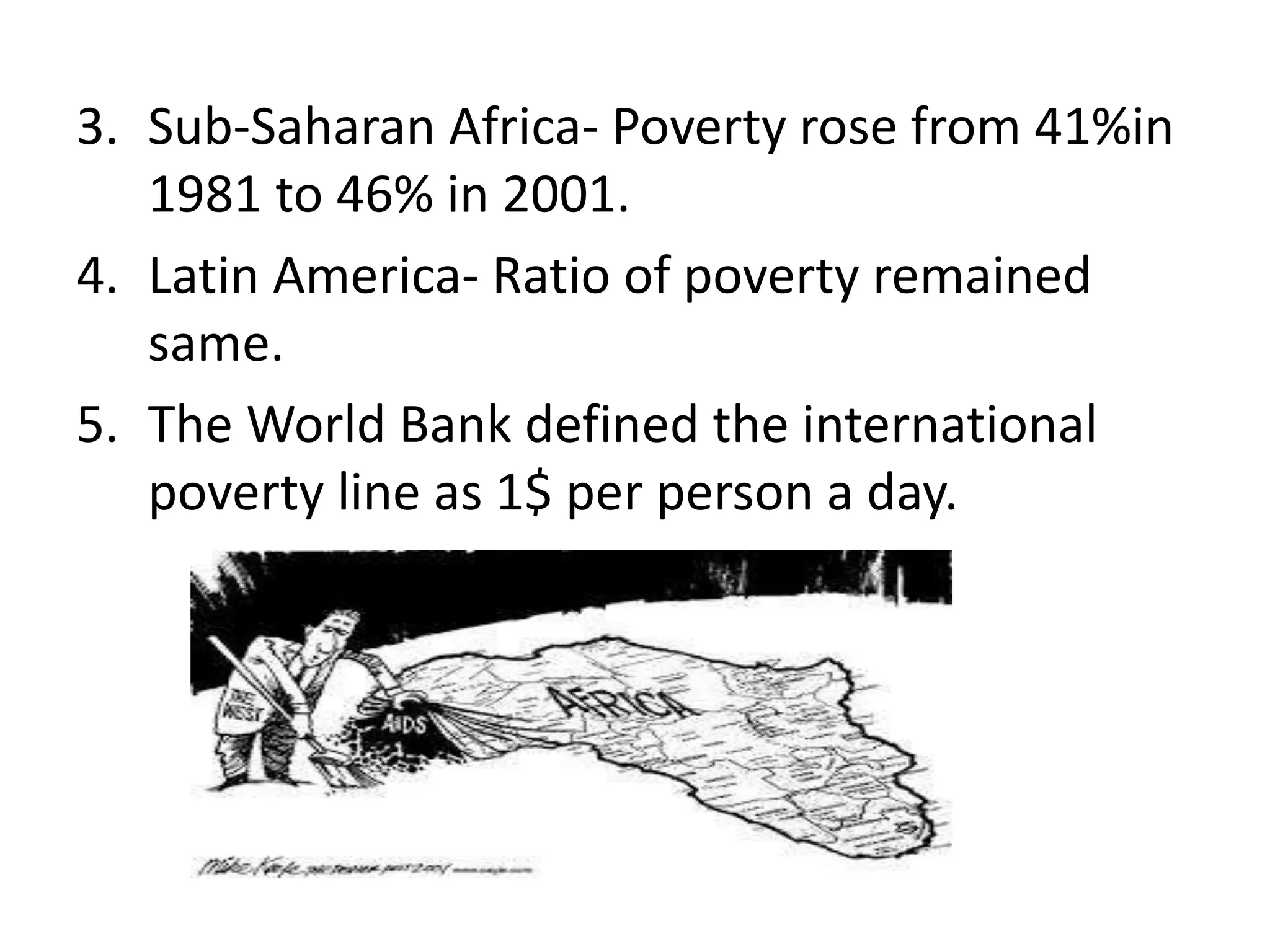
3. Sub-Saharan Africa- Poverty rose from 41%in
1981 to 46% in 2001.
4. Latin America- Ratio of poverty remained
same.
5. The World Bank defined the international
poverty line as 1$ per person a day.
Causes of poverty in India
• Colonial Exploitation: During the British administration the
industrial sector of the economy was completely destroyed
and poor farmers were force to sell there products at lower
price. Gradually the country became pauperized and the
extend of poverty increase with the passage of time.
• High Growth rate of population: The slow growth of income
accompanied by a higher population growth reduces the per
capita income and, consumption expenditure and thus
increase poverty.
• Limited job opportunities- Effect of irrigation and green
revolution were limited to some part of India.
People started working as rickshaw pullers, vendors
construction workers with a small amount of income.
• Inequality distribution of income: Large sections of people are
poor,
wealth and productive assets have been concentrated with
few hand.
• Social factors:Due to socio-cultural factors, people in India
spend large portion of their income extravagantly which in
result became poor.
• Increase in Price: Increase in prices increasing the member of
poor.
Anti Poverty Programme
• The current anti-poverty strategy of the
government is based broadly on two planks:
1. Promotion of economic growth
2. Targeted anti-poverty programmes
Targeted anti-poverty programme
• National Rural Employment Guarantee
Act(NREGA)-Sep 2005: The Act provides 100
days assured employment every year to every
rural household in 200 district and later
extanded to 600 district.
• National Food for Work Programme(NFWP)-
2004: Scheme implemented in 150 backward
States. Programme open to all rurals who
wants to do manual unskilled work.
• Prime Minister Rozgar Yozana(PMRY)-1993:Main
aim is to create self employment opportunities
for educated unemployment youth in rural and
small town.
• Rural Employment Generation Programme
(REGP)-1995: self employment toeducated
unemployment.
• Swarnajayanti Gram Swarozgar Yojana(SGSY)-
1999: Aim to bring poor families above the
poverty line by organizing them into self help
groups through a mix of bank credit and
government subsidies.
• Pradhan Mantri Gramodaya Yozana(PMGY)-
2000: Additional central assistance is given to
states for basic services such as education,
shelter, water through and rural electrification
• Antyodaya Anna Yozana(AAY)-Dec 2000:One
crore Families below the poverty line are
provided with free food grains through the
PDS.
Challenge Ahead

Presentation1 poverty

  • 3.
    Dimension of poverty •Hunger • Lack of shelter and clothing • Poverty is being sick and not able to see a doctor. • Not able to send the child to school. • Lack of regular job • illiteracy • Poor sanitation and lack of clean water. • Helplessness
  • 4.
    Biggest challenge ofindependent India is poverty • Mahatma Gandhi said that India will become independent only if it become free from poverty
  • 5.
    • Income andlevel of consumption are usual indicators of poverty but according to social scientists: • Literacy • Lack of general resistance due to malnutrition, • Lack of access to safe water and sanitation Poverty as seen by social scientist
  • 6.
    Analyses of povertybased on two: 1. Social exclusion a cause and result of poverty. • Slum people having to live in a poor surrounding with other poor people. • Low caste people who were excluded from the society, facilities, benefits and opportunities that other enjoys.
  • 7.
    Vulnerability to poverty •when a person has the least capability of withstanding various challenged towards his economic relevance are called vulverability to poor • Communities- Schedule caste and tribes • Individual – women, widow and handicapped.
  • 9.
    Poverty line mayvary with time and place • America-poor • India-luxury
  • 10.
    Measurement of poverty ExpenditureMethod • Under this the minimum food requirement for survival estimated. • The food value is converted into calories. • The caloric value of foods is then converted into the money value i.e. in rupees. • The total equivalent amount is considered as the poverty line. Income Method • This method is used by the government while distributing food through PDS at the local level. • Under this a poverty line is fixed by the government. • All the families whose total income is less than the poverty line fixed by the government are considered as BPL.
  • 11.
    Poverty line estimatedin India 1. Money earned • A person is considered as a poor if he earns Rs. 328 per month for rural area and Rs. 454 for the urban areas. 2. Calorie intake • The expected calorie intake has been fixed at 2400 calories per person in rural areas and 2100 calories in urban areas. A person consuming less than this amount is considered to be living below poverty line.
  • 13.
    Vulnerable Groups OfPoverty 1. Social groups vulnerable to poor • Schedule Tribes • Schedule castes 2. Economic groups vulnerable to poor • Rural agriculture labour • Urban casual labour 3. Poorest to poor- Women, Children, Female infants and elderly people.
  • 15.
  • 16.
    Global Poverty Scenario 1.China and southeast Asian-poverty declined from 606 million in 1981to 212 million on 2001 because of rapid economic development. 2. South Asian countries i.e. India,Pakistan,Srilanka,Nepal,Bangladesh and Bhutan- number of poor has declined marginally.
  • 17.
    3. Sub-Saharan Africa-Poverty rose from 41%in 1981 to 46% in 2001. 4. Latin America- Ratio of poverty remained same. 5. The World Bank defined the international poverty line as 1$ per person a day.
  • 18.
    Causes of povertyin India • Colonial Exploitation: During the British administration the industrial sector of the economy was completely destroyed and poor farmers were force to sell there products at lower price. Gradually the country became pauperized and the extend of poverty increase with the passage of time. • High Growth rate of population: The slow growth of income accompanied by a higher population growth reduces the per capita income and, consumption expenditure and thus increase poverty. • Limited job opportunities- Effect of irrigation and green revolution were limited to some part of India.
  • 19.
    People started workingas rickshaw pullers, vendors construction workers with a small amount of income. • Inequality distribution of income: Large sections of people are poor, wealth and productive assets have been concentrated with few hand. • Social factors:Due to socio-cultural factors, people in India spend large portion of their income extravagantly which in result became poor. • Increase in Price: Increase in prices increasing the member of poor.
  • 20.
    Anti Poverty Programme •The current anti-poverty strategy of the government is based broadly on two planks: 1. Promotion of economic growth 2. Targeted anti-poverty programmes
  • 21.
    Targeted anti-poverty programme •National Rural Employment Guarantee Act(NREGA)-Sep 2005: The Act provides 100 days assured employment every year to every rural household in 200 district and later extanded to 600 district. • National Food for Work Programme(NFWP)- 2004: Scheme implemented in 150 backward States. Programme open to all rurals who wants to do manual unskilled work.
  • 22.
    • Prime MinisterRozgar Yozana(PMRY)-1993:Main aim is to create self employment opportunities for educated unemployment youth in rural and small town. • Rural Employment Generation Programme (REGP)-1995: self employment toeducated unemployment. • Swarnajayanti Gram Swarozgar Yojana(SGSY)- 1999: Aim to bring poor families above the poverty line by organizing them into self help groups through a mix of bank credit and government subsidies.
  • 23.
    • Pradhan MantriGramodaya Yozana(PMGY)- 2000: Additional central assistance is given to states for basic services such as education, shelter, water through and rural electrification • Antyodaya Anna Yozana(AAY)-Dec 2000:One crore Families below the poverty line are provided with free food grains through the PDS.
  • 24.