Unemployment
Types and Causes
FROM
KARTHIK & ZARNA
(BBA 4TH SEM)
*Unemployment occurs when a person who is
actively searching for employment is unable to
find work.
*Unemployment refers to the condition and
extent of joblessness within an economy.
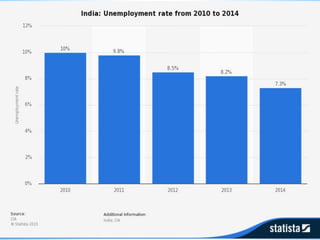
*Unemployment Rate in India decreased to 4.90
percent in 2013 from 5.20 percent in 2012.
Unemployment Rate in India averaged 7.32 percent
from 1983 until 2013, reaching an all time high of
9.40 percent in 2009 and a record low of 4.90
percent in 2013
*Unemployment Rate in India is expected to be 4.90
percent by the end of this quarter, according to
Trading Economics global macro models and analysts
expectations. In the long-term, the India
Unemployment Rate is projected to trend around
4.60 percent in 2020, according to our econometric
models.
Seasonal Unemployment
*Unemployment due to lack of demand
during certain times during of the year.
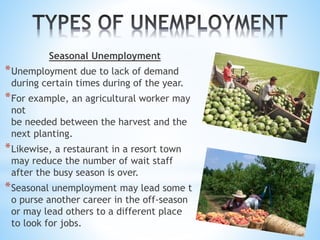
*For example, an agricultural worker may
not
be needed between the harvest and the
next planting.
*Likewise, a restaurant in a resort town
may reduce the number of wait staff
after the busy season is over.
*Seasonal unemployment may lead some t
o purse another career in the off-season
or may lead others to a different place
to look for jobs.
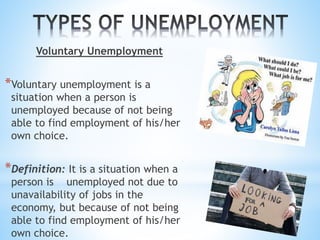
Voluntary Unemployment
*Voluntary unemployment is a
situation when a person is
unemployed because of not being
able to find employment of his/her
own choice.
*Definition: It is a situation when a
person is unemployed not due to
unavailability of jobs in the
economy, but because of not being
able to find employment of his/her
own choice.
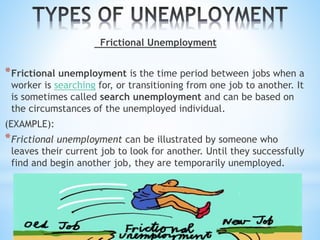
Frictional Unemployment
*Frictional unemployment is the time period between jobs when a
worker is searching for, or transitioning from one job to another. It
is sometimes called search unemployment and can be based on
the circumstances of the unemployed individual.
(EXAMPLE):
*Frictional unemployment can be illustrated by someone who
leaves their current job to look for another. Until they successfully
find and begin another job, they are temporarily unemployed.
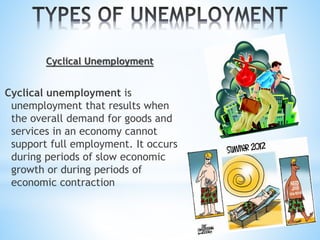
Cyclical Unemployment
Cyclical unemployment is
unemployment that results when
the overall demand for goods and
services in an economy cannot
support full employment. It occurs
during periods of slow economic
growth or during periods of
economic contraction
*Let's take a look at a few events that may trigger cyclical unemployment.
*During a housing boom, there is a period of tremendous economic growth.
Building houses is a labor- and material-intensive activity. Just think of all
the construction workers who build a house. You have carpenters,
electricians, plumbers, masons, concrete workers and roofers. You also
employ real estate agents, loan officers and loan brokers.
*But that's just half of the story. Let's not forget about the people and
companies that harvest the lumber for the house and the metal used for
wiring and pipes. Then we have the people and businesses that make
carpets, hardwood flooring, appliances, lighting and other fixtures that are
installed in a typical home. Finally, we mustn't forget about all the
middlemen, such as retailers and suppliers.
*When the housing market tanked, like during the Great Depression, many of
these people were no longer necessary to keep up with the dismal demand
for new construction. Consequently, because the demand for housing
plummeted, employers laid off workers they didn‘t anymore
Disguised Unemployment
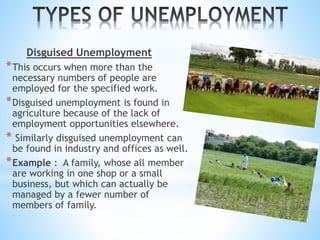
*This occurs when more than the
necessary numbers of people are
employed for the specified work.
*Disguised unemployment is found in
agriculture because of the lack of
employment opportunities elsewhere.
* Similarly disguised unemployment can
be found in industry and offices as well.
*Example : A family, whose all member
are working in one shop or a small
business, but which can actually be
managed by a fewer number of
members of family.
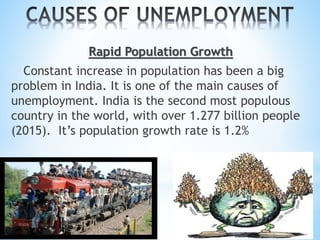
Rapid Population Growth
Constant increase in population has been a big
problem in India. It is one of the main causes of
unemployment. India is the second most populous
country in the world, with over 1.277 billion people
(2015). It’s population growth rate is 1.2%
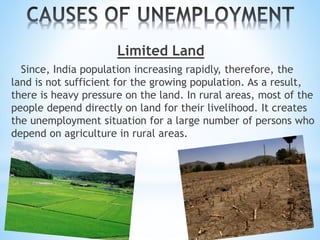
Limited Land
Since, India population increasing rapidly, therefore, the
land is not sufficient for the growing population. As a result,
there is heavy pressure on the land. In rural areas, most of the
people depend directly on land for their livelihood. It creates
the unemployment situation for a large number of persons who
depend on agriculture in rural areas.
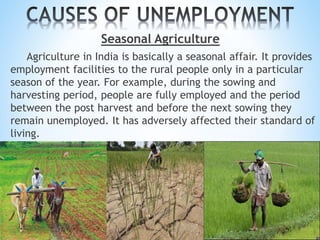
Seasonal Agriculture
Agriculture in India is basically a seasonal affair. It provides
employment facilities to the rural people only in a particular
season of the year. For example, during the sowing and
harvesting period, people are fully employed and the period
between the post harvest and before the next sowing they
remain unemployed. It has adversely affected their standard of
living.
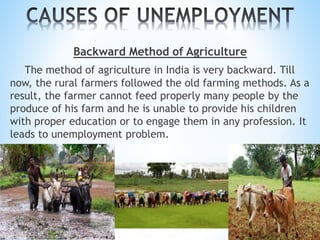
Backward Method of Agriculture
The method of agriculture in India is very backward. Till
now, the rural farmers followed the old farming methods. As a
result, the farmer cannot feed properly many people by the
produce of his farm and he is unable to provide his children
with proper education or to engage them in any profession. It
leads to unemployment problem.
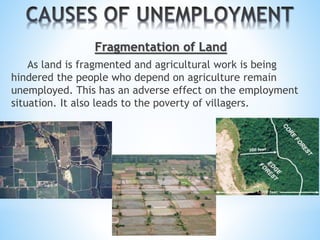
Fragmentation of Land
As land is fragmented and agricultural work is being
hindered the people who depend on agriculture remain
unemployed. This has an adverse effect on the employment
situation. It also leads to the poverty of villagers.
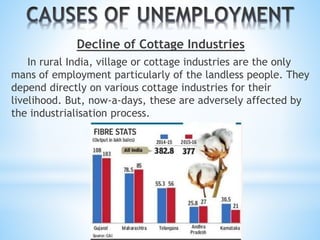
Decline of Cottage Industries
In rural India, village or cottage industries are the only
mans of employment particularly of the landless people. They
depend directly on various cottage industries for their
livelihood. But, now-a-days, these are adversely affected by
the industrialisation process.
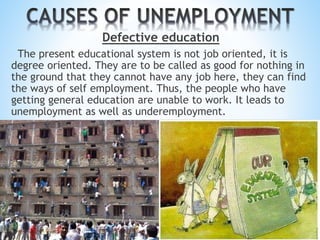
Defective education
The present educational system is not job oriented, it is
degree oriented. They are to be called as good for nothing in
the ground that they cannot have any job here, they can find
the ways of self employment. Thus, the people who have
getting general education are unable to work. It leads to
unemployment as well as underemployment.
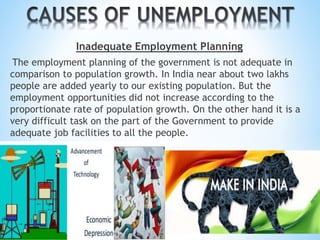
Inadequate Employment Planning
The employment planning of the government is not adequate in
comparison to population growth. In India near about two lakhs
people are added yearly to our existing population. But the
employment opportunities did not increase according to the
proportionate rate of population growth. On the other hand it is a
very difficult task on the part of the Government to provide
adequate job facilities to all the people.

Unemployment

  • 1.
  • 2.
    *Unemployment occurs whena person who is actively searching for employment is unable to find work. *Unemployment refers to the condition and extent of joblessness within an economy. *Unemployment Rate in India decreased to 4.90 percent in 2013 from 5.20 percent in 2012. Unemployment Rate in India averaged 7.32 percent from 1983 until 2013, reaching an all time high of 9.40 percent in 2009 and a record low of 4.90 percent in 2013 *Unemployment Rate in India is expected to be 4.90 percent by the end of this quarter, according to Trading Economics global macro models and analysts expectations. In the long-term, the India Unemployment Rate is projected to trend around 4.60 percent in 2020, according to our econometric models.
  • 4.
    Seasonal Unemployment *Unemployment dueto lack of demand during certain times during of the year. *For example, an agricultural worker may not be needed between the harvest and the next planting. *Likewise, a restaurant in a resort town may reduce the number of wait staff after the busy season is over. *Seasonal unemployment may lead some t o purse another career in the off-season or may lead others to a different place to look for jobs.
  • 5.
    Voluntary Unemployment *Voluntary unemploymentis a situation when a person is unemployed because of not being able to find employment of his/her own choice. *Definition: It is a situation when a person is unemployed not due to unavailability of jobs in the economy, but because of not being able to find employment of his/her own choice.
  • 6.
    Frictional Unemployment *Frictional unemploymentis the time period between jobs when a worker is searching for, or transitioning from one job to another. It is sometimes called search unemployment and can be based on the circumstances of the unemployed individual. (EXAMPLE): *Frictional unemployment can be illustrated by someone who leaves their current job to look for another. Until they successfully find and begin another job, they are temporarily unemployed.
  • 7.
    Cyclical Unemployment Cyclical unemploymentis unemployment that results when the overall demand for goods and services in an economy cannot support full employment. It occurs during periods of slow economic growth or during periods of economic contraction
  • 8.
    *Let's take alook at a few events that may trigger cyclical unemployment. *During a housing boom, there is a period of tremendous economic growth. Building houses is a labor- and material-intensive activity. Just think of all the construction workers who build a house. You have carpenters, electricians, plumbers, masons, concrete workers and roofers. You also employ real estate agents, loan officers and loan brokers. *But that's just half of the story. Let's not forget about the people and companies that harvest the lumber for the house and the metal used for wiring and pipes. Then we have the people and businesses that make carpets, hardwood flooring, appliances, lighting and other fixtures that are installed in a typical home. Finally, we mustn't forget about all the middlemen, such as retailers and suppliers. *When the housing market tanked, like during the Great Depression, many of these people were no longer necessary to keep up with the dismal demand for new construction. Consequently, because the demand for housing plummeted, employers laid off workers they didn‘t anymore
  • 9.
    Disguised Unemployment *This occurswhen more than the necessary numbers of people are employed for the specified work. *Disguised unemployment is found in agriculture because of the lack of employment opportunities elsewhere. * Similarly disguised unemployment can be found in industry and offices as well. *Example : A family, whose all member are working in one shop or a small business, but which can actually be managed by a fewer number of members of family.
  • 10.
    Rapid Population Growth Constantincrease in population has been a big problem in India. It is one of the main causes of unemployment. India is the second most populous country in the world, with over 1.277 billion people (2015). It’s population growth rate is 1.2%
  • 11.
    Limited Land Since, Indiapopulation increasing rapidly, therefore, the land is not sufficient for the growing population. As a result, there is heavy pressure on the land. In rural areas, most of the people depend directly on land for their livelihood. It creates the unemployment situation for a large number of persons who depend on agriculture in rural areas.
  • 12.
    Seasonal Agriculture Agriculture inIndia is basically a seasonal affair. It provides employment facilities to the rural people only in a particular season of the year. For example, during the sowing and harvesting period, people are fully employed and the period between the post harvest and before the next sowing they remain unemployed. It has adversely affected their standard of living.
  • 13.
    Backward Method ofAgriculture The method of agriculture in India is very backward. Till now, the rural farmers followed the old farming methods. As a result, the farmer cannot feed properly many people by the produce of his farm and he is unable to provide his children with proper education or to engage them in any profession. It leads to unemployment problem.
  • 14.
    Fragmentation of Land Asland is fragmented and agricultural work is being hindered the people who depend on agriculture remain unemployed. This has an adverse effect on the employment situation. It also leads to the poverty of villagers.
  • 15.
    Decline of CottageIndustries In rural India, village or cottage industries are the only mans of employment particularly of the landless people. They depend directly on various cottage industries for their livelihood. But, now-a-days, these are adversely affected by the industrialisation process.
  • 16.
    Defective education The presenteducational system is not job oriented, it is degree oriented. They are to be called as good for nothing in the ground that they cannot have any job here, they can find the ways of self employment. Thus, the people who have getting general education are unable to work. It leads to unemployment as well as underemployment.
  • 17.
    Inadequate Employment Planning Theemployment planning of the government is not adequate in comparison to population growth. In India near about two lakhs people are added yearly to our existing population. But the employment opportunities did not increase according to the proportionate rate of population growth. On the other hand it is a very difficult task on the part of the Government to provide adequate job facilities to all the people.