--GANESHBUNKAR
INDEX
• Acknowledgment
• Introduction
• Type of Poverty
• Categories of Poverty
• Poverty line
• Poverty in India
• Poverty in Assam
• Causes of poverty
• Poverty alleviation programmers
ACKNOWLEDGMENT
I would like to express my special thanks of
gratitude to my teacher Mrs.Neelam Kunjwal as well
as our principal Mr. Rajesh Kanthariya who gave me
the golden opportunity to do this wonderful project
on the topic Poverty, which also helped me in doing
a lot of Research and i came to know about so
many new things I am really thankful to them.
Secondly i would also like to thank my parents
and friends who helped me a lot in finalizing this
project within the limited time frame.
INTRO
• Poverty is not having enough material possessions or income for a
person's needs.
Poverty may include social, economic, and political elements.
TYPE OF POVERTY
1. Absolute poverty
2. Relative Poverty
3. Situational Poverty
4. Generational Poverty
5. Urban Poverty
6. Rural Poverty
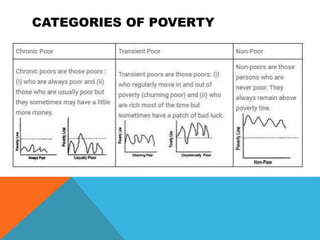
CATEGORIES OF POVERTY
POVERTY LINE
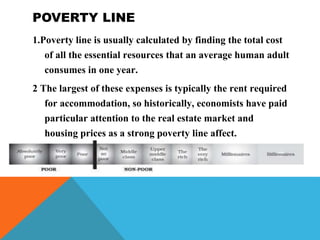
1.Poverty line is usually calculated by finding the total cost
of all the essential resources that an average human adult
consumes in one year.
2 The largest of these expenses is typically the rent required
for accommodation, so historically, economists have paid
particular attention to the real estate market and
housing prices as a strong poverty line affect.
POVERTY IN INDIA
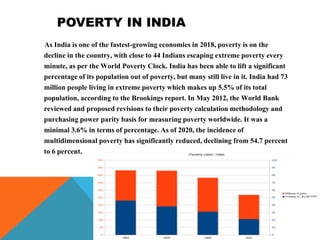
As India is one of the fastest-growing economies in 2018, poverty is on the
decline in the country, with close to 44 Indians escaping extreme poverty every
minute, as per the World Poverty Clock. India has been able to lift a significant
percentage of its population out of poverty, but many still live in it. India had 73
million people living in extreme poverty which makes up 5.5% of its total
population, according to the Brookings report. In May 2012, the World Bank
reviewed and proposed revisions to their poverty calculation methodology and
purchasing power parity basis for measuring poverty worldwide. It was a
minimal 3.6% in terms of percentage. As of 2020, the incidence of
multidimensional poverty has significantly reduced, declining from 54.7 percent
to 6 percent.
ASSAM POVERTY, GROWTH &
INEQUALITY
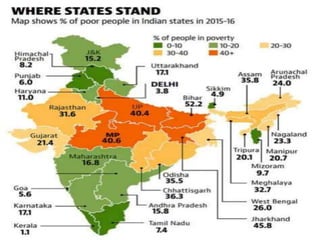
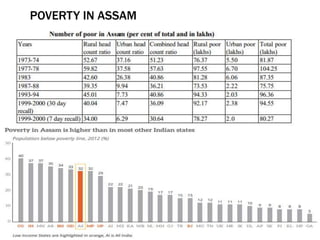
Assam is home to 31 million people, a third of whom are poor. While poverty levels
in Assam declined rapidly between 1994 and 2005,the state has since lagged
behind most other states in reducing poverty levels. The incidence of poverty in
Assam remains higher than the national average, with poverty levels being very
high in some parts in some parts of the State. Growth, which is driven mainly
by services, is among the lowest in the country. Consumption inequality, while
low relative to mainly by services, is among the lowest in the country.
Consumption inequality, while low relative to other Indian States, has been
increasing, especially in urban areas.
POVERTY IN ASSAM
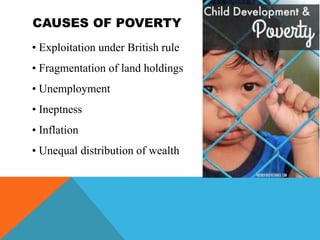
CAUSES OF POVERTY
• Exploitation under British rule
• Fragmentation of land holdings
• Unemployment
• Ineptness
• Inflation
• Unequal distribution of wealth
POVERTY ALLEVIATION PROGRAMMERS
• Growth oriented approach
• The first one is growth oriented approach. It is based on the
expectation that the effects of economic growth rapid increase in
gross domestic product and per capita income would spread to all
sections of society
• Poverty alleviation programmers.
• Providing basic amenities through public
expenditure:

Poverty class 12 cbse ppt

  • 1.
  • 2.
    INDEX • Acknowledgment • Introduction •Type of Poverty • Categories of Poverty • Poverty line • Poverty in India • Poverty in Assam • Causes of poverty • Poverty alleviation programmers
  • 3.
    ACKNOWLEDGMENT I would liketo express my special thanks of gratitude to my teacher Mrs.Neelam Kunjwal as well as our principal Mr. Rajesh Kanthariya who gave me the golden opportunity to do this wonderful project on the topic Poverty, which also helped me in doing a lot of Research and i came to know about so many new things I am really thankful to them. Secondly i would also like to thank my parents and friends who helped me a lot in finalizing this project within the limited time frame.
  • 4.
    INTRO • Poverty isnot having enough material possessions or income for a person's needs. Poverty may include social, economic, and political elements.
  • 5.
    TYPE OF POVERTY 1.Absolute poverty 2. Relative Poverty 3. Situational Poverty 4. Generational Poverty 5. Urban Poverty 6. Rural Poverty
  • 6.
  • 7.
    POVERTY LINE 1.Poverty lineis usually calculated by finding the total cost of all the essential resources that an average human adult consumes in one year. 2 The largest of these expenses is typically the rent required for accommodation, so historically, economists have paid particular attention to the real estate market and housing prices as a strong poverty line affect.
  • 8.
    POVERTY IN INDIA AsIndia is one of the fastest-growing economies in 2018, poverty is on the decline in the country, with close to 44 Indians escaping extreme poverty every minute, as per the World Poverty Clock. India has been able to lift a significant percentage of its population out of poverty, but many still live in it. India had 73 million people living in extreme poverty which makes up 5.5% of its total population, according to the Brookings report. In May 2012, the World Bank reviewed and proposed revisions to their poverty calculation methodology and purchasing power parity basis for measuring poverty worldwide. It was a minimal 3.6% in terms of percentage. As of 2020, the incidence of multidimensional poverty has significantly reduced, declining from 54.7 percent to 6 percent.
  • 10.
    ASSAM POVERTY, GROWTH& INEQUALITY Assam is home to 31 million people, a third of whom are poor. While poverty levels in Assam declined rapidly between 1994 and 2005,the state has since lagged behind most other states in reducing poverty levels. The incidence of poverty in Assam remains higher than the national average, with poverty levels being very high in some parts in some parts of the State. Growth, which is driven mainly by services, is among the lowest in the country. Consumption inequality, while low relative to mainly by services, is among the lowest in the country. Consumption inequality, while low relative to other Indian States, has been increasing, especially in urban areas.
  • 11.
  • 12.
    CAUSES OF POVERTY •Exploitation under British rule • Fragmentation of land holdings • Unemployment • Ineptness • Inflation • Unequal distribution of wealth
  • 13.
    POVERTY ALLEVIATION PROGRAMMERS •Growth oriented approach • The first one is growth oriented approach. It is based on the expectation that the effects of economic growth rapid increase in gross domestic product and per capita income would spread to all sections of society • Poverty alleviation programmers. • Providing basic amenities through public expenditure: