BY
URVI PATIL
VIII A
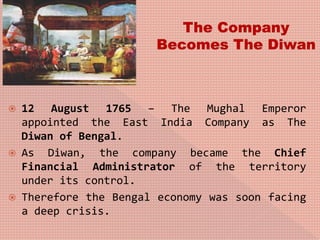
 12 August 1765 – The Mughal Emperor
appointed the East India Company as The
Diwan of Bengal.
 As Diwan, the company became the Chief
Financial Administrator of the territory
under its control.
 Therefore the Bengal economy was soon facing
a deep crisis.
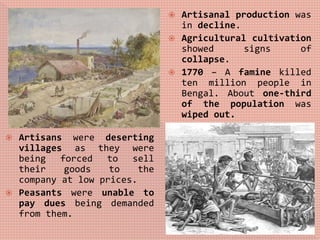
 Artisans were deserting
villages as they were
being forced to sell
their goods to the
company at low prices.
 Peasants were unable to
pay dues being demanded
from them.
 Artisanal production was
in decline.
 Agricultural cultivation
showed signs of
collapse.
 1770 – A famine killed
ten million people in
Bengal. About one-third
of the population was
wiped out.
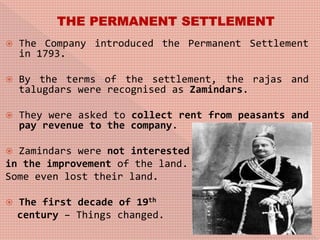
 The Company introduced the Permanent Settlement
in 1793.
 By the terms of the settlement, the rajas and
talugdars were recognised as Zamindars.
 They were asked to collect rent from peasants and
pay revenue to the company.
 Zamindars were not interested
in the improvement of the land.
Some even lost their land.
 The first decade of 19th
century – Things changed.
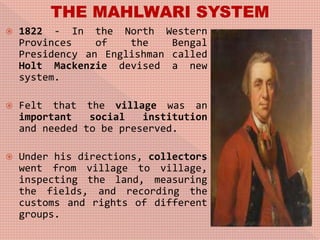
 1822 - In the North Western
Provinces of the Bengal
Presidency an Englishman called
Holt Mackenzie devised a new
system.
 Felt that the village was an
important social institution
and needed to be preserved.
 Under his directions, collectors
went from village to village,
inspecting the land, measuring
the fields, and recording the
customs and rights of different
groups.
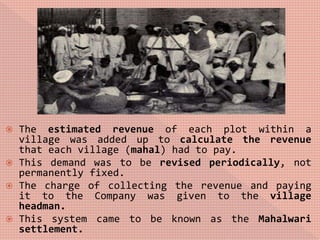
 The estimated revenue of each plot within a
village was added up to calculate the revenue
that each village (mahal) had to pay.
 This demand was to be revised periodically, not
permanently fixed.
 The charge of collecting the revenue and paying
it to the Company was given to the village
headman.
 This system came to be known as the Mahalwari
settlement.
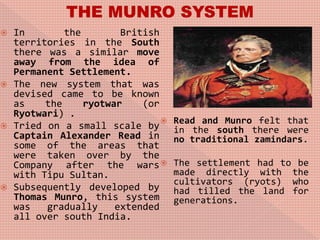
 In the British
territories in the South
there was a similar move
away from the idea of
Permanent Settlement.
 The new system that was
devised came to be known
as the ryotwar (or
Ryotwari) .
 Tried on a small scale by
Captain Alexander Read in
some of the areas that
were taken over by the
Company after the wars
with Tipu Sultan.
 Subsequently developed by
Thomas Munro, this system
was gradually extended
all over south India.
 Read and Munro felt that
in the south there were
no traditional zamindars.
 The settlement had to be
made directly with the
cultivators (ryots) who
had tilled the land for
generations.
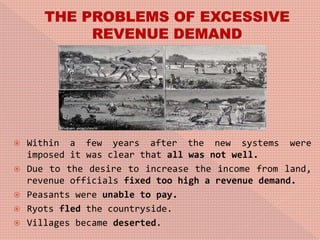
 Within a few years after the new systems were
imposed it was clear that all was not well.
 Due to the desire to increase the income from land,
revenue officials fixed too high a revenue demand.
 Peasants were unable to pay.
 Ryots fled the countryside.
 Villages became deserted.
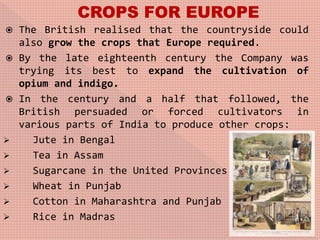
 The British realised that the countryside could
also grow the crops that Europe required.
 By the late eighteenth century the Company was
trying its best to expand the cultivation of
opium and indigo.
 In the century and a half that followed, the
British persuaded or forced cultivators in
various parts of India to produce other crops:
 Jute in Bengal
 Tea in Assam
 Sugarcane in the United Provinces
 Wheat in Punjab
 Cotton in Maharashtra and Punjab
 Rice in Madras
 By the thirteenth century
Indian indigo was being used
by cloth manufacturers in
Italy, France and Britain to
dye cloth.
 Only small amounts of Indian
indigo reached the European
market and its price was
very high.
 European cloth manufacturers
had to depend on another
plant called woad to make
violet and blue dyes.
 Worried by the competition
from indigo, woad producers
in Europe pressurised their
governments to ban the
import of indigo.
 Cloth dyers preferred
indigo as a dye.
 Indigo produced a rich
blue colour.
 By the 17th century,
European cloth producers
persuaded their
governments to relax the
ban on indigo import.
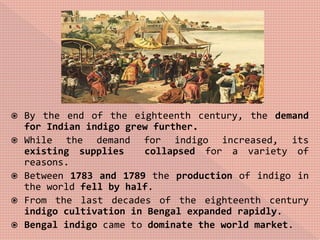
 By the end of the eighteenth century, the demand
for Indian indigo grew further.
 While the demand for indigo increased, its
existing supplies collapsed for a variety of
reasons.
 Between 1783 and 1789 the production of indigo in
the world fell by half.
 From the last decades of the eighteenth century
indigo cultivation in Bengal expanded rapidly.
 Bengal indigo came to dominate the world market.
 As the indigo trade grew,
commercial agents and
officials of the Company
began investing in indigo
production.
 Attracted by the prospect
of high profits, numerous
Scotsmen and Englishmen
came to India and became
planters.
 Those who had no money to
produce indigo could get
loans from the Company and
the banks that were coming
up at the time.
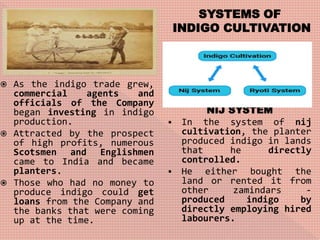
SYSTEMS OF
INDIGO CULTIVATION
NIJ SYSTEM
 In the system of nij
cultivation, the planter
produced indigo in lands
that he directly
controlled.
 He either bought the
land or rented it from
other zamindars -
produced indigo by
directly employing hired
labourers.
RYOTI SYSTEM
 Under the ryoti system, the
planters forced the ryots to
sign a contract, an
agreement (satta).
 At times they pressurised
the village headmen to sign
the contract on behalf of
the ryots.
 Those who signed the
contract got cash advances
from the planters at low
rates of interest to produce
indigo.
 But the loan committed the
ryot to cultivating indigo
on at least 25 per cent of
the area under his holding.
 The planter provided the
seed and the drill, while
the cultivators prepared the
soil, sowed the seed and
looked after the crop.
 The procurement price for
indigo was so less that
cultivators were always in
debt trap.
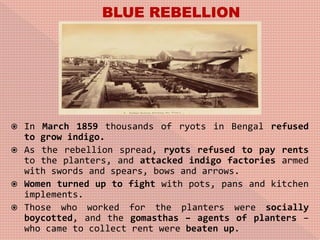
 In March 1859 thousands of ryots in Bengal refused
to grow indigo.
 As the rebellion spread, ryots refused to pay rents
to the planters, and attacked indigo factories armed
with swords and spears, bows and arrows.
 Women turned up to fight with pots, pans and kitchen
implements.
 Those who worked for the planters were socially
boycotted, and the gomasthas – agents of planters –
who came to collect rent were beaten up.
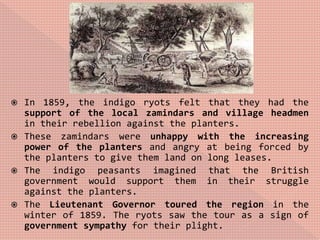
 In 1859, the indigo ryots felt that they had the
support of the local zamindars and village headmen
in their rebellion against the planters.
 These zamindars were unhappy with the increasing
power of the planters and angry at being forced by
the planters to give them land on long leases.
 The indigo peasants imagined that the British
government would support them in their struggle
against the planters.
 The Lieutenant Governor toured the region in the
winter of 1859. The ryots saw the tour as a sign of
government sympathy for their plight.
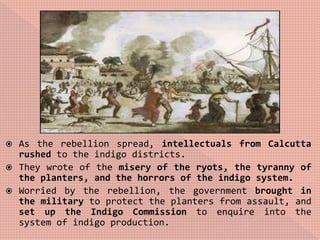
 As the rebellion spread, intellectuals from Calcutta
rushed to the indigo districts.
 They wrote of the misery of the ryots, the tyranny of
the planters, and the horrors of the indigo system.
 Worried by the rebellion, the government brought in
the military to protect the planters from assault, and
set up the Indigo Commission to enquire into the
system of indigo production.
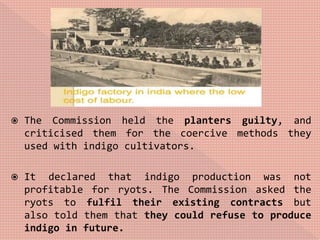
 The Commission held the planters guilty, and
criticised them for the coercive methods they
used with indigo cultivators.
 It declared that indigo production was not
profitable for ryots. The Commission asked the
ryots to fulfil their existing contracts but
also told them that they could refuse to produce
indigo in future.
 After the revolt, indigo
production collapsed in
Bengal. But the planters now
shifted their operation to
Bihar.
 With the discovery of
synthetic dyes in the late
nineteenth century their
business was severely
affected, but yet they
managed to expand
production.
 When Mahatma Gandhi returned
from South Africa, a peasant
from Bihar persuaded him
visit Champaran and see the
plight of the indigo
cultivators there.
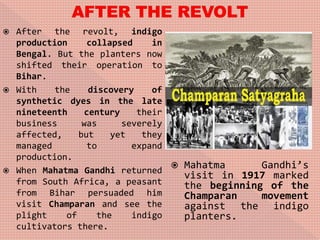
 Mahatma Gandhi’s
visit in 1917 marked
the beginning of the
Champaran movement
against the indigo
planters.
URVI PATIL
VIII A

Ruling the Countryside.pptx

  • 1.
  • 2.
     12 August1765 – The Mughal Emperor appointed the East India Company as The Diwan of Bengal.  As Diwan, the company became the Chief Financial Administrator of the territory under its control.  Therefore the Bengal economy was soon facing a deep crisis.
  • 3.
     Artisans weredeserting villages as they were being forced to sell their goods to the company at low prices.  Peasants were unable to pay dues being demanded from them.  Artisanal production was in decline.  Agricultural cultivation showed signs of collapse.  1770 – A famine killed ten million people in Bengal. About one-third of the population was wiped out.
  • 4.
     The Companyintroduced the Permanent Settlement in 1793.  By the terms of the settlement, the rajas and talugdars were recognised as Zamindars.  They were asked to collect rent from peasants and pay revenue to the company.  Zamindars were not interested in the improvement of the land. Some even lost their land.  The first decade of 19th century – Things changed.
  • 5.
     1822 -In the North Western Provinces of the Bengal Presidency an Englishman called Holt Mackenzie devised a new system.  Felt that the village was an important social institution and needed to be preserved.  Under his directions, collectors went from village to village, inspecting the land, measuring the fields, and recording the customs and rights of different groups.
  • 6.
     The estimatedrevenue of each plot within a village was added up to calculate the revenue that each village (mahal) had to pay.  This demand was to be revised periodically, not permanently fixed.  The charge of collecting the revenue and paying it to the Company was given to the village headman.  This system came to be known as the Mahalwari settlement.
  • 7.
     In theBritish territories in the South there was a similar move away from the idea of Permanent Settlement.  The new system that was devised came to be known as the ryotwar (or Ryotwari) .  Tried on a small scale by Captain Alexander Read in some of the areas that were taken over by the Company after the wars with Tipu Sultan.  Subsequently developed by Thomas Munro, this system was gradually extended all over south India.  Read and Munro felt that in the south there were no traditional zamindars.  The settlement had to be made directly with the cultivators (ryots) who had tilled the land for generations.
  • 8.
     Within afew years after the new systems were imposed it was clear that all was not well.  Due to the desire to increase the income from land, revenue officials fixed too high a revenue demand.  Peasants were unable to pay.  Ryots fled the countryside.  Villages became deserted.
  • 9.
     The Britishrealised that the countryside could also grow the crops that Europe required.  By the late eighteenth century the Company was trying its best to expand the cultivation of opium and indigo.  In the century and a half that followed, the British persuaded or forced cultivators in various parts of India to produce other crops:  Jute in Bengal  Tea in Assam  Sugarcane in the United Provinces  Wheat in Punjab  Cotton in Maharashtra and Punjab  Rice in Madras
  • 10.
     By thethirteenth century Indian indigo was being used by cloth manufacturers in Italy, France and Britain to dye cloth.  Only small amounts of Indian indigo reached the European market and its price was very high.  European cloth manufacturers had to depend on another plant called woad to make violet and blue dyes.  Worried by the competition from indigo, woad producers in Europe pressurised their governments to ban the import of indigo.  Cloth dyers preferred indigo as a dye.  Indigo produced a rich blue colour.  By the 17th century, European cloth producers persuaded their governments to relax the ban on indigo import.
  • 11.
     By theend of the eighteenth century, the demand for Indian indigo grew further.  While the demand for indigo increased, its existing supplies collapsed for a variety of reasons.  Between 1783 and 1789 the production of indigo in the world fell by half.  From the last decades of the eighteenth century indigo cultivation in Bengal expanded rapidly.  Bengal indigo came to dominate the world market.
  • 12.
     As theindigo trade grew, commercial agents and officials of the Company began investing in indigo production.  Attracted by the prospect of high profits, numerous Scotsmen and Englishmen came to India and became planters.  Those who had no money to produce indigo could get loans from the Company and the banks that were coming up at the time. SYSTEMS OF INDIGO CULTIVATION NIJ SYSTEM  In the system of nij cultivation, the planter produced indigo in lands that he directly controlled.  He either bought the land or rented it from other zamindars - produced indigo by directly employing hired labourers.
  • 13.
    RYOTI SYSTEM  Underthe ryoti system, the planters forced the ryots to sign a contract, an agreement (satta).  At times they pressurised the village headmen to sign the contract on behalf of the ryots.  Those who signed the contract got cash advances from the planters at low rates of interest to produce indigo.  But the loan committed the ryot to cultivating indigo on at least 25 per cent of the area under his holding.  The planter provided the seed and the drill, while the cultivators prepared the soil, sowed the seed and looked after the crop.  The procurement price for indigo was so less that cultivators were always in debt trap.
  • 14.
     In March1859 thousands of ryots in Bengal refused to grow indigo.  As the rebellion spread, ryots refused to pay rents to the planters, and attacked indigo factories armed with swords and spears, bows and arrows.  Women turned up to fight with pots, pans and kitchen implements.  Those who worked for the planters were socially boycotted, and the gomasthas – agents of planters – who came to collect rent were beaten up.
  • 15.
     In 1859,the indigo ryots felt that they had the support of the local zamindars and village headmen in their rebellion against the planters.  These zamindars were unhappy with the increasing power of the planters and angry at being forced by the planters to give them land on long leases.  The indigo peasants imagined that the British government would support them in their struggle against the planters.  The Lieutenant Governor toured the region in the winter of 1859. The ryots saw the tour as a sign of government sympathy for their plight.
  • 16.
     As therebellion spread, intellectuals from Calcutta rushed to the indigo districts.  They wrote of the misery of the ryots, the tyranny of the planters, and the horrors of the indigo system.  Worried by the rebellion, the government brought in the military to protect the planters from assault, and set up the Indigo Commission to enquire into the system of indigo production.
  • 17.
     The Commissionheld the planters guilty, and criticised them for the coercive methods they used with indigo cultivators.  It declared that indigo production was not profitable for ryots. The Commission asked the ryots to fulfil their existing contracts but also told them that they could refuse to produce indigo in future.
  • 18.
     After therevolt, indigo production collapsed in Bengal. But the planters now shifted their operation to Bihar.  With the discovery of synthetic dyes in the late nineteenth century their business was severely affected, but yet they managed to expand production.  When Mahatma Gandhi returned from South Africa, a peasant from Bihar persuaded him visit Champaran and see the plight of the indigo cultivators there.  Mahatma Gandhi’s visit in 1917 marked the beginning of the Champaran movement against the indigo planters.
  • 19.