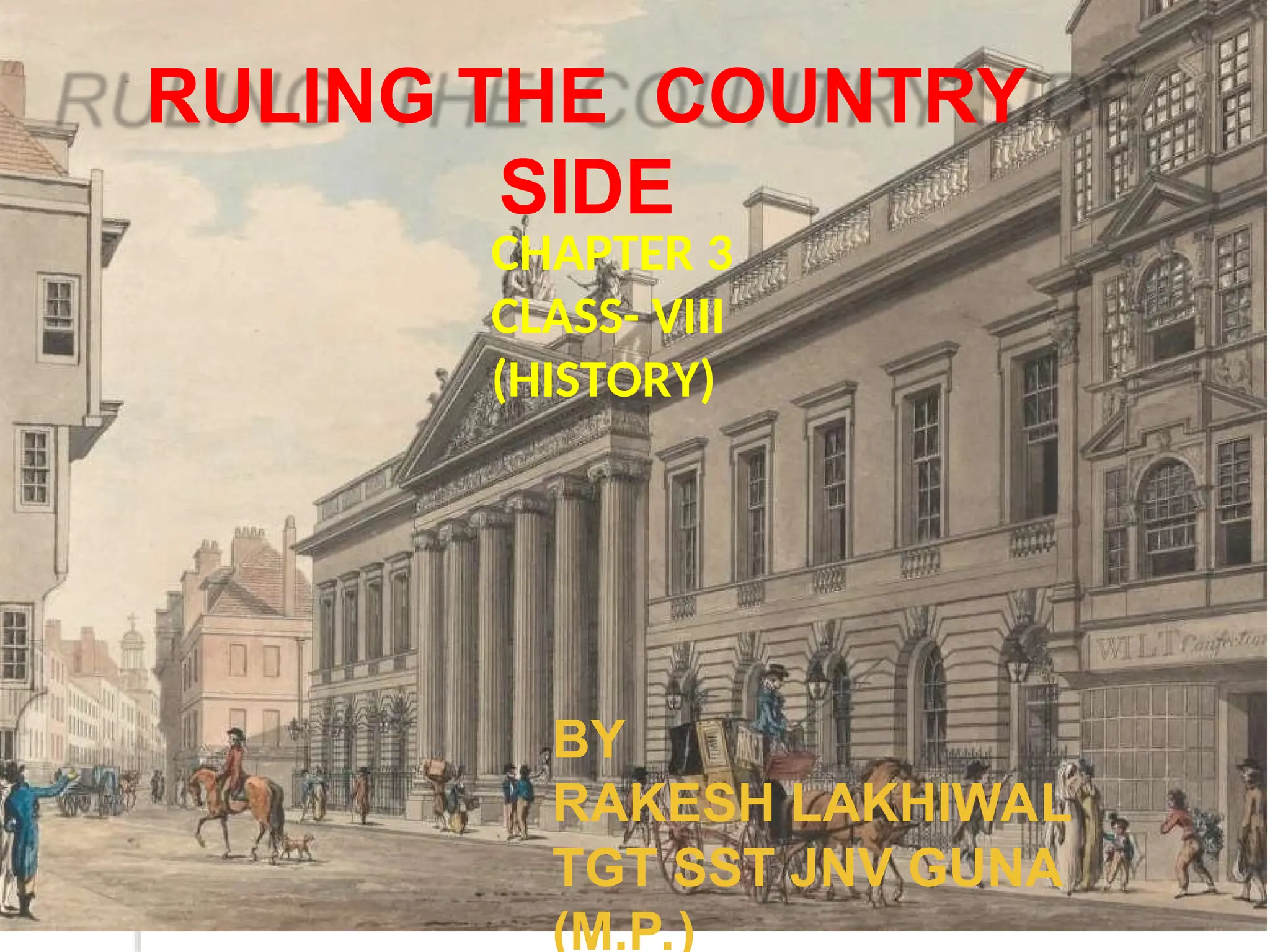
RULING THE COUNTRY
SIDE
CHAPTER 3
CLASS- VIII
(HISTORY)
BY
RAKESH LAKHIWAL
TGT SST JNV GUNA
(M.P.)
INTRODUCTION :
• The Company becomes the Diwan
• Revenue for the company
• The Need to improve Agriculture
• Problems in Agriculture
• A new system is devised
• The Munro system and its problems
• Crops for the Europe
• Indigo cultivation and Nij
• Ryots forced to grow indigo: Blue
Rebellion
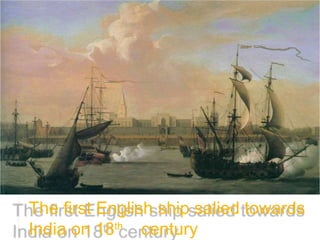
The first English ship salied towards
India on 18th
century
Grant of Diwani and Financial
Powers
⚫The East India Company was made the Diwan
of Bengal on 12 August 1765; by then
Mughal Emperor Shah Alam II.
⚫Thus, the Company became of the chief
financial administrator of the territory of
Bengal.
Powers
⚫ The Company officials understood one
important aspect of expanding their base in
India.
⚫ They understood the importance of those
who had ruled the countryside in the past,
and had enjoyed authority and prestige.
⚫ The Company wanted to be careful not
to annoy those people.
⚫ Growth of Revenue: Initially, the Company was
just interested in collecting revenue sothat its
trade and other expenses could be financed.
⚫ But the Company was not interested
in setting up any regular system of
assessment and collection.
⚫ The revenue was enough to
double the purchase by Company within five
years.
Powers
⚫ Growth of Problems for Common People: But the
Bengal economy was facing a deep crisis.
⚫ Artisans were being forced to sell their goods to the
Company at low prices and hence most of
them were deserting their villages.
⚫ Peasants were not able to pay the dues.
⚫ Production by artisans declined and farm
production also declined.
⚫ In 1770, a terrible famine
hit Bengal. It killed 10 million people.
Problems faced by Bengal Province
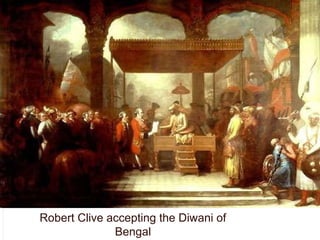
Robert Clive accepting the Diwani of
Bengal
Robert Clive
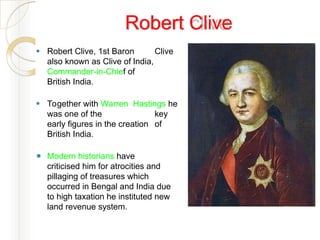
⚫ Robert Clive, 1st Baron Clive
also known as Clive of India,
Commander-in-Chief of
British India.
⚫ Together with Warren Hastings he
was one of the key
early figures in the creation of
British India.
⚫ Modern historians have
criticised him for atrocities and
pillaging of treasures which
occurred in Bengal and India due
to high taxation he instituted new
land revenue system.
Permanent
Settlement
⚫ The Company had to take some steps to
improve agriculture by improving investment
in land. The Permanent Settlement was
introduced in 1793.
⚫ According to this, the Rajas and
Taluqdars were recognized as
zamindars and were given the responsibility
of revenue collection from the peasants.
⚫
Permanent
Settlement
⚫ The amount to be paid was fixed
permanently and hence the name Permanent
Settlement.
⚫ The Company officials felt that it would
ensure a regular flow of revenue. They also felt
that this would motivate the zamindars to
invest in improving the land.
⚫ The zamindars would benefit from increased
production because the revenue demand
would not be increased.
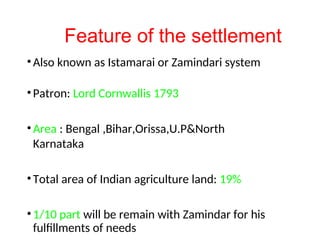
Feature of the settlement
•Also known as Istamarai or Zamindari system
•Patron: Lord Cornwallis 1793
•Area : Bengal ,Bihar,Orissa,U.P&North
Karnataka
•Total area of Indian agriculture land: 19%
•1/10 part will be remain with Zamindar for his
fulfillments of needs
The Problems of Permanent Settlement
⚫ The revenue was fixed at such a high
level that the zamindars found it difficult
to pay.
⚫ A zamindar who failed to pay the
revenue lost his zamindari.
⚫ Hence, zamindars were not
investing in the improvement of land.
The Problems of Permanent Settlement
⚫
⚫
⚫ But the situation changed by the first
decade of the nineteenth century.
There was price rise and expansion in
cultivation.
The income of the zamindars increased
but it did not result in any gain
for the Company because of fixed
revenue demand.
The zamindars preferred to earn as much
profit.
They were just happy to lease out the land to
tenants.
⚫ Extremely oppressive for the
cultivator.
⚫ Pay a high rent to the
zamindar but there was no security of his
right on the land.
⚫ Cultivator often had to
take loan from the moneylender, to pay
rent.
⚫ Failure of payment of the
rental meant eviction for the cultivator
from the land.
The Problems of Permanent Settlement
Mahalwari Settlement
⚫ Mahalwari system was introduced.
⚫ The villagewas known as mahal
and hence this system was known as
Mahalwari System.
⚫ It was also decided to revise
the revenue demand periodically.
⚫ The villageheadman was given the
responsibility of revenue collection.
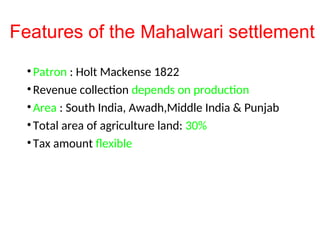
Features of the Mahalwari settlement
•Patron : Holt Mackense 1822
•Revenue collection depends on production
•Area : South India, Awadh,Middle India & Punjab
•Total area of agriculture land: 30%
•Tax amount flexible
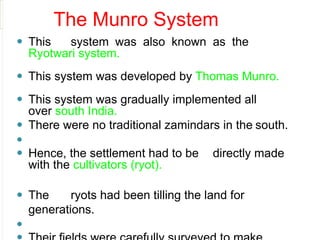
The Munro System
⚫ This system was also known as the
Ryotwari system.
⚫ This system was developed by Thomas Munro.
⚫ This system was gradually implemented all
over south India.
⚫ There were no traditional zamindars in the south.
⚫
⚫ Hence, the settlement had to be directly made
with the cultivators (ryot).
⚫ The ryots had been tilling the land for
generations.
⚫
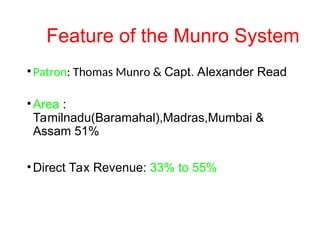
Feature of the Munro System
•Patron: Thomas Munro & Capt. Alexander Read
•Area :
Tamilnadu(Baramahal),Madras,Mumbai &
Assam 51%
•Direct Tax Revenue: 33% to 55%
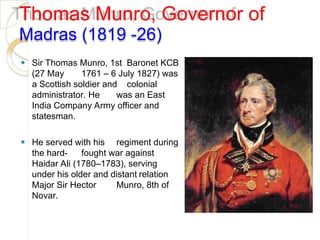
Thomas Munro, Governor of
Madras (1819 -26)
⚫ Sir Thomas Munro, 1st Baronet KCB
(27 May 1761 – 6 July 1827) was
a Scottish soldier and colonial
administrator. He was an East
India Company Army officer and
statesman.
⚫ He served with his regiment during
the hard- fought war against
Haidar Ali (1780–1783), serving
under his older and distant relation
Major Sir Hector Munro, 8th of
Novar.
Problems of Excessive Revenue
Demand
⚫ The revenue officials wanted to
increase the income from land. Hence,
they fixed very high revenue demand.
⚫ Peasants were not able to pay the
revenue. The ryots fled the
countryside and villages became
deserted in many regions.
Crops for Europe
⚫ The Company was trying to expand
the cultivation of opium and indigo.
⚫ Forced the cultivators to
produce other crops; like jute, tea,
sugarcane, cotton, wheatand rice; to
be supplied to Europe.
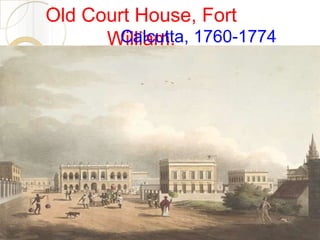
Old Court House, Fort
William,
Calcutta, 1760-1774
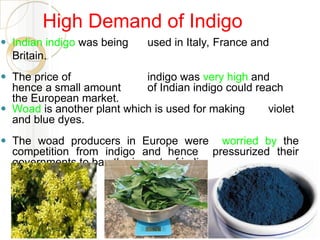
High Demand of Indigo
⚫ Indian indigo was being used in Italy, France and
Britain.
⚫ The price of indigo was very high and
hence a small amount of Indian indigo could reach
the European market.
⚫ Woad is another plant which is used for making violet
and blue dyes.
⚫ The woad producers in Europe were worried by the
competition from indigo and hence pressurized their
governments to ban the import of indigo.
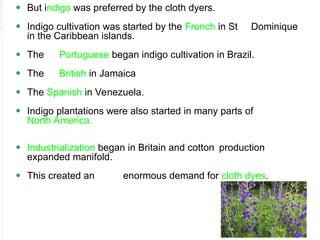
⚫ But indigo was preferred by the cloth dyers.
⚫ Indigo cultivation was started by the French in St Dominique
in the Caribbean islands.
⚫ The Portuguese began indigo cultivation in Brazil.
⚫ The British in Jamaica
⚫ The Spanish in Venezuela.
⚫ Indigo plantations were also started in many parts of
North America.
⚫ Industrialization began in Britain and cotton production
expanded manifold.
⚫ This created an enormous demand for cloth dyes.
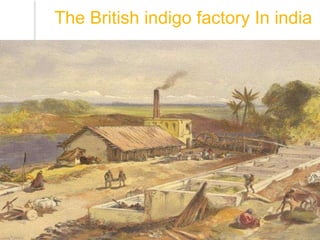
The British indigo factory In india
India: A Major Source of Indigo
⚫
The Company looked for ways to expand the area
under indigo cultivation in India.
⚫ Only about
30% of indigo imported to Britain in 1788 was from
India.
⚫ This figure went up to 95% by 1810.
⚫ Many
people from Scotland and England came to India and
became planters.
⚫ TheCompany and banks were giving loans for indigo
cultivation at that time.
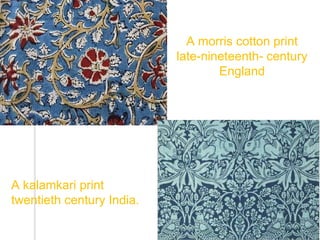
A kalamkari print
twentieth century India.
A morris cotton print
late-nineteenth- century
England
SYSTEMS OF INDIGO
CULTIVATION
Nij Cultivation:
⚫In this system, the planter produced indigo on
those lands which were under his direct control.
⚫The planter either bought the land or rented
it from other zamindars. He directly
employed labourers to produce indigo.
The problem with nij
cultivation
⚫ Indigo could only be cultivated on fertile lands. But
these areas were densely populated and hence, only
small plots could be acquired. This made it difficult to
expand the area under nij cultivation.
⚫ They attempted to lease in the land around the indigo
factory. While doing so, they evicted the peasants
from the area. Peasants’ eviction always created
conflict and tension.
⚫ A large plantation required a large number of
workers. Work at indigo plantation coincided with the
time when peasants were busy with rice cultivation.
Hence, mobilizing the labour for indigo cultivation
was a difficult task.
Ryoti System
⚫ Under the ryoti system, indigo cultivation was done by
the ryots.
⚫ The planters made the ryots to
sign a contract or an agreement (satta).
⚫ Sometimes, they pressurized the village
headmen to sign the contract on behalf of
the ryots.
⚫ After signing the contract, the ryots
got cash advances from the planters.
⚫ But after taking the loan, the ryot was
committed to grow indigo on at least 25% of
his land holding.
⚫ Seeds and drills were
provided by the planter.
⚫ The cultivators prepared
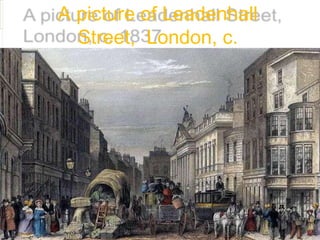
A picture of Leadenhall
Street, London, c.
1837
Blue Rebellion
⚫ Thousands of ryots in Bengal refused to grow indigo in
March 1859.
⚫ The ryots refused to pay rents to the
planters. They attacked indigo factories.
⚫ They used to be
armed with swords and spears, bows and arrows.
⚫ Women also fought with pots, panda and kitchen
implements.
⚫ Those who worked for the planters were
socially boycotted.
⚫ The gomasthas were beaten up when
they came to collect rent.
⚫ The gomasthas were the
⚫ In many villages, headmen mobilized the indigo
peasants against the lathiyals.
⚫ The headmen were angry
because they had been forced to sign indigo
contract.
⚫ Some zamindars were angry with the increasing power of
the planters and at being forced to give them land on long
leases.
⚫ So, some zamindars also
supported the villagers in their revolt against the indigo
planters.
Blue Rebellion
How The British
Reacted?
⚫ The possibility of another popular rebellion.
⚫ The Lieutenant Governor toured the region in the winter
of 1859.
⚫ This was seen as a sign of sympathy by the ryots.
⚫ They began to believe that the British government
would support them in their struggle.
⚫ Intellectuals from Calcutta rushed to the
indigo districts.
⚫ They began writing about the misery
of the ryots and the horrors of the indigo system.
⚫ The government called in the military to protect the
planters.
⚫ The Indigo Commission was set up toenquire into the
system of indigo production.
⚫ The Commission held the
planters guilty. It asked the ryots to fulfill their
existing obligations and then they were free to cultivate
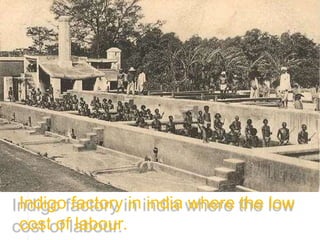
Indigo factory in india where the low
cost of labour.
After the Revolt
⚫ The indigo production collapsed in Bengal, after
the revolt.
⚫ The planters now shifted their
operation to Bihar.
⚫ Discovery of synthetic dyes
in the late nineteenth century severely
affected the business.
⚫ But the planters
managed to expand production.
⚫ When Mahatma Gandhi returned from South
Africa, the plight of indigo farmers in
Champaran was brought to his notice.
The Indian indigo
Ch 3 Ruling the Countryside 1.pptx...ppt

Ch 3 Ruling the Countryside 1.pptx...ppt

  • 1.
    RULING THE COUNTRY SIDE CHAPTER3 CLASS- VIII (HISTORY) BY RAKESH LAKHIWAL TGT SST JNV GUNA (M.P.)
  • 2.
    INTRODUCTION : • TheCompany becomes the Diwan • Revenue for the company • The Need to improve Agriculture • Problems in Agriculture • A new system is devised • The Munro system and its problems • Crops for the Europe • Indigo cultivation and Nij • Ryots forced to grow indigo: Blue Rebellion
  • 3.
    The first Englishship salied towards India on 18th century
  • 4.
    Grant of Diwaniand Financial Powers ⚫The East India Company was made the Diwan of Bengal on 12 August 1765; by then Mughal Emperor Shah Alam II. ⚫Thus, the Company became of the chief financial administrator of the territory of Bengal.
  • 5.
    Powers ⚫ The Companyofficials understood one important aspect of expanding their base in India. ⚫ They understood the importance of those who had ruled the countryside in the past, and had enjoyed authority and prestige. ⚫ The Company wanted to be careful not to annoy those people.
  • 6.
    ⚫ Growth ofRevenue: Initially, the Company was just interested in collecting revenue sothat its trade and other expenses could be financed. ⚫ But the Company was not interested in setting up any regular system of assessment and collection. ⚫ The revenue was enough to double the purchase by Company within five years. Powers
  • 7.
    ⚫ Growth ofProblems for Common People: But the Bengal economy was facing a deep crisis. ⚫ Artisans were being forced to sell their goods to the Company at low prices and hence most of them were deserting their villages. ⚫ Peasants were not able to pay the dues. ⚫ Production by artisans declined and farm production also declined. ⚫ In 1770, a terrible famine hit Bengal. It killed 10 million people. Problems faced by Bengal Province
  • 8.
    Robert Clive acceptingthe Diwani of Bengal
  • 9.
    Robert Clive ⚫ RobertClive, 1st Baron Clive also known as Clive of India, Commander-in-Chief of British India. ⚫ Together with Warren Hastings he was one of the key early figures in the creation of British India. ⚫ Modern historians have criticised him for atrocities and pillaging of treasures which occurred in Bengal and India due to high taxation he instituted new land revenue system.
  • 10.
    Permanent Settlement ⚫ The Companyhad to take some steps to improve agriculture by improving investment in land. The Permanent Settlement was introduced in 1793. ⚫ According to this, the Rajas and Taluqdars were recognized as zamindars and were given the responsibility of revenue collection from the peasants. ⚫
  • 11.
    Permanent Settlement ⚫ The amountto be paid was fixed permanently and hence the name Permanent Settlement. ⚫ The Company officials felt that it would ensure a regular flow of revenue. They also felt that this would motivate the zamindars to invest in improving the land. ⚫ The zamindars would benefit from increased production because the revenue demand would not be increased.
  • 12.
    Feature of thesettlement •Also known as Istamarai or Zamindari system •Patron: Lord Cornwallis 1793 •Area : Bengal ,Bihar,Orissa,U.P&North Karnataka •Total area of Indian agriculture land: 19% •1/10 part will be remain with Zamindar for his fulfillments of needs
  • 13.
    The Problems ofPermanent Settlement ⚫ The revenue was fixed at such a high level that the zamindars found it difficult to pay. ⚫ A zamindar who failed to pay the revenue lost his zamindari. ⚫ Hence, zamindars were not investing in the improvement of land.
  • 14.
    The Problems ofPermanent Settlement ⚫ ⚫ ⚫ But the situation changed by the first decade of the nineteenth century. There was price rise and expansion in cultivation. The income of the zamindars increased but it did not result in any gain for the Company because of fixed revenue demand. The zamindars preferred to earn as much profit. They were just happy to lease out the land to tenants.
  • 15.
    ⚫ Extremely oppressivefor the cultivator. ⚫ Pay a high rent to the zamindar but there was no security of his right on the land. ⚫ Cultivator often had to take loan from the moneylender, to pay rent. ⚫ Failure of payment of the rental meant eviction for the cultivator from the land. The Problems of Permanent Settlement
  • 17.
    Mahalwari Settlement ⚫ Mahalwarisystem was introduced. ⚫ The villagewas known as mahal and hence this system was known as Mahalwari System. ⚫ It was also decided to revise the revenue demand periodically. ⚫ The villageheadman was given the responsibility of revenue collection.
  • 18.
    Features of theMahalwari settlement •Patron : Holt Mackense 1822 •Revenue collection depends on production •Area : South India, Awadh,Middle India & Punjab •Total area of agriculture land: 30% •Tax amount flexible
  • 19.
    The Munro System ⚫This system was also known as the Ryotwari system. ⚫ This system was developed by Thomas Munro. ⚫ This system was gradually implemented all over south India. ⚫ There were no traditional zamindars in the south. ⚫ ⚫ Hence, the settlement had to be directly made with the cultivators (ryot). ⚫ The ryots had been tilling the land for generations. ⚫
  • 20.
    Feature of theMunro System •Patron: Thomas Munro & Capt. Alexander Read •Area : Tamilnadu(Baramahal),Madras,Mumbai & Assam 51% •Direct Tax Revenue: 33% to 55%
  • 21.
    Thomas Munro, Governorof Madras (1819 -26) ⚫ Sir Thomas Munro, 1st Baronet KCB (27 May 1761 – 6 July 1827) was a Scottish soldier and colonial administrator. He was an East India Company Army officer and statesman. ⚫ He served with his regiment during the hard- fought war against Haidar Ali (1780–1783), serving under his older and distant relation Major Sir Hector Munro, 8th of Novar.
  • 22.
    Problems of ExcessiveRevenue Demand ⚫ The revenue officials wanted to increase the income from land. Hence, they fixed very high revenue demand. ⚫ Peasants were not able to pay the revenue. The ryots fled the countryside and villages became deserted in many regions.
  • 23.
    Crops for Europe ⚫The Company was trying to expand the cultivation of opium and indigo. ⚫ Forced the cultivators to produce other crops; like jute, tea, sugarcane, cotton, wheatand rice; to be supplied to Europe.
  • 24.
    Old Court House,Fort William, Calcutta, 1760-1774
  • 25.
    High Demand ofIndigo ⚫ Indian indigo was being used in Italy, France and Britain. ⚫ The price of indigo was very high and hence a small amount of Indian indigo could reach the European market. ⚫ Woad is another plant which is used for making violet and blue dyes. ⚫ The woad producers in Europe were worried by the competition from indigo and hence pressurized their governments to ban the import of indigo.
  • 26.
    ⚫ But indigowas preferred by the cloth dyers. ⚫ Indigo cultivation was started by the French in St Dominique in the Caribbean islands. ⚫ The Portuguese began indigo cultivation in Brazil. ⚫ The British in Jamaica ⚫ The Spanish in Venezuela. ⚫ Indigo plantations were also started in many parts of North America. ⚫ Industrialization began in Britain and cotton production expanded manifold. ⚫ This created an enormous demand for cloth dyes.
  • 27.
    The British indigofactory In india
  • 28.
    India: A MajorSource of Indigo ⚫ The Company looked for ways to expand the area under indigo cultivation in India. ⚫ Only about 30% of indigo imported to Britain in 1788 was from India. ⚫ This figure went up to 95% by 1810. ⚫ Many people from Scotland and England came to India and became planters. ⚫ TheCompany and banks were giving loans for indigo cultivation at that time.
  • 29.
    A kalamkari print twentiethcentury India. A morris cotton print late-nineteenth- century England
  • 30.
    SYSTEMS OF INDIGO CULTIVATION NijCultivation: ⚫In this system, the planter produced indigo on those lands which were under his direct control. ⚫The planter either bought the land or rented it from other zamindars. He directly employed labourers to produce indigo.
  • 31.
    The problem withnij cultivation ⚫ Indigo could only be cultivated on fertile lands. But these areas were densely populated and hence, only small plots could be acquired. This made it difficult to expand the area under nij cultivation. ⚫ They attempted to lease in the land around the indigo factory. While doing so, they evicted the peasants from the area. Peasants’ eviction always created conflict and tension. ⚫ A large plantation required a large number of workers. Work at indigo plantation coincided with the time when peasants were busy with rice cultivation. Hence, mobilizing the labour for indigo cultivation was a difficult task.
  • 32.
    Ryoti System ⚫ Underthe ryoti system, indigo cultivation was done by the ryots. ⚫ The planters made the ryots to sign a contract or an agreement (satta). ⚫ Sometimes, they pressurized the village headmen to sign the contract on behalf of the ryots. ⚫ After signing the contract, the ryots got cash advances from the planters. ⚫ But after taking the loan, the ryot was committed to grow indigo on at least 25% of his land holding. ⚫ Seeds and drills were provided by the planter. ⚫ The cultivators prepared
  • 33.
    A picture ofLeadenhall Street, London, c. 1837
  • 34.
    Blue Rebellion ⚫ Thousandsof ryots in Bengal refused to grow indigo in March 1859. ⚫ The ryots refused to pay rents to the planters. They attacked indigo factories. ⚫ They used to be armed with swords and spears, bows and arrows. ⚫ Women also fought with pots, panda and kitchen implements. ⚫ Those who worked for the planters were socially boycotted. ⚫ The gomasthas were beaten up when they came to collect rent. ⚫ The gomasthas were the
  • 35.
    ⚫ In manyvillages, headmen mobilized the indigo peasants against the lathiyals. ⚫ The headmen were angry because they had been forced to sign indigo contract. ⚫ Some zamindars were angry with the increasing power of the planters and at being forced to give them land on long leases. ⚫ So, some zamindars also supported the villagers in their revolt against the indigo planters. Blue Rebellion
  • 36.
    How The British Reacted? ⚫The possibility of another popular rebellion. ⚫ The Lieutenant Governor toured the region in the winter of 1859. ⚫ This was seen as a sign of sympathy by the ryots. ⚫ They began to believe that the British government would support them in their struggle. ⚫ Intellectuals from Calcutta rushed to the indigo districts. ⚫ They began writing about the misery of the ryots and the horrors of the indigo system. ⚫ The government called in the military to protect the planters. ⚫ The Indigo Commission was set up toenquire into the system of indigo production. ⚫ The Commission held the planters guilty. It asked the ryots to fulfill their existing obligations and then they were free to cultivate
  • 37.
    Indigo factory inindia where the low cost of labour.
  • 38.
    After the Revolt ⚫The indigo production collapsed in Bengal, after the revolt. ⚫ The planters now shifted their operation to Bihar. ⚫ Discovery of synthetic dyes in the late nineteenth century severely affected the business. ⚫ But the planters managed to expand production. ⚫ When Mahatma Gandhi returned from South Africa, the plight of indigo farmers in Champaran was brought to his notice.
  • 39.