
COMMUNICATION SKILLS
Vidya Patil ,
Assistant Professor ,
Dept. of English ,
Govt. First Grade College, Humnabad.
Meaning
 The ability to communicate is the primary
factor that distiguishes human beings from
animals. And it is the ability to communicate
well that distinguishes one individual from
another.
 The fact is that apart from the basic
necessities, one needs to be equipped with
habits for good communication skills, as only
this will make a happy and successful social
being.
. * The word “communication” comes from the
Latin verb “communicare” which means to
impart, to participate or to share.
* Effective communication is important to all of
us in every sphere of our lives – be it our career or
our relationships.
* Better language = Better communication =
Confidence
* Communicating confidently is the secret of
living a happy and successful life.
Definition
Communication is commonly defined as
“the imparting or interchange of
thoughts, opinions, information by
speech, writing or signs.”
Features of Communication
 It is meaning – based.
 It is conventional.
 It is appropriate.
 It is interactional.
 It is structured.
Ingredients of Communication
* Social contact of two or more persons –
Sender and Receiver.
* Transmission of some message.
* A common medium.
* A common language.
* A common frame of reference.
* Interpretation of that message.
* Feedback.
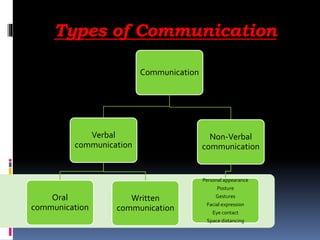
Types of Communication
Communication
Verbal
communication
Oral
communication
Written
communication
Non-Verbal
communication
Personal appearance
Posture
Gestures
Facial expression
Eye contact
Space distancing
INTERVIEW
INTERVIEW
* The word “interview” is derived from intrevue
meaning sight between .
* It is a meeting between two persons with a
specific purpose.
* It demands direct and dynamic interaction.
* It involves an assessment of one participant
by another.
Features of an Interview
* There is a definite purpose.
* Both the parties need to prepare for the
event.
* They are pre-arranged.
* There are atleast two participants in the
event.
* There is clear exchange of information.
Structure of Interview
1) OPENING :
a) Introduction.
b) Statement of the purpose.
c) Making the other person comfortable.
d) Creating an atmosphere of relaxed,
open-minded approach.
2) MAIN BODY:
a) Aim at exchange of information.
b) Keeping the discussion to the point.
c) Listen attentively and patiently.
d) Keep eye-to-eye contact.
e) Give carefully thought out answers.
f) Make sure to cover the agenda.
g) Take care that interruptions, if any, are
polite.
h) Seek clarification if required.
3) CLOSING :
a) Summing up the discussion.
b) Describing the action decided upon.
c) Avoiding a hurried or abrupt ending.
d) Closing on a positive note.
e) Exchange feelings of gratitude and
thankfulness.
Guidelines for the Interviewee
* Be prepared for the Interview.
* Have a presentable appearance.
* Make effective use of Body Language.
* Answer completely and correctly.
* Never try to bluff.
* Be polite.
* Avoid talking too much.
* Avoid criticism.
* Do not forget to thank the interviewers.
* Do not hesitate to ask questions.
PUBLIC SPEAKING
PUBLIC SPEAKING
* “All epoch-making revolutionary
events have been produced not
by the written word but by the
spoken word.”
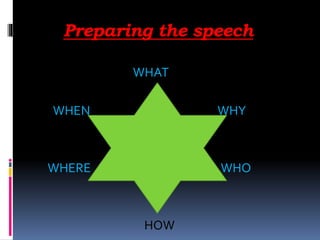
Preparing the speech
WHAT
WHEN WHY
WHERE WHO
HOW
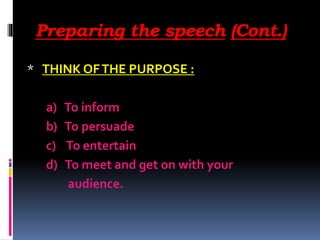
Preparing the speech (Cont.)
* THINK OFTHE PURPOSE :
a) To inform
b) To persuade
c) To entertain
d) To meet and get on with your
audience.
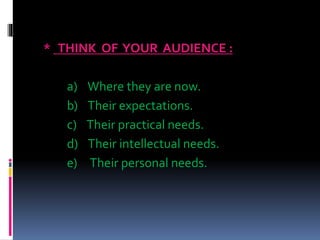
* THINK OF YOUR AUDIENCE :
a) Where they are now.
b) Their expectations.
c) Their practical needs.
d) Their intellectual needs.
e) Their personal needs.
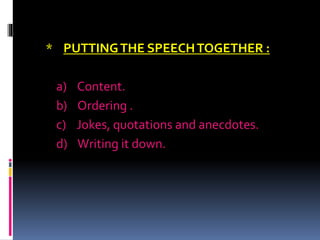
* PUTTINGTHE SPEECHTOGETHER :
a) Content.
b) Ordering .
c) Jokes, quotations and anecdotes.
d) Writing it down.
* DELIVERING THE SPEECH :
a) Being confident.
b) Talking to your audience.
c) Dealing with interruptions and
questions.
d) Using your voice.
e) Using Communication aids.
THANK YOU
- Vidya Patil
Assistant Professor
Dept. of English
Govt. First Grade College
Humnabad.

Communication Skills power point

  • 1.
    COMMUNICATION SKILLS Vidya Patil, Assistant Professor , Dept. of English , Govt. First Grade College, Humnabad.
  • 2.
    Meaning  The abilityto communicate is the primary factor that distiguishes human beings from animals. And it is the ability to communicate well that distinguishes one individual from another.  The fact is that apart from the basic necessities, one needs to be equipped with habits for good communication skills, as only this will make a happy and successful social being.
  • 3.
    . * Theword “communication” comes from the Latin verb “communicare” which means to impart, to participate or to share. * Effective communication is important to all of us in every sphere of our lives – be it our career or our relationships. * Better language = Better communication = Confidence * Communicating confidently is the secret of living a happy and successful life.
  • 4.
    Definition Communication is commonlydefined as “the imparting or interchange of thoughts, opinions, information by speech, writing or signs.”
  • 5.
    Features of Communication It is meaning – based.  It is conventional.  It is appropriate.  It is interactional.  It is structured.
  • 6.
    Ingredients of Communication *Social contact of two or more persons – Sender and Receiver. * Transmission of some message. * A common medium. * A common language. * A common frame of reference. * Interpretation of that message. * Feedback.
  • 7.
  • 8.
  • 9.
    INTERVIEW * The word“interview” is derived from intrevue meaning sight between . * It is a meeting between two persons with a specific purpose. * It demands direct and dynamic interaction. * It involves an assessment of one participant by another.
  • 10.
    Features of anInterview * There is a definite purpose. * Both the parties need to prepare for the event. * They are pre-arranged. * There are atleast two participants in the event. * There is clear exchange of information.
  • 11.
    Structure of Interview 1)OPENING : a) Introduction. b) Statement of the purpose. c) Making the other person comfortable. d) Creating an atmosphere of relaxed, open-minded approach.
  • 12.
    2) MAIN BODY: a)Aim at exchange of information. b) Keeping the discussion to the point. c) Listen attentively and patiently. d) Keep eye-to-eye contact. e) Give carefully thought out answers. f) Make sure to cover the agenda. g) Take care that interruptions, if any, are polite. h) Seek clarification if required.
  • 13.
    3) CLOSING : a)Summing up the discussion. b) Describing the action decided upon. c) Avoiding a hurried or abrupt ending. d) Closing on a positive note. e) Exchange feelings of gratitude and thankfulness.
  • 14.
    Guidelines for theInterviewee * Be prepared for the Interview. * Have a presentable appearance. * Make effective use of Body Language. * Answer completely and correctly. * Never try to bluff. * Be polite. * Avoid talking too much. * Avoid criticism. * Do not forget to thank the interviewers. * Do not hesitate to ask questions.
  • 15.
  • 16.
    PUBLIC SPEAKING * “Allepoch-making revolutionary events have been produced not by the written word but by the spoken word.”
  • 17.
  • 18.
    Preparing the speech(Cont.) * THINK OFTHE PURPOSE : a) To inform b) To persuade c) To entertain d) To meet and get on with your audience.
  • 19.
    * THINK OFYOUR AUDIENCE : a) Where they are now. b) Their expectations. c) Their practical needs. d) Their intellectual needs. e) Their personal needs.
  • 20.
    * PUTTINGTHE SPEECHTOGETHER: a) Content. b) Ordering . c) Jokes, quotations and anecdotes. d) Writing it down.
  • 21.
    * DELIVERING THESPEECH : a) Being confident. b) Talking to your audience. c) Dealing with interruptions and questions. d) Using your voice. e) Using Communication aids.
  • 22.
    THANK YOU - VidyaPatil Assistant Professor Dept. of English Govt. First Grade College Humnabad.