INTRODUCTION
 With the victory in Battle of Buxor, East India Company completed annexation of
Bengal.
 Company in fact wanted to become the nawab of Bengal instead depending on
puppet nawabs.
 The purpose was to acquire financial power in its hand.
 To realize its ambitions company introduced several economic measures.
 They included new revenue settlements.
 According to company’s plan its revenue sources could be used for military
expenses and buying products to export to Britain.
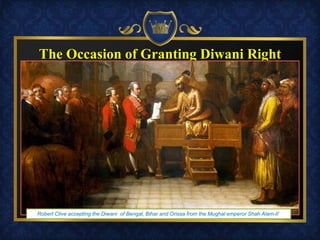
The Occasion of Granting Diwani Right
Robert Clive accepting the Diwani of Bengal, Bihar and Orissa from the Mughal emperor Shah Alam-II`
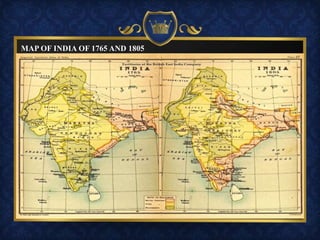
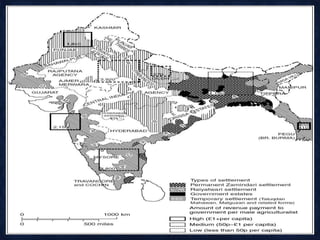
MAP OF INDIA OF 1765 AND 1805
COMPANY BECOMES THE DIWAN
 The Treaty of Alhabad was concluded on 12 August 1765, between the Mughal emperor
Shah Alam – II and The Company ( Robert Clive).
 According to which East India Company became the Diwan of Bengal.
 That is the right to collect revenue from provinces of Bengal, Orissa and Bihar.
 The company became chief financial administrator.
 It had to administer land and organize revenue.
 The effort was to yield as much revenue as it could to meet its growing expenses.
 The company had to buy it needed and sell what it wanted.
 The company was primarily a trader though it acquired Diwani right.
 Unwilling to set up regular system of revenue assessment.
 Its effort was to increase revenue to buy cotton and silk at cheaper rate.
 Before 1765 company purchased goods by importing gold and silver from England.
 Now revenue collected from Bengal could finance for buying goods.
 But, artisans deserted villages as they were forced to sell their goods at
cheaper price.
 So both artisanal and agricultural production declined.
 Most disastrous was the death of 10 million people due to famine in 1770.
Revenue for the Company
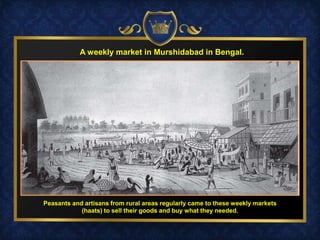
Peasants and artisans from rural areas regularly came to these weekly markets
(haats) to sell their goods and buy what they needed.
A weekly market in Murshidabad in Bengal.
REVENUE SETTLEMENTS EMPLOYED BY THE COMPANY
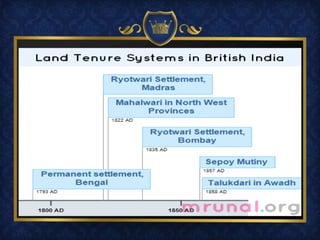
Various revenue system were employed
by the company to realize it revenue
demand.
 Old Zamindari System
 Permanent System
 Mahalwari system
 Ryotwari system
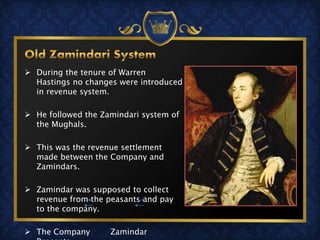
 During the tenure of Warren
Hastings no changes were introduced
in revenue system.
 He followed the Zamindari system of
the Mughals.
 This was the revenue settlement
made between the Company and
Zamindars.
 Zamindar was supposed to collect
revenue from the peasants and pay
to the company.
 The Company Zamindar
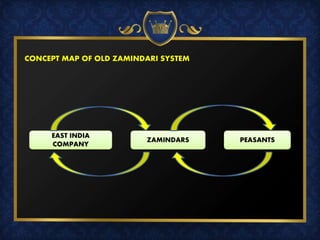
CONCEPT MAP OF OLD ZAMINDARI SYSTEM
EAST INDIA
COMPANY
ZAMINDARS PEASANTS
The need to improve agriculture
PERMANENT SETTLEMENT
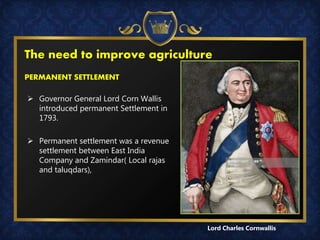
 Governor General Lord Corn Wallis
introduced permanent Settlement in
1793.
 Permanent settlement was a revenue
settlement between East India
Company and Zamindar( Local rajas
and taluqdars),
Lord Charles Cornwallis
FEATURES OF PERMANENT SETTLEMENT
 According to terms of settlement local rajas and taluqdars
were recognised as zamindars.
 These zamindars were asked to collect revenue from
peasants for the company.
 The amount to be paid was fixed permanently and not be
increased in future.
 The purpose was to ensure regular flow of income.
 To encourage zamindars to invest on improving land.
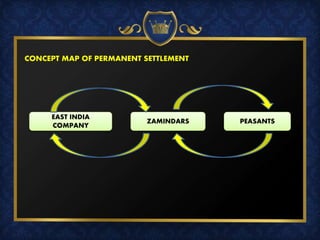
CONCEPT MAP OF PERMANENT SETTLEMENT
EAST INDIA
COMPANY
ZAMINDARS PEASANTS
PERMANENT SETTLEMENT
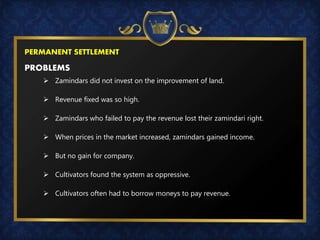
PROBLEMS
 Zamindars did not invest on the improvement of land.
 Revenue fixed was so high.
 Zamindars who failed to pay the revenue lost their zamindari right.
 When prices in the market increased, zamindars gained income.
 But no gain for company.
 Cultivators found the system as oppressive.
 Cultivators often had to borrow moneys to pay revenue.
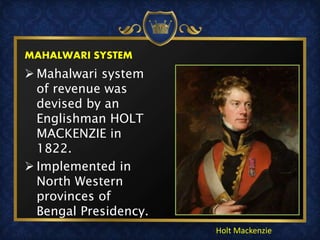
 Mahalwari system
of revenue was
devised by an
Englishman HOLT
MACKENZIE in
1822.
 Implemented in
North Western
provinces of
Bengal Presidency.
Holt Mackenzie
MAHALWARI SYSTEM
MAHALWARI SYSTEM
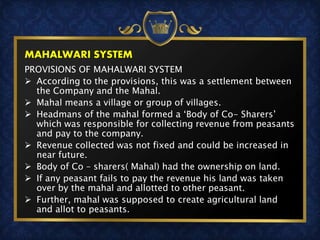
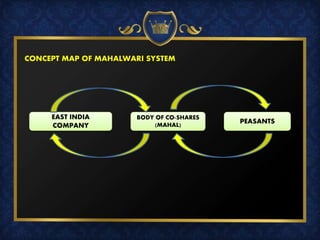
PROVISIONS OF MAHALWARI SYSTEM
 According to the provisions, this was a settlement between
the Company and the Mahal.
 Mahal means a village or group of villages.
 Headmans of the mahal formed a ‘Body of Co- Sharers’
which was responsible for collecting revenue from peasants
and pay to the company.
 Revenue collected was not fixed and could be increased in
near future.
 Body of Co – sharers( Mahal) had the ownership on land.
 If any peasant fails to pay the revenue his land was taken
over by the mahal and allotted to other peasant.
 Further, mahal was supposed to create agricultural land
and allot to peasants.
CONCEPT MAP OF MAHALWARI SYSTEM
EAST INDIA
COMPANY
BODY OF CO-SHARES
(MAHAL)
PEASANTS
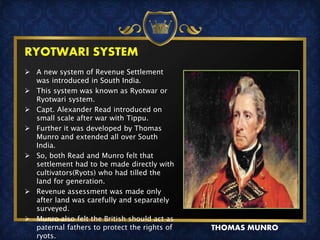
RYOTWARI SYSTEM
 A new system of Revenue Settlement
was introduced in South India.
 This system was known as Ryotwar or
Ryotwari system.
 Capt. Alexander Read introduced on
small scale after war with Tippu.
 Further it was developed by Thomas
Munro and extended all over South
India.
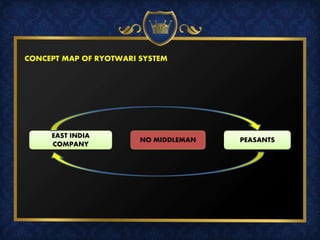
 So, both Read and Munro felt that
settlement had to be made directly with
cultivators(Ryots) who had tilled the
land for generation.
 Revenue assessment was made only
after land was carefully and separately
surveyed.
 Munro also felt the British should act as
paternal fathers to protect the rights of
ryots.
THOMAS MUNRO
CONCEPT MAP OF RYOTWARI SYSTEM
EAST INDIA
COMPANY
NO MIDDLEMAN PEASANTS
All was not well
 None of the revenue settlements was good.
 Revenue rate fixed or collected was very high.
 Peasants fled the countryside due to inability to pay the revenue.
 The imagination of officials of new system transforming peasants into rich
enterprising farmers failed.
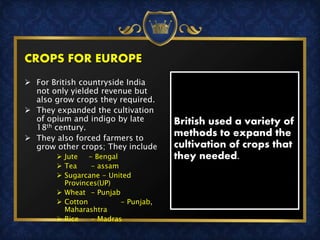
CROPS FOR EUROPE
 For British countryside India
not only yielded revenue but
also grow crops they required.
 They expanded the cultivation
of opium and indigo by late
18th century.
 They also forced farmers to
grow other crops; They include
 Jute - Bengal
 Tea - assam
 Sugarcane - United
Provinces(UP)
 Wheat - Punjab
 Cotton - Punjab,
Maharashtra
 Rice - Madras
British used a variety of
methods to expand the
cultivation of crops that
they needed.
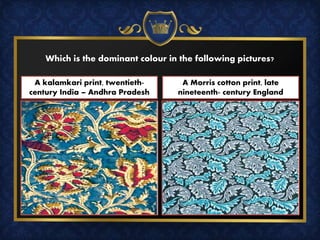
Which is the dominant colour in the following pictures?
A kalamkari print, twentieth-
century India – Andhra Pradesh
A Morris cotton print, late
nineteenth- century England
If your answer is blue, you are correct.
Blue is commonly called as Indigo.
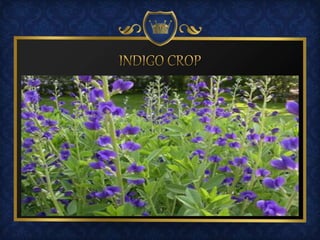
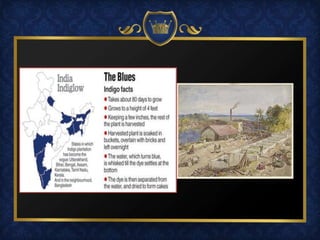
 How is indigo colour produced?
 Indigo colour is produced from a plant called
indigo cultivated in India.
 India was biggest supplier of indigo in the world
during colonial period.
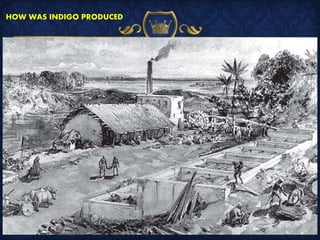
HOW WAS INDIGO PRODUCED
Why the demand for Indian Indigo?
 The indigo plant grows primarily in the tropics.
 By the thirteenth century Indian indigo was being used by
cloth
manufacturers in Italy, France and Britain to dye cloth.
 A small amount of Indian indigo reached European market
and its price was very high.
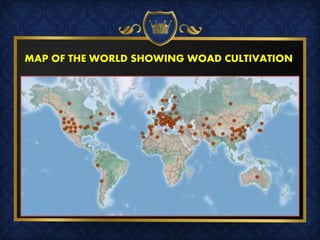
 So European cloth manufacturers depended on woad to
produce blue and violet colour.
 It was grown in Northern Italy and southern France and
parts of Germany and Britain.
 Its producers pressurized their governments to ban import
of Indigo.
 But cloth dyers preferred indigo for its rich blue colour.
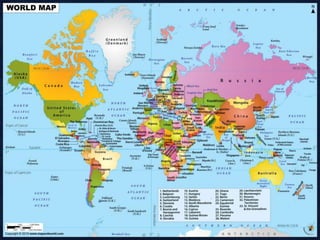
MAP OF THE WORLD SHOWING WOAD CULTIVATION
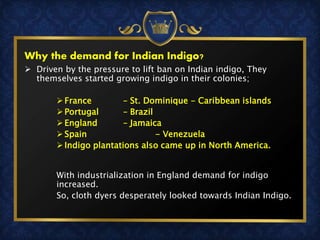
 Driven by the pressure to lift ban on Indian indigo, They
themselves started growing indigo in their colonies;
 France – St. Dominique - Caribbean islands
 Portugal – Brazil
 England – Jamaica
 Spain - Venezuela
 Indigo plantations also came up in North America.
With industrialization in England demand for indigo
increased.
So, cloth dyers desperately looked towards Indian Indigo.
Why the demand for Indian Indigo?
BRITAIN TURNS TO INDIA
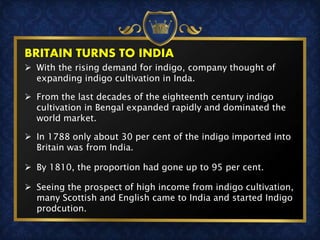
 With the rising demand for indigo, company thought of
expanding indigo cultivation in Inda.
 From the last decades of the eighteenth century indigo
cultivation in Bengal expanded rapidly and dominated the
world market.
 In 1788 only about 30 per cent of the indigo imported into
Britain was from India.
 By 1810, the proportion had gone up to 95 per cent.
 Seeing the prospect of high income from indigo cultivation,
many Scottish and English came to India and started Indigo
prodcution.
HOW WAS INDIGO CULTIVATED?
Methods of Indigo cultivation
 Nij
 Ryoti
Nij System
 nij was a system of indigo cultivation.
 Planter produced indigo in the lands that is directly
controlled by him.
 He either bought or rented the land from others.
 He produced indigo by employing hired labourers.
Problem With NIJ Cultivation
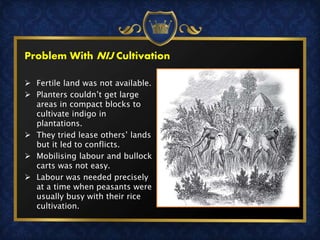
 Fertile land was not available.
 Planters couldn’t get large
areas in compact blocks to
cultivate indigo in
plantations.
 They tried lease others’ lands
but it led to conflicts.
 Mobilising labour and bullock
carts was not easy.
 Labour was needed precisely
at a time when peasants were
usually busy with their rice
cultivation.
 Under ryoti, planters forced peasants(ryots) to sign a
contract(satta)-an agreement.
 Viilage headmans had to sign contract on behalf of ryots.
 Those who signed contract, got cash advance from planters at
low rate of interest to grow indigo.
 But loan committed the ryot to grow indigo on about 25% of
his land holding.
 The planter provided the seed and drill.
 Ryot prepared the soil, sowed seed and looked after the crop.
Ryoti System
Problem with ryoti system
 Once indigo was harvested, a new loan was given to ryot.
 Ryots felt the system was harsh as the cycle of loan was
never ending.
 Ryots got very low price to their indigo.
 The planter chose the best soil in which peasant wanted
cultivate rice.
 After indigo was harvested land could not sown rice as it
lost fertility.
The “Blue Rebellion” and After
 Fed up with oppressive ryoti system peasants decided to not accept
loan anymore.
 This led to clash between planters and peasants when they refused to
grow indigo in March 1859.
 As rebellion spread ryots refused to pay rent, attacked indigo
factories armed with sword, spears, arrows and bows.
 Women too came out with kitchen implements.
 Planters boycotted, gomastas were beaten up.
 In many areas village headmen and zamindars mobilized indigo
peasants and fought pitched battle with lathiyals.
 Because zamindars were also not happy with planters.
 The British government was worried about the possibility of another
popular rebellion after 1857 revolt.
 Lt. governor toured the troubled districts in 1859.
 This was seen as sympathy towards indigo growers.
 Magistrate Ashley Eden issued a notice stating that ryots would not be compelled to
accept indigo contracts.
 Intellectuals of Calcutta visited indigo districts and wrote horror of
indigo system.
 The Government set up Indigo Commission
 The Commission held planters guilty, asked ryots to refuse contracts
in future.
 After the rebellion indigo production in Bengal collapsed and
shifted to Bihar.
 But, discovery of synthetic dye in late nineteenth century indigo
industry severely affected.
 In 1917, Mahatma Gandhi visited Champaner of Bihar to see the
[plight of indigo cultivators and demanded The government to
look into the matter.
CONCLUSION
THANK YOU
Thank you!
You can use this PowerPoint template for free based on creative commons license.
Follow us on Twitter @slideh or subscribe to our mailing list
Or upload your presentation for free and share online in SlideOnline.com
www.SlideHunter.com
Upload to Slide Online.comDownload Free Templates

3. ruling the countryside

  • 2.
    INTRODUCTION  With thevictory in Battle of Buxor, East India Company completed annexation of Bengal.  Company in fact wanted to become the nawab of Bengal instead depending on puppet nawabs.  The purpose was to acquire financial power in its hand.  To realize its ambitions company introduced several economic measures.  They included new revenue settlements.  According to company’s plan its revenue sources could be used for military expenses and buying products to export to Britain.
  • 3.
    The Occasion ofGranting Diwani Right Robert Clive accepting the Diwani of Bengal, Bihar and Orissa from the Mughal emperor Shah Alam-II`
  • 4.
    MAP OF INDIAOF 1765 AND 1805
  • 5.
    COMPANY BECOMES THEDIWAN  The Treaty of Alhabad was concluded on 12 August 1765, between the Mughal emperor Shah Alam – II and The Company ( Robert Clive).  According to which East India Company became the Diwan of Bengal.  That is the right to collect revenue from provinces of Bengal, Orissa and Bihar.  The company became chief financial administrator.  It had to administer land and organize revenue.  The effort was to yield as much revenue as it could to meet its growing expenses.  The company had to buy it needed and sell what it wanted.
  • 6.
     The companywas primarily a trader though it acquired Diwani right.  Unwilling to set up regular system of revenue assessment.  Its effort was to increase revenue to buy cotton and silk at cheaper rate.  Before 1765 company purchased goods by importing gold and silver from England.  Now revenue collected from Bengal could finance for buying goods.  But, artisans deserted villages as they were forced to sell their goods at cheaper price.  So both artisanal and agricultural production declined.  Most disastrous was the death of 10 million people due to famine in 1770. Revenue for the Company
  • 7.
    Peasants and artisansfrom rural areas regularly came to these weekly markets (haats) to sell their goods and buy what they needed. A weekly market in Murshidabad in Bengal.
  • 8.
    REVENUE SETTLEMENTS EMPLOYEDBY THE COMPANY Various revenue system were employed by the company to realize it revenue demand.  Old Zamindari System  Permanent System  Mahalwari system  Ryotwari system
  • 9.
     During thetenure of Warren Hastings no changes were introduced in revenue system.  He followed the Zamindari system of the Mughals.  This was the revenue settlement made between the Company and Zamindars.  Zamindar was supposed to collect revenue from the peasants and pay to the company.  The Company Zamindar
  • 10.
    CONCEPT MAP OFOLD ZAMINDARI SYSTEM EAST INDIA COMPANY ZAMINDARS PEASANTS
  • 11.
    The need toimprove agriculture PERMANENT SETTLEMENT  Governor General Lord Corn Wallis introduced permanent Settlement in 1793.  Permanent settlement was a revenue settlement between East India Company and Zamindar( Local rajas and taluqdars), Lord Charles Cornwallis
  • 12.
    FEATURES OF PERMANENTSETTLEMENT  According to terms of settlement local rajas and taluqdars were recognised as zamindars.  These zamindars were asked to collect revenue from peasants for the company.  The amount to be paid was fixed permanently and not be increased in future.  The purpose was to ensure regular flow of income.  To encourage zamindars to invest on improving land.
  • 13.
    CONCEPT MAP OFPERMANENT SETTLEMENT EAST INDIA COMPANY ZAMINDARS PEASANTS
  • 14.
    PERMANENT SETTLEMENT PROBLEMS  Zamindarsdid not invest on the improvement of land.  Revenue fixed was so high.  Zamindars who failed to pay the revenue lost their zamindari right.  When prices in the market increased, zamindars gained income.  But no gain for company.  Cultivators found the system as oppressive.  Cultivators often had to borrow moneys to pay revenue.
  • 16.
     Mahalwari system ofrevenue was devised by an Englishman HOLT MACKENZIE in 1822.  Implemented in North Western provinces of Bengal Presidency. Holt Mackenzie MAHALWARI SYSTEM
  • 17.
    MAHALWARI SYSTEM PROVISIONS OFMAHALWARI SYSTEM  According to the provisions, this was a settlement between the Company and the Mahal.  Mahal means a village or group of villages.  Headmans of the mahal formed a ‘Body of Co- Sharers’ which was responsible for collecting revenue from peasants and pay to the company.  Revenue collected was not fixed and could be increased in near future.  Body of Co – sharers( Mahal) had the ownership on land.  If any peasant fails to pay the revenue his land was taken over by the mahal and allotted to other peasant.  Further, mahal was supposed to create agricultural land and allot to peasants.
  • 18.
    CONCEPT MAP OFMAHALWARI SYSTEM EAST INDIA COMPANY BODY OF CO-SHARES (MAHAL) PEASANTS
  • 19.
    RYOTWARI SYSTEM  Anew system of Revenue Settlement was introduced in South India.  This system was known as Ryotwar or Ryotwari system.  Capt. Alexander Read introduced on small scale after war with Tippu.  Further it was developed by Thomas Munro and extended all over South India.  So, both Read and Munro felt that settlement had to be made directly with cultivators(Ryots) who had tilled the land for generation.  Revenue assessment was made only after land was carefully and separately surveyed.  Munro also felt the British should act as paternal fathers to protect the rights of ryots. THOMAS MUNRO
  • 20.
    CONCEPT MAP OFRYOTWARI SYSTEM EAST INDIA COMPANY NO MIDDLEMAN PEASANTS
  • 21.
    All was notwell  None of the revenue settlements was good.  Revenue rate fixed or collected was very high.  Peasants fled the countryside due to inability to pay the revenue.  The imagination of officials of new system transforming peasants into rich enterprising farmers failed.
  • 22.
    CROPS FOR EUROPE For British countryside India not only yielded revenue but also grow crops they required.  They expanded the cultivation of opium and indigo by late 18th century.  They also forced farmers to grow other crops; They include  Jute - Bengal  Tea - assam  Sugarcane - United Provinces(UP)  Wheat - Punjab  Cotton - Punjab, Maharashtra  Rice - Madras British used a variety of methods to expand the cultivation of crops that they needed.
  • 23.
    Which is thedominant colour in the following pictures? A kalamkari print, twentieth- century India – Andhra Pradesh A Morris cotton print, late nineteenth- century England
  • 25.
    If your answeris blue, you are correct. Blue is commonly called as Indigo.  How is indigo colour produced?  Indigo colour is produced from a plant called indigo cultivated in India.  India was biggest supplier of indigo in the world during colonial period.
  • 27.
  • 28.
    Why the demandfor Indian Indigo?  The indigo plant grows primarily in the tropics.  By the thirteenth century Indian indigo was being used by cloth manufacturers in Italy, France and Britain to dye cloth.  A small amount of Indian indigo reached European market and its price was very high.  So European cloth manufacturers depended on woad to produce blue and violet colour.  It was grown in Northern Italy and southern France and parts of Germany and Britain.  Its producers pressurized their governments to ban import of Indigo.  But cloth dyers preferred indigo for its rich blue colour.
  • 29.
    MAP OF THEWORLD SHOWING WOAD CULTIVATION
  • 30.
     Driven bythe pressure to lift ban on Indian indigo, They themselves started growing indigo in their colonies;  France – St. Dominique - Caribbean islands  Portugal – Brazil  England – Jamaica  Spain - Venezuela  Indigo plantations also came up in North America. With industrialization in England demand for indigo increased. So, cloth dyers desperately looked towards Indian Indigo. Why the demand for Indian Indigo?
  • 32.
    BRITAIN TURNS TOINDIA  With the rising demand for indigo, company thought of expanding indigo cultivation in Inda.  From the last decades of the eighteenth century indigo cultivation in Bengal expanded rapidly and dominated the world market.  In 1788 only about 30 per cent of the indigo imported into Britain was from India.  By 1810, the proportion had gone up to 95 per cent.  Seeing the prospect of high income from indigo cultivation, many Scottish and English came to India and started Indigo prodcution.
  • 33.
    HOW WAS INDIGOCULTIVATED? Methods of Indigo cultivation  Nij  Ryoti
  • 34.
    Nij System  nijwas a system of indigo cultivation.  Planter produced indigo in the lands that is directly controlled by him.  He either bought or rented the land from others.  He produced indigo by employing hired labourers.
  • 35.
    Problem With NIJCultivation  Fertile land was not available.  Planters couldn’t get large areas in compact blocks to cultivate indigo in plantations.  They tried lease others’ lands but it led to conflicts.  Mobilising labour and bullock carts was not easy.  Labour was needed precisely at a time when peasants were usually busy with their rice cultivation.
  • 36.
     Under ryoti,planters forced peasants(ryots) to sign a contract(satta)-an agreement.  Viilage headmans had to sign contract on behalf of ryots.  Those who signed contract, got cash advance from planters at low rate of interest to grow indigo.  But loan committed the ryot to grow indigo on about 25% of his land holding.  The planter provided the seed and drill.  Ryot prepared the soil, sowed seed and looked after the crop. Ryoti System
  • 37.
    Problem with ryotisystem  Once indigo was harvested, a new loan was given to ryot.  Ryots felt the system was harsh as the cycle of loan was never ending.  Ryots got very low price to their indigo.  The planter chose the best soil in which peasant wanted cultivate rice.  After indigo was harvested land could not sown rice as it lost fertility.
  • 38.
    The “Blue Rebellion”and After  Fed up with oppressive ryoti system peasants decided to not accept loan anymore.  This led to clash between planters and peasants when they refused to grow indigo in March 1859.  As rebellion spread ryots refused to pay rent, attacked indigo factories armed with sword, spears, arrows and bows.  Women too came out with kitchen implements.  Planters boycotted, gomastas were beaten up.  In many areas village headmen and zamindars mobilized indigo peasants and fought pitched battle with lathiyals.  Because zamindars were also not happy with planters.
  • 39.
     The Britishgovernment was worried about the possibility of another popular rebellion after 1857 revolt.  Lt. governor toured the troubled districts in 1859.  This was seen as sympathy towards indigo growers.  Magistrate Ashley Eden issued a notice stating that ryots would not be compelled to accept indigo contracts.  Intellectuals of Calcutta visited indigo districts and wrote horror of indigo system.  The Government set up Indigo Commission  The Commission held planters guilty, asked ryots to refuse contracts in future.
  • 40.
     After therebellion indigo production in Bengal collapsed and shifted to Bihar.  But, discovery of synthetic dye in late nineteenth century indigo industry severely affected.  In 1917, Mahatma Gandhi visited Champaner of Bihar to see the [plight of indigo cultivators and demanded The government to look into the matter.
  • 42.
  • 43.
  • 44.
    Thank you! You canuse this PowerPoint template for free based on creative commons license. Follow us on Twitter @slideh or subscribe to our mailing list Or upload your presentation for free and share online in SlideOnline.com www.SlideHunter.com Upload to Slide Online.comDownload Free Templates

Editor's Notes

  • #45 You can remove this slide if you need. But we will strongly appreciate that you help us to spread the voice and let your colleagues and audience to download our free templates. Here are a free resources: Prepare your presentations: SlideHunter.com lets you download free templates for your presentations. Share online: SlideOnline.com lets you upload presentations for free.