Page 1 of 9
Rules of Stress & Intonation in English
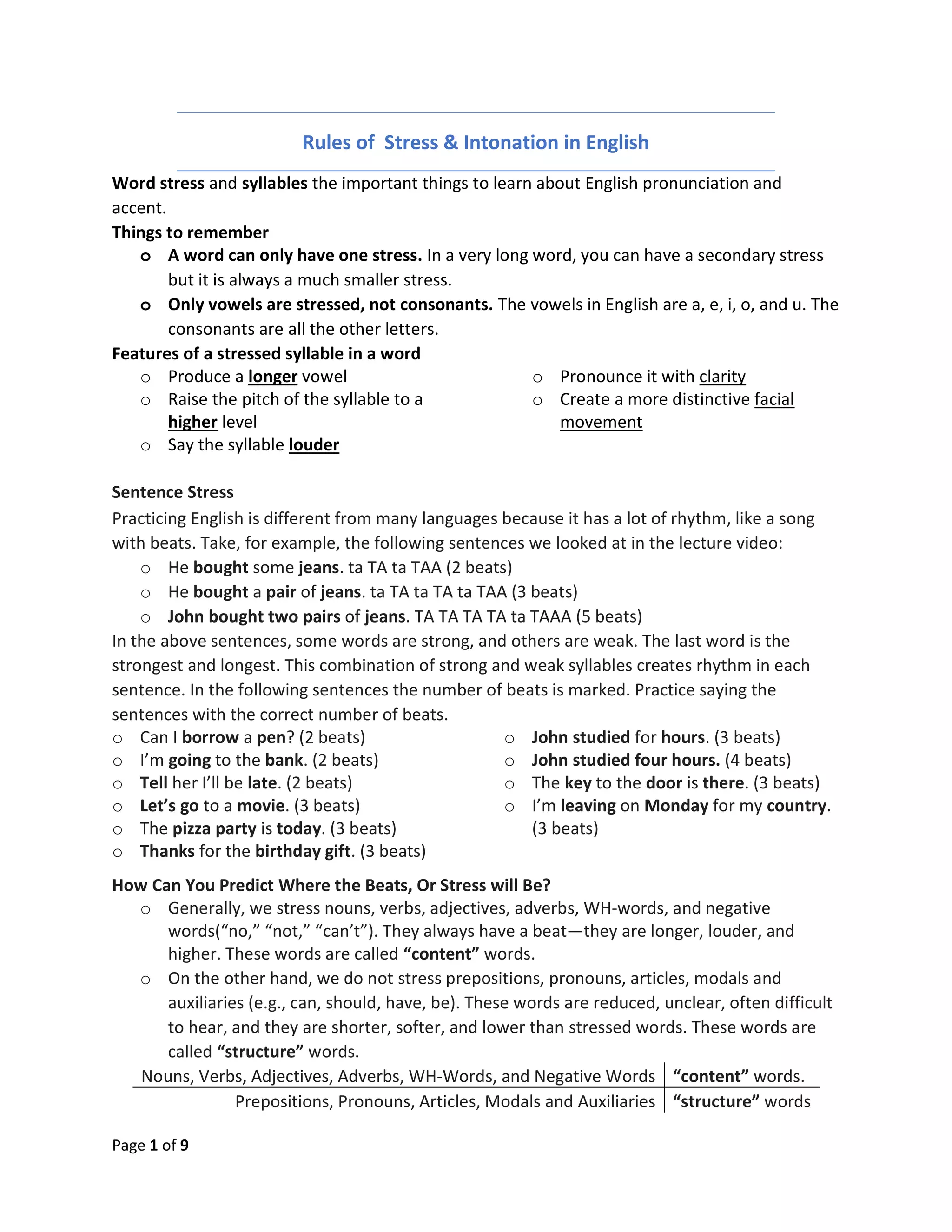
Word stress and syllables the important things to learn about English pronunciation and
accent.
Things to remember
o A word can only have one stress. In a very long word, you can have a secondary stress
but it is always a much smaller stress.
o Only vowels are stressed, not consonants. The vowels in English are a, e, i, o, and u. The
consonants are all the other letters.
Features of a stressed syllable in a word
o Produce a longer vowel
o Raise the pitch of the syllable to a
higher level
o Say the syllable louder
o Pronounce it with clarity
o Create a more distinctive facial
movement
Sentence Stress
Practicing English is different from many languages because it has a lot of rhythm, like a song
with beats. Take, for example, the following sentences we looked at in the lecture video:
o He bought some jeans. ta TA ta TAA (2 beats)
o He bought a pair of jeans. ta TA ta TA ta TAA (3 beats)
o John bought two pairs of jeans. TA TA TA TA ta TAAA (5 beats)
In the above sentences, some words are strong, and others are weak. The last word is the
strongest and longest. This combination of strong and weak syllables creates rhythm in each
sentence. In the following sentences the number of beats is marked. Practice saying the
sentences with the correct number of beats.
o Can I borrow a pen? (2 beats)
o I’m going to the bank. (2 beats)
o Tell her I’ll be late. (2 beats)
o Let’s go to a movie. (3 beats)
o The pizza party is today. (3 beats)
o Thanks for the birthday gift. (3 beats)
o John studied for hours. (3 beats)
o John studied four hours. (4 beats)
o The key to the door is there. (3 beats)
o I’m leaving on Monday for my country.
(3 beats)
How Can You Predict Where the Beats, Or Stress will Be?
o Generally, we stress nouns, verbs, adjectives, adverbs, WH-words, and negative
words(“no,” “not,” “can’t”). They always have a beat—they are longer, louder, and
higher. These words are called “content” words.
o On the other hand, we do not stress prepositions, pronouns, articles, modals and
auxiliaries (e.g., can, should, have, be). These words are reduced, unclear, often difficult
to hear, and they are shorter, softer, and lower than stressed words. These words are
called “structure” words.
Nouns, Verbs, Adjectives, Adverbs, WH-Words, and Negative Words “content” words.
Prepositions, Pronouns, Articles, Modals and Auxiliaries “structure” words
Page 2 of 9
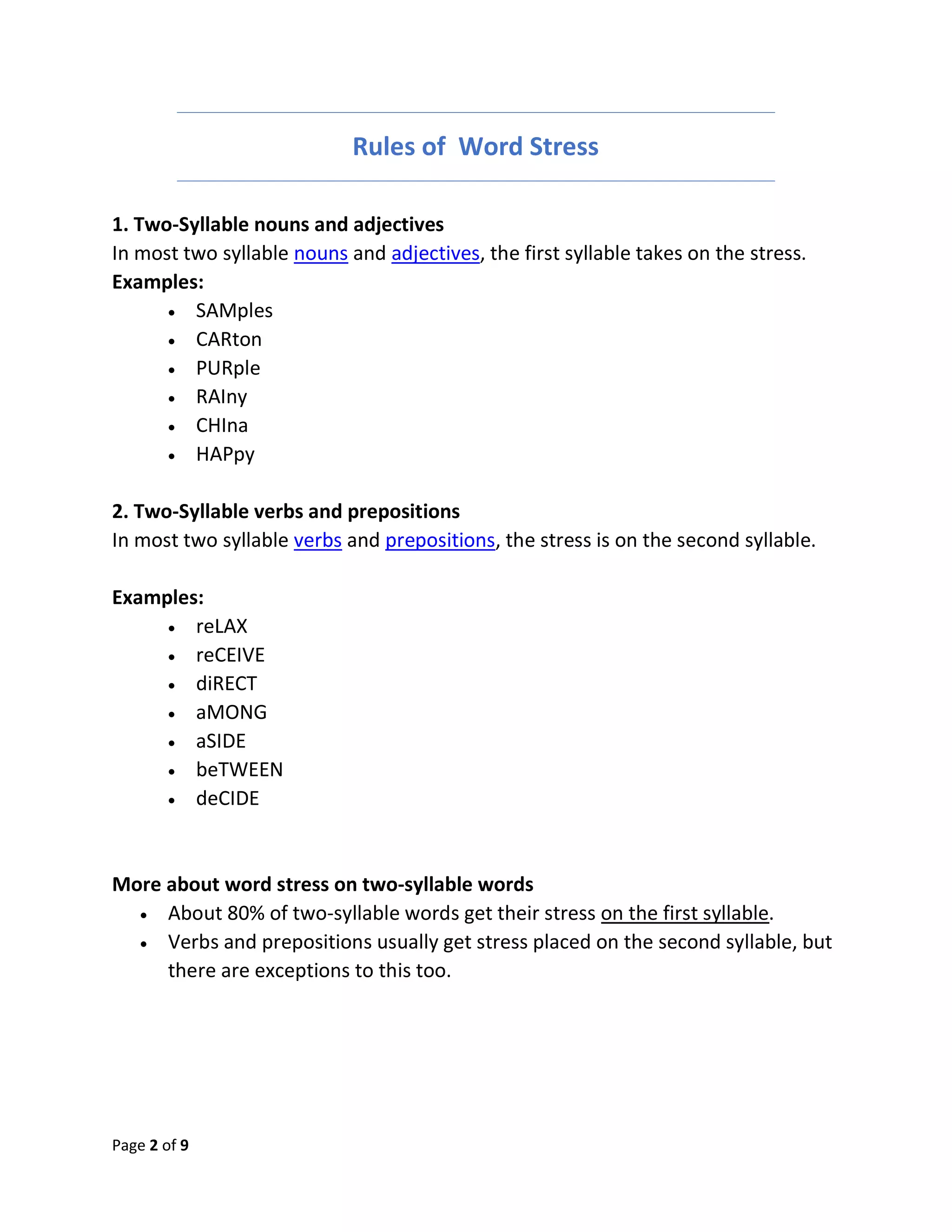
Rules of Word Stress
1. Two-Syllable nouns and adjectives
In most two syllable nouns and adjectives, the first syllable takes on the stress.
Examples:
 SAMples
 CARton
 PURple
 RAIny
 CHIna
 HAPpy
2. Two-Syllable verbs and prepositions
In most two syllable verbs and prepositions, the stress is on the second syllable.
Examples:
 reLAX
 reCEIVE
 diRECT
 aMONG
 aSIDE
 beTWEEN
 deCIDE
More about word stress on two-syllable words
 About 80% of two-syllable words get their stress on the first syllable.
 Verbs and prepositions usually get stress placed on the second syllable, but
there are exceptions to this too.
Page 3 of 9
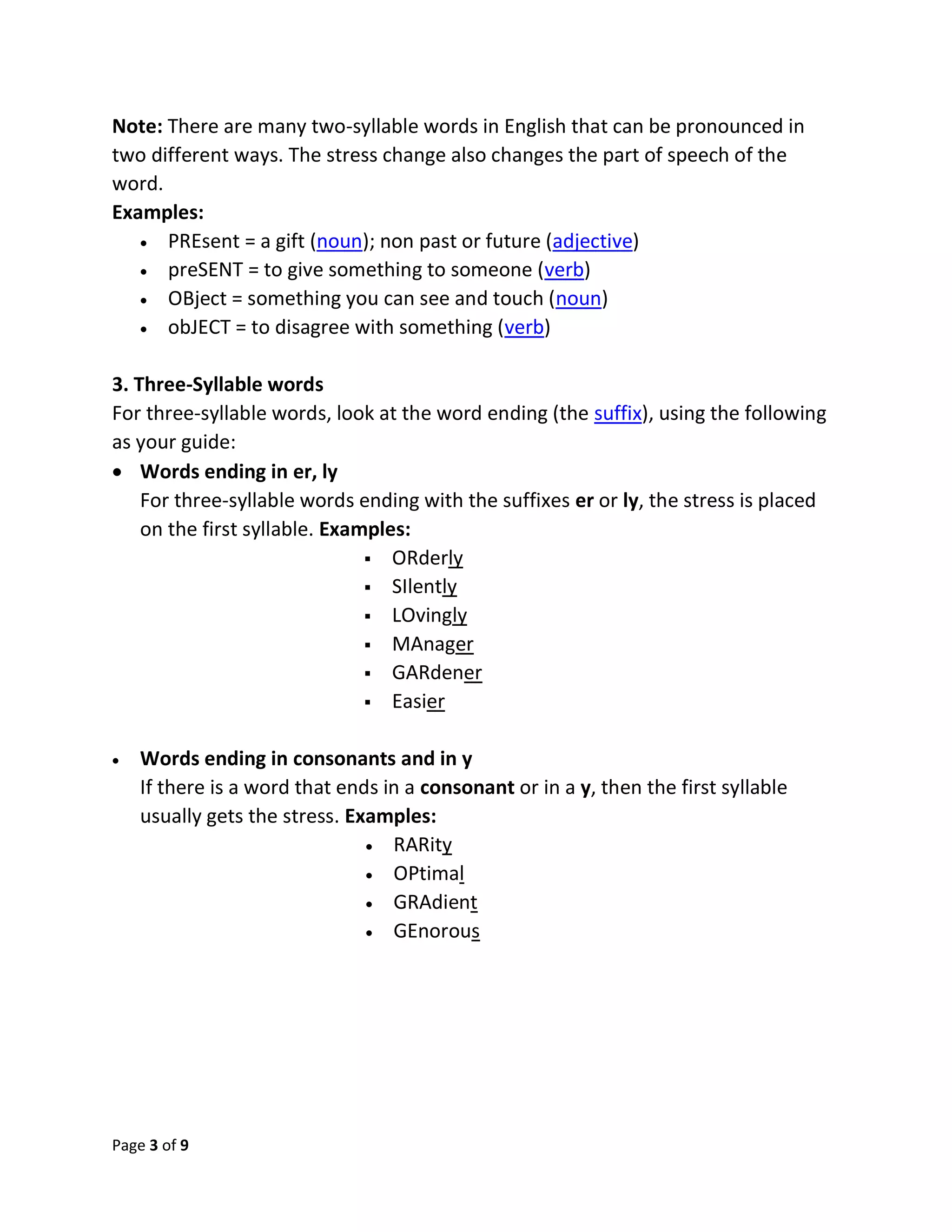
Note: There are many two-syllable words in English that can be pronounced in
two different ways. The stress change also changes the part of speech of the
word.
Examples:
 PREsent = a gift (noun); non past or future (adjective)
 preSENT = to give something to someone (verb)
 OBject = something you can see and touch (noun)
 obJECT = to disagree with something (verb)
3. Three-Syllable words
For three-syllable words, look at the word ending (the suffix), using the following
as your guide:
 Words ending in er, ly
For three-syllable words ending with the suffixes er or ly, the stress is placed
on the first syllable. Examples:
 ORderly
 SIlently
 LOvingly
 MAnager
 GARdener
 Easier
 Words ending in consonants and in y
If there is a word that ends in a consonant or in a y, then the first syllable
usually gets the stress. Examples:
 RARity
 OPtimal
 GRAdient
 GEnorous
Page 4 of 9
4. Words with various endings
Take a good look at the list of suffixes below.
The stress is going to be on the syllable right before the suffix. This applies to
words of all syllable lengths.
Examples:
I. able: ADDable, DURable, LAUGHable
II. ial: differENTial, SOcial, fiNANcial
III. cian: muSIcian, phySIcian, cliNIcian
IV. ery: BAkery, SCEnery
V. ian: coMEdian, ciVILian, techNIcian
VI. ible: reSIstible, imPOSsible, TERRible
VII. ic: arCHAic, plaTOnic, characteRIStic
VIII. ics: diaBEtics, paediAtrics, TOpics
IX. ion: classifiCAtion, repoSItion, vegeTAtion
X. ia: MEdia, bacTERia, vicTORia
XI. ient: inGREdient, PAtient, ANcient
XII. ious: mySTERious, reLIgious, VARious
XIII. ish: SELfish, ENglish, PUnish
XIV. osis: hypNOsis, diagNOsis, osmosis
5. Words ending in ade, ee, ese, que, ette, oon
Words that use the suffix ade, ee, ese, eer, que, ette, or oon have the primary
stress actually placed on the suffix.
This applies to words of all syllable lengths.
Examples:
I. ade: lemoNADE, cruSADE, arCADE
II. ee: aGREE, jamborEE, guaranTEE
III. eer: sightSEER, puppeTEER
IV. ese: SiamESE, JapanESE, chEESE
V. ette: cassETTE, CorvETTE, towelETTE
VI. que: unIQUE, physIQUE
VII. oon: baLOON, afterNOON, carTOON
Page 5 of 9
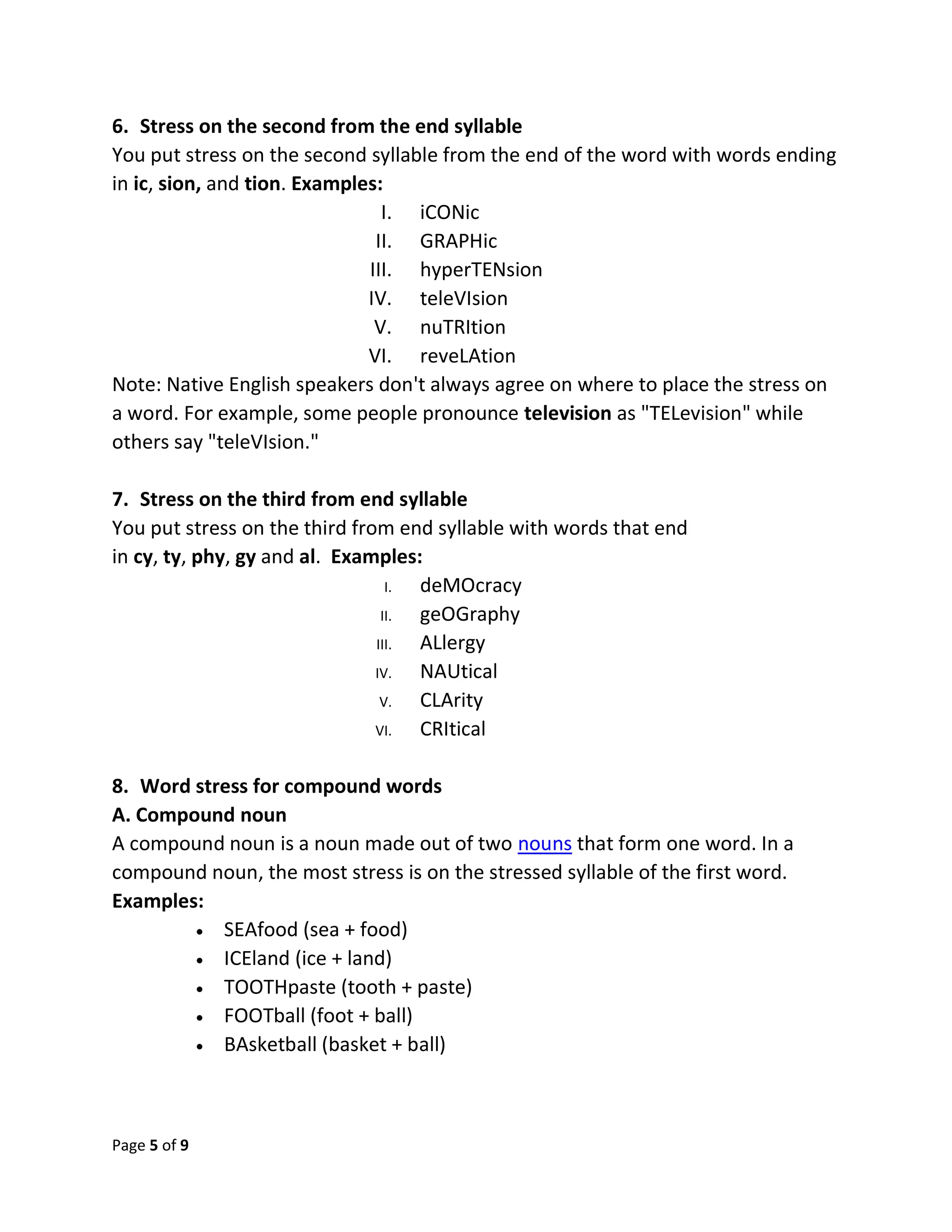
6. Stress on the second from the end syllable
You put stress on the second syllable from the end of the word with words ending
in ic, sion, and tion. Examples:
I. iCONic
II. GRAPHic
III. hyperTENsion
IV. teleVIsion
V. nuTRItion
VI. reveLAtion
Note: Native English speakers don't always agree on where to place the stress on
a word. For example, some people pronounce television as "TELevision" while
others say "teleVIsion."
7. Stress on the third from end syllable
You put stress on the third from end syllable with words that end
in cy, ty, phy, gy and al. Examples:
I. deMOcracy
II. geOGraphy
III. ALlergy
IV. NAUtical
V. CLArity
VI. CRItical
8. Word stress for compound words
A. Compound noun
A compound noun is a noun made out of two nouns that form one word. In a
compound noun, the most stress is on the stressed syllable of the first word.
Examples:
 SEAfood (sea + food)
 ICEland (ice + land)
 TOOTHpaste (tooth + paste)
 FOOTball (foot + ball)
 BAsketball (basket + ball)
Page 6 of 9
B. Compound adjectives
A compound adjective is an adjective made of at least two words.
Often, hyphens are used in compound adjectives. In compound adjectives, the
most stress is placed in the stressed syllable of the second word.
Examples:
 ten-MEter
 rock-SOlid
 fifteen-MInute
 old-FAshioned
C. Compound verbs
A compound verb is when a subject has two or more verbs. The stress is on the
second or on the last part. Examples:
 Matilda loves bread but deTESTS butter.
 Sarah baked cookies and ATE them up.
 Dogs love to eat bones and love to DRINK water.
D. Noun + compound nouns
Noun + compound Nouns are two word compound nouns. In noun + compound
noun, the stress is on the first word.
Examples:
 AIRplane mechanic
 PROject manager
 BOARD member
9. Proper nouns
Proper nouns are specific names of people, places or things. For example: Jeniffer,
Spain, Google. The second word is always the one that takes the stress.
Examples:
 North DAKOTA
 Mr. SMITH
 Apple INCORPORATED
Page 7 of 9
10.Reflexive pronouns
Reflexive pronouns show that the action affects the person who performs the
action. For example: I hit myself. The second syllable usually takes the stress.
Examples:
 mySELF
 themSELVES
 ourselves
1. Numbers
If the number is a multiple of ten, the stress is placed on the first syllable.
Examples:
 TEN
 FIFty
 ONE-hundred
Stress Rules | coursera
Although English stress varies considerably, there are a few rules that will help you predict stress.
Stress Rule 1
Stress One- and Two-Word Compound Nouns on the 1st Word
air
conditioner
database handout pancake summertime
airplane daycare headache paperback sunglasses
airfare deadline headline parking lot sunscreen
airport debit card high school passport supermarket
apartment
building
daydream highway password sweatshirt
automobile
department
store
homework peanuts sweatpants
bachelor’s
degree
dining room homesick
peanut
butter
swimming
pool
backpack dishwasher hotdog phone call swimsuit
baseball
driver’s
license
household
police
officer
sunrise
Page 8 of 9
bathroom driver’s test housewife popcorn sunset
beach ball driveway ice cream post office sunshine
beach towel drugstore internet raincoat teammate
bedroom earrings keyboard reality show thunderstorm
birthday earthquake
language
school
redhead toenail
bookstore eyebrows laptop restroom toothache
boyfriend eyelashes layoff
rock
concert
tooth brush
breakdown father-in-law lipstick sailboat toothpaste
breakfast fingernail liquor store seashells townhouse
breakup firefighter living room seashore toy store
bus stop flashlight lunchroom seasick truck driver
candy bar football makeup seatbelt T-shirt
can opener frenchfries
master’s
degree
security
guard
vacuum
cleaner
cell phone friendship men’s room shoe store voicemail
checkbook frying pan microwave
shopping
mall
volleyball
checking
account
gas station mother-in-law sit-ups wash cloth
cheesecake girlfriend motorcycle six-pack
washing
machine
chewing gum golf ball movie theater snowstorm watchdog
classmate grandfather necklace soccer ball watchman
cockroach grandmother neighborhood softball website
coffee cup grocery store newspaper soft drink weekend
coffee maker haircut nightmare software White House
copy machine hairdresser nighttime
stomach
ache
wintertime
credit card hamburger notebook stoplight women’s room
Page 9 of 9
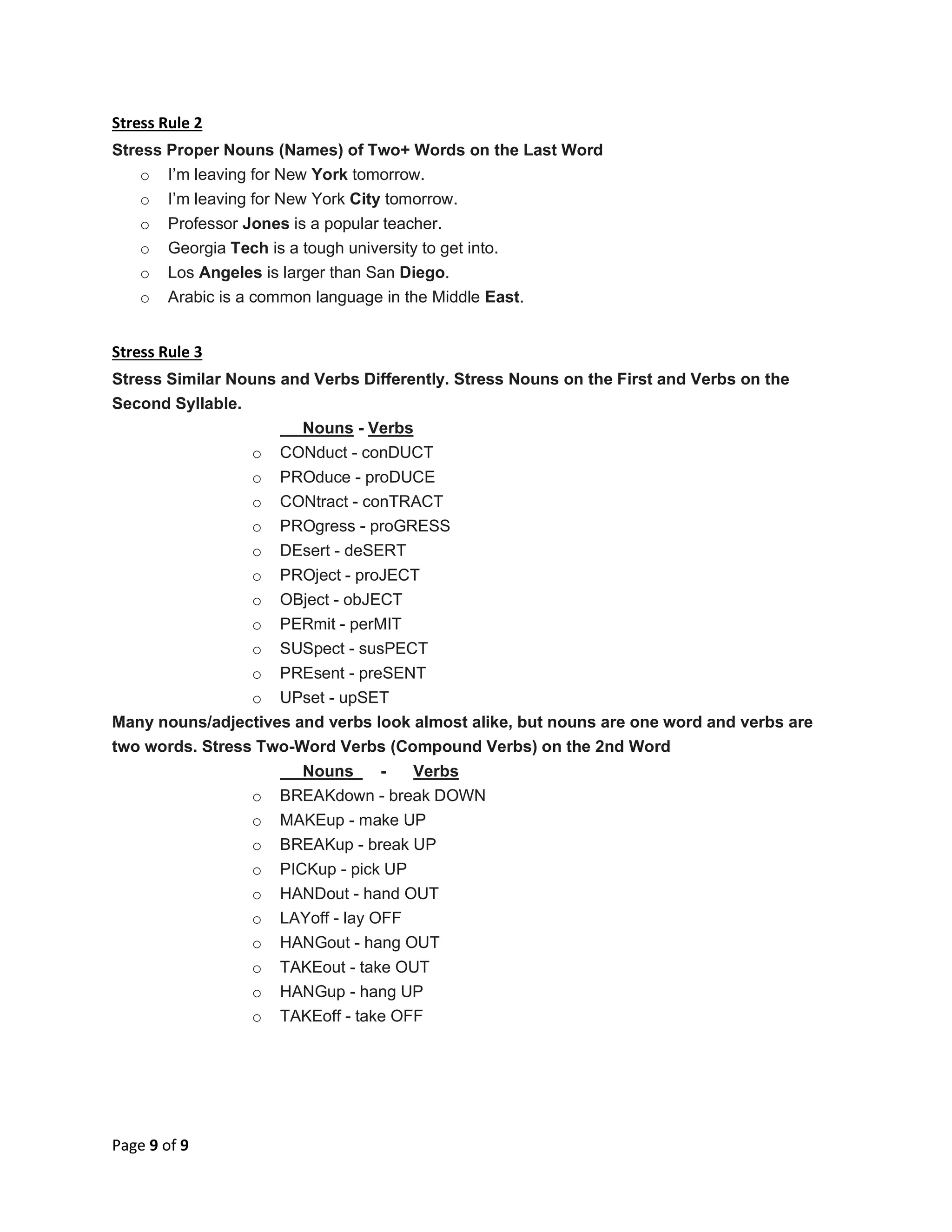
Stress Rule 2
Stress Proper Nouns (Names) of Two+ Words on the Last Word
o I’m leaving for New York tomorrow.
o I’m leaving for New York City tomorrow.
o Professor Jones is a popular teacher.
o Georgia Tech is a tough university to get into.
o Los Angeles is larger than San Diego.
o Arabic is a common language in the Middle East.
Stress Rule 3
Stress Similar Nouns and Verbs Differently. Stress Nouns on the First and Verbs on the
Second Syllable.
Nouns - Verbs
o CONduct - conDUCT
o PROduce - proDUCE
o CONtract - conTRACT
o PROgress - proGRESS
o DEsert - deSERT
o PROject - proJECT
o OBject - obJECT
o PERmit - perMIT
o SUSpect - susPECT
o PREsent - preSENT
o UPset - upSET
Many nouns/adjectives and verbs look almost alike, but nouns are one word and verbs are
two words. Stress Two-Word Verbs (Compound Verbs) on the 2nd Word
Nouns - Verbs
o BREAKdown - break DOWN
o MAKEup - make UP
o BREAKup - break UP
o PICKup - pick UP
o HANDout - hand OUT
o LAYoff - lay OFF
o HANGout - hang OUT
o TAKEout - take OUT
o HANGup - hang UP
o TAKEoff - take OFF

Rules of word & sentence stress and intonation

  • 1.
    Page 1 of9 Rules of Stress & Intonation in English Word stress and syllables the important things to learn about English pronunciation and accent. Things to remember o A word can only have one stress. In a very long word, you can have a secondary stress but it is always a much smaller stress. o Only vowels are stressed, not consonants. The vowels in English are a, e, i, o, and u. The consonants are all the other letters. Features of a stressed syllable in a word o Produce a longer vowel o Raise the pitch of the syllable to a higher level o Say the syllable louder o Pronounce it with clarity o Create a more distinctive facial movement Sentence Stress Practicing English is different from many languages because it has a lot of rhythm, like a song with beats. Take, for example, the following sentences we looked at in the lecture video: o He bought some jeans. ta TA ta TAA (2 beats) o He bought a pair of jeans. ta TA ta TA ta TAA (3 beats) o John bought two pairs of jeans. TA TA TA TA ta TAAA (5 beats) In the above sentences, some words are strong, and others are weak. The last word is the strongest and longest. This combination of strong and weak syllables creates rhythm in each sentence. In the following sentences the number of beats is marked. Practice saying the sentences with the correct number of beats. o Can I borrow a pen? (2 beats) o I’m going to the bank. (2 beats) o Tell her I’ll be late. (2 beats) o Let’s go to a movie. (3 beats) o The pizza party is today. (3 beats) o Thanks for the birthday gift. (3 beats) o John studied for hours. (3 beats) o John studied four hours. (4 beats) o The key to the door is there. (3 beats) o I’m leaving on Monday for my country. (3 beats) How Can You Predict Where the Beats, Or Stress will Be? o Generally, we stress nouns, verbs, adjectives, adverbs, WH-words, and negative words(“no,” “not,” “can’t”). They always have a beat—they are longer, louder, and higher. These words are called “content” words. o On the other hand, we do not stress prepositions, pronouns, articles, modals and auxiliaries (e.g., can, should, have, be). These words are reduced, unclear, often difficult to hear, and they are shorter, softer, and lower than stressed words. These words are called “structure” words. Nouns, Verbs, Adjectives, Adverbs, WH-Words, and Negative Words “content” words. Prepositions, Pronouns, Articles, Modals and Auxiliaries “structure” words
  • 2.
    Page 2 of9 Rules of Word Stress 1. Two-Syllable nouns and adjectives In most two syllable nouns and adjectives, the first syllable takes on the stress. Examples:  SAMples  CARton  PURple  RAIny  CHIna  HAPpy 2. Two-Syllable verbs and prepositions In most two syllable verbs and prepositions, the stress is on the second syllable. Examples:  reLAX  reCEIVE  diRECT  aMONG  aSIDE  beTWEEN  deCIDE More about word stress on two-syllable words  About 80% of two-syllable words get their stress on the first syllable.  Verbs and prepositions usually get stress placed on the second syllable, but there are exceptions to this too.
  • 3.
    Page 3 of9 Note: There are many two-syllable words in English that can be pronounced in two different ways. The stress change also changes the part of speech of the word. Examples:  PREsent = a gift (noun); non past or future (adjective)  preSENT = to give something to someone (verb)  OBject = something you can see and touch (noun)  obJECT = to disagree with something (verb) 3. Three-Syllable words For three-syllable words, look at the word ending (the suffix), using the following as your guide:  Words ending in er, ly For three-syllable words ending with the suffixes er or ly, the stress is placed on the first syllable. Examples:  ORderly  SIlently  LOvingly  MAnager  GARdener  Easier  Words ending in consonants and in y If there is a word that ends in a consonant or in a y, then the first syllable usually gets the stress. Examples:  RARity  OPtimal  GRAdient  GEnorous
  • 4.
    Page 4 of9 4. Words with various endings Take a good look at the list of suffixes below. The stress is going to be on the syllable right before the suffix. This applies to words of all syllable lengths. Examples: I. able: ADDable, DURable, LAUGHable II. ial: differENTial, SOcial, fiNANcial III. cian: muSIcian, phySIcian, cliNIcian IV. ery: BAkery, SCEnery V. ian: coMEdian, ciVILian, techNIcian VI. ible: reSIstible, imPOSsible, TERRible VII. ic: arCHAic, plaTOnic, characteRIStic VIII. ics: diaBEtics, paediAtrics, TOpics IX. ion: classifiCAtion, repoSItion, vegeTAtion X. ia: MEdia, bacTERia, vicTORia XI. ient: inGREdient, PAtient, ANcient XII. ious: mySTERious, reLIgious, VARious XIII. ish: SELfish, ENglish, PUnish XIV. osis: hypNOsis, diagNOsis, osmosis 5. Words ending in ade, ee, ese, que, ette, oon Words that use the suffix ade, ee, ese, eer, que, ette, or oon have the primary stress actually placed on the suffix. This applies to words of all syllable lengths. Examples: I. ade: lemoNADE, cruSADE, arCADE II. ee: aGREE, jamborEE, guaranTEE III. eer: sightSEER, puppeTEER IV. ese: SiamESE, JapanESE, chEESE V. ette: cassETTE, CorvETTE, towelETTE VI. que: unIQUE, physIQUE VII. oon: baLOON, afterNOON, carTOON
  • 5.
    Page 5 of9 6. Stress on the second from the end syllable You put stress on the second syllable from the end of the word with words ending in ic, sion, and tion. Examples: I. iCONic II. GRAPHic III. hyperTENsion IV. teleVIsion V. nuTRItion VI. reveLAtion Note: Native English speakers don't always agree on where to place the stress on a word. For example, some people pronounce television as "TELevision" while others say "teleVIsion." 7. Stress on the third from end syllable You put stress on the third from end syllable with words that end in cy, ty, phy, gy and al. Examples: I. deMOcracy II. geOGraphy III. ALlergy IV. NAUtical V. CLArity VI. CRItical 8. Word stress for compound words A. Compound noun A compound noun is a noun made out of two nouns that form one word. In a compound noun, the most stress is on the stressed syllable of the first word. Examples:  SEAfood (sea + food)  ICEland (ice + land)  TOOTHpaste (tooth + paste)  FOOTball (foot + ball)  BAsketball (basket + ball)
  • 6.
    Page 6 of9 B. Compound adjectives A compound adjective is an adjective made of at least two words. Often, hyphens are used in compound adjectives. In compound adjectives, the most stress is placed in the stressed syllable of the second word. Examples:  ten-MEter  rock-SOlid  fifteen-MInute  old-FAshioned C. Compound verbs A compound verb is when a subject has two or more verbs. The stress is on the second or on the last part. Examples:  Matilda loves bread but deTESTS butter.  Sarah baked cookies and ATE them up.  Dogs love to eat bones and love to DRINK water. D. Noun + compound nouns Noun + compound Nouns are two word compound nouns. In noun + compound noun, the stress is on the first word. Examples:  AIRplane mechanic  PROject manager  BOARD member 9. Proper nouns Proper nouns are specific names of people, places or things. For example: Jeniffer, Spain, Google. The second word is always the one that takes the stress. Examples:  North DAKOTA  Mr. SMITH  Apple INCORPORATED
  • 7.
    Page 7 of9 10.Reflexive pronouns Reflexive pronouns show that the action affects the person who performs the action. For example: I hit myself. The second syllable usually takes the stress. Examples:  mySELF  themSELVES  ourselves 1. Numbers If the number is a multiple of ten, the stress is placed on the first syllable. Examples:  TEN  FIFty  ONE-hundred Stress Rules | coursera Although English stress varies considerably, there are a few rules that will help you predict stress. Stress Rule 1 Stress One- and Two-Word Compound Nouns on the 1st Word air conditioner database handout pancake summertime airplane daycare headache paperback sunglasses airfare deadline headline parking lot sunscreen airport debit card high school passport supermarket apartment building daydream highway password sweatshirt automobile department store homework peanuts sweatpants bachelor’s degree dining room homesick peanut butter swimming pool backpack dishwasher hotdog phone call swimsuit baseball driver’s license household police officer sunrise
  • 8.
    Page 8 of9 bathroom driver’s test housewife popcorn sunset beach ball driveway ice cream post office sunshine beach towel drugstore internet raincoat teammate bedroom earrings keyboard reality show thunderstorm birthday earthquake language school redhead toenail bookstore eyebrows laptop restroom toothache boyfriend eyelashes layoff rock concert tooth brush breakdown father-in-law lipstick sailboat toothpaste breakfast fingernail liquor store seashells townhouse breakup firefighter living room seashore toy store bus stop flashlight lunchroom seasick truck driver candy bar football makeup seatbelt T-shirt can opener frenchfries master’s degree security guard vacuum cleaner cell phone friendship men’s room shoe store voicemail checkbook frying pan microwave shopping mall volleyball checking account gas station mother-in-law sit-ups wash cloth cheesecake girlfriend motorcycle six-pack washing machine chewing gum golf ball movie theater snowstorm watchdog classmate grandfather necklace soccer ball watchman cockroach grandmother neighborhood softball website coffee cup grocery store newspaper soft drink weekend coffee maker haircut nightmare software White House copy machine hairdresser nighttime stomach ache wintertime credit card hamburger notebook stoplight women’s room
  • 9.
    Page 9 of9 Stress Rule 2 Stress Proper Nouns (Names) of Two+ Words on the Last Word o I’m leaving for New York tomorrow. o I’m leaving for New York City tomorrow. o Professor Jones is a popular teacher. o Georgia Tech is a tough university to get into. o Los Angeles is larger than San Diego. o Arabic is a common language in the Middle East. Stress Rule 3 Stress Similar Nouns and Verbs Differently. Stress Nouns on the First and Verbs on the Second Syllable. Nouns - Verbs o CONduct - conDUCT o PROduce - proDUCE o CONtract - conTRACT o PROgress - proGRESS o DEsert - deSERT o PROject - proJECT o OBject - obJECT o PERmit - perMIT o SUSpect - susPECT o PREsent - preSENT o UPset - upSET Many nouns/adjectives and verbs look almost alike, but nouns are one word and verbs are two words. Stress Two-Word Verbs (Compound Verbs) on the 2nd Word Nouns - Verbs o BREAKdown - break DOWN o MAKEup - make UP o BREAKup - break UP o PICKup - pick UP o HANDout - hand OUT o LAYoff - lay OFF o HANGout - hang OUT o TAKEout - take OUT o HANGup - hang UP o TAKEoff - take OFF