BUS 521: Operations Management
An Assignment on
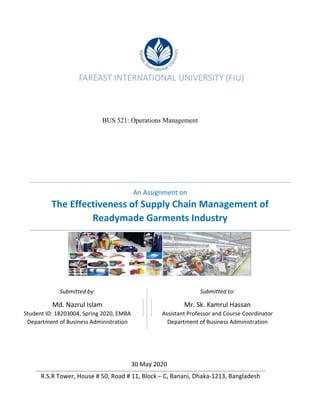
The Effectiveness of Supply Chain Management of
Readymade Garments Industry
Submitted by:
Md. Nazrul Islam
Student ID: 18203004, Spring 2020, EMBA
Department of Business Administration
Submitted to:
Mr. Sk. Kamrul Hassan
Assistant Professor and Course Coordinator
Department of Business Administration
FAREAST INTERNATIONAL UNIVERSITY (FIU)
30 May 2020
R.S.R Tower, House # 50, Road # 11, Block – C, Banani, Dhaka-1213, Bangladesh
Page | 2
Table of Contents
INTRODUCTION.............................................................................................................................................3
OBJECTIVES OF THE STUDY...........................................................................................................................3
METHODOLOGY ............................................................................................................................................3
DISCUSSION...................................................................................................................................................3
Supply Chain Management (SCM) and its Framework .............................................................................3
Factors Affecting Effectiveness of SCM ....................................................................................................5
Overview of Existing SCM In Bangladesh RMG Industry...........................................................................5
CONCLUSION.................................................................................................................................................6
RECOMMENDATION .....................................................................................................................................6
REFERENCES..................................................................................................................................................7
Page | 3
INTRODUCTION
Effective Supply Chain Management(SCM) is very crucial for RMG industry to remain
competitive in the global market. The Readymade Garment(RMG) Industry of Bangladesh has
turned in to the largest foreign exchange earning sector which is exporting all kinds of apparel
garments to the USA, Europe and other developed countries of the world and importing
unavailable accessories, fabrics and machines from abroad like Japan, China, Hong Kong, Korea,
Taiwan, Pakistan, Indonesia and India. In this context, Bangladesh is struggling with meeting
customer lead time, quality problem and with productivity comparing with other RMG
producing nations. Moreover, the industry experienced few obstructions relating to building
collapse and fire incident which forced the industry into more challenging situation. The
country has no alternative to implement proper SCM in order to achieve the desired export
goal of US$ 50 billion set by government within year 2021. But unfortunately, the level of
effectiveness of SCM is not satisfactory. This study seeks an idea about effectiveness of SCM of
RMG industry in general as well as in Bangladesh context and found it at unsatisfactory level in
Bangladesh.
OBJECTIVES OF THE STUDY
The objective of the study is got to know-
 Detail idea about SCM and its effectiveness factors in RMG industry
 Overview of existing SCM in RMG sector in Bangladesh
 capturing/gathering suggestions and recommendations in increasing effectiveness of
SCM
METHODOLOGY
In preparation of this assignment, secondary data and information from articles on online
newspaper, fashion news website, journals and these paper, term paper and books has been
gathered from the internet and reviewed. Class handout and lecture also used to complete this
assignment.
DISCUSSION
Supply Chain Management (SCM) and its Framework
Supply chain management working as a key success factor for the RMG industry.
That’s why the core focus of factory management is to develop an effective supply chain
management system.
A supply chain is a network of facilities that procure raw materials, transform them into
intermediate goods and then final products, and deliver the products to customers through a
distribution system(Lee & Billington, 1995). It consists of the series of activities and
organisations that resources move through on their journey from initial suppliers to final
customers.
Page | 4
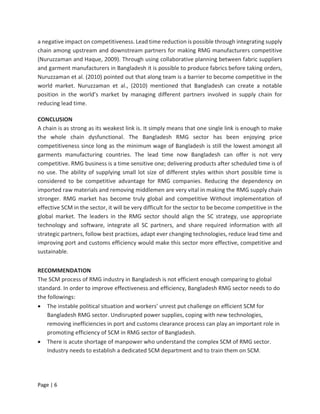
Supply Chain Management is mainly related to logistics, but it is applicable to all resources like
manpower, machine, goods/materials, services, information and money. Supply Chain
Management is the process of managing resources, the flow/movement of resources from one
party to another, one place to another place, one department to another department, and one
section to another section as they move in a process from supplier to manufacturer to wholesaler
(Distribution Centre, Regional Distribution Centre) to retailer to consumer.
Fig: Bangladesh RMG SCM Structure
The movement of resources should be in a way so that the availability of the right resources in
the right place, at the right time, with adequate quantity Supply chain management involves
coordinating and integrating these flows both within and among companies.
Effectiveness of supply chain management is defined as an external standard “of how well an
organization is meeting the demands of the various groups and organizations that are concerned
with its activities through its supply chain” (Pfeffer and Salancik 1978). It is said that the ultimate
goal of any effective supply chain management system is to reduce inventory (with the
assumption that products are available when needed). The important thing is supplying the
required resources at a minimum cost.
Page | 5
Factors Affecting Effectiveness of SCM
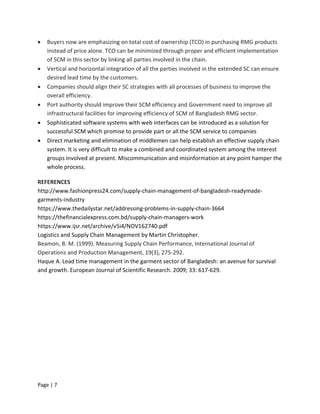
There are factors which impact directly and indirectly on effectiveness of supply chain. They are
forecasting demand based on information such as market research, placing and receiving
customer orders, inventory management, planning of production, communicating between
supply chain(SC) partners, location and shipment/managing distribution.
Fig: Factors Affecting Effectiveness of SCM
Overview of Existing SCM In Bangladesh RMG Industry
Ready Made Garments (RMG) is very important sector for our Bangladesh. It is one of the biggest
and most GDP earning sectors in Bangladesh. Bangladesh has emerged as a key player in RMG
sector since 1978. Textiles and clothing account for about 85% of total export earnings of
Bangladesh. The overall SCM practices in Bangladesh RMG sector require more improvement.
People working in this sector are not generally aware about the recouping the benefits of
implementing proper SCM. Only 5-7% of the companies have separate SCM department (BGMEA,
2016). The general elements of supply chain process in Bangladesh Garment Industry are
Supplier, Garment Industries, Individuals, Raw Materials, Finished Goods, Payment etc. In
addition to that following activities are conducted as part of company’s SCM are Inventory
management, Transportation service procurement, Materials handling, Inbound transportation,
Transportation, Operations management etc. Other elements of SCM including collaborative
planning use of appropriate technology, procuring new machine to improve productivity, training
company personnel, improving quality on a continuous basis are not very satisfactory in
Bangladesh. Moreover, the poor backward linkage and other infrastructural facilities including
port efficiency and custom clearance made the efficient implementation of SCM in the sector
more challenging. Few of the key characteristics of the RMG industry are short life cycle, highly
fluctuating end demand which is changing over time, variety of designs and styles evolving
everyday worldwide, and yarn and cotton supplies from many countries is very dynamic and
difficult to manage (Sen, 2008). So, RMG manufacturing companies should manage the supply
chain in a way that satisfies the needs of the end consumers (Gunasekaran et al., 2008).
Bangladesh RMG manufacturers are importing most of the raw materials including woven fabrics
from China, Pakistan, India, and Indonesia. So, the lead time is becoming longer which is putting
Page | 6
a negative impact on competitiveness. Lead time reduction is possible through integrating supply
chain among upstream and downstream partners for making RMG manufacturers competitive
(Nuruzzaman and Haque, 2009). Through using collaborative planning between fabric suppliers
and garment manufacturers in Bangladesh it is possible to produce fabrics before taking orders,
Nuruzzaman et al. (2010) pointed out that along team is a barrier to become competitive in the
world market. Nuruzzaman et al., (2010) mentioned that Bangladesh can create a notable
position in the world’s market by managing different partners involved in supply chain for
reducing lead time.
CONCLUSION
A chain is as strong as its weakest link is. It simply means that one single link is enough to make
the whole chain dysfunctional. The Bangladesh RMG sector has been enjoying price
competitiveness since long as the minimum wage of Bangladesh is still the lowest amongst all
garments manufacturing countries. The lead time now Bangladesh can offer is not very
competitive. RMG business is a time sensitive one; delivering products after scheduled time is of
no use. The ability of supplying small lot size of different styles within short possible time is
considered to be competitive advantage for RMG companies. Reducing the dependency on
imported raw materials and removing middlemen are very vital in making the RMG supply chain
stronger. RMG market has become truly global and competitive Without implementation of
effective SCM in the sector, it will be very difficult for the sector to be become competitive in the
global market. The leaders in the RMG sector should align the SC strategy, use appropriate
technology and software, integrate all SC partners, and share required information with all
strategic partners, follow best practices, adapt ever changing technologies, reduce lead time and
improving port and customs efficiency would make this sector more effective, competitive and
sustainable.
RECOMMENDATION
The SCM process of RMG industry in Bangladesh is not efficient enough comparing to global
standard. In order to improve effectiveness and efficiency, Bangladesh RMG sector needs to do
the followings:
 The instable political situation and workers’ unrest put challenge on efficient SCM for
Bangladesh RMG sector. Undisrupted power supplies, coping with new technologies,
removing inefficiencies in port and customs clearance process can play an important role in
promoting efficiency of SCM in RMG sector of Bangladesh.
 There is acute shortage of manpower who understand the complex SCM of RMG sector.
Industry needs to establish a dedicated SCM department and to train them on SCM.
Page | 7
 Buyers now are emphasizing on total cost of ownership (TCO) in purchasing RMG products
instead of price alone. TCO can be minimized through proper and efficient implementation
of SCM in this sector by linking all parties involved in the chain.
 Vertical and horizontal integration of all the parties involved in the extended SC can ensure
desired lead time by the customers.
 Companies should align their SC strategies with all processes of business to improve the
overall efficiency.
 Port authority should improve their SCM efficiency and Government need to improve all
infrastructural facilities for improving efficiency of SCM of Bangladesh RMG sector.
 Sophisticated software systems with web interfaces can be introduced as a solution for
successful SCM which promise to provide part or all the SCM service to companies
 Direct marketing and elimination of middlemen can help establish an effective supply chain
system. It is very difficult to make a combined and coordinated system among the interest
groups involved at present. Miscommunication and misinformation at any point hamper the
whole process.
REFERENCES
http://www.fashionpress24.com/supply-chain-management-of-bangladesh-readymade-
garments-industry
https://www.thedailystar.net/addressing-problems-in-supply-chain-3664
https://thefinancialexpress.com.bd/supply-chain-managers-work
https://www.ijsr.net/archive/v5i4/NOV162740.pdf
Logistics and Supply Chain Management by Martin Christopher.
Beamon, B. M. (1999). Measuring Supply Chain Performance, International Journal of
Operations and Production Management, 19(3), 275-292.
Haque A. Lead time management in the garment sector of Bangladesh: an avenue for survival
and growth. European Journal of Scientific Research. 2009; 33: 617-629.

Assignment scm rmg factories_id-18203004

  • 1.
    BUS 521: OperationsManagement An Assignment on The Effectiveness of Supply Chain Management of Readymade Garments Industry Submitted by: Md. Nazrul Islam Student ID: 18203004, Spring 2020, EMBA Department of Business Administration Submitted to: Mr. Sk. Kamrul Hassan Assistant Professor and Course Coordinator Department of Business Administration FAREAST INTERNATIONAL UNIVERSITY (FIU) 30 May 2020 R.S.R Tower, House # 50, Road # 11, Block – C, Banani, Dhaka-1213, Bangladesh
  • 2.
    Page | 2 Tableof Contents INTRODUCTION.............................................................................................................................................3 OBJECTIVES OF THE STUDY...........................................................................................................................3 METHODOLOGY ............................................................................................................................................3 DISCUSSION...................................................................................................................................................3 Supply Chain Management (SCM) and its Framework .............................................................................3 Factors Affecting Effectiveness of SCM ....................................................................................................5 Overview of Existing SCM In Bangladesh RMG Industry...........................................................................5 CONCLUSION.................................................................................................................................................6 RECOMMENDATION .....................................................................................................................................6 REFERENCES..................................................................................................................................................7
  • 3.
    Page | 3 INTRODUCTION EffectiveSupply Chain Management(SCM) is very crucial for RMG industry to remain competitive in the global market. The Readymade Garment(RMG) Industry of Bangladesh has turned in to the largest foreign exchange earning sector which is exporting all kinds of apparel garments to the USA, Europe and other developed countries of the world and importing unavailable accessories, fabrics and machines from abroad like Japan, China, Hong Kong, Korea, Taiwan, Pakistan, Indonesia and India. In this context, Bangladesh is struggling with meeting customer lead time, quality problem and with productivity comparing with other RMG producing nations. Moreover, the industry experienced few obstructions relating to building collapse and fire incident which forced the industry into more challenging situation. The country has no alternative to implement proper SCM in order to achieve the desired export goal of US$ 50 billion set by government within year 2021. But unfortunately, the level of effectiveness of SCM is not satisfactory. This study seeks an idea about effectiveness of SCM of RMG industry in general as well as in Bangladesh context and found it at unsatisfactory level in Bangladesh. OBJECTIVES OF THE STUDY The objective of the study is got to know-  Detail idea about SCM and its effectiveness factors in RMG industry  Overview of existing SCM in RMG sector in Bangladesh  capturing/gathering suggestions and recommendations in increasing effectiveness of SCM METHODOLOGY In preparation of this assignment, secondary data and information from articles on online newspaper, fashion news website, journals and these paper, term paper and books has been gathered from the internet and reviewed. Class handout and lecture also used to complete this assignment. DISCUSSION Supply Chain Management (SCM) and its Framework Supply chain management working as a key success factor for the RMG industry. That’s why the core focus of factory management is to develop an effective supply chain management system. A supply chain is a network of facilities that procure raw materials, transform them into intermediate goods and then final products, and deliver the products to customers through a distribution system(Lee & Billington, 1995). It consists of the series of activities and organisations that resources move through on their journey from initial suppliers to final customers.
  • 4.
    Page | 4 SupplyChain Management is mainly related to logistics, but it is applicable to all resources like manpower, machine, goods/materials, services, information and money. Supply Chain Management is the process of managing resources, the flow/movement of resources from one party to another, one place to another place, one department to another department, and one section to another section as they move in a process from supplier to manufacturer to wholesaler (Distribution Centre, Regional Distribution Centre) to retailer to consumer. Fig: Bangladesh RMG SCM Structure The movement of resources should be in a way so that the availability of the right resources in the right place, at the right time, with adequate quantity Supply chain management involves coordinating and integrating these flows both within and among companies. Effectiveness of supply chain management is defined as an external standard “of how well an organization is meeting the demands of the various groups and organizations that are concerned with its activities through its supply chain” (Pfeffer and Salancik 1978). It is said that the ultimate goal of any effective supply chain management system is to reduce inventory (with the assumption that products are available when needed). The important thing is supplying the required resources at a minimum cost.
  • 5.
    Page | 5 FactorsAffecting Effectiveness of SCM There are factors which impact directly and indirectly on effectiveness of supply chain. They are forecasting demand based on information such as market research, placing and receiving customer orders, inventory management, planning of production, communicating between supply chain(SC) partners, location and shipment/managing distribution. Fig: Factors Affecting Effectiveness of SCM Overview of Existing SCM In Bangladesh RMG Industry Ready Made Garments (RMG) is very important sector for our Bangladesh. It is one of the biggest and most GDP earning sectors in Bangladesh. Bangladesh has emerged as a key player in RMG sector since 1978. Textiles and clothing account for about 85% of total export earnings of Bangladesh. The overall SCM practices in Bangladesh RMG sector require more improvement. People working in this sector are not generally aware about the recouping the benefits of implementing proper SCM. Only 5-7% of the companies have separate SCM department (BGMEA, 2016). The general elements of supply chain process in Bangladesh Garment Industry are Supplier, Garment Industries, Individuals, Raw Materials, Finished Goods, Payment etc. In addition to that following activities are conducted as part of company’s SCM are Inventory management, Transportation service procurement, Materials handling, Inbound transportation, Transportation, Operations management etc. Other elements of SCM including collaborative planning use of appropriate technology, procuring new machine to improve productivity, training company personnel, improving quality on a continuous basis are not very satisfactory in Bangladesh. Moreover, the poor backward linkage and other infrastructural facilities including port efficiency and custom clearance made the efficient implementation of SCM in the sector more challenging. Few of the key characteristics of the RMG industry are short life cycle, highly fluctuating end demand which is changing over time, variety of designs and styles evolving everyday worldwide, and yarn and cotton supplies from many countries is very dynamic and difficult to manage (Sen, 2008). So, RMG manufacturing companies should manage the supply chain in a way that satisfies the needs of the end consumers (Gunasekaran et al., 2008). Bangladesh RMG manufacturers are importing most of the raw materials including woven fabrics from China, Pakistan, India, and Indonesia. So, the lead time is becoming longer which is putting
  • 6.
    Page | 6 anegative impact on competitiveness. Lead time reduction is possible through integrating supply chain among upstream and downstream partners for making RMG manufacturers competitive (Nuruzzaman and Haque, 2009). Through using collaborative planning between fabric suppliers and garment manufacturers in Bangladesh it is possible to produce fabrics before taking orders, Nuruzzaman et al. (2010) pointed out that along team is a barrier to become competitive in the world market. Nuruzzaman et al., (2010) mentioned that Bangladesh can create a notable position in the world’s market by managing different partners involved in supply chain for reducing lead time. CONCLUSION A chain is as strong as its weakest link is. It simply means that one single link is enough to make the whole chain dysfunctional. The Bangladesh RMG sector has been enjoying price competitiveness since long as the minimum wage of Bangladesh is still the lowest amongst all garments manufacturing countries. The lead time now Bangladesh can offer is not very competitive. RMG business is a time sensitive one; delivering products after scheduled time is of no use. The ability of supplying small lot size of different styles within short possible time is considered to be competitive advantage for RMG companies. Reducing the dependency on imported raw materials and removing middlemen are very vital in making the RMG supply chain stronger. RMG market has become truly global and competitive Without implementation of effective SCM in the sector, it will be very difficult for the sector to be become competitive in the global market. The leaders in the RMG sector should align the SC strategy, use appropriate technology and software, integrate all SC partners, and share required information with all strategic partners, follow best practices, adapt ever changing technologies, reduce lead time and improving port and customs efficiency would make this sector more effective, competitive and sustainable. RECOMMENDATION The SCM process of RMG industry in Bangladesh is not efficient enough comparing to global standard. In order to improve effectiveness and efficiency, Bangladesh RMG sector needs to do the followings:  The instable political situation and workers’ unrest put challenge on efficient SCM for Bangladesh RMG sector. Undisrupted power supplies, coping with new technologies, removing inefficiencies in port and customs clearance process can play an important role in promoting efficiency of SCM in RMG sector of Bangladesh.  There is acute shortage of manpower who understand the complex SCM of RMG sector. Industry needs to establish a dedicated SCM department and to train them on SCM.
  • 7.
    Page | 7 Buyers now are emphasizing on total cost of ownership (TCO) in purchasing RMG products instead of price alone. TCO can be minimized through proper and efficient implementation of SCM in this sector by linking all parties involved in the chain.  Vertical and horizontal integration of all the parties involved in the extended SC can ensure desired lead time by the customers.  Companies should align their SC strategies with all processes of business to improve the overall efficiency.  Port authority should improve their SCM efficiency and Government need to improve all infrastructural facilities for improving efficiency of SCM of Bangladesh RMG sector.  Sophisticated software systems with web interfaces can be introduced as a solution for successful SCM which promise to provide part or all the SCM service to companies  Direct marketing and elimination of middlemen can help establish an effective supply chain system. It is very difficult to make a combined and coordinated system among the interest groups involved at present. Miscommunication and misinformation at any point hamper the whole process. REFERENCES http://www.fashionpress24.com/supply-chain-management-of-bangladesh-readymade- garments-industry https://www.thedailystar.net/addressing-problems-in-supply-chain-3664 https://thefinancialexpress.com.bd/supply-chain-managers-work https://www.ijsr.net/archive/v5i4/NOV162740.pdf Logistics and Supply Chain Management by Martin Christopher. Beamon, B. M. (1999). Measuring Supply Chain Performance, International Journal of Operations and Production Management, 19(3), 275-292. Haque A. Lead time management in the garment sector of Bangladesh: an avenue for survival and growth. European Journal of Scientific Research. 2009; 33: 617-629.