SPEECH
be with you!
ENGLISH 8
Objectives:
At the end of the lesson, the students should be able to:
1. identify prosodic features: stress, intonation, and pause in the
text;
2. identify the rules in word stress and appreciate the importance of
speaking with correct stress of words through reading the sentences
given ;
3. recognize the importance of prosodic features of speech in
language and literature.
Read each pair of sentences properly.
•I receive a present today.
•Today, I present my work
in my class.
Read each pair of sentences properly.
•The students submit their
projects on time.
•The model projects well
on the stage.
Read each pair of sentences properly.
•That’s the object I’m
looking for!
•I object to what you are
trying to impose to us!
Read each pair of sentences properly.
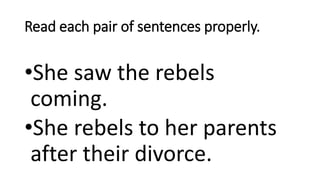
•She saw the rebels
coming.
•She rebels to her parents
after their divorce.
Read each pair of sentences properly.
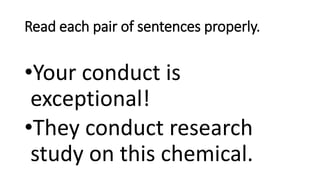
•Your conduct is
exceptional!
•They conduct research
study on this chemical.
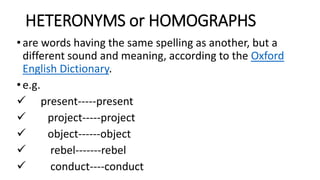
HETERONYMS or HOMOGRAPHS
•are words having the same spelling as another, but a
different sound and meaning, according to the Oxford
English Dictionary.
•e.g.
 present-----present
 project-----project
 object------object
 rebel-------rebel
 conduct----conduct
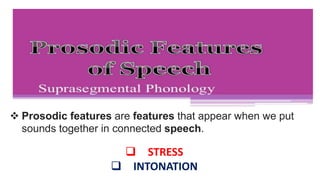
 STRESS
 INTONATION
 Prosodic features are features that appear when we put
sounds together in connected speech.
Stress
•refers to the prominence given to a
syllable or word which makes the word
or syllable stand out above the adjacent
syllable or word.
•It can be word stress or sentence stress.
STRESS no more!!!!
WORD STRESS RULES
1. Two-Syllable nouns and adjectives
• In most two syllable nouns and adjectives, the first syllable takes on the
stress.
Examples:
• SAMples PURple
• CARton RAIny
• CHIna HAPpy
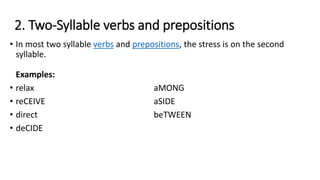
2. Two-Syllable verbs and prepositions
• In most two syllable verbs and prepositions, the stress is on the second
syllable.
Examples:
• relax aMONG
• reCEIVE aSIDE
• direct beTWEEN
• deCIDE
3. Three-Syllable words
•For three-syllable words, look at
the word ending (the suffix),
using the following as your
guide:
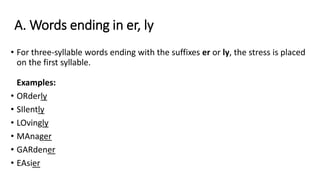
A. Words ending in er, ly
• For three-syllable words ending with the suffixes er or ly, the stress is placed
on the first syllable.
Examples:
• ORderly
• SIlently
• LOvingly
• MAnager
• GARdener
• EAsier
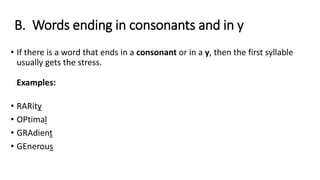
B. Words ending in consonants and in y
• If there is a word that ends in a consonant or in a y, then the first syllable
usually gets the stress.
Examples:
• RARity
• OPtimal
• GRAdient
• GEnerous
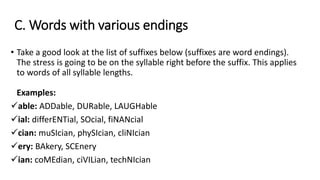
C. Words with various endings
• Take a good look at the list of suffixes below (suffixes are word endings).
The stress is going to be on the syllable right before the suffix. This applies
to words of all syllable lengths.
Examples:
able: ADDable, DURable, LAUGHable
ial: differENTial, SOcial, fiNANcial
cian: muSIcian, phySIcian, cliNIcian
ery: BAkery, SCEnery
ian: coMEdian, ciVILian, techNIcian
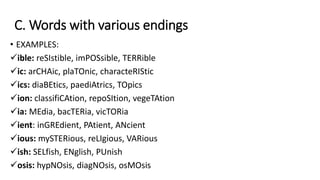
C. Words with various endings
• EXAMPLES:
ible: reSIstible, imPOSsible, TERRible
ic: arCHAic, plaTOnic, characteRIStic
ics: diaBEtics, paediAtrics, TOpics
ion: classifiCAtion, repoSItion, vegeTAtion
ia: MEdia, bacTERia, vicTORia
ient: inGREdient, PAtient, ANcient
ious: mySTERious, reLIgious, VARious
ish: SELfish, ENglish, PUnish
osis: hypNOsis, diagNOsis, osMOsis
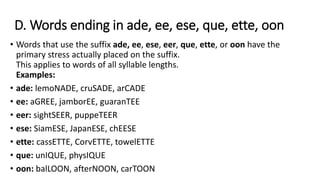
D. Words ending in ade, ee, ese, que, ette, oon
• Words that use the suffix ade, ee, ese, eer, que, ette, or oon have the
primary stress actually placed on the suffix.
This applies to words of all syllable lengths.
Examples:
• ade: lemoNADE, cruSADE, arCADE
• ee: aGREE, jamborEE, guaranTEE
• eer: sightSEER, puppeTEER
• ese: SiamESE, JapanESE, chEESE
• ette: cassETTE, CorvETTE, towelETTE
• que: unIQUE, physIQUE
• oon: balLOON, afterNOON, carTOON
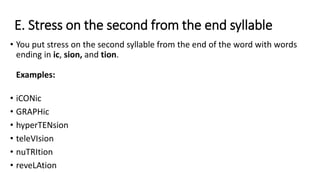
E. Stress on the second from the end syllable
• You put stress on the second syllable from the end of the word with words
ending in ic, sion, and tion.
Examples:
• iCONic
• GRAPHic
• hyperTENsion
• teleVIsion
• nuTRItion
• reveLAtion
F. Stress on the third from end syllable
• You put stress on the third from end syllable with words that end
in cy, ty, phy, gy and al.
Examples:
deMOcracy
geOGraphy
ALlergy
NAUtical
CLArity
CRItical
4. Word stress for compound words
• A. Compound noun
• A compound noun is a noun made out of two nouns that form one word. In
a compound noun, the most stress is on the stressed syllable of the first
word.
Examples:
• SEAfood (sea + food)
• ICEland (ice + land)
• TOOTHpaste (tooth + paste)
• FOOTball (foot + ball)
• BAsketball (basket + ball)
4. Word stress for compound words
• B. Compound adjectives
• A compound adjective is an adjective made of at least two words.
Often, hyphens are used in compound adjectives. In compound adjectives,
the most stress is placed in the stressed syllable of the second word.
Examples:
• ten-MEter
• rock-SOlid
• fifteen-MInute
• old-FAshioned
4. Word stress for compound words
C. Compound verbs
• A compound verb is when a subject has two or more verbs. The stress is on
the second or on the last part.
Examples:
• Matilda loves bread but deTESTS butter.
• Sarah baked cookies and ATE them up.
• Dogs love to eat bones and love to DRINK water.
4. Word stress for compound words
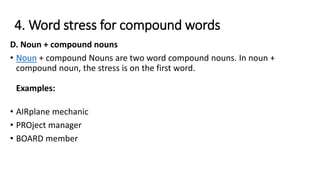
D. Noun + compound nouns
• Noun + compound Nouns are two word compound nouns. In noun +
compound noun, the stress is on the first word.
Examples:
• AIRplane mechanic
• PROject manager
• BOARD member
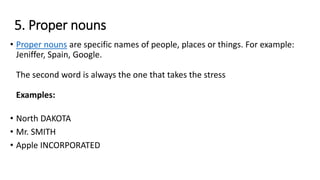
5. Proper nouns
• Proper nouns are specific names of people, places or things. For example:
Jeniffer, Spain, Google.
The second word is always the one that takes the stress
Examples:
• North DAKOTA
• Mr. SMITH
• Apple INCORPORATED
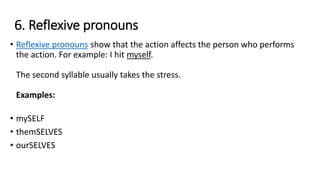
6. Reflexive pronouns
• Reflexive pronouns show that the action affects the person who performs
the action. For example: I hit myself.
The second syllable usually takes the stress.
Examples:
• mySELF
• themSELVES
• ourSELVES
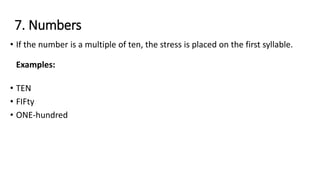
7. Numbers
• If the number is a multiple of ten, the stress is placed on the first syllable.
Examples:
• TEN
• FIFty
• ONE-hundred
LET’S GET
INTONATION!
Read the following sentences with appropriate
feelings as indicated in each item.
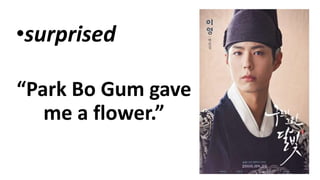
•surprised
“Park Bo Gum gave
me a flower.”
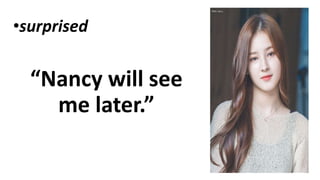
•surprised
“Nancy will see
me later.”
•sad
“Park Bo Gum gave
me a flower.”
•sad
“Nancy will see
me later.”
•confused
“Park Bo Gum gave
me a flower.”
•confused
“Nancy will see
me later.”
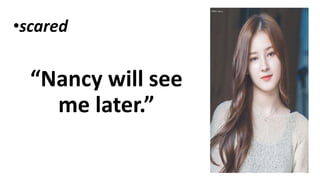
•scared
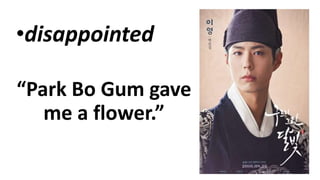
“Park Bo Gum gave
me a flower.”
•scared
“Nancy will see
me later.”
•disappointed
“Park Bo Gum gave
me a flower.”
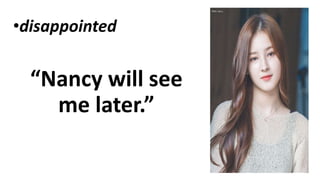
•disappointed
“Nancy will see
me later.”
INTONATION
•noun
:the rise and fall of the voice in speaking.
Four Kinds of Intonation Patterns:
(1) falling
(2) rising
(3) non-final, and
(4) wavering intonation.
Falling Intonation
•This is when your pitch lowers at the end of a phrase or
sentence. We use falling intonation at the end of a
statement or with a question that uses who, what, when,
where, why, or how.
e.g. statements:
1. I went to the store.
2. She has a new car.
3. I have to work late tonight.
4. My computer is broken.
5. He is coming home.
Falling Intonation
•e.g. questions
1. Who was that?
2. What is his name?
3. When will we leave?
4. Where are you going?
5. Why did you leave?
6. How did he fall?
Rising Intonation
• This is when your pitch goes up. It is used when asking a
yes/no question or questions that are answerable by
yes/no.
• e.g.
1. Is his name John?
2. Are you leaving?
3. Are we going to the movies?
4. Is it true?
5. Can you believe it?
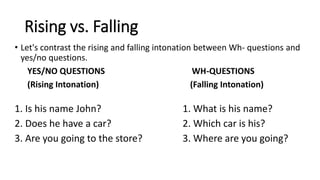
Rising vs. Falling
• Let's contrast the rising and falling intonation between Wh- questions and
yes/no questions.
YES/NO QUESTIONS WH-QUESTIONS
(Rising Intonation) (Falling Intonation)
1. Is his name John? 1. What is his name?
2. Does he have a car? 2. Which car is his?
3. Are you going to the store? 3. Where are you going?
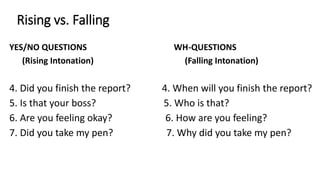
Rising vs. Falling
YES/NO QUESTIONS WH-QUESTIONS
(Rising Intonation) (Falling Intonation)
4. Did you finish the report? 4. When will you finish the report?
5. Is that your boss? 5. Who is that?
6. Are you feeling okay? 6. How are you feeling?
7. Did you take my pen? 7. Why did you take my pen?
I STAND Corrected!
Directions: Identify the following items as Rising
and Falling Intonation.
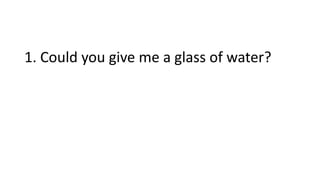
1. Could you give me a glass of water?
2. Give me a glass of water.
3. Can I walk you home tonight?
4. Send this notice to your boss.
5. Pardon me?

COT 2 -.pptx

  • 1.
  • 2.
    Objectives: At the endof the lesson, the students should be able to: 1. identify prosodic features: stress, intonation, and pause in the text; 2. identify the rules in word stress and appreciate the importance of speaking with correct stress of words through reading the sentences given ; 3. recognize the importance of prosodic features of speech in language and literature.
  • 3.
    Read each pairof sentences properly. •I receive a present today. •Today, I present my work in my class.
  • 4.
    Read each pairof sentences properly. •The students submit their projects on time. •The model projects well on the stage.
  • 5.
    Read each pairof sentences properly. •That’s the object I’m looking for! •I object to what you are trying to impose to us!
  • 6.
    Read each pairof sentences properly. •She saw the rebels coming. •She rebels to her parents after their divorce.
  • 7.
    Read each pairof sentences properly. •Your conduct is exceptional! •They conduct research study on this chemical.
  • 8.
    HETERONYMS or HOMOGRAPHS •arewords having the same spelling as another, but a different sound and meaning, according to the Oxford English Dictionary. •e.g.  present-----present  project-----project  object------object  rebel-------rebel  conduct----conduct
  • 9.
     STRESS  INTONATION Prosodic features are features that appear when we put sounds together in connected speech.
  • 11.
    Stress •refers to theprominence given to a syllable or word which makes the word or syllable stand out above the adjacent syllable or word. •It can be word stress or sentence stress.
  • 13.
  • 14.
    1. Two-Syllable nounsand adjectives • In most two syllable nouns and adjectives, the first syllable takes on the stress. Examples: • SAMples PURple • CARton RAIny • CHIna HAPpy
  • 15.
    2. Two-Syllable verbsand prepositions • In most two syllable verbs and prepositions, the stress is on the second syllable. Examples: • relax aMONG • reCEIVE aSIDE • direct beTWEEN • deCIDE
  • 16.
    3. Three-Syllable words •Forthree-syllable words, look at the word ending (the suffix), using the following as your guide:
  • 17.
    A. Words endingin er, ly • For three-syllable words ending with the suffixes er or ly, the stress is placed on the first syllable. Examples: • ORderly • SIlently • LOvingly • MAnager • GARdener • EAsier
  • 18.
    B. Words endingin consonants and in y • If there is a word that ends in a consonant or in a y, then the first syllable usually gets the stress. Examples: • RARity • OPtimal • GRAdient • GEnerous
  • 19.
    C. Words withvarious endings • Take a good look at the list of suffixes below (suffixes are word endings). The stress is going to be on the syllable right before the suffix. This applies to words of all syllable lengths. Examples: able: ADDable, DURable, LAUGHable ial: differENTial, SOcial, fiNANcial cian: muSIcian, phySIcian, cliNIcian ery: BAkery, SCEnery ian: coMEdian, ciVILian, techNIcian
  • 20.
    C. Words withvarious endings • EXAMPLES: ible: reSIstible, imPOSsible, TERRible ic: arCHAic, plaTOnic, characteRIStic ics: diaBEtics, paediAtrics, TOpics ion: classifiCAtion, repoSItion, vegeTAtion ia: MEdia, bacTERia, vicTORia ient: inGREdient, PAtient, ANcient ious: mySTERious, reLIgious, VARious ish: SELfish, ENglish, PUnish osis: hypNOsis, diagNOsis, osMOsis
  • 21.
    D. Words endingin ade, ee, ese, que, ette, oon • Words that use the suffix ade, ee, ese, eer, que, ette, or oon have the primary stress actually placed on the suffix. This applies to words of all syllable lengths. Examples: • ade: lemoNADE, cruSADE, arCADE • ee: aGREE, jamborEE, guaranTEE • eer: sightSEER, puppeTEER • ese: SiamESE, JapanESE, chEESE • ette: cassETTE, CorvETTE, towelETTE • que: unIQUE, physIQUE • oon: balLOON, afterNOON, carTOON
  • 22.
    E. Stress onthe second from the end syllable • You put stress on the second syllable from the end of the word with words ending in ic, sion, and tion. Examples: • iCONic • GRAPHic • hyperTENsion • teleVIsion • nuTRItion • reveLAtion
  • 23.
    F. Stress onthe third from end syllable • You put stress on the third from end syllable with words that end in cy, ty, phy, gy and al. Examples: deMOcracy geOGraphy ALlergy NAUtical CLArity CRItical
  • 24.
    4. Word stressfor compound words • A. Compound noun • A compound noun is a noun made out of two nouns that form one word. In a compound noun, the most stress is on the stressed syllable of the first word. Examples: • SEAfood (sea + food) • ICEland (ice + land) • TOOTHpaste (tooth + paste) • FOOTball (foot + ball) • BAsketball (basket + ball)
  • 25.
    4. Word stressfor compound words • B. Compound adjectives • A compound adjective is an adjective made of at least two words. Often, hyphens are used in compound adjectives. In compound adjectives, the most stress is placed in the stressed syllable of the second word. Examples: • ten-MEter • rock-SOlid • fifteen-MInute • old-FAshioned
  • 26.
    4. Word stressfor compound words C. Compound verbs • A compound verb is when a subject has two or more verbs. The stress is on the second or on the last part. Examples: • Matilda loves bread but deTESTS butter. • Sarah baked cookies and ATE them up. • Dogs love to eat bones and love to DRINK water.
  • 27.
    4. Word stressfor compound words D. Noun + compound nouns • Noun + compound Nouns are two word compound nouns. In noun + compound noun, the stress is on the first word. Examples: • AIRplane mechanic • PROject manager • BOARD member
  • 28.
    5. Proper nouns •Proper nouns are specific names of people, places or things. For example: Jeniffer, Spain, Google. The second word is always the one that takes the stress Examples: • North DAKOTA • Mr. SMITH • Apple INCORPORATED
  • 29.
    6. Reflexive pronouns •Reflexive pronouns show that the action affects the person who performs the action. For example: I hit myself. The second syllable usually takes the stress. Examples: • mySELF • themSELVES • ourSELVES
  • 30.
    7. Numbers • Ifthe number is a multiple of ten, the stress is placed on the first syllable. Examples: • TEN • FIFty • ONE-hundred
  • 31.
  • 32.
    Read the followingsentences with appropriate feelings as indicated in each item.
  • 33.
    •surprised “Park Bo Gumgave me a flower.”
  • 34.
  • 35.
    •sad “Park Bo Gumgave me a flower.”
  • 36.
  • 37.
    •confused “Park Bo Gumgave me a flower.”
  • 38.
  • 39.
    •scared “Park Bo Gumgave me a flower.”
  • 40.
  • 41.
    •disappointed “Park Bo Gumgave me a flower.”
  • 42.
  • 44.
    INTONATION •noun :the rise andfall of the voice in speaking. Four Kinds of Intonation Patterns: (1) falling (2) rising (3) non-final, and (4) wavering intonation.
  • 45.
    Falling Intonation •This iswhen your pitch lowers at the end of a phrase or sentence. We use falling intonation at the end of a statement or with a question that uses who, what, when, where, why, or how. e.g. statements: 1. I went to the store. 2. She has a new car. 3. I have to work late tonight. 4. My computer is broken. 5. He is coming home.
  • 46.
    Falling Intonation •e.g. questions 1.Who was that? 2. What is his name? 3. When will we leave? 4. Where are you going? 5. Why did you leave? 6. How did he fall?
  • 47.
    Rising Intonation • Thisis when your pitch goes up. It is used when asking a yes/no question or questions that are answerable by yes/no. • e.g. 1. Is his name John? 2. Are you leaving? 3. Are we going to the movies? 4. Is it true? 5. Can you believe it?
  • 48.
    Rising vs. Falling •Let's contrast the rising and falling intonation between Wh- questions and yes/no questions. YES/NO QUESTIONS WH-QUESTIONS (Rising Intonation) (Falling Intonation) 1. Is his name John? 1. What is his name? 2. Does he have a car? 2. Which car is his? 3. Are you going to the store? 3. Where are you going?
  • 49.
    Rising vs. Falling YES/NOQUESTIONS WH-QUESTIONS (Rising Intonation) (Falling Intonation) 4. Did you finish the report? 4. When will you finish the report? 5. Is that your boss? 5. Who is that? 6. Are you feeling okay? 6. How are you feeling? 7. Did you take my pen? 7. Why did you take my pen?
  • 50.
    I STAND Corrected! Directions:Identify the following items as Rising and Falling Intonation.
  • 51.
    1. Could yougive me a glass of water?
  • 52.
    2. Give mea glass of water.
  • 53.
    3. Can Iwalk you home tonight?
  • 54.
    4. Send thisnotice to your boss.
  • 55.