Evaluation of
Instructional Materials
Smaldino et al (2012). Instructional technology and media for
learning
Selection Rubric
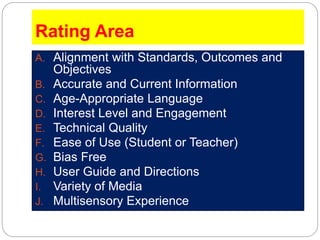
Rating Area
A. Alignment with Standards, Outcomes and
Objectives
B. Accurate and Current Information
C. Age-Appropriate Language
D. Interest Level and Engagement
E. Technical Quality
F. Ease of Use (Student or Teacher)
G. Bias Free
H. User Guide and Directions
I. Variety of Media
J. Multisensory Experience
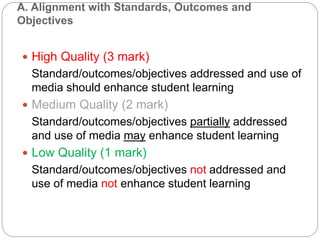
A. Alignment with Standards, Outcomes and
Objectives
 High Quality (3 mark)
Standard/outcomes/objectives addressed and use of
media should enhance student learning
 Medium Quality (2 mark)
Standard/outcomes/objectives partially addressed
and use of media may enhance student learning
 Low Quality (1 mark)
Standard/outcomes/objectives not addressed and
use of media not enhance student learning
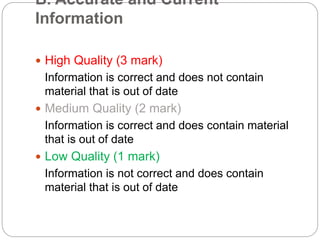
B. Accurate and Current
Information
 High Quality (3 mark)
Information is correct and does not contain
material that is out of date
 Medium Quality (2 mark)
Information is correct and does contain material
that is out of date
 Low Quality (1 mark)
Information is not correct and does contain
material that is out of date
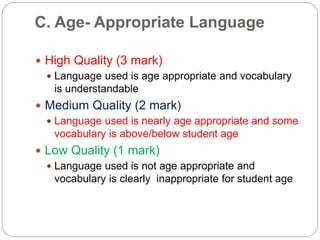
C. Age- Appropriate Language
 High Quality (3 mark)
 Language used is age appropriate and vocabulary
is understandable
 Medium Quality (2 mark)
 Language used is nearly age appropriate and some
vocabulary is above/below student age
 Low Quality (1 mark)
 Language used is not age appropriate and
vocabulary is clearly inappropriate for student age
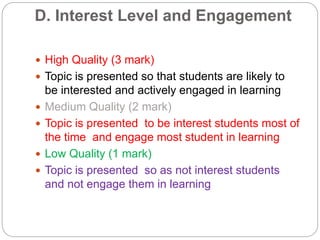
D. Interest Level and Engagement
 High Quality (3 mark)
 Topic is presented so that students are likely to
be interested and actively engaged in learning
 Medium Quality (2 mark)
 Topic is presented to be interest students most of
the time and engage most student in learning
 Low Quality (1 mark)
 Topic is presented so as not interest students
and not engage them in learning
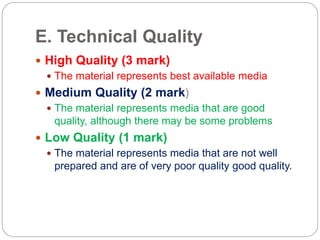
E. Technical Quality
 High Quality (3 mark)
 The material represents best available media
 Medium Quality (2 mark)
 The material represents media that are good
quality, although there may be some problems
 Low Quality (1 mark)
 The material represents media that are not well
prepared and are of very poor quality good quality.
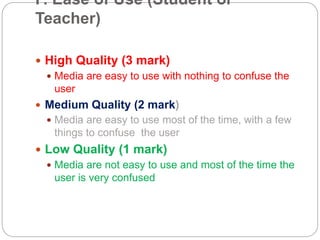
F. Ease of Use (Student or
Teacher)
 High Quality (3 mark)
 Media are easy to use with nothing to confuse the
user
 Medium Quality (2 mark)
 Media are easy to use most of the time, with a few
things to confuse the user
 Low Quality (1 mark)
 Media are not easy to use and most of the time the
user is very confused
G. Bias Free
 High Quality (3 mark)
There is no evidence of objectionable bias or
advertsing
 Medium Quality (2 mark)
There is little evidence of bias or advertsing
 Low Quality (1 mark)
There is much evidence of bias or advertising
H. User Guide and Directions
 High Quality (3 mark)
The user guide is an excellent resource to
support a lesson. Directions should help teachers
and students use the media
 Medium Quality (2 mark)
The user guide is good resource to support a
lesson. Directions may help teachers and
students use the media
 Low Quality (1 mark)
The user guide is poor resource to support a
lesson. Directions do not help teachers and
students use the media
I. Variety of Media
 High Quality (3 mark)
 Most students like the variety of media and are
not confused
 Medium Quality (2 mark)
Some students find the media interesting and
some are confused
 Low Quality (1 mark)
Most students do not find the media interesting
and many are confused
J. Multisensory Experience
 High Quality (3 mark)
The media incorporate the appropriate number of
senses to promote learning
 Medium Quality (2 mark)
The media incorporate some senses to promote
learning
 Low Quality (1 mark)
The media incorporate few of senses to promote
learning

Rubric evaluation media instructional k7

  • 1.
    Evaluation of Instructional Materials Smaldinoet al (2012). Instructional technology and media for learning Selection Rubric
  • 2.
    Rating Area A. Alignmentwith Standards, Outcomes and Objectives B. Accurate and Current Information C. Age-Appropriate Language D. Interest Level and Engagement E. Technical Quality F. Ease of Use (Student or Teacher) G. Bias Free H. User Guide and Directions I. Variety of Media J. Multisensory Experience
  • 3.
    A. Alignment withStandards, Outcomes and Objectives  High Quality (3 mark) Standard/outcomes/objectives addressed and use of media should enhance student learning  Medium Quality (2 mark) Standard/outcomes/objectives partially addressed and use of media may enhance student learning  Low Quality (1 mark) Standard/outcomes/objectives not addressed and use of media not enhance student learning
  • 4.
    B. Accurate andCurrent Information  High Quality (3 mark) Information is correct and does not contain material that is out of date  Medium Quality (2 mark) Information is correct and does contain material that is out of date  Low Quality (1 mark) Information is not correct and does contain material that is out of date
  • 5.
    C. Age- AppropriateLanguage  High Quality (3 mark)  Language used is age appropriate and vocabulary is understandable  Medium Quality (2 mark)  Language used is nearly age appropriate and some vocabulary is above/below student age  Low Quality (1 mark)  Language used is not age appropriate and vocabulary is clearly inappropriate for student age
  • 6.
    D. Interest Leveland Engagement  High Quality (3 mark)  Topic is presented so that students are likely to be interested and actively engaged in learning  Medium Quality (2 mark)  Topic is presented to be interest students most of the time and engage most student in learning  Low Quality (1 mark)  Topic is presented so as not interest students and not engage them in learning
  • 7.
    E. Technical Quality High Quality (3 mark)  The material represents best available media  Medium Quality (2 mark)  The material represents media that are good quality, although there may be some problems  Low Quality (1 mark)  The material represents media that are not well prepared and are of very poor quality good quality.
  • 8.
    F. Ease ofUse (Student or Teacher)  High Quality (3 mark)  Media are easy to use with nothing to confuse the user  Medium Quality (2 mark)  Media are easy to use most of the time, with a few things to confuse the user  Low Quality (1 mark)  Media are not easy to use and most of the time the user is very confused
  • 9.
    G. Bias Free High Quality (3 mark) There is no evidence of objectionable bias or advertsing  Medium Quality (2 mark) There is little evidence of bias or advertsing  Low Quality (1 mark) There is much evidence of bias or advertising
  • 10.
    H. User Guideand Directions  High Quality (3 mark) The user guide is an excellent resource to support a lesson. Directions should help teachers and students use the media  Medium Quality (2 mark) The user guide is good resource to support a lesson. Directions may help teachers and students use the media  Low Quality (1 mark) The user guide is poor resource to support a lesson. Directions do not help teachers and students use the media
  • 11.
    I. Variety ofMedia  High Quality (3 mark)  Most students like the variety of media and are not confused  Medium Quality (2 mark) Some students find the media interesting and some are confused  Low Quality (1 mark) Most students do not find the media interesting and many are confused
  • 12.
    J. Multisensory Experience High Quality (3 mark) The media incorporate the appropriate number of senses to promote learning  Medium Quality (2 mark) The media incorporate some senses to promote learning  Low Quality (1 mark) The media incorporate few of senses to promote learning