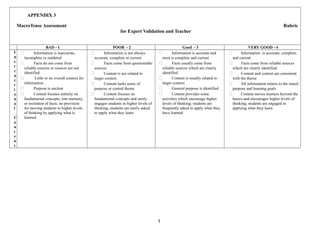
APPENDIX 3
MacroTense Assessment Rubric
for Expert Validation and Teacher
BAD - 1 POOR - 2 Good - 3 VERY GOOD - 4
I
n
s
t
r
u
c
t
i
o
n
a
l
C
o
n
t
e
n
t
 Information is inaccurate,
incomplete or outdated
 Facts do not come from
reliable sources or sources are not
identified
 Little or no overall context for
information
 Purpose is unclear
 Content focuses entirely on
fundamental concepts, rote memory,
or recitation of facts; no provision
for moving students to higher levels
of thinking by applying what is
learned
 Information is not always
accurate, complete or current
 Facts come from questionable
sources
 Content is not related to
larger context
 Content lacks sense of
purpose or central theme
 Content focuses on
fundamental concepts and rarely
engages students in higher levels of
thinking; students are rarely asked
to apply what they learn
 Information is accurate and
most is complete and current
 Facts usually come from
reliable sources which are clearly
identified
 Content is usually related to
larger context
 General purpose is identified
 Content provides some
activities which encourage higher
levels of thinking; students are
frequently asked to apply what they
have learned
 Information is accurate, complete,
and current
 Facts come from reliable sources
which are clearly identified
 Content and context are consistent
with the theme
 All information relates to the stated
purpose and learning goals
 Content moves learners beyond the
basics and encourages higher levels of
thinking; students are engaged in
applying what they learn
1
C
u
r
r
i
c
u
l
u
m
C
o
n
n
e
c
t
i
o
n
s
 National and/or state standards are
not accessible within the product
and there are no apparent links to the
learning activities
 No prerequisite knowledge
requirements are given
 No real world examples are given
 National and/or state standards are
not located within the product but
some relation to standards is
apparent
 Lists some prerequisite knowledge
necessary for success
 Uses some real world examples to
make the instruction relevant for
the learner
 Complies with some subject based
guidelines
 National and/or state standards are
sometimes available and may be
linked to lessons
 Outlines prerequisite knowledge
necessary for success
 Uses many real world examples to
make the instruction relevant for the
learner
 Complies with most subject based
guidelines
 National and state standards are
accessible within the product and may
be easily linked to lessons
 Lists all prerequisite skills
 Uses all real world examples to make
the instruction relevant for the learner
 Complies with all subject based
guidelines
2
G
r
a
p
h
i
c
s
a
n
d
M
u
l
t
i
m
e
d
i
a
 Graphics are absent, poorly placed,
or fail to assist learning
 Background and text are not
compatible and text is difficult to
read
 Graphics are inconsistent,
inappropriate, and do not enhance
learning
 Poor use of color
 Gratuitous animation with no
relation to learning goals
 Multimedia is superfluous and often
gets in the way of purpose and
learning goals
 Graphics minimally support
learning
 Background and text are frequently
incompatible and text is often
difficult to read
 Graphics are not always consistent
or appropriate
 Colors are used somewhat
ineffectively
 Animation rarely complements
learning
 Multimedia seems unrelated to
purpose and learning goals
Graphics are intended to assist
learning
Background and text are usually
pleasing, compatible and legible
Most graphics are consistent and
appropriate in design
Colors are used in a somewhat
effective way
Animation often complements
learning
Multimedia is sometimes unrelated
to purpose and learning goals
 Graphics are well designed and
rendered to enhance learning
 Background and text are pleasing,
compatible and easy to read
 Graphics are consistent, appropriate
and designed to optimize learning
 Colors are used in an effective way
 Animation always complements
learning
 Multimedia appears to be directly
related to stated purpose and learning
goals
L
a
y
-
o
u
t
 Layout is confusing
 Learners cannot navigate through the
information to find what they need
 Layout is illogical and unpredictable
 Layout is inconsistent
 Layout is not intuitive
 Layout is difficult to navigate
 Layout is frequently illogical
 Layout is frequently inconsistent
Layout is clear but learners
sometimes need help to find
necessary features
learners can usually navigate
through the information to find
what they need
Layout is logical in most cases, but
sometimes confusing
Layout is frequently consistent, but
occasionally confusing
 Layout is clear and intuitive; learners
can always find what they need
 It is easy to navigate through the
information to find necessary features
 Layout is logical
 Layout is consistent on all pages
T
e
c
h
n
i
c
a
l
 Links do not work properly
 Specific browser needed to view
pages, but no directions are available
for users to download appropriate
browser
 Multimedia resources do not work
 Web site is often down or unreliable;
software installation often results in
aborted efforts or conflicts
 Not all links work properly
 Pages work in only one browser ,
but directions and links are
provided so users can download
appropriate browser
 Multimedia resources work some
of the time
 Web site is unreliable or software
is hard to install properly
Most links work properly
Most pages work in most browsers
 Multimedia resources work most of
the time
Users are able to access web site or
install software with minimal effort
 All links work properly
 Pages work in most common browsers:
Netscape and Internet Explorer
 All multimedia resources work at all
times
 Users are able to access web site or
install software with ease
 Clear and complete directions are
available for access or installation
3
A
s
p
e
c
t
s
A
d
a
p
t
a
b
i
l
i
t
y
a
n
d
A
c
c
e
s
s
i
b
i
l
i
t
y
 Pictures and icons do not have ALT
tags
 Paragraphs and sections have unclear
and inaccurate informative headings
 Clear and clean fonts are not used
 Content is not culturally diverse
 Content does not accommodate
unique learning styles and various
ability levels
 Few pictures and icons have ALT
tags
 Some paragraphs and sections have
clear and accurate informative
headings
 Clear and clean fonts are used
consistently some of the time
 Some content is culturally diverse
 Some content accommodates
unique learning styles and various
ability levels
Most pictures and icons have ALT
tags
Most paragraphs and sections have
clear and accurate informative
headings
Clear and clean fonts are used
consistently most of the time
Content includes some culturally
diverse features
Most content accommodates unique
learning styles and various ability
levels
 Hyperlinks have ALT tags for rollover
to assist sight-impaired learners
 Paragraphs and sections have clear and
accurate informative headings
 Clear and clean fonts are used
consistently
 Content is culturally diverse
 Product accommodates unique learning
styles and various ability levels
L
e
a
r
n
e
r
 Does not require learners to become
actively engaged
 Text and documents do not employ
multimedia enhancements to make
learning interactive
 Does not provide feedback
 Sometimes requires learners to
become actively engaged
 Text and documents sometimes
employ multimedia enhancements
to make learning interactive
 Provides minimal feedback
Usually requires learners to become
actively engaged
Text and documents usually employ
multimedia enhancements to make
learning interactive
Provides some feedback throughout
 Always requires learners to become
actively engaged in order to learn
 Text and documents always employ
multimedia enhancements to make
learning interactive
 Provides appropriate feedback
4
E
n
g
a
g
e
m
e
n
t
I
n
t
e
r
a
c
t
i
v
i
t
y
throughout the instruction
 Does not motivate the learner
throughout the instruction
 Rarely motivates learner to
continue learning
the instruction
Often motivates the learner to
continue learning and master
concepts
throughout the instruction
 Keenly motivates the learner to
continue learning and master concepts
T
e
a
c
h
e
r
a
n
d
L
e
a
r
n
e
r
 Program provides little or no help to
the teacher or the student
 Tech support is inadequate or
unreliable
 Program does not offer support
materials or outside means of
reinforcement
 Teachers and students are not able to
track progress
 Program offers limited options for
help
 Program offers online support only
 Student support materials are
limited and do not relate directly to
the lesson
 Teachers and students can
sometimes track a student's
progress through feedback or other
documentation
Program offers various forms of
help for the student but may not be
quickly accessible
Program often provides ways to
reach tech support
Program provides student with
additional websites which relate to
the lesson
Teachers and students can
frequently track a student's progress
through feedback or other
documentation
 Program offers help at any stage
 Provides various ways to reach
technical support
 Program provides students with
additional resources such as web sites,
bibliographies, etc. which are suitable to
lesson
 Teachers and students can easily track a
student's progress through feedback or
other documentation
5
S
u
p
p
o
r
t
M
a
t
e
r
i
a
l
s
A
s
s
e
s
s
m
e
n
t
 Assessment is inappropriate or
unavailable and does not produce an
accurate account of student learning
 It is not clear how to assess the
learning in this product
 Assessment is inappropriate or
unrelated to learning goals and
rarely engages learners
 Teachers must develop their own
assessments
Assessment is usually challenging
and appropriate enough to engage
learners
Teachers can assess students'
progress using established methods
of assessment
 Assessment methods are challenging,
appropriate, and suited to learning goals
 Teachers can easily assess students'
progress by evaluating the outcomes
provided within the product
A
g
e
/
G
r
a
d
e
L
e
v
e
l
 Reading level is not appropriate for
target audience
 Product is not suitable for the age
and grade level
 Directions are inadequate and
incomplete
 Reading level is often too difficult
or too easy for target audience
 Many features are unsuitable for
the age and grade level
 Directions are sometimes unclear
or ambiguous
Reading level is appropriate for
target audience, but some portions
may be too easy or too difficult
 Most features are suitable for the
age and grade level
Most directions are clear, but some
are ambiguous or confusing
 Reading level is appropriate for target
audience
 Product is suitable for the age and
grade level
 Directions are clear and complete
enough for students to perform required
tasks
F  Learners are unable to save at regular  Learners can save at some point Learners can save at some point and  Learners can save at regular intervals
6
l
e
x
i
b
i
l
i
t
y
intervals
 Cannot be integrated into classroom
activities
 It is unclear how this program would
be used with students; contains no
guidelines or suggestions for
alternative classroom settings
but cannot re-enter the instruction
without difficulty
 Some aspects of the software can
be integrated into classroom
activities
 Few lessons can be used in a
variety of classroom settings;
Includes few suggestions for
altering instruction for whole class,
individual, or group experiences
can usually re-enter the instruction
easily
Most aspects of the software can be
integrated into classroom activities
The program includes suggestions
for use in whole class instruction,
individual, or group learning
experiences
and re-enter the instruction at any point
 All aspects of the software can be
easily integrated into classroom
activities
 The program features activities for use
in whole class instruction, individual, or
group learning experiences
Scale: 40-44= VERY GOOD | 35-39=Good | 30-34=POOR Below 30=BAD
for Classroom Use
Total Points
Adapted from Kristin Miller and Jacqueline Bach, SAS inSchool Interns, Summer, 2001
7

evaluation rubric assessment

  • 1.
    APPENDIX 3 MacroTense AssessmentRubric for Expert Validation and Teacher BAD - 1 POOR - 2 Good - 3 VERY GOOD - 4 I n s t r u c t i o n a l C o n t e n t  Information is inaccurate, incomplete or outdated  Facts do not come from reliable sources or sources are not identified  Little or no overall context for information  Purpose is unclear  Content focuses entirely on fundamental concepts, rote memory, or recitation of facts; no provision for moving students to higher levels of thinking by applying what is learned  Information is not always accurate, complete or current  Facts come from questionable sources  Content is not related to larger context  Content lacks sense of purpose or central theme  Content focuses on fundamental concepts and rarely engages students in higher levels of thinking; students are rarely asked to apply what they learn  Information is accurate and most is complete and current  Facts usually come from reliable sources which are clearly identified  Content is usually related to larger context  General purpose is identified  Content provides some activities which encourage higher levels of thinking; students are frequently asked to apply what they have learned  Information is accurate, complete, and current  Facts come from reliable sources which are clearly identified  Content and context are consistent with the theme  All information relates to the stated purpose and learning goals  Content moves learners beyond the basics and encourages higher levels of thinking; students are engaged in applying what they learn 1
  • 2.
    C u r r i c u l u m C o n n e c t i o n s  National and/orstate standards are not accessible within the product and there are no apparent links to the learning activities  No prerequisite knowledge requirements are given  No real world examples are given  National and/or state standards are not located within the product but some relation to standards is apparent  Lists some prerequisite knowledge necessary for success  Uses some real world examples to make the instruction relevant for the learner  Complies with some subject based guidelines  National and/or state standards are sometimes available and may be linked to lessons  Outlines prerequisite knowledge necessary for success  Uses many real world examples to make the instruction relevant for the learner  Complies with most subject based guidelines  National and state standards are accessible within the product and may be easily linked to lessons  Lists all prerequisite skills  Uses all real world examples to make the instruction relevant for the learner  Complies with all subject based guidelines 2
  • 3.
    G r a p h i c s a n d M u l t i m e d i a  Graphics areabsent, poorly placed, or fail to assist learning  Background and text are not compatible and text is difficult to read  Graphics are inconsistent, inappropriate, and do not enhance learning  Poor use of color  Gratuitous animation with no relation to learning goals  Multimedia is superfluous and often gets in the way of purpose and learning goals  Graphics minimally support learning  Background and text are frequently incompatible and text is often difficult to read  Graphics are not always consistent or appropriate  Colors are used somewhat ineffectively  Animation rarely complements learning  Multimedia seems unrelated to purpose and learning goals Graphics are intended to assist learning Background and text are usually pleasing, compatible and legible Most graphics are consistent and appropriate in design Colors are used in a somewhat effective way Animation often complements learning Multimedia is sometimes unrelated to purpose and learning goals  Graphics are well designed and rendered to enhance learning  Background and text are pleasing, compatible and easy to read  Graphics are consistent, appropriate and designed to optimize learning  Colors are used in an effective way  Animation always complements learning  Multimedia appears to be directly related to stated purpose and learning goals L a y - o u t  Layout is confusing  Learners cannot navigate through the information to find what they need  Layout is illogical and unpredictable  Layout is inconsistent  Layout is not intuitive  Layout is difficult to navigate  Layout is frequently illogical  Layout is frequently inconsistent Layout is clear but learners sometimes need help to find necessary features learners can usually navigate through the information to find what they need Layout is logical in most cases, but sometimes confusing Layout is frequently consistent, but occasionally confusing  Layout is clear and intuitive; learners can always find what they need  It is easy to navigate through the information to find necessary features  Layout is logical  Layout is consistent on all pages T e c h n i c a l  Links do not work properly  Specific browser needed to view pages, but no directions are available for users to download appropriate browser  Multimedia resources do not work  Web site is often down or unreliable; software installation often results in aborted efforts or conflicts  Not all links work properly  Pages work in only one browser , but directions and links are provided so users can download appropriate browser  Multimedia resources work some of the time  Web site is unreliable or software is hard to install properly Most links work properly Most pages work in most browsers  Multimedia resources work most of the time Users are able to access web site or install software with minimal effort  All links work properly  Pages work in most common browsers: Netscape and Internet Explorer  All multimedia resources work at all times  Users are able to access web site or install software with ease  Clear and complete directions are available for access or installation 3
  • 4.
    A s p e c t s A d a p t a b i l i t y a n d A c c e s s i b i l i t y  Pictures andicons do not have ALT tags  Paragraphs and sections have unclear and inaccurate informative headings  Clear and clean fonts are not used  Content is not culturally diverse  Content does not accommodate unique learning styles and various ability levels  Few pictures and icons have ALT tags  Some paragraphs and sections have clear and accurate informative headings  Clear and clean fonts are used consistently some of the time  Some content is culturally diverse  Some content accommodates unique learning styles and various ability levels Most pictures and icons have ALT tags Most paragraphs and sections have clear and accurate informative headings Clear and clean fonts are used consistently most of the time Content includes some culturally diverse features Most content accommodates unique learning styles and various ability levels  Hyperlinks have ALT tags for rollover to assist sight-impaired learners  Paragraphs and sections have clear and accurate informative headings  Clear and clean fonts are used consistently  Content is culturally diverse  Product accommodates unique learning styles and various ability levels L e a r n e r  Does not require learners to become actively engaged  Text and documents do not employ multimedia enhancements to make learning interactive  Does not provide feedback  Sometimes requires learners to become actively engaged  Text and documents sometimes employ multimedia enhancements to make learning interactive  Provides minimal feedback Usually requires learners to become actively engaged Text and documents usually employ multimedia enhancements to make learning interactive Provides some feedback throughout  Always requires learners to become actively engaged in order to learn  Text and documents always employ multimedia enhancements to make learning interactive  Provides appropriate feedback 4
  • 5.
    E n g a g e m e n t I n t e r a c t i v i t y throughout the instruction Does not motivate the learner throughout the instruction  Rarely motivates learner to continue learning the instruction Often motivates the learner to continue learning and master concepts throughout the instruction  Keenly motivates the learner to continue learning and master concepts T e a c h e r a n d L e a r n e r  Program provides little or no help to the teacher or the student  Tech support is inadequate or unreliable  Program does not offer support materials or outside means of reinforcement  Teachers and students are not able to track progress  Program offers limited options for help  Program offers online support only  Student support materials are limited and do not relate directly to the lesson  Teachers and students can sometimes track a student's progress through feedback or other documentation Program offers various forms of help for the student but may not be quickly accessible Program often provides ways to reach tech support Program provides student with additional websites which relate to the lesson Teachers and students can frequently track a student's progress through feedback or other documentation  Program offers help at any stage  Provides various ways to reach technical support  Program provides students with additional resources such as web sites, bibliographies, etc. which are suitable to lesson  Teachers and students can easily track a student's progress through feedback or other documentation 5
  • 6.
    S u p p o r t M a t e r i a l s A s s e s s m e n t  Assessment isinappropriate or unavailable and does not produce an accurate account of student learning  It is not clear how to assess the learning in this product  Assessment is inappropriate or unrelated to learning goals and rarely engages learners  Teachers must develop their own assessments Assessment is usually challenging and appropriate enough to engage learners Teachers can assess students' progress using established methods of assessment  Assessment methods are challenging, appropriate, and suited to learning goals  Teachers can easily assess students' progress by evaluating the outcomes provided within the product A g e / G r a d e L e v e l  Reading level is not appropriate for target audience  Product is not suitable for the age and grade level  Directions are inadequate and incomplete  Reading level is often too difficult or too easy for target audience  Many features are unsuitable for the age and grade level  Directions are sometimes unclear or ambiguous Reading level is appropriate for target audience, but some portions may be too easy or too difficult  Most features are suitable for the age and grade level Most directions are clear, but some are ambiguous or confusing  Reading level is appropriate for target audience  Product is suitable for the age and grade level  Directions are clear and complete enough for students to perform required tasks F  Learners are unable to save at regular  Learners can save at some point Learners can save at some point and  Learners can save at regular intervals 6
  • 7.
    l e x i b i l i t y intervals  Cannot beintegrated into classroom activities  It is unclear how this program would be used with students; contains no guidelines or suggestions for alternative classroom settings but cannot re-enter the instruction without difficulty  Some aspects of the software can be integrated into classroom activities  Few lessons can be used in a variety of classroom settings; Includes few suggestions for altering instruction for whole class, individual, or group experiences can usually re-enter the instruction easily Most aspects of the software can be integrated into classroom activities The program includes suggestions for use in whole class instruction, individual, or group learning experiences and re-enter the instruction at any point  All aspects of the software can be easily integrated into classroom activities  The program features activities for use in whole class instruction, individual, or group learning experiences Scale: 40-44= VERY GOOD | 35-39=Good | 30-34=POOR Below 30=BAD for Classroom Use Total Points Adapted from Kristin Miller and Jacqueline Bach, SAS inSchool Interns, Summer, 2001 7