RURBAN
Redefining Rural Architecture
What is RURBAN ?
Vision:
• The National Rurban Mission (NRuM) follows the vision of "Development of a cluster
of
• villages that preserve and nurture the essence of rural community life with
• focus on equity and inclusiveness without compromising with the facilities perceived to be
• essentially urban in nature, thus creating a cluster of "RurbanVillages".
Objective:
• The objective of the National Rurban Mission (NRuM) is to stimulate local economic
• development, enhance basic services, and create well planned Rurban
• clusters.
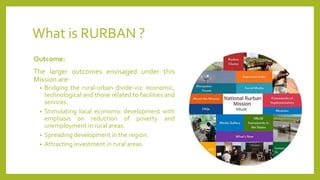
What is RURBAN ?
Outcome:
The larger outcomes envisaged under this
Mission are:
• Bridging the rural-urban divide-viz: economic,
technological and those related to facilities and
services.
• Stimulating local economic development with
emphasis on reduction of poverty and
unemployment in rural areas.
• Spreading development in the region.
• Attracting investment in rural areas.
Why we need RURBAN ?
• There has been an increase in the rural-to-urban migration for various reasons, such as
• better infrastructure
• Education
• job opportunities.
• This has led to overcrowding of cities and creation of ghost towns or villages.Therefore
there is a need to create independent villages that provide the same facilities as urban
areas but still retain the rural character and community spirit.
• Large parts of rural areas in the country are not stand-alone settlements but part of a
cluster of settlements, which are relatively proximate to each other.
• These clusters typically illustrate potential for growth, have economic drivers and derive
locational and competitive advantages.These clusters once developed can then be
classified as Rurban.
NATIONAL RURBAN
MISSION
National Rurban Mission
• Government of India, has launched the Shyama Prasad Mukherji Rurban Mission
(SPMRM), aimed at developing such rural areas by provisioning of economic,
social and physical infrastructure facilities. The Mssion was launched on 21st
February, 2016.
• The Mission aims at development of 300 Rurban clusters, in the next five years.
These clusters would be strengthened with the required amenities, through
convergence of various schemes of the Government.
• The National Rurban Mission (NRuM) follows the vision of & Development of
cluster of villages that preserve and nurture the essence of rural community life
with focus on equity and inclusiveness without compromising with the facilities
perceived to be essentially urban in nature, thus creating a cluster of & “Rurban
Villages”.
National Rurban Mission
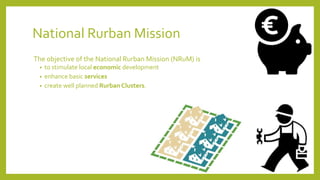
The objective of the National Rurban Mission (NRuM) is
• to stimulate local economic development
• enhance basic services
• create well planned RurbanClusters.
Selection Procedure for a Rurban Cluster
Development
• There will be two categories of clusters under NRuM:
• Non-Tribal
• Tribal.
• While selecting the Rurban cluster the State may identify a large village/gram
panchayat that are growth centers with resources available in the area that could
potentially lead the economic transformation of the region.These growth centers
could also be block headquarter villages or census towns.
• The clusters could then be formed by identifying geographically contiguous
villages/gram panchayats within a radius of 5–10 km (or radius appropriate to the
population density and geography of the region) around the identified growth
center.
Activities under Rurban Mission
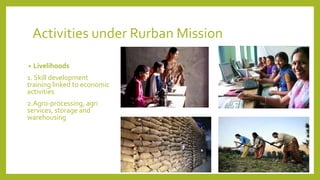
• Livelihoods
1. Skill development
training linked to economic
activities
2.Agro‐processing, agri
services, storage and
warehousing
Activities under Rurban Mission
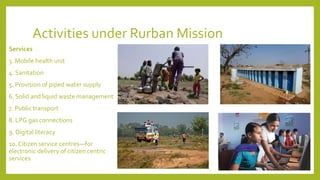
Services
3. Mobile health unit
4. Sanitation
5. Provision of piped water supply
6. Solid and liquid waste management
7. Public transport
8. LPG gas connections
9. Digital literacy
10. Citizen service centres—for
electronic delivery of citizen centric
services
Activities under Rurban Mission
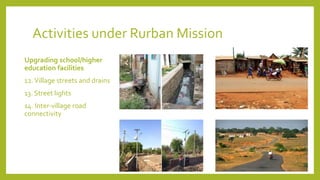
Upgrading school/higher
education facilities
12.Village streets and drains
13. Street lights
14. Inter‐village road
connectivity
CASE STUDY
Chatia Aulia, Sonipat- 131001
ChatiaAulia
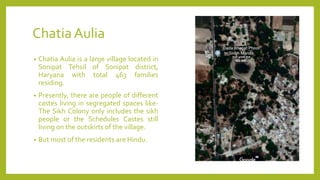
• Chatia Aulia is a large village located in
Sonipat Tehsil of Sonipat district,
Haryana with total 463 families
residing.
• Presently, there are people of different
castes living in segregated spaces like-
The Sikh Colony only includes the sikh
people or the Schedules Castes still
living on the outskirts of the village.
• But most of the residents are Hindu.
Livelihood
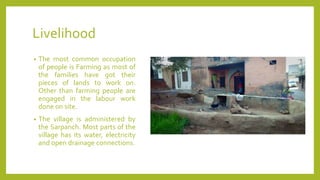
• The most common occupation
of people is Farming as most of
the families have got their
pieces of lands to work on.
Other than farming people are
engaged in the labour work
done on site.
• The village is administered by
the Sarpanch. Most parts of the
village has its water, electricity
and open drainage connections.
Electricity & Street Lights
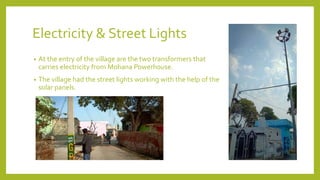
• At the entry of the village are the two transformers that
carries electricity from Mohana Powerhouse.
• The village had the street lights working with the help of the
solar panels.
Water Supply
• Government has provided submersible water pumps to the villagers for the supply
of water.
• Presently used for the bathing purposes of cattles (cow, buffaloes, etc.)
Drainage & Sanitation
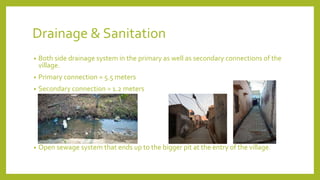
• Both side drainage system in the primary as well as secondary connections of the
village.
• Primary connection = 5.5 meters
• Secondary connection = 1.2 meters
• Open sewage system that ends up to the bigger pit at the entry of the village.
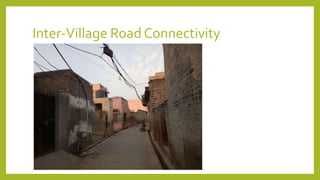
Inter-Village Road Connectivity
Building
Typologies
Residential
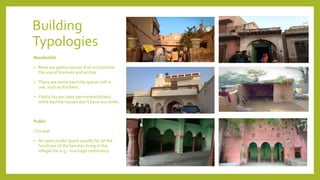
• Most are pakka houses that incorporate
the use of brackets and arches.
• There are some kachcha spaces still in
use, such as kitchens.
• Pakka houses have permanent toilets,
while kachha houses don’t have any toilet.
Public
Choupal:
• An open public space usually for all the
functions of the families living in the
village( for e.g.- marriage ceremony).
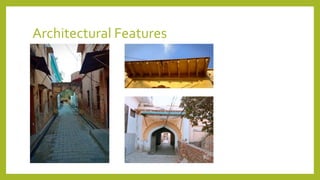
Architectural Features
INTERVENTIONS
AvasaraAcademy, Maharashtra
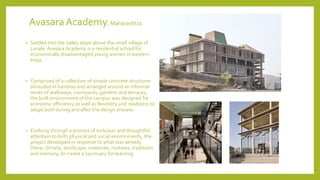
• Settled into the valley slope above the small village of
Lavale, Avasara Academy is a residential school for
economically disadvantaged young women in western
India.
• Comprised of a collection of simple concrete structures
shrouded in bamboo and arranged around an informal
series of walkways, courtyards, gardens and terraces,
the built environment of the campus was designed for
economic efficiency as well as flexibility and readiness to
adapt both during and after the design process.
• Evolving through a process of inclusion and thoughtful
attention to both physical and social environments, the
project developed in response to what was already
there; climate, landscape, materials, routines, traditions
and memory, to create a sanctuary for learning.
Gnana Illam House,Tamil Nadu
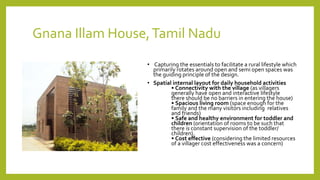
• Capturing the essentials to facilitate a rural lifestyle which
primarily rotates around open and semi open spaces was
the guiding principle of the design.
• Spatial internal layout for daily household activities
• Connectivity with the village (as villagers
generally have open and interactive lifestyle
there should be no barriers in entering the house)
• Spacious living room (space enough for the
family and the many visitors including relatives
and friends)
• Safe and healthy environment for toddler and
children (orientation of rooms to be such that
there is constant supervision of the toddler/
children).
• Cost effective (considering the limited resources
of a villager cost effectiveness was a concern)
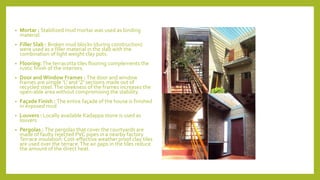
• Mortar : Stabilized mud mortar was used as binding
material.
• Filler Slab : Broken mud blocks (during construction)
were used as a filler material in the slab with the
combination of light weight clay pots.
• Flooring:The terracotta tiles flooring complements the
rustic finish of the interiors.
• Door andWindow Frames : The door and window
frames are simple ‘L’ and ‘Z’ sections made out of
recycled steel.The sleekness of the frames increases the
open-able area without compromising the stability.
• Façade Finish : The entire façade of the house is finished
in exposed mud
• Louvers : Locally available Kadappa stone is used as
louvers
• Pergolas : The pergolas that cover the courtyards are
made of faulty rejected PVC pipes in a nearby factory.
Terrace insulation: Cost-effective weather proof clay tiles
are used over the terrace.The air gaps in the tiles reduce
the amount of the direct heat.
ROLE OF ARCHITECTS
Role of Architects
• The architects must use their knowledge and skills to help people solve their own
problems rather than dispensing wisdom and solution. Further they added that the
architects should act as enablers, rather than preachers and providers.
• The community is no doubt gifted with its own vernacular system and has more
knowledge about their own needs, but need to share this with the expert (architect) who
can help them with scientific appropriateness and visualization of their ideas.
Role of Architects
Housing for the villagers should be considered in the context of sustainable
development and as a carrier of their socio- cultural identity.
This includes the following tasks:
Raising awareness among the villagers regarding sustainable development.
Space planning for built environment within the natural environment.
Reduction in the need and dependency on consumption of non – renewable natural
resources.
Finding the solution of housing within the frame of vernacular trends of that place.
Concluding Statement
We do not need to reimagine the rural as a replica of
the urban but use its strengths to forge a contextual
future that is forward‐looking, sustainable,
livelihood‐centred and mindful of existing
socio‐economic conditions.
“
”

Rurban- Redefining Rural Architecture

  • 1.
  • 3.
    What is RURBAN? Vision: • The National Rurban Mission (NRuM) follows the vision of "Development of a cluster of • villages that preserve and nurture the essence of rural community life with • focus on equity and inclusiveness without compromising with the facilities perceived to be • essentially urban in nature, thus creating a cluster of "RurbanVillages". Objective: • The objective of the National Rurban Mission (NRuM) is to stimulate local economic • development, enhance basic services, and create well planned Rurban • clusters.
  • 4.
    What is RURBAN? Outcome: The larger outcomes envisaged under this Mission are: • Bridging the rural-urban divide-viz: economic, technological and those related to facilities and services. • Stimulating local economic development with emphasis on reduction of poverty and unemployment in rural areas. • Spreading development in the region. • Attracting investment in rural areas.
  • 5.
    Why we needRURBAN ? • There has been an increase in the rural-to-urban migration for various reasons, such as • better infrastructure • Education • job opportunities. • This has led to overcrowding of cities and creation of ghost towns or villages.Therefore there is a need to create independent villages that provide the same facilities as urban areas but still retain the rural character and community spirit. • Large parts of rural areas in the country are not stand-alone settlements but part of a cluster of settlements, which are relatively proximate to each other. • These clusters typically illustrate potential for growth, have economic drivers and derive locational and competitive advantages.These clusters once developed can then be classified as Rurban.
  • 6.
  • 8.
    National Rurban Mission •Government of India, has launched the Shyama Prasad Mukherji Rurban Mission (SPMRM), aimed at developing such rural areas by provisioning of economic, social and physical infrastructure facilities. The Mssion was launched on 21st February, 2016. • The Mission aims at development of 300 Rurban clusters, in the next five years. These clusters would be strengthened with the required amenities, through convergence of various schemes of the Government. • The National Rurban Mission (NRuM) follows the vision of & Development of cluster of villages that preserve and nurture the essence of rural community life with focus on equity and inclusiveness without compromising with the facilities perceived to be essentially urban in nature, thus creating a cluster of & “Rurban Villages”.
  • 9.
    National Rurban Mission Theobjective of the National Rurban Mission (NRuM) is • to stimulate local economic development • enhance basic services • create well planned RurbanClusters.
  • 10.
    Selection Procedure fora Rurban Cluster Development • There will be two categories of clusters under NRuM: • Non-Tribal • Tribal. • While selecting the Rurban cluster the State may identify a large village/gram panchayat that are growth centers with resources available in the area that could potentially lead the economic transformation of the region.These growth centers could also be block headquarter villages or census towns. • The clusters could then be formed by identifying geographically contiguous villages/gram panchayats within a radius of 5–10 km (or radius appropriate to the population density and geography of the region) around the identified growth center.
  • 11.
    Activities under RurbanMission • Livelihoods 1. Skill development training linked to economic activities 2.Agro‐processing, agri services, storage and warehousing
  • 12.
    Activities under RurbanMission Services 3. Mobile health unit 4. Sanitation 5. Provision of piped water supply 6. Solid and liquid waste management 7. Public transport 8. LPG gas connections 9. Digital literacy 10. Citizen service centres—for electronic delivery of citizen centric services
  • 13.
    Activities under RurbanMission Upgrading school/higher education facilities 12.Village streets and drains 13. Street lights 14. Inter‐village road connectivity
  • 14.
    CASE STUDY Chatia Aulia,Sonipat- 131001
  • 15.
    ChatiaAulia • Chatia Auliais a large village located in Sonipat Tehsil of Sonipat district, Haryana with total 463 families residing. • Presently, there are people of different castes living in segregated spaces like- The Sikh Colony only includes the sikh people or the Schedules Castes still living on the outskirts of the village. • But most of the residents are Hindu.
  • 16.
    Livelihood • The mostcommon occupation of people is Farming as most of the families have got their pieces of lands to work on. Other than farming people are engaged in the labour work done on site. • The village is administered by the Sarpanch. Most parts of the village has its water, electricity and open drainage connections.
  • 17.
    Electricity & StreetLights • At the entry of the village are the two transformers that carries electricity from Mohana Powerhouse. • The village had the street lights working with the help of the solar panels.
  • 18.
    Water Supply • Governmenthas provided submersible water pumps to the villagers for the supply of water. • Presently used for the bathing purposes of cattles (cow, buffaloes, etc.)
  • 19.
    Drainage & Sanitation •Both side drainage system in the primary as well as secondary connections of the village. • Primary connection = 5.5 meters • Secondary connection = 1.2 meters • Open sewage system that ends up to the bigger pit at the entry of the village.
  • 20.
  • 21.
    Building Typologies Residential • Most arepakka houses that incorporate the use of brackets and arches. • There are some kachcha spaces still in use, such as kitchens. • Pakka houses have permanent toilets, while kachha houses don’t have any toilet. Public Choupal: • An open public space usually for all the functions of the families living in the village( for e.g.- marriage ceremony).
  • 22.
  • 23.
  • 24.
    AvasaraAcademy, Maharashtra • Settledinto the valley slope above the small village of Lavale, Avasara Academy is a residential school for economically disadvantaged young women in western India. • Comprised of a collection of simple concrete structures shrouded in bamboo and arranged around an informal series of walkways, courtyards, gardens and terraces, the built environment of the campus was designed for economic efficiency as well as flexibility and readiness to adapt both during and after the design process. • Evolving through a process of inclusion and thoughtful attention to both physical and social environments, the project developed in response to what was already there; climate, landscape, materials, routines, traditions and memory, to create a sanctuary for learning.
  • 25.
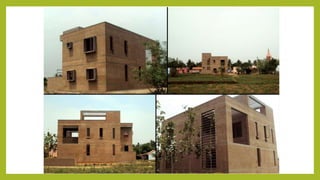
    Gnana Illam House,TamilNadu • Capturing the essentials to facilitate a rural lifestyle which primarily rotates around open and semi open spaces was the guiding principle of the design. • Spatial internal layout for daily household activities • Connectivity with the village (as villagers generally have open and interactive lifestyle there should be no barriers in entering the house) • Spacious living room (space enough for the family and the many visitors including relatives and friends) • Safe and healthy environment for toddler and children (orientation of rooms to be such that there is constant supervision of the toddler/ children). • Cost effective (considering the limited resources of a villager cost effectiveness was a concern)
  • 27.
    • Mortar :Stabilized mud mortar was used as binding material. • Filler Slab : Broken mud blocks (during construction) were used as a filler material in the slab with the combination of light weight clay pots. • Flooring:The terracotta tiles flooring complements the rustic finish of the interiors. • Door andWindow Frames : The door and window frames are simple ‘L’ and ‘Z’ sections made out of recycled steel.The sleekness of the frames increases the open-able area without compromising the stability. • Façade Finish : The entire façade of the house is finished in exposed mud • Louvers : Locally available Kadappa stone is used as louvers • Pergolas : The pergolas that cover the courtyards are made of faulty rejected PVC pipes in a nearby factory. Terrace insulation: Cost-effective weather proof clay tiles are used over the terrace.The air gaps in the tiles reduce the amount of the direct heat.
  • 28.
  • 29.
    Role of Architects •The architects must use their knowledge and skills to help people solve their own problems rather than dispensing wisdom and solution. Further they added that the architects should act as enablers, rather than preachers and providers. • The community is no doubt gifted with its own vernacular system and has more knowledge about their own needs, but need to share this with the expert (architect) who can help them with scientific appropriateness and visualization of their ideas.
  • 30.
    Role of Architects Housingfor the villagers should be considered in the context of sustainable development and as a carrier of their socio- cultural identity. This includes the following tasks: Raising awareness among the villagers regarding sustainable development. Space planning for built environment within the natural environment. Reduction in the need and dependency on consumption of non – renewable natural resources. Finding the solution of housing within the frame of vernacular trends of that place.
  • 31.
    Concluding Statement We donot need to reimagine the rural as a replica of the urban but use its strengths to forge a contextual future that is forward‐looking, sustainable, livelihood‐centred and mindful of existing socio‐economic conditions. “ ”