Royal Lake: Meeting Agenda
 Introductions and Opening Remarks
 Project Goal and Status
 Royal Lake Conditions
 Project Overview
 Site Access
 Dredging
– Phase I and Phase II
– Dredging Alternatives
 Lake Habitat and Shoreline Restoration
 Project Timeline
 Questions and Answers
 Restore Sediment Pool Capacity
– Downstream water quality benefits
– Lake water quality
– Aesthetics
 Improve Lake Water Quality and Habitat
 Provide Long Term Maintenance Improvements
Project Goals and Benefits
 Completed Data Collection
 Completed Lake Dredging and Management Plan
 Design Plans and Specifications
– Preliminary Design – Completed
– Final Design – Current design phase
 Permitting – In Progress
 Late 2014/Early 2015 – Complete Final Design and Permitting
 Dredging Projected to Start in Late Summer, 2015
Royal Lake: Project Status
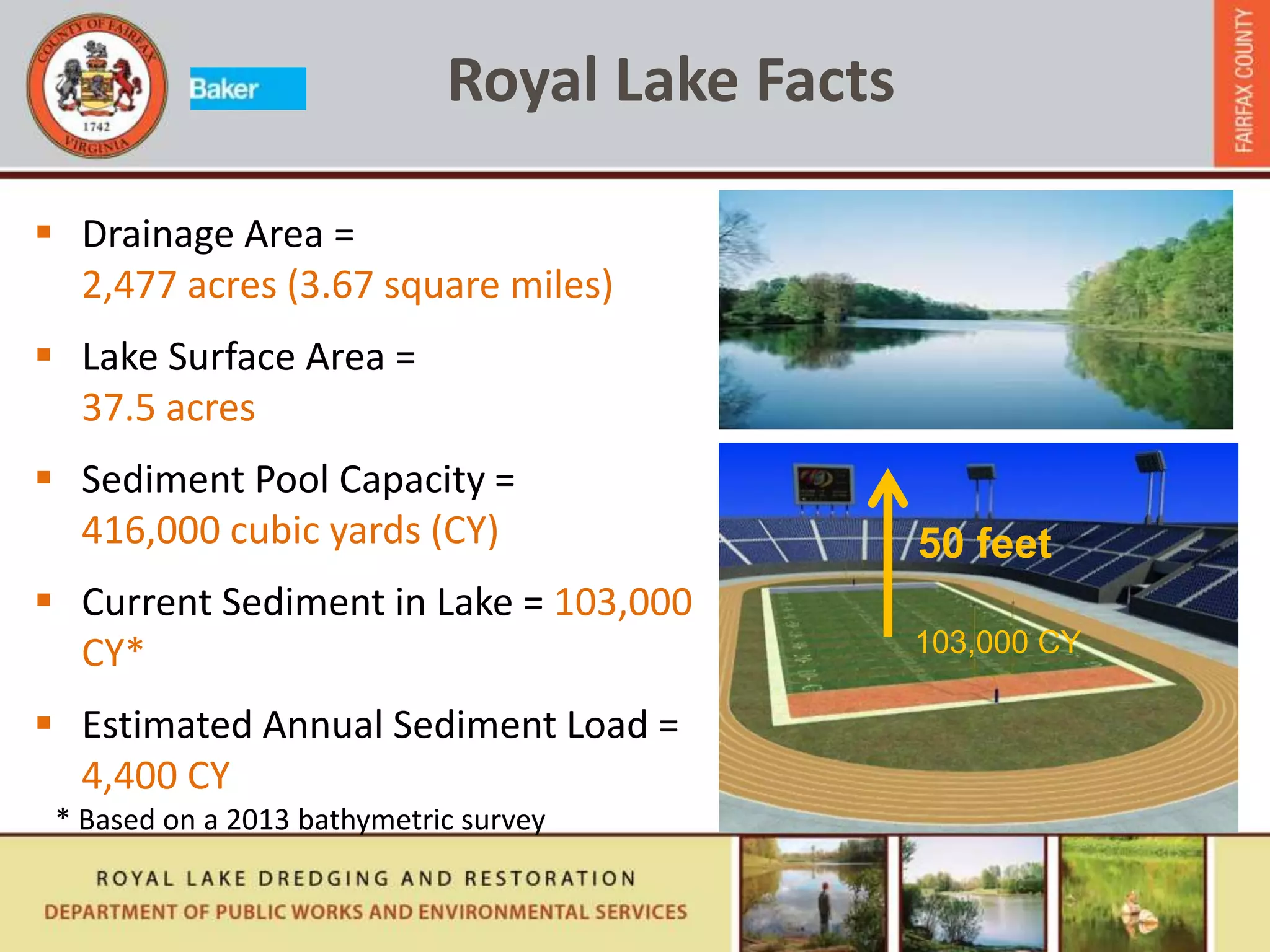
Royal Lake Facts
 Drainage Area =
2,477 acres (3.67 square miles)
 Lake Surface Area =
37.5 acres
 Sediment Pool Capacity =
416,000 cubic yards (CY)
 Current Sediment in Lake = 103,000
CY*
 Estimated Annual Sediment Load =
4,400 CY
50 feet
103,000 CY
* Based on a 2013 bathymetric survey
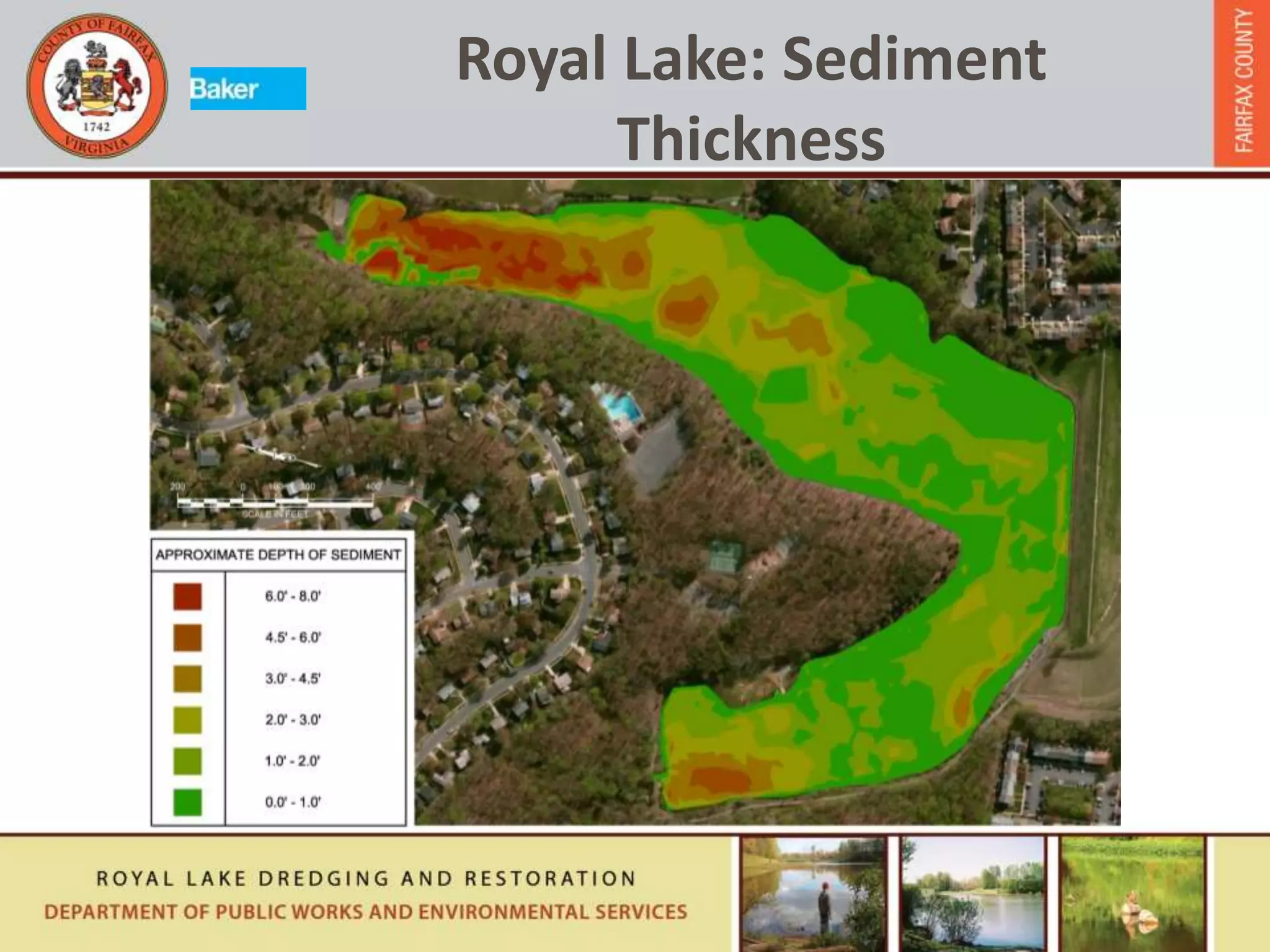
Royal Lake: Sediment
Thickness
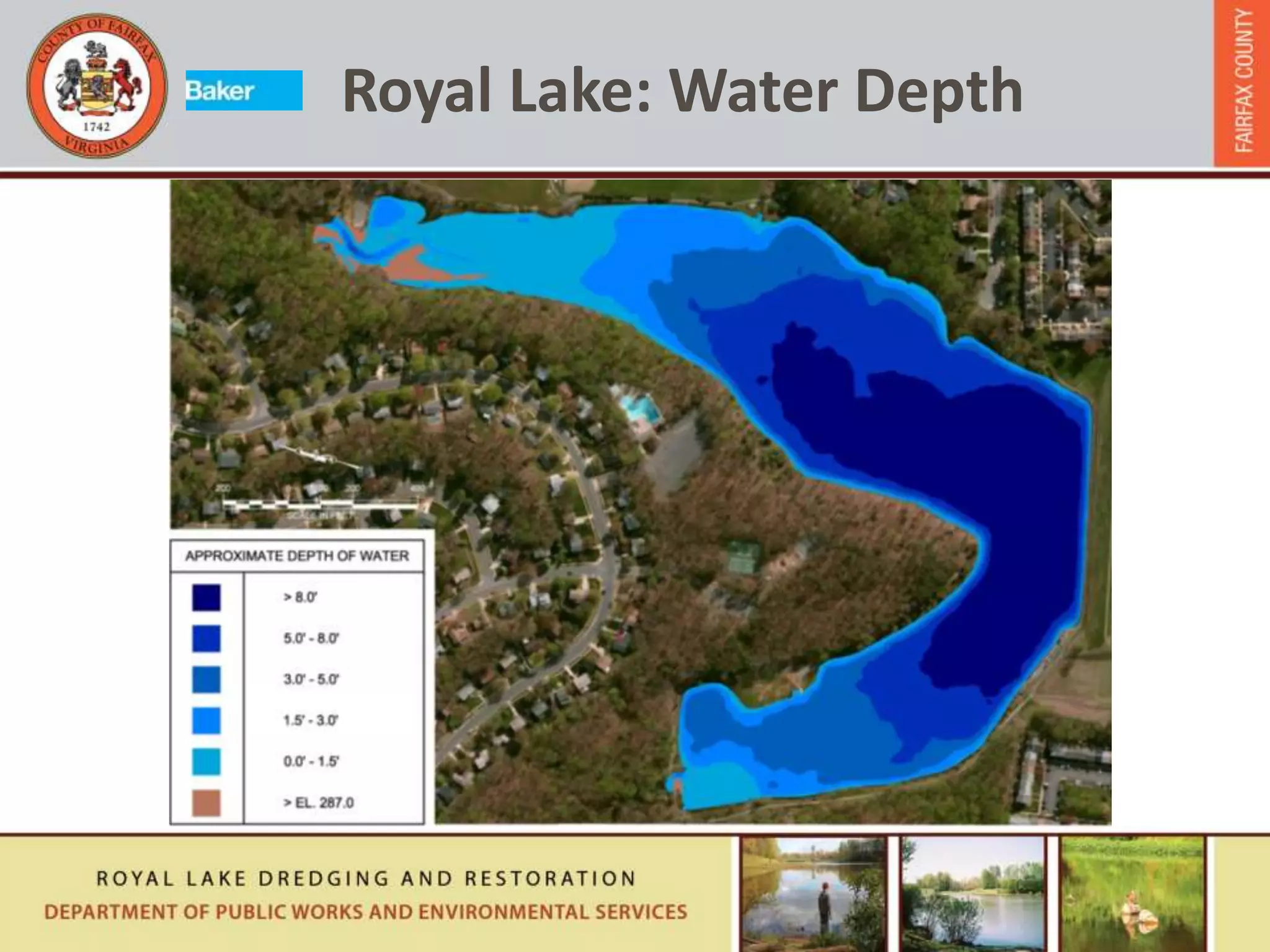
Royal Lake: Water Depth
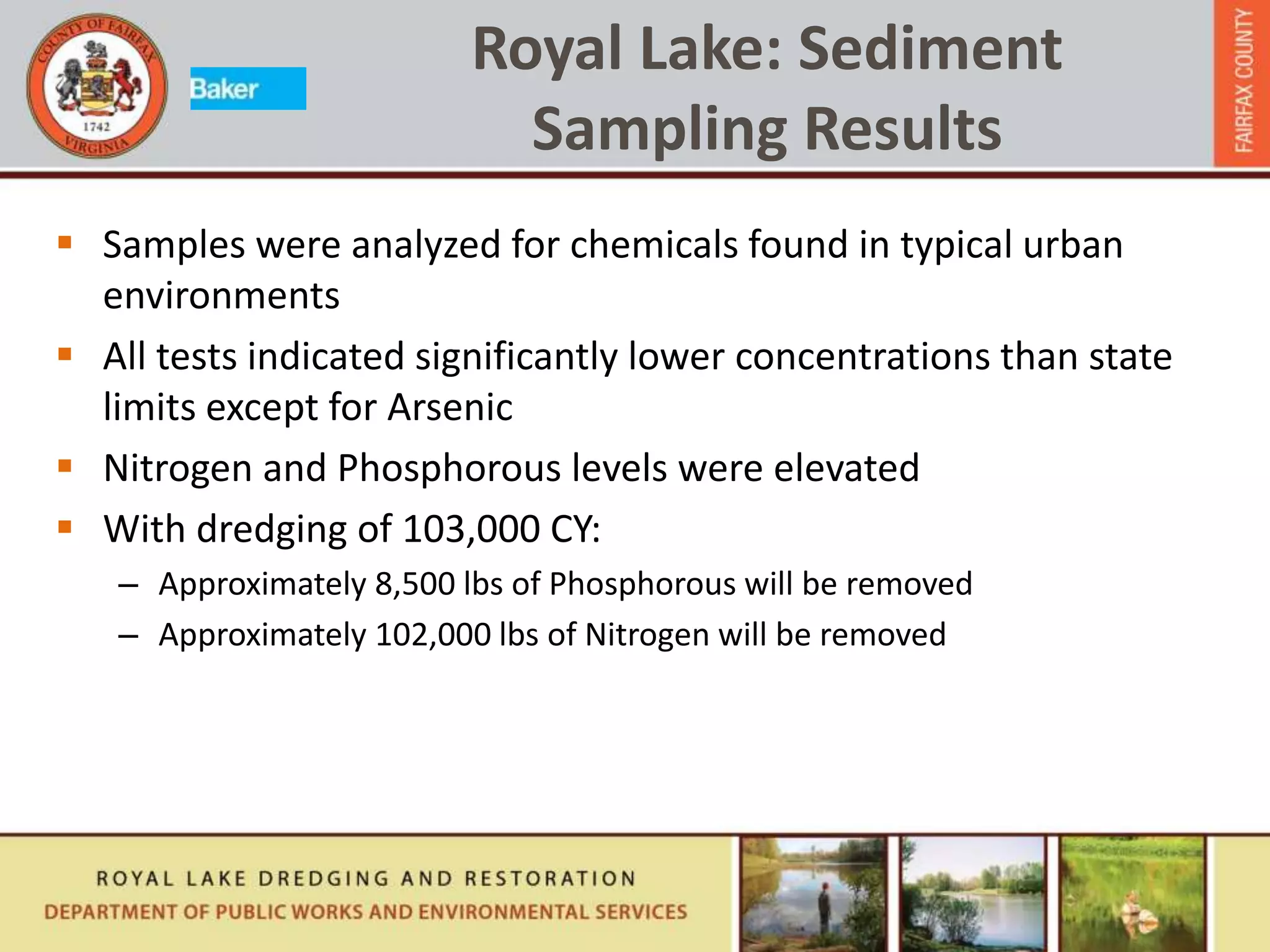
Royal Lake: Sediment
Sampling Results
 Samples were analyzed for chemicals found in typical urban
environments
 All tests indicated significantly lower concentrations than state
limits except for Arsenic
 Nitrogen and Phosphorous levels were elevated
 With dredging of 103,000 CY:
– Approximately 8,500 lbs of Phosphorous will be removed
– Approximately 102,000 lbs of Nitrogen will be removed
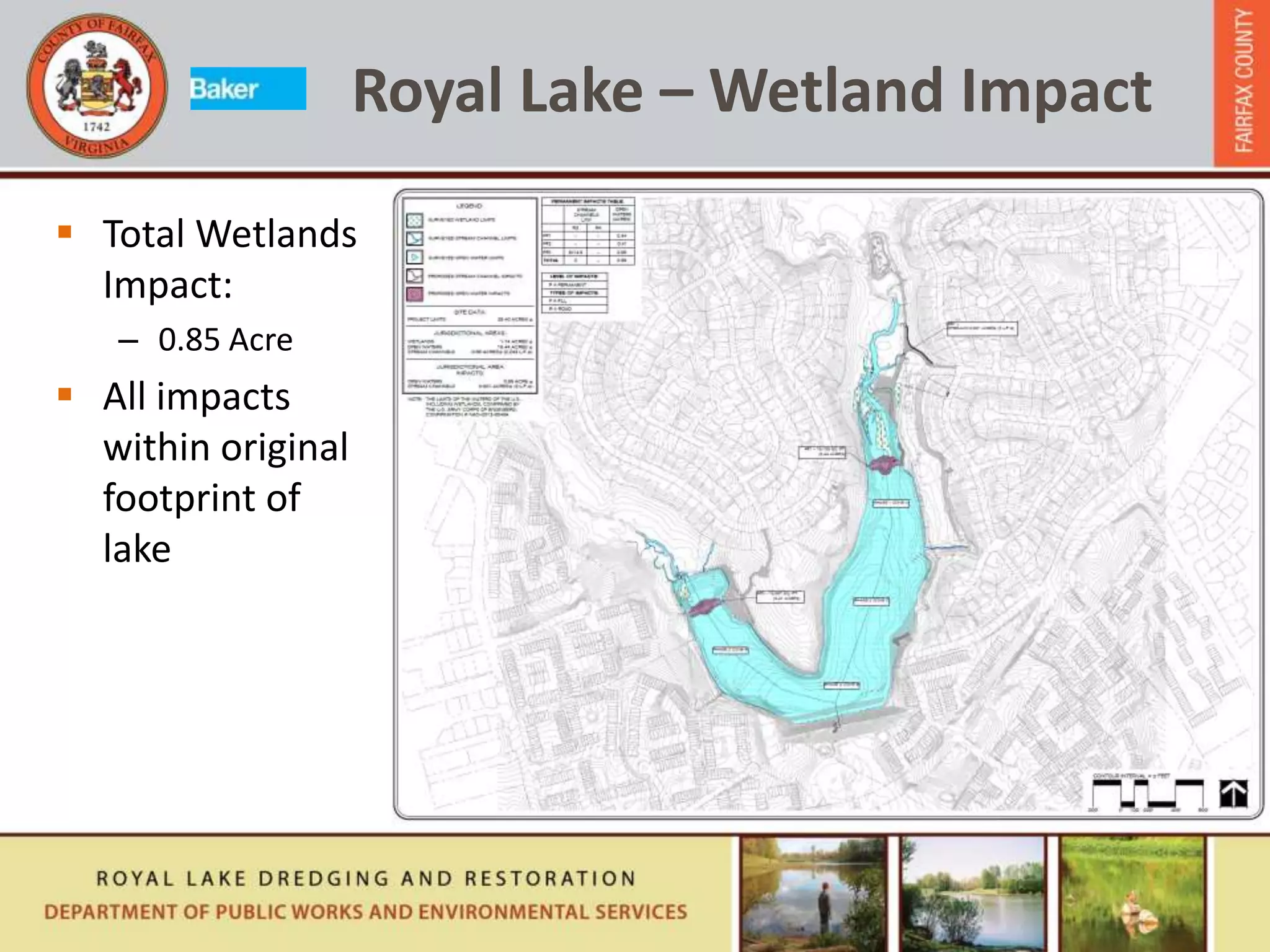
 Total Wetlands
Impact:
– 0.85 Acre
 All impacts
within original
footprint of
lake
Royal Lake – Wetland Impact
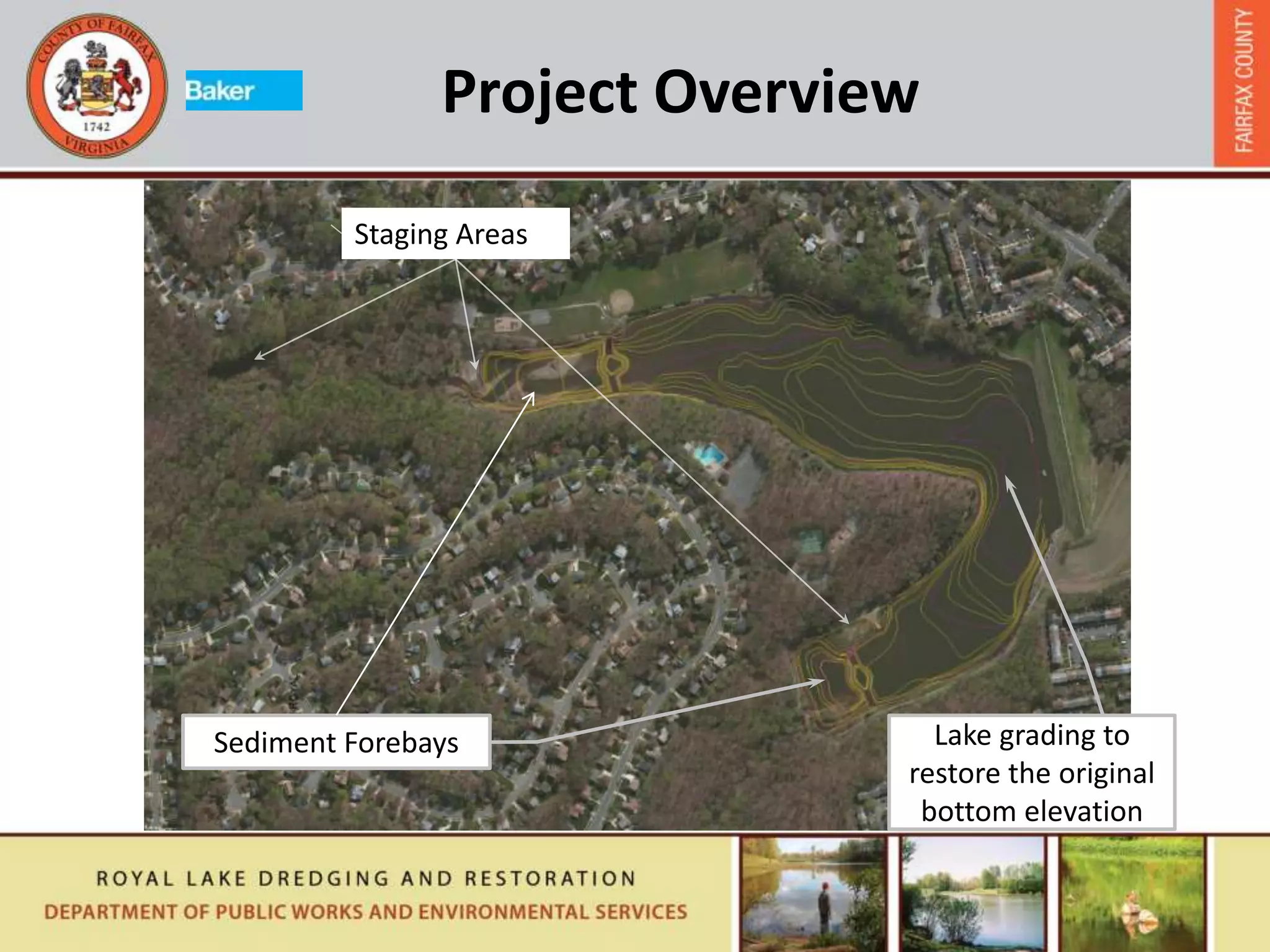
Project Overview
Staging Areas
Sediment Forebays Lake grading to
restore the original
bottom elevation
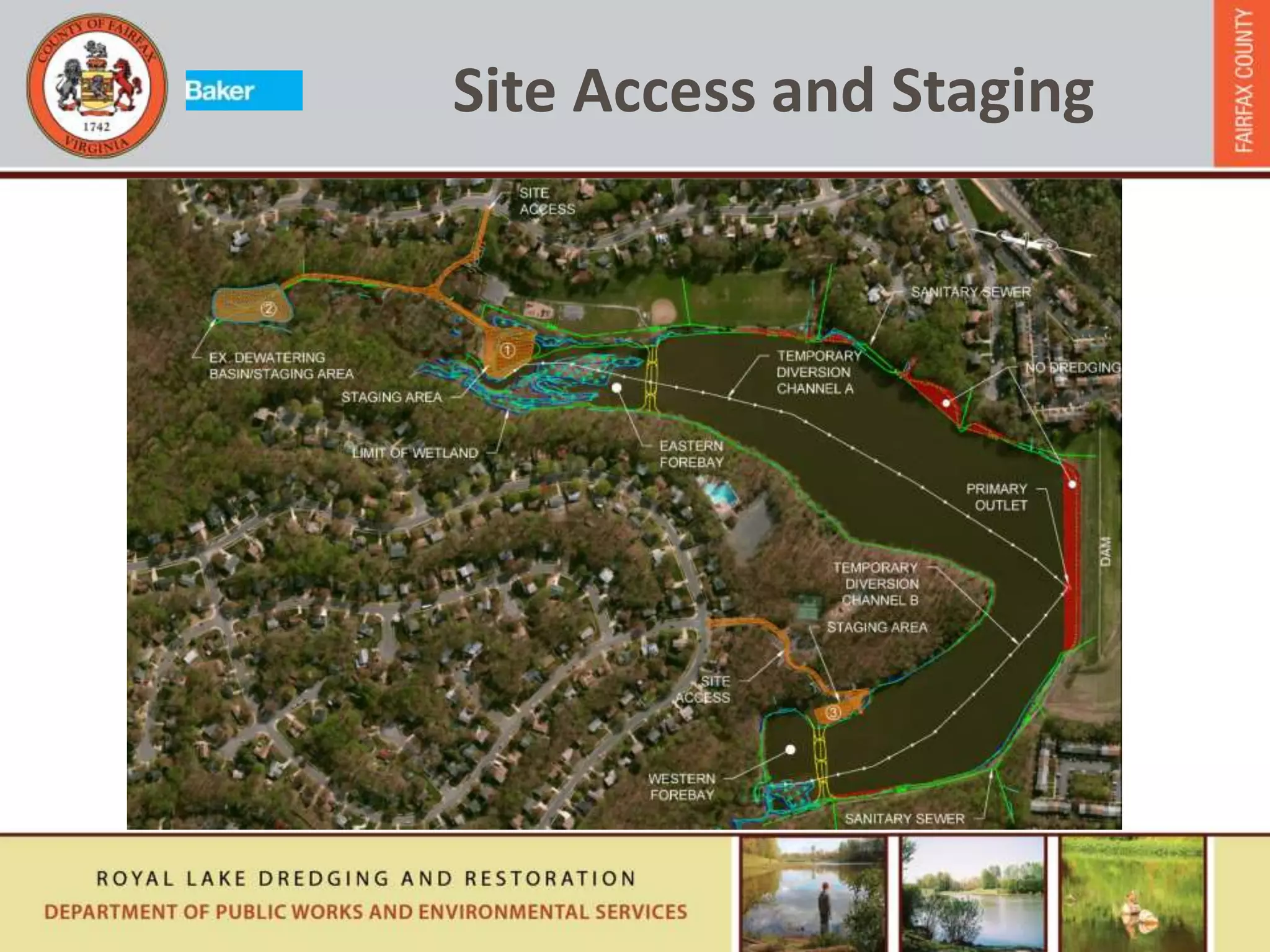
Site Access and Staging
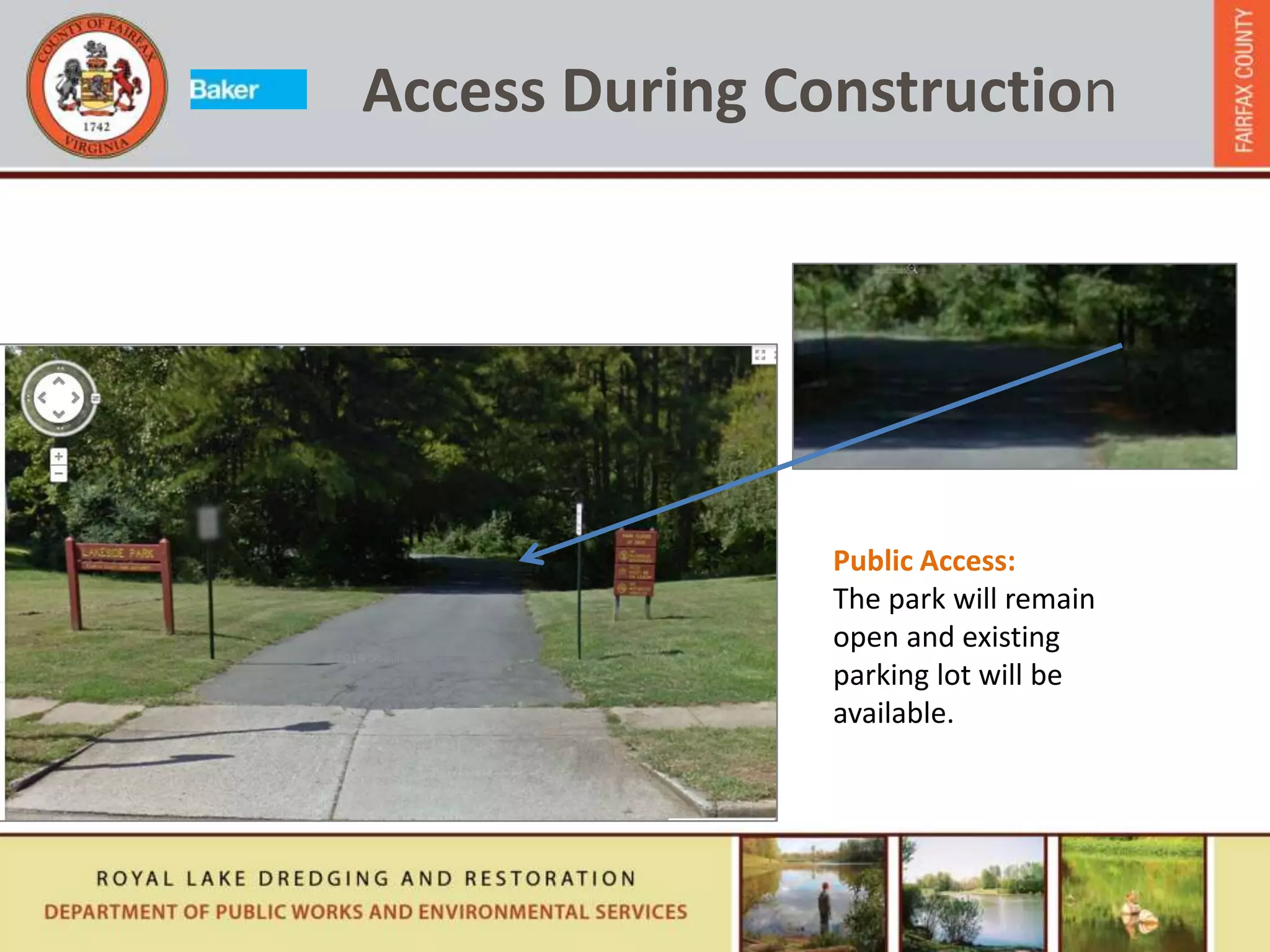
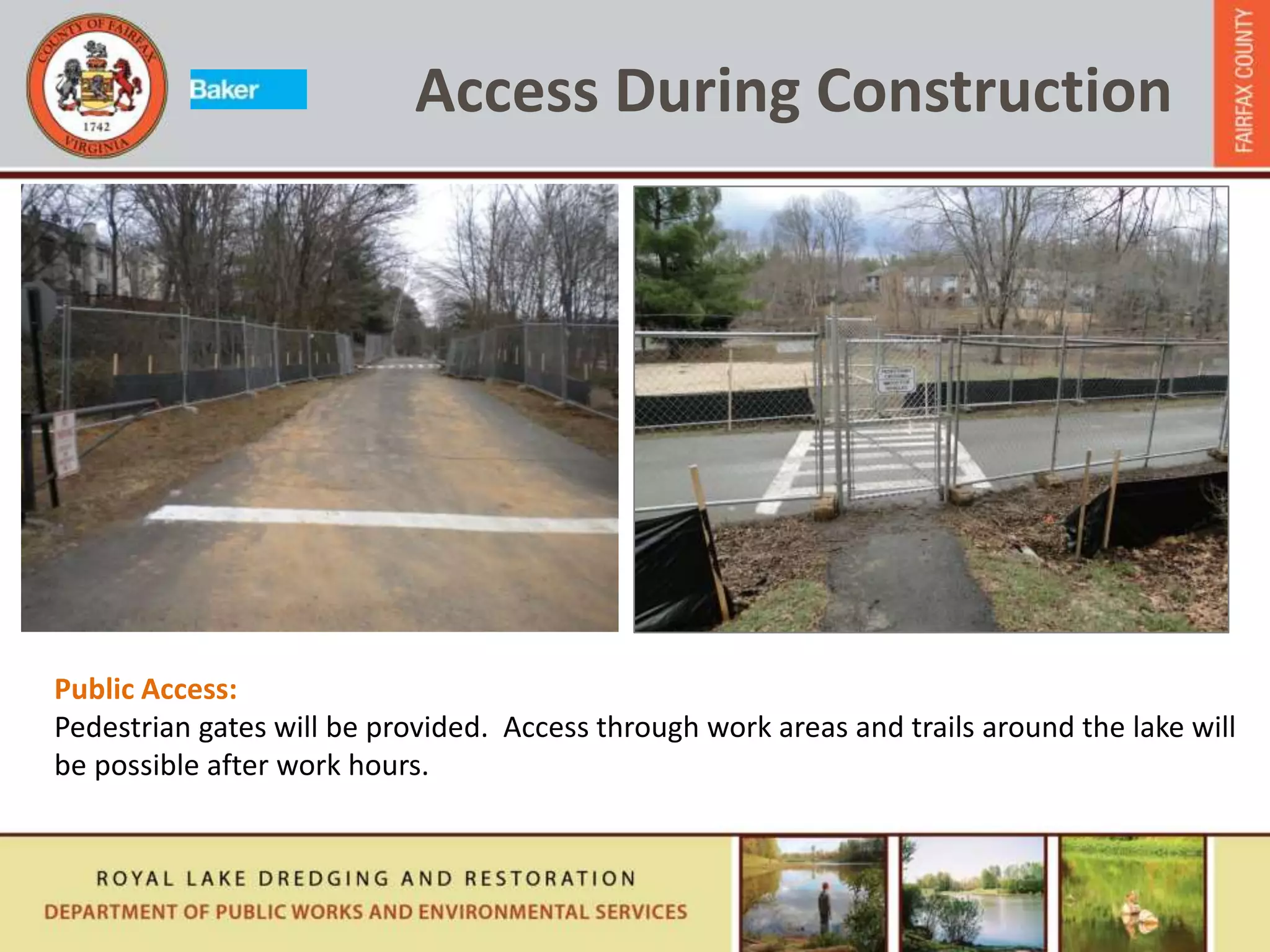
Access During Construction
Public Access:
The park will remain
open and existing
parking lot will be
available.
Access During Construction
Public Access:
Pedestrian gates will be provided. Access through work areas and trails around the lake will
be possible after work hours.
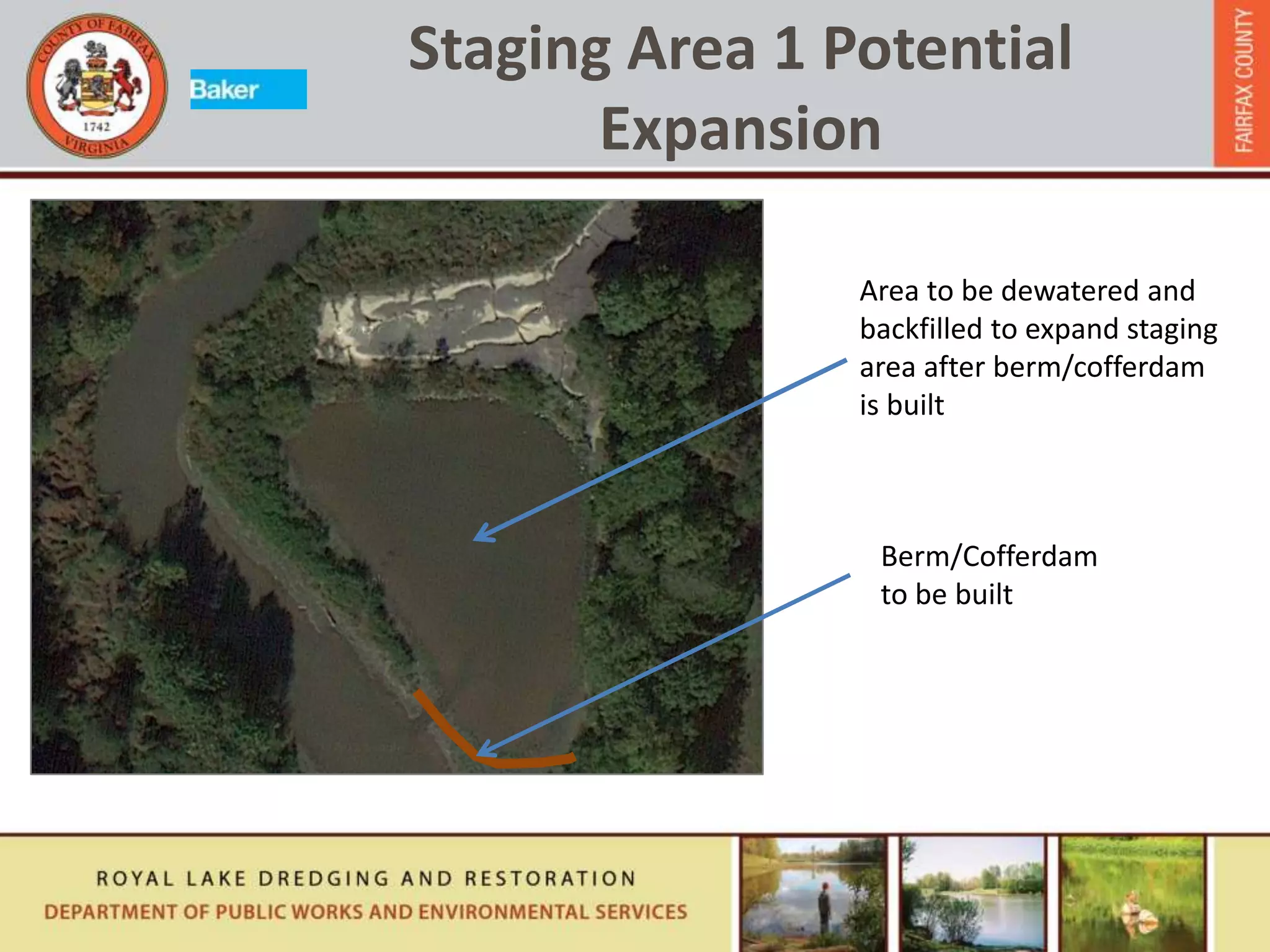
Staging Area 1 Potential
Expansion
Berm/Cofferdam
to be built
Area to be dewatered and
backfilled to expand staging
area after berm/cofferdam
is built
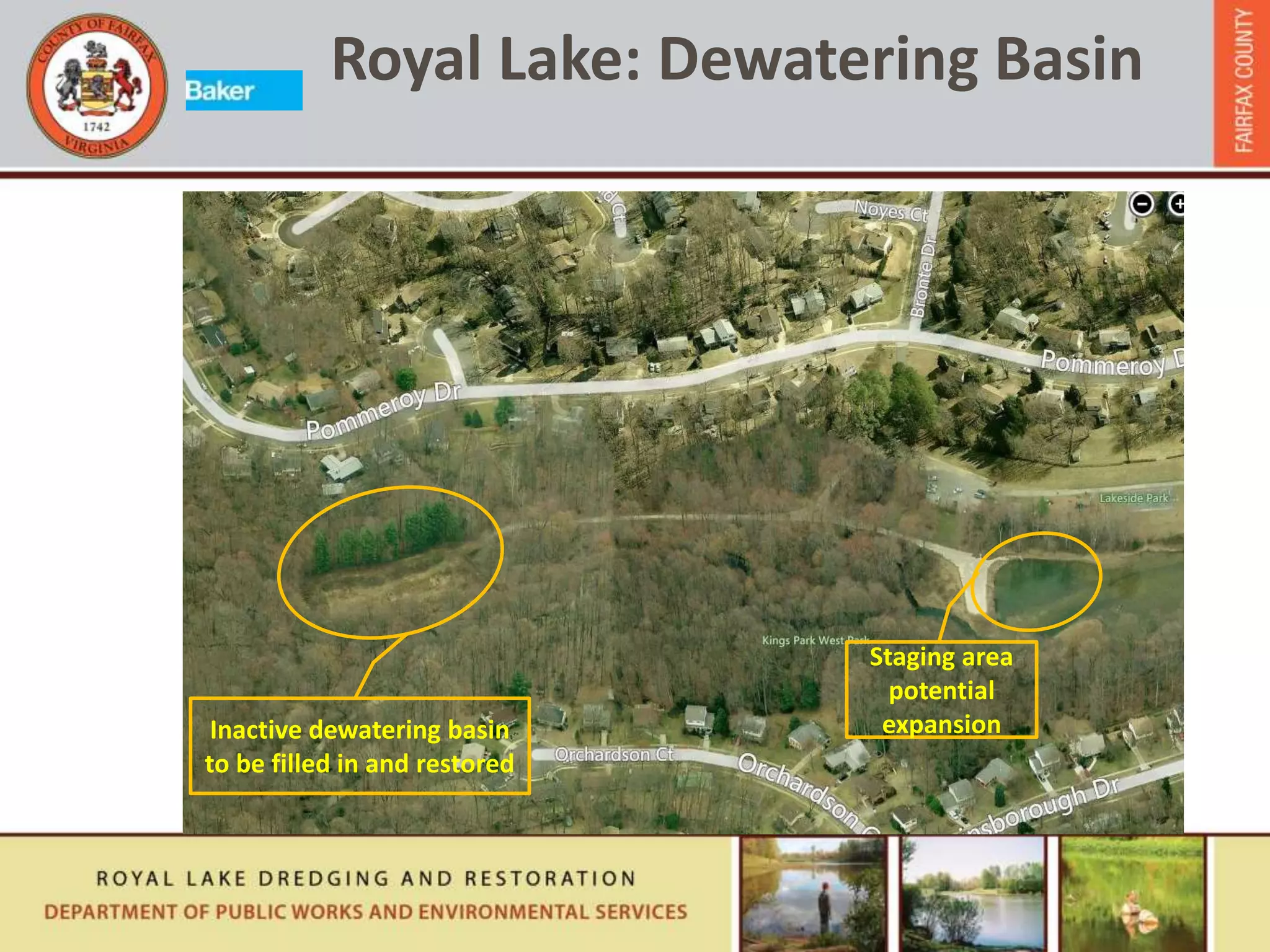
Royal Lake: Dewatering Basin
Inactive dewatering basin
to be filled in and restored
Staging area
potential
expansion
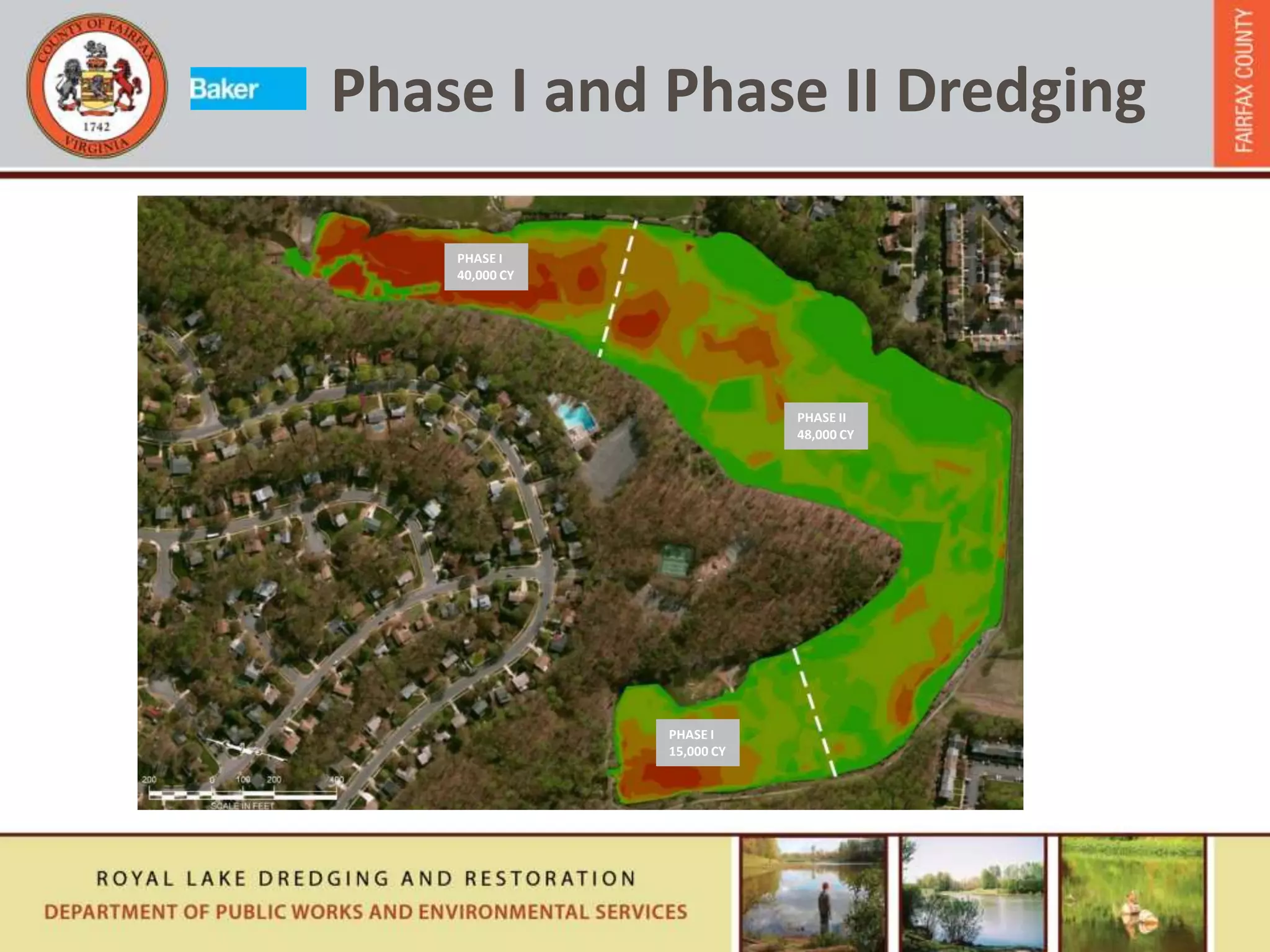
Phase I and Phase II Dredging
PHASE II
48,000 CY
PHASE I
15,000 CY
PHASE I
40,000 CY
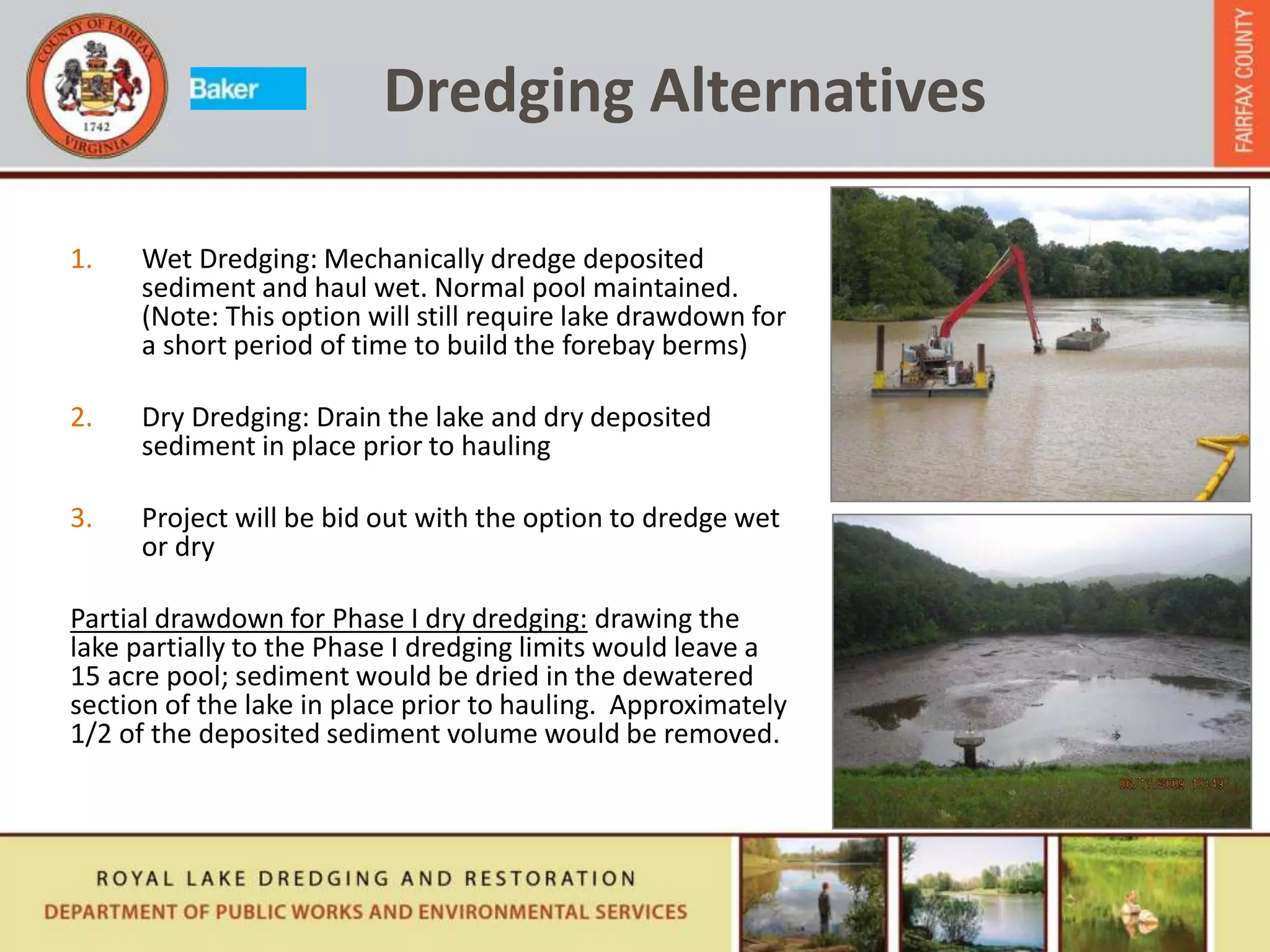
Dredging Alternatives
1. Wet Dredging: Mechanically dredge deposited
sediment and haul wet. Normal pool maintained.
(Note: This option will still require lake drawdown for
a short period of time to build the forebay berms)
2. Dry Dredging: Drain the lake and dry deposited
sediment in place prior to hauling
3. Project will be bid out with the option to dredge wet
or dry
Partial drawdown for Phase I dry dredging: drawing the
lake partially to the Phase I dredging limits would leave a
15 acre pool; sediment would be dried in the dewatered
section of the lake in place prior to hauling. Approximately
1/2 of the deposited sediment volume would be removed.
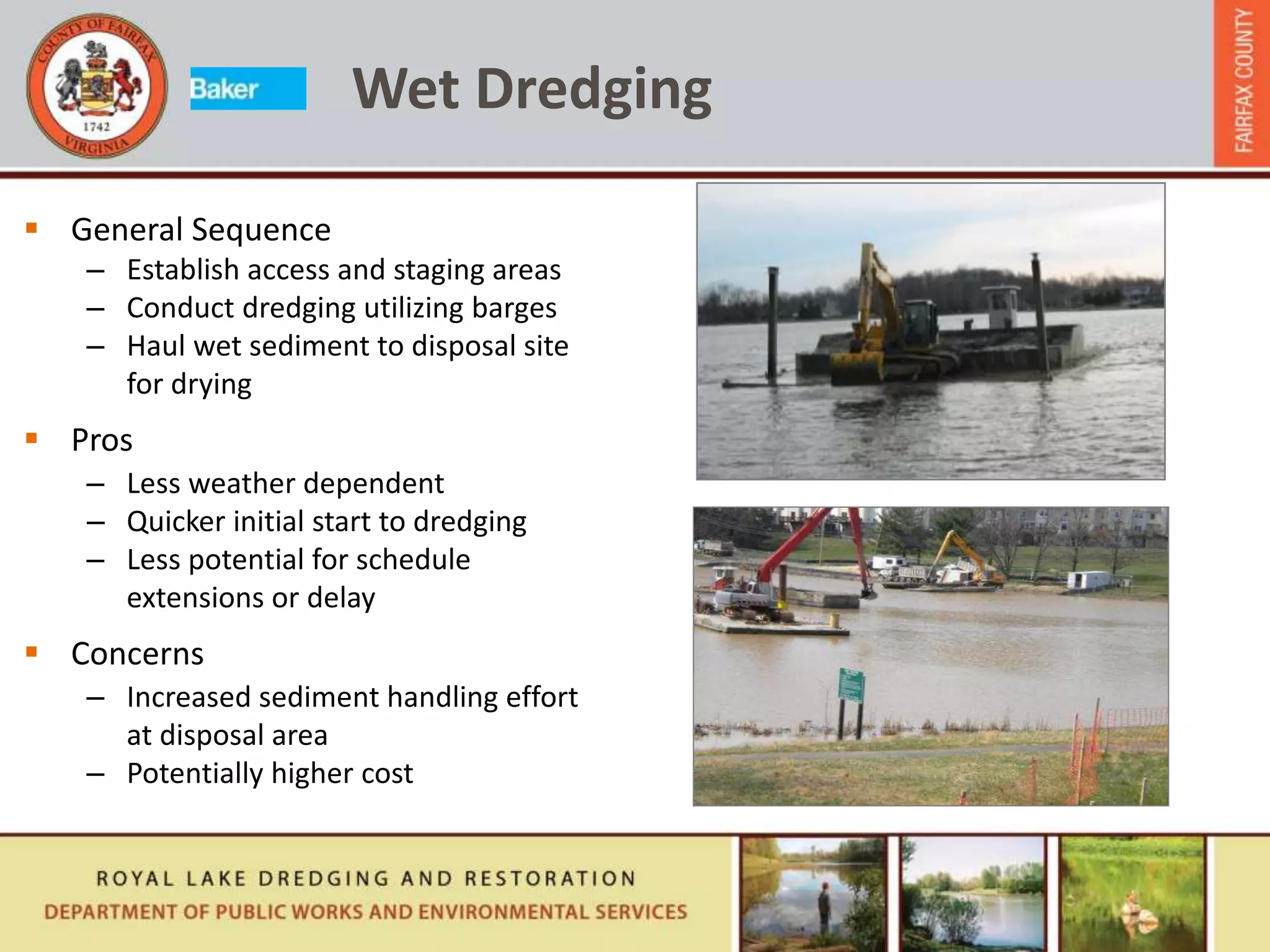
 General Sequence
– Establish access and staging areas
– Conduct dredging utilizing barges
– Haul wet sediment to disposal site
for drying
 Pros
– Less weather dependent
– Quicker initial start to dredging
– Less potential for schedule
extensions or delay
 Concerns
– Increased sediment handling effort
at disposal area
– Potentially higher cost
Wet Dredging
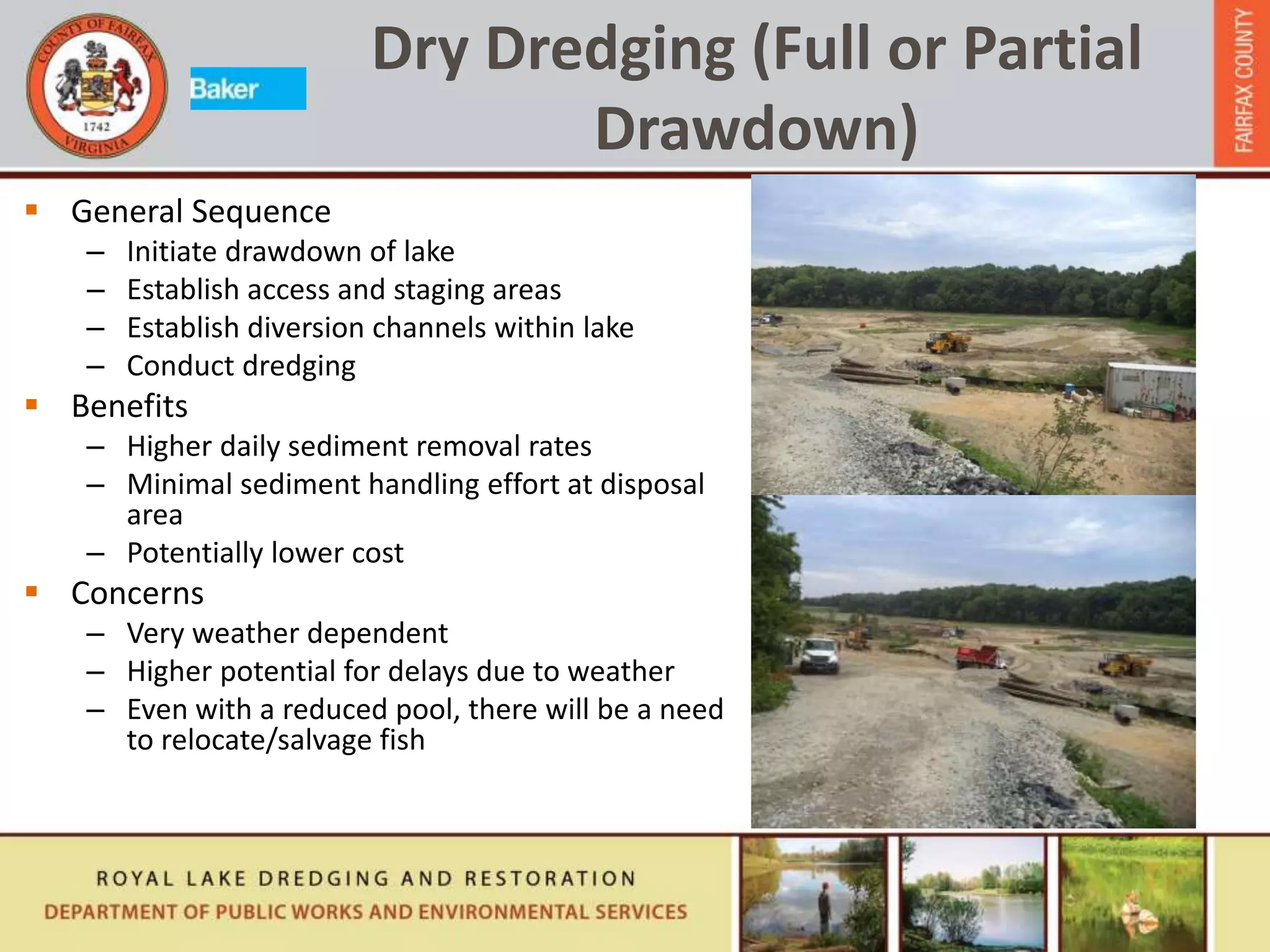
 General Sequence
– Initiate drawdown of lake
– Establish access and staging areas
– Establish diversion channels within lake
– Conduct dredging
 Benefits
– Higher daily sediment removal rates
– Minimal sediment handling effort at disposal
area
– Potentially lower cost
 Concerns
– Very weather dependent
– Higher potential for delays due to weather
– Even with a reduced pool, there will be a need
to relocate/salvage fish
Dry Dredging (Full or Partial
Drawdown)
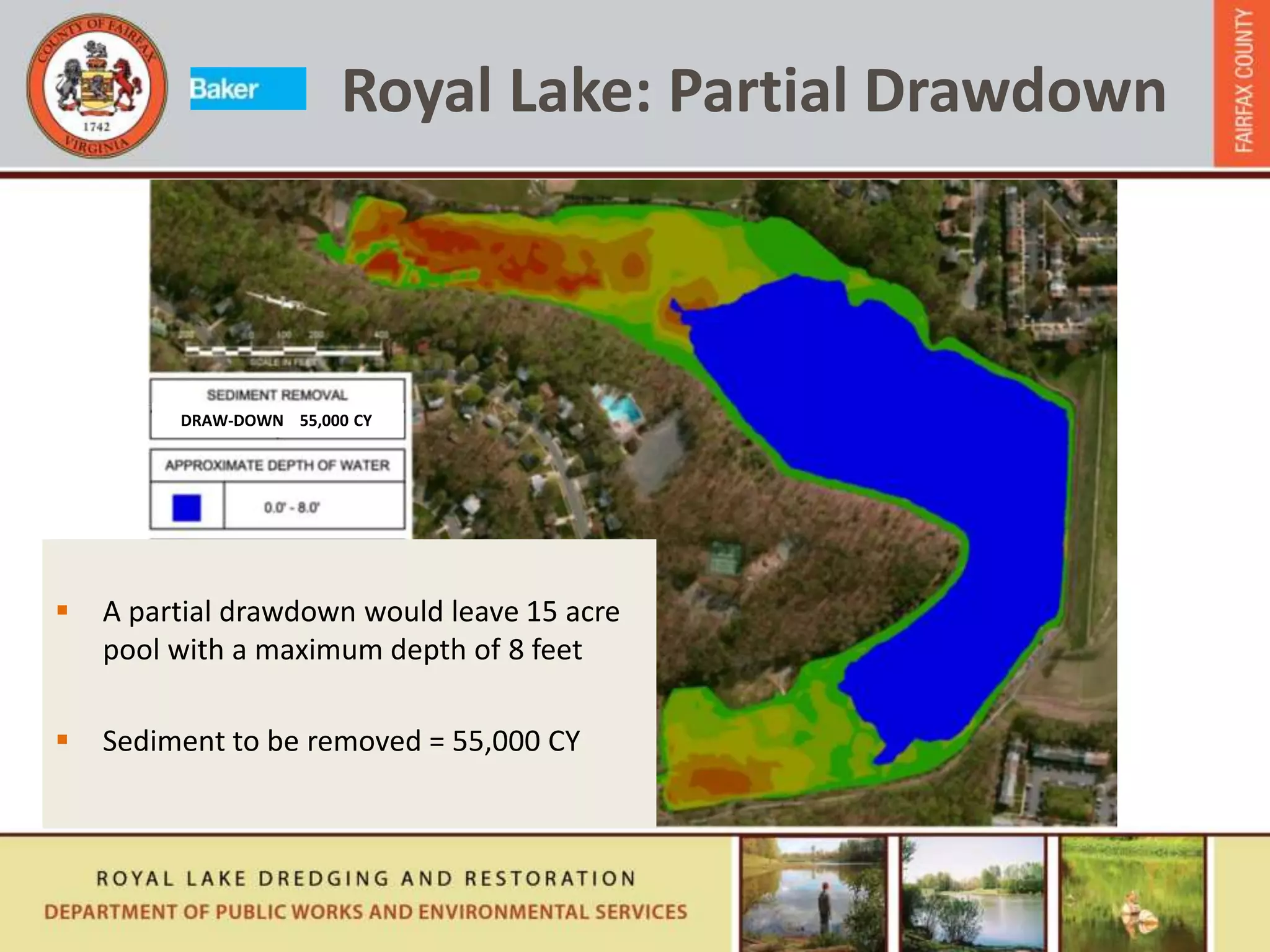
Royal Lake: Partial Drawdown
 A partial drawdown would leave 15 acre
pool with a maximum depth of 8 feet
 Sediment to be removed = 55,000 CY
DRAW-DOWN 55,000 CY
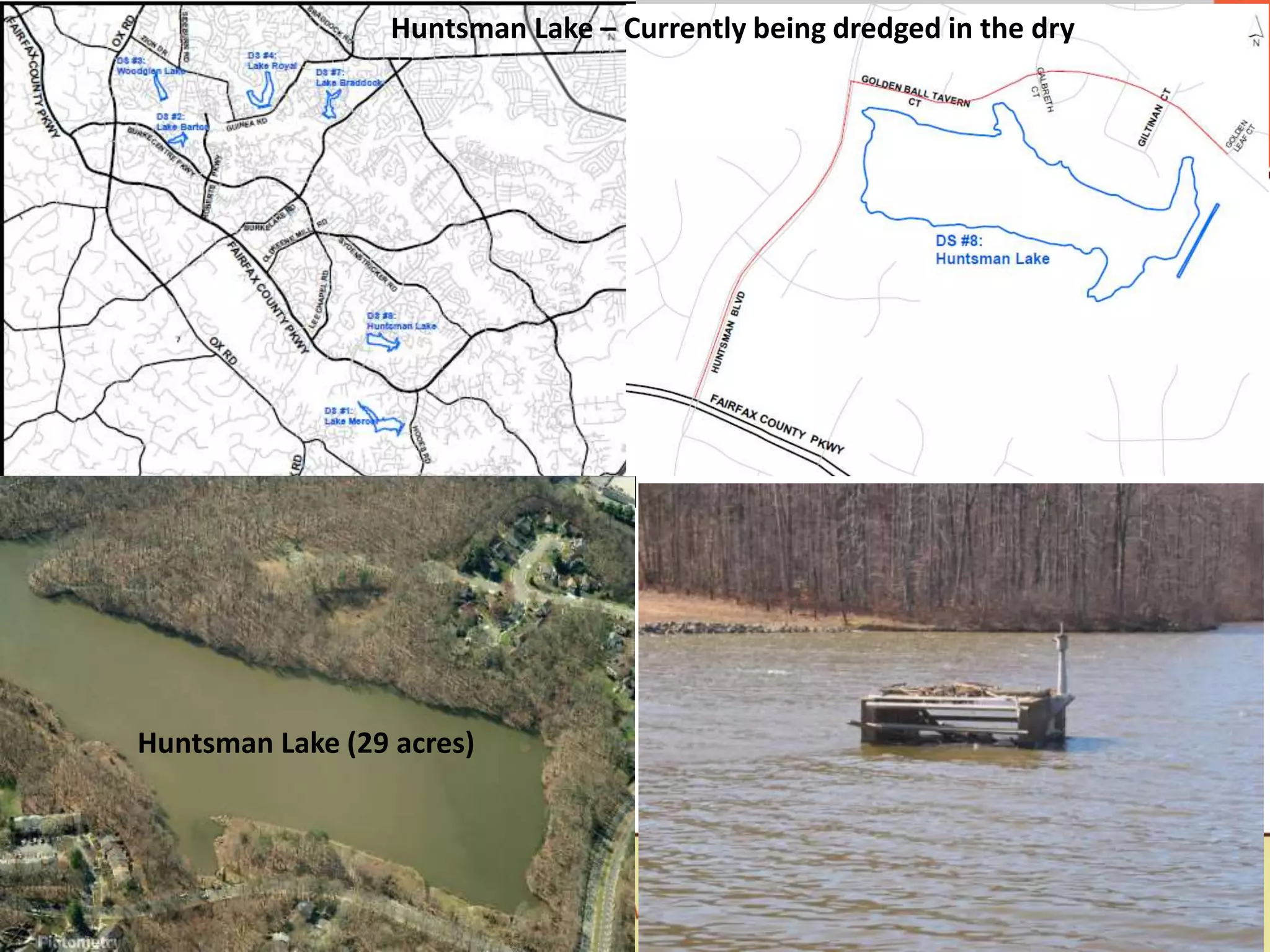
Huntsman Lake (29 acres)
Huntsman Lake – Currently being dredged in the dry
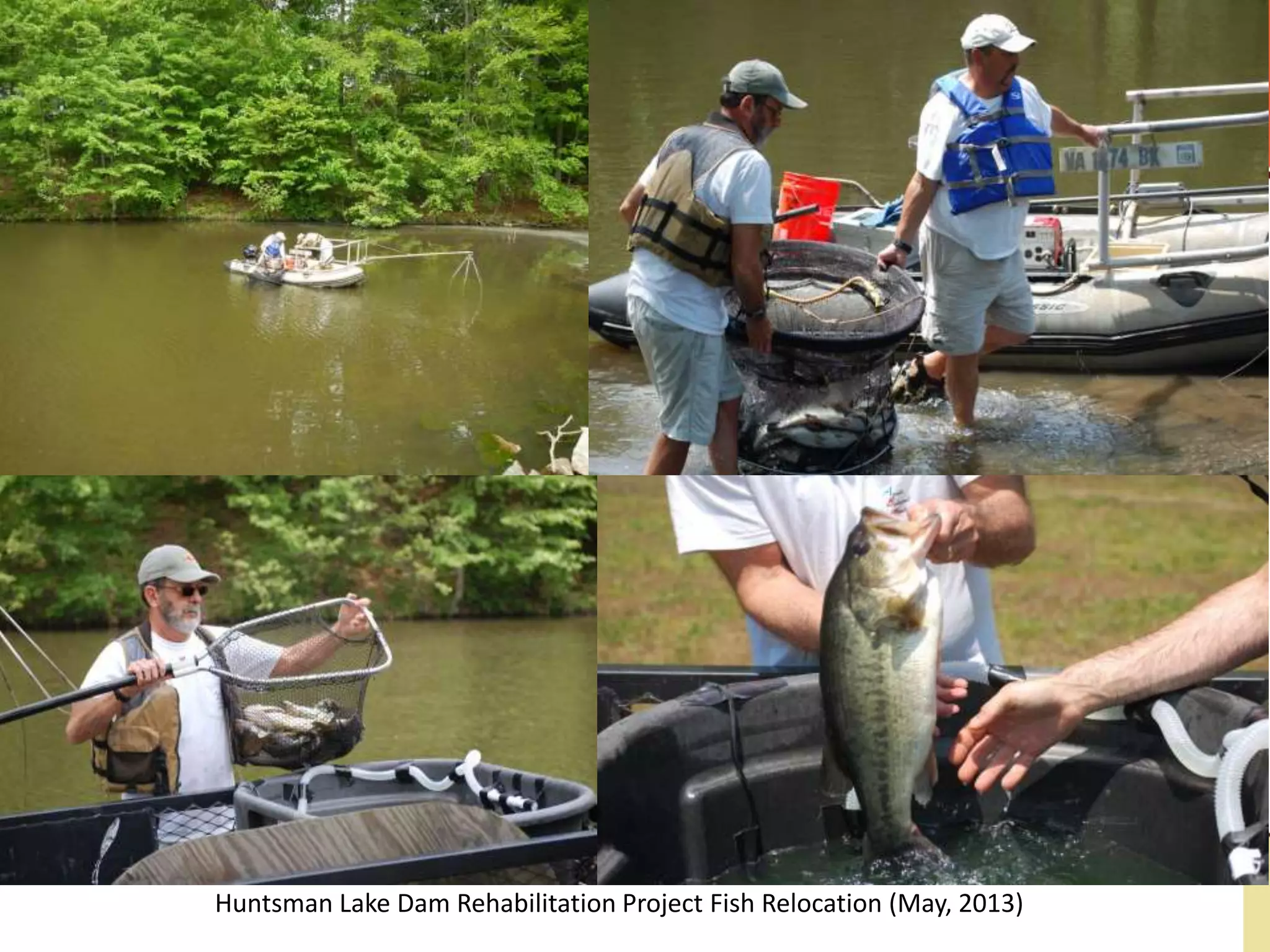
Huntsman Lake Dam Rehabilitation Project Fish Relocation (May, 2013)
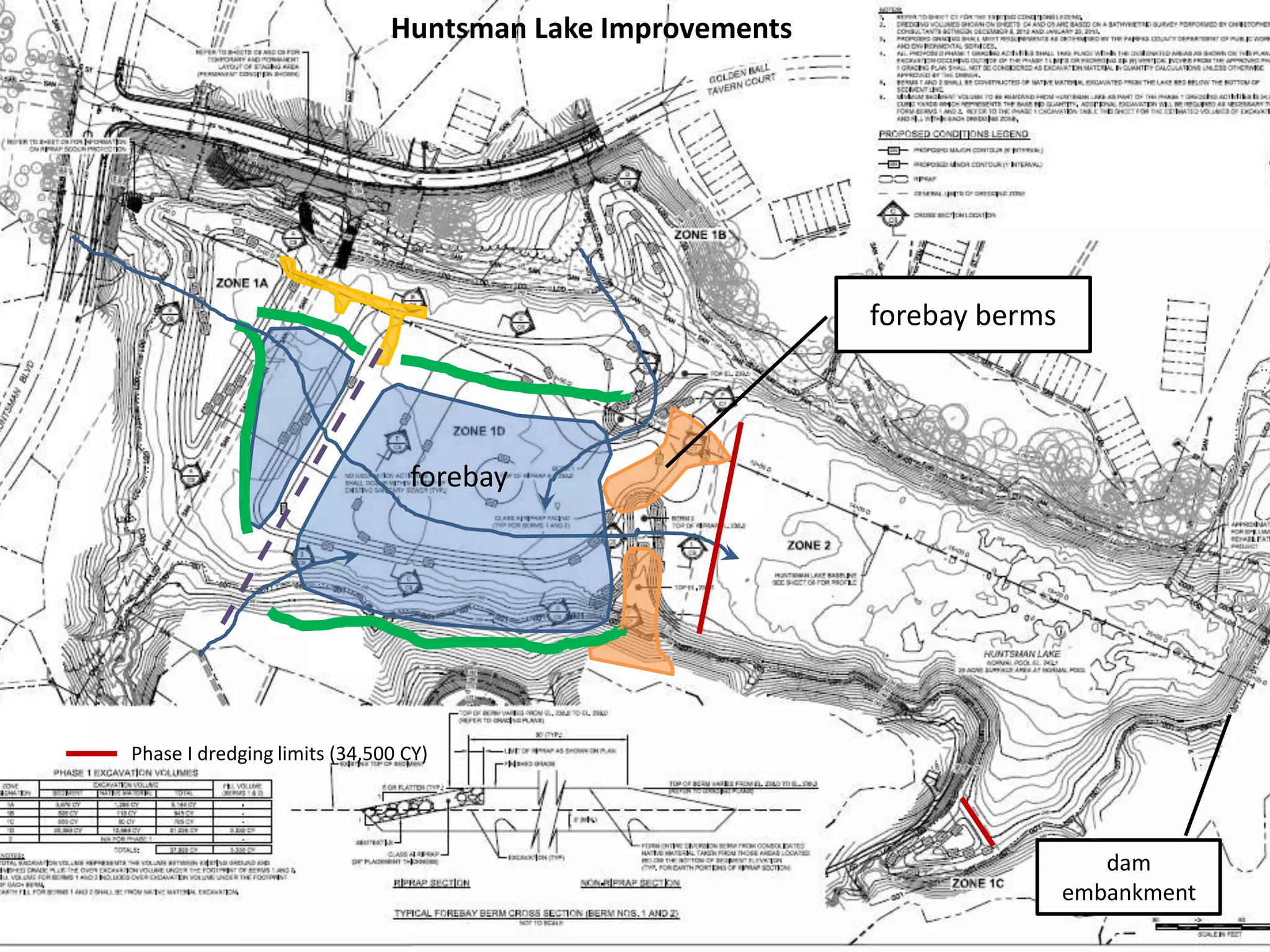
Huntsman Lake Improvements
forebay
forebay berms
dam
embankment
Phase I dredging limits (34,500 CY)
Huntsman Lake Improvements
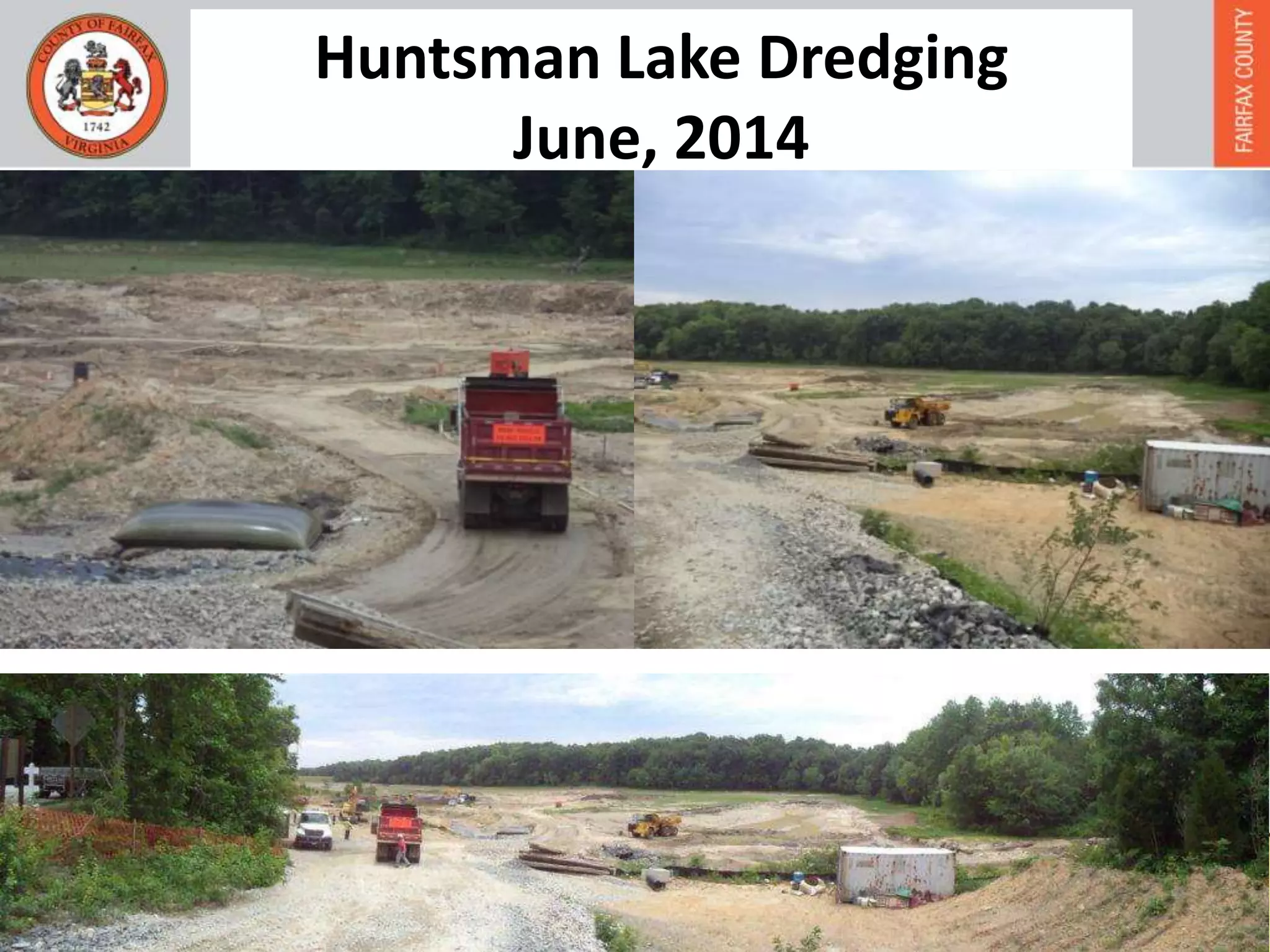
Huntsman Lake Dredging
June, 2014
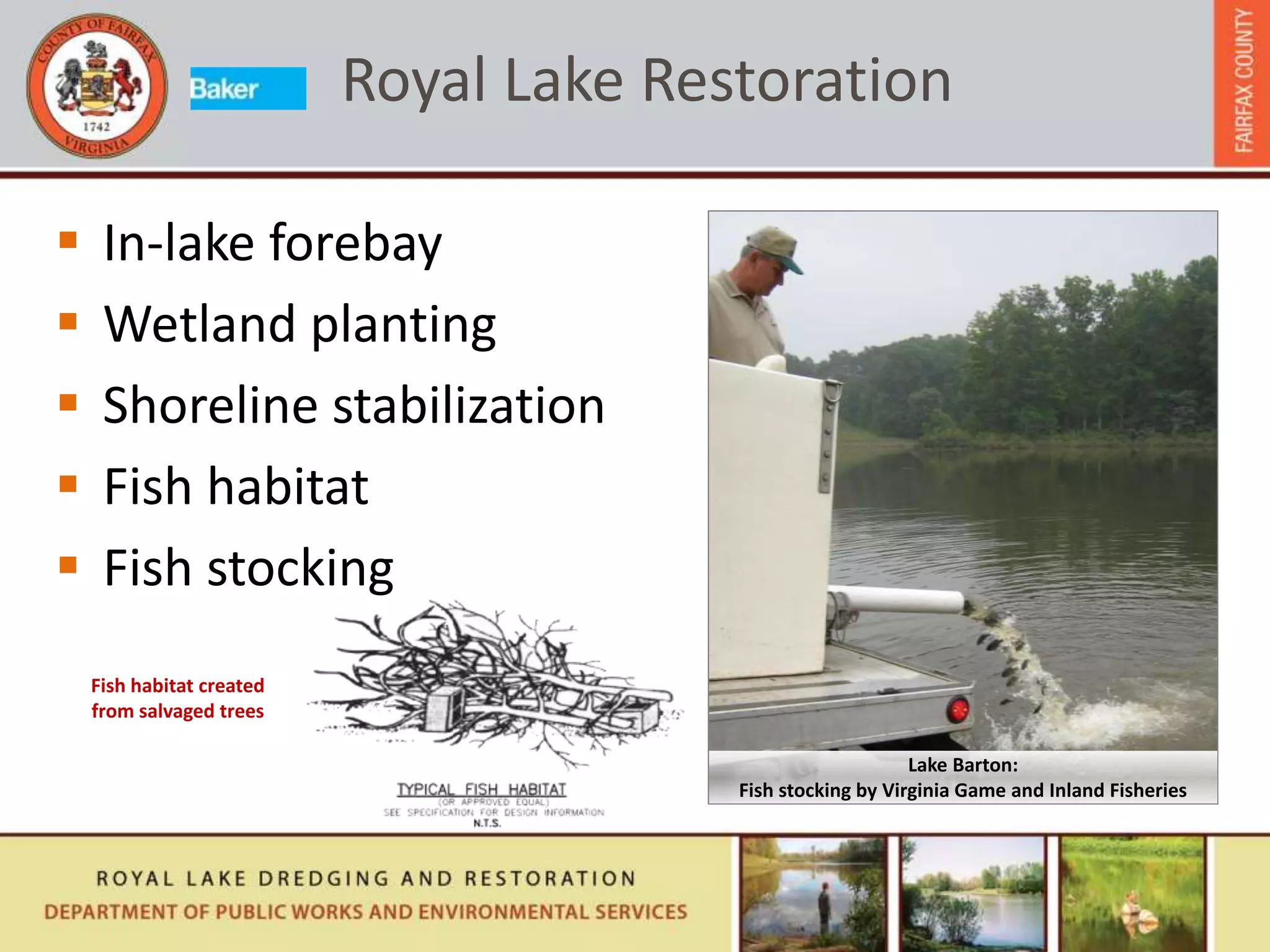
 In-lake forebay
 Wetland planting
 Shoreline stabilization
 Fish habitat
 Fish stocking
Royal Lake Restoration
Fish habitat created
from salvaged trees
Lake Barton:
Fish stocking by Virginia Game and Inland Fisheries
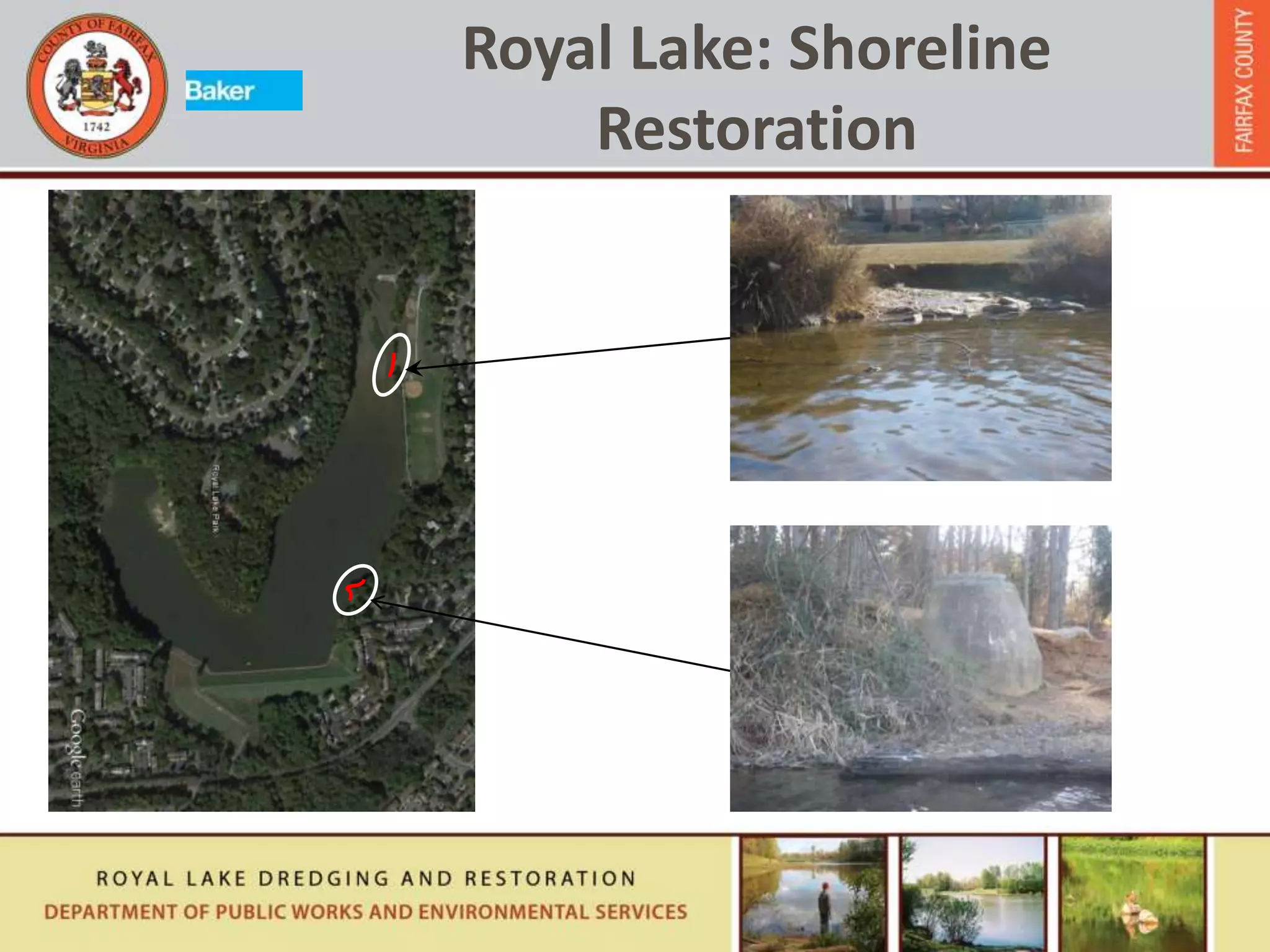
Royal Lake: Shoreline
Restoration
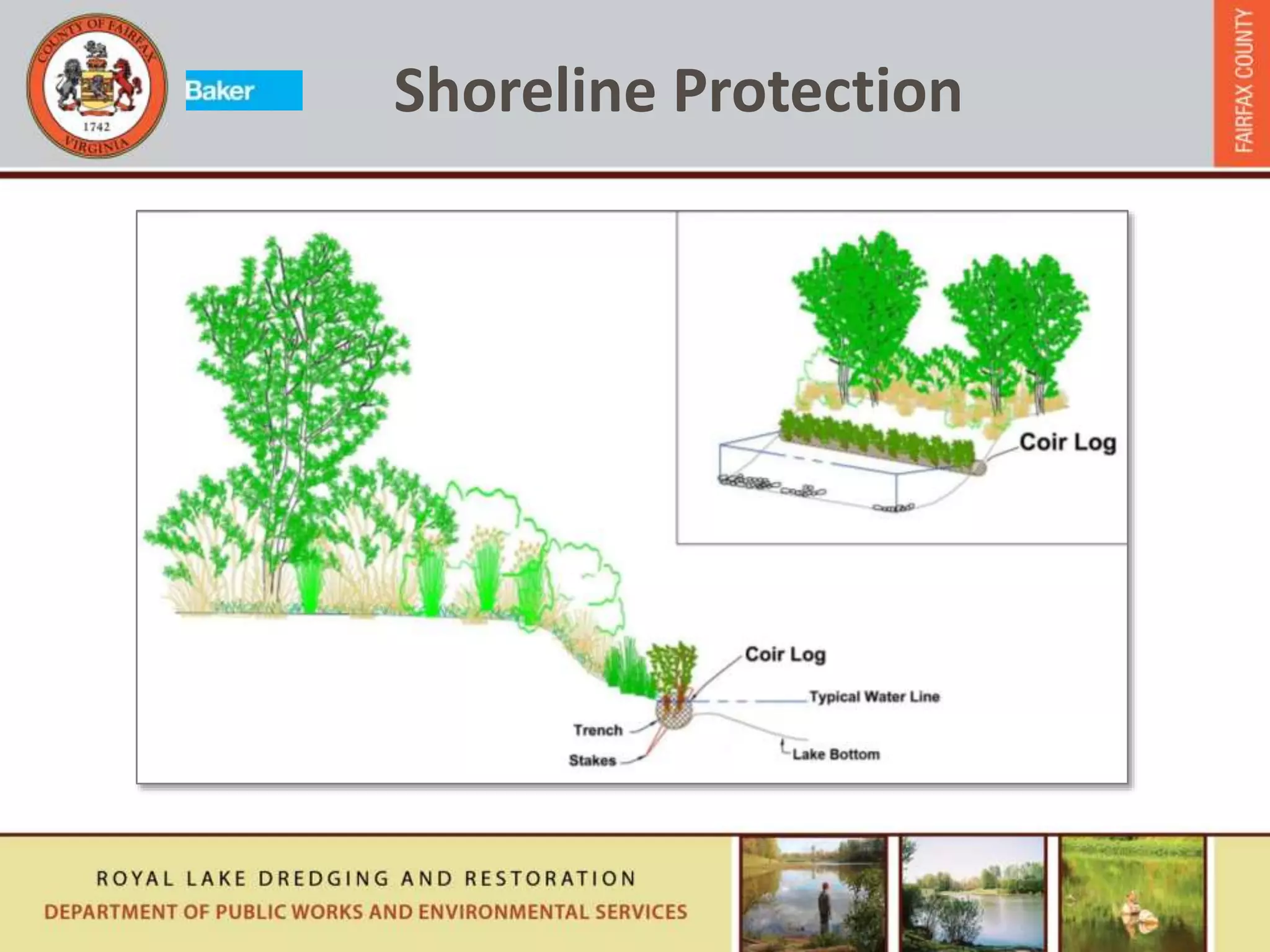
Shoreline Protection
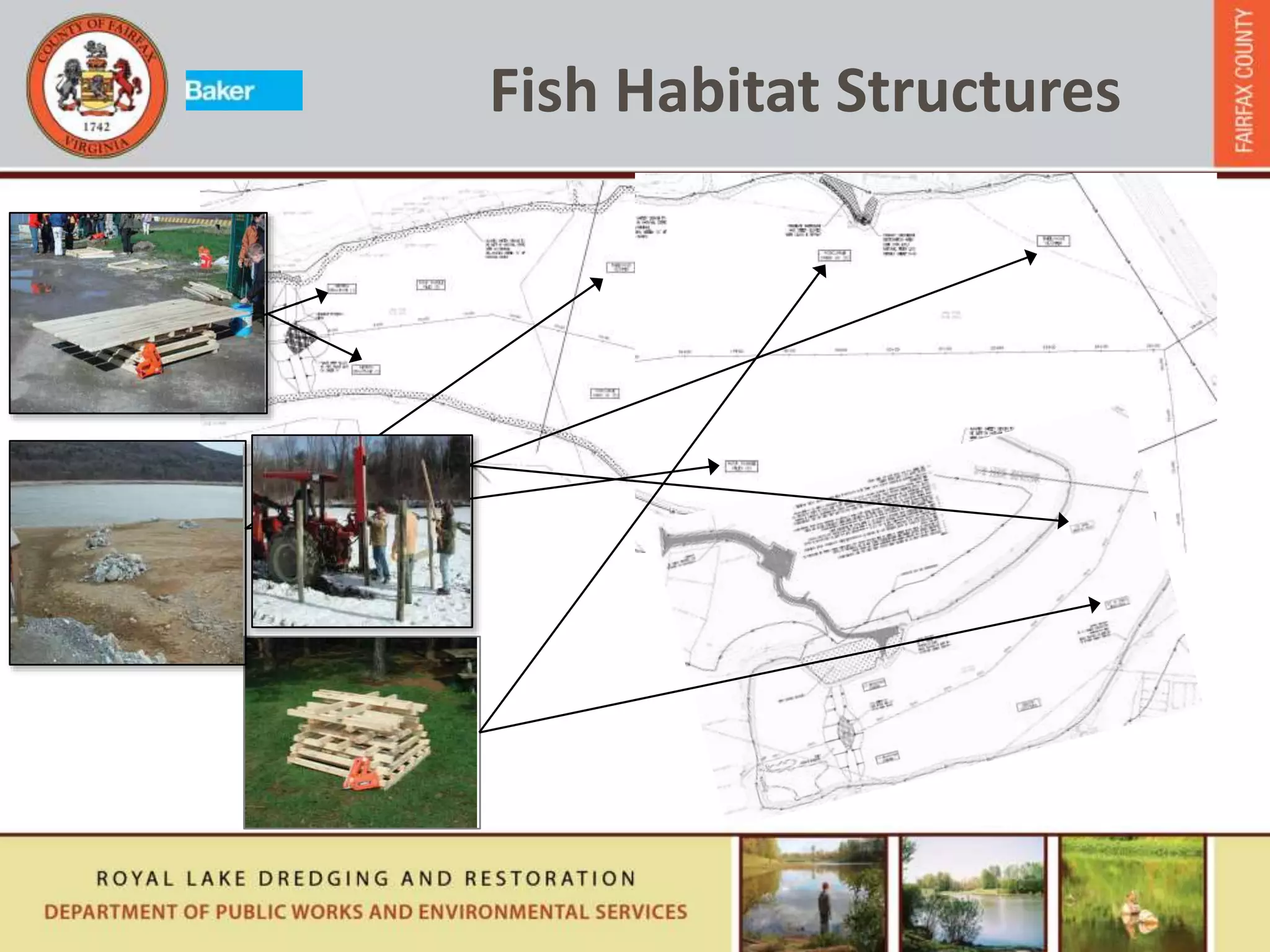
Fish Habitat Structures
 Community coordination at design and construction phase
– Pardon Our Dust meeting to be scheduled after contractor selection
 Late 2014/Early 2015: Complete final design
 Spring 2015: Bid advertisement
 Late summer 2015: Begin dredging
 Project Duration:
– Phase 1, Base Dredge: Dredge approximately 55,000 CY = 5 to 6 Months
– Phase 2, Full Dredge: 9 to 12 Months (total)
 Lake may be drained/partially drained for project depending on bid results
 For the wet dredge option, the lake will still require lowering for a short
period to construct the forebays
Royal Lake Dredging and Restoration
Project Timeline and Coordination
Contacts:
Martin Chang
martin.chang@fairfaxcounty.gov
Dipmani Kumar
dipmani.kumar@fairfaxcounty.gov
Matt Meyers
matthew.meyers@fairfaxcounty.gov
Stormwater Planning Division
Fairfax County DPWES
(703)324-5500, TY 711
Partners:
Royal Lake Dredging and
Restoration

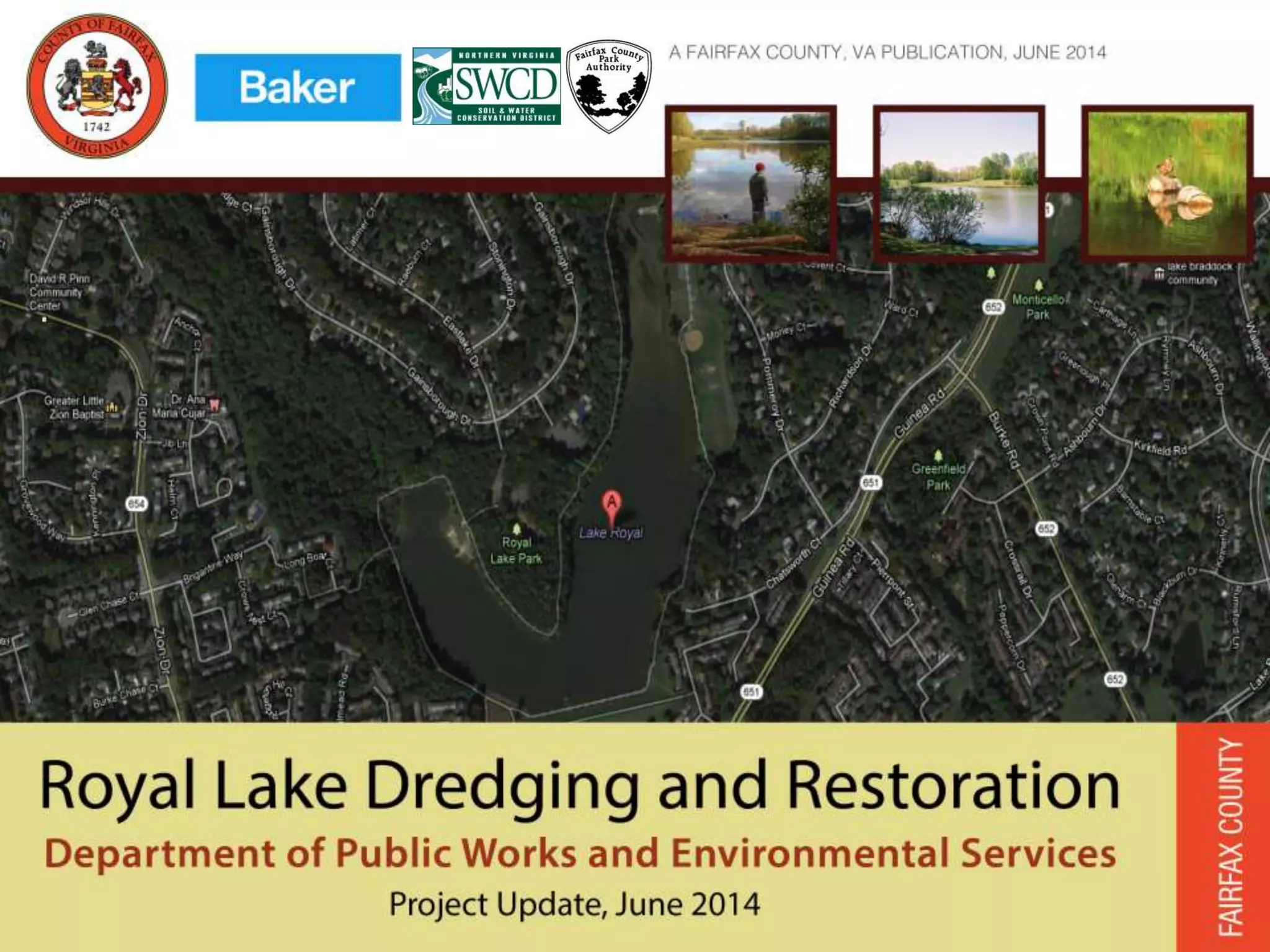
Royal Lake Dredging and Restoration Project Update-June 2014

  • 2.
    Royal Lake: MeetingAgenda  Introductions and Opening Remarks  Project Goal and Status  Royal Lake Conditions  Project Overview  Site Access  Dredging – Phase I and Phase II – Dredging Alternatives  Lake Habitat and Shoreline Restoration  Project Timeline  Questions and Answers
  • 3.
     Restore SedimentPool Capacity – Downstream water quality benefits – Lake water quality – Aesthetics  Improve Lake Water Quality and Habitat  Provide Long Term Maintenance Improvements Project Goals and Benefits
  • 4.
     Completed DataCollection  Completed Lake Dredging and Management Plan  Design Plans and Specifications – Preliminary Design – Completed – Final Design – Current design phase  Permitting – In Progress  Late 2014/Early 2015 – Complete Final Design and Permitting  Dredging Projected to Start in Late Summer, 2015 Royal Lake: Project Status
  • 5.
    Royal Lake Facts Drainage Area = 2,477 acres (3.67 square miles)  Lake Surface Area = 37.5 acres  Sediment Pool Capacity = 416,000 cubic yards (CY)  Current Sediment in Lake = 103,000 CY*  Estimated Annual Sediment Load = 4,400 CY 50 feet 103,000 CY * Based on a 2013 bathymetric survey
  • 6.
  • 7.
  • 8.
    Royal Lake: Sediment SamplingResults  Samples were analyzed for chemicals found in typical urban environments  All tests indicated significantly lower concentrations than state limits except for Arsenic  Nitrogen and Phosphorous levels were elevated  With dredging of 103,000 CY: – Approximately 8,500 lbs of Phosphorous will be removed – Approximately 102,000 lbs of Nitrogen will be removed
  • 9.
     Total Wetlands Impact: –0.85 Acre  All impacts within original footprint of lake Royal Lake – Wetland Impact
  • 10.
    Project Overview Staging Areas SedimentForebays Lake grading to restore the original bottom elevation
  • 11.
  • 12.
    Access During Construction PublicAccess: The park will remain open and existing parking lot will be available.
  • 13.
    Access During Construction PublicAccess: Pedestrian gates will be provided. Access through work areas and trails around the lake will be possible after work hours.
  • 14.
    Staging Area 1Potential Expansion Berm/Cofferdam to be built Area to be dewatered and backfilled to expand staging area after berm/cofferdam is built
  • 15.
    Royal Lake: DewateringBasin Inactive dewatering basin to be filled in and restored Staging area potential expansion
  • 16.
    Phase I andPhase II Dredging PHASE II 48,000 CY PHASE I 15,000 CY PHASE I 40,000 CY
  • 17.
    Dredging Alternatives 1. WetDredging: Mechanically dredge deposited sediment and haul wet. Normal pool maintained. (Note: This option will still require lake drawdown for a short period of time to build the forebay berms) 2. Dry Dredging: Drain the lake and dry deposited sediment in place prior to hauling 3. Project will be bid out with the option to dredge wet or dry Partial drawdown for Phase I dry dredging: drawing the lake partially to the Phase I dredging limits would leave a 15 acre pool; sediment would be dried in the dewatered section of the lake in place prior to hauling. Approximately 1/2 of the deposited sediment volume would be removed.
  • 18.
     General Sequence –Establish access and staging areas – Conduct dredging utilizing barges – Haul wet sediment to disposal site for drying  Pros – Less weather dependent – Quicker initial start to dredging – Less potential for schedule extensions or delay  Concerns – Increased sediment handling effort at disposal area – Potentially higher cost Wet Dredging
  • 19.
     General Sequence –Initiate drawdown of lake – Establish access and staging areas – Establish diversion channels within lake – Conduct dredging  Benefits – Higher daily sediment removal rates – Minimal sediment handling effort at disposal area – Potentially lower cost  Concerns – Very weather dependent – Higher potential for delays due to weather – Even with a reduced pool, there will be a need to relocate/salvage fish Dry Dredging (Full or Partial Drawdown)
  • 20.
    Royal Lake: PartialDrawdown  A partial drawdown would leave 15 acre pool with a maximum depth of 8 feet  Sediment to be removed = 55,000 CY DRAW-DOWN 55,000 CY
  • 21.
    Huntsman Lake (29acres) Huntsman Lake – Currently being dredged in the dry
  • 22.
    Huntsman Lake DamRehabilitation Project Fish Relocation (May, 2013)
  • 23.
    Huntsman Lake Improvements forebay forebayberms dam embankment Phase I dredging limits (34,500 CY) Huntsman Lake Improvements
  • 24.
  • 25.
     In-lake forebay Wetland planting  Shoreline stabilization  Fish habitat  Fish stocking Royal Lake Restoration Fish habitat created from salvaged trees Lake Barton: Fish stocking by Virginia Game and Inland Fisheries
  • 26.
  • 27.
  • 28.
  • 29.
     Community coordinationat design and construction phase – Pardon Our Dust meeting to be scheduled after contractor selection  Late 2014/Early 2015: Complete final design  Spring 2015: Bid advertisement  Late summer 2015: Begin dredging  Project Duration: – Phase 1, Base Dredge: Dredge approximately 55,000 CY = 5 to 6 Months – Phase 2, Full Dredge: 9 to 12 Months (total)  Lake may be drained/partially drained for project depending on bid results  For the wet dredge option, the lake will still require lowering for a short period to construct the forebays Royal Lake Dredging and Restoration Project Timeline and Coordination
  • 30.
    Contacts: Martin Chang martin.chang@fairfaxcounty.gov Dipmani Kumar dipmani.kumar@fairfaxcounty.gov MattMeyers matthew.meyers@fairfaxcounty.gov Stormwater Planning Division Fairfax County DPWES (703)324-5500, TY 711 Partners: Royal Lake Dredging and Restoration

Editor's Notes

  • #3 32,500/160,000 = 20.3% Land Use in Drainage Area by Type, Acres and Percentage Residential/Business, 522 acres, 70.5% Woodland, 118 acres, 15.9% Transportation, 79 acres, 10.7% Water, 13 acres, 1.8% Grassland, 8 acres, 1.1% Total = 740 acres Floodpool of Woodglen Lake = 36 acres Land Ownership: Upstream of dam: 79% private, 21% public Downstream of dam: 47% private, 53% public
  • #6 65,000 CY/295,000 CY = 22 percent full
  • #9 32,500/160,000 = 20.3% Land Use in Drainage Area by Type, Acres and Percentage Residential/Business, 522 acres, 70.5% Woodland, 118 acres, 15.9% Transportation, 79 acres, 10.7% Water, 13 acres, 1.8% Grassland, 8 acres, 1.1% Total = 740 acres Floodpool of Woodglen Lake = 36 acres Land Ownership: Upstream of dam: 79% private, 21% public Downstream of dam: 47% private, 53% public
  • #23 Built in 1973 as a flood-control dam
  • #25 Built in 1973 as a flood-control dam
  • #30 Built in 1973 as a flood-control dam