FINANCIAL MANAGER
ROLES OF Financial MANAGER
FINANCIAL MANAGER ?
Financial managers are responsible for the health of
an organization. They produce financial reports,
direct investment activities, and develop strategies
and plans for the long-term financial goals of their
organization. Financial managers typically:
 Prepare financial statements, business activity
reports, and forecasts,
 Monitor financial details to ensure that legal
requirements are met,
 Supervise employees who do financial reporting
and budgeting,
 Review company financial reports and seek ways
to reduce costs,
 Analyze market trends to find opportunities for
expansion or for acquiring other companies,
 Help management make financial decisions.
Types of Financial Manager
 The top Financial Manager within a firm usually the Chief Financial Officer
(CFO)
 Treasurer :- Overseas cash management , credit management , capital
expenditure and financial planning.
 Controller:- Overseas taxes, cost accounting, financial accounting,
and data processing.
 Credit managers:- They manage the organization's
credit business.
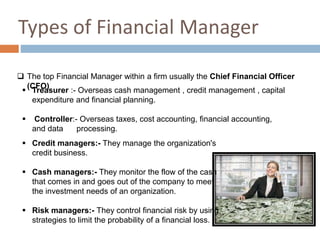
 Cash managers:- They monitor the flow of the cash
that comes in and goes out of the company to meet
the investment needs of an organization.
 Risk managers:- They control financial risk by using
strategies to limit the probability of a financial loss.
Role of Financial Manager
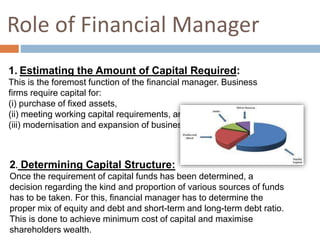
1. Estimating the Amount of Capital Required:
This is the foremost function of the financial manager. Business
firms require capital for:
(i) purchase of fixed assets,
(ii) meeting working capital requirements, and
(iii) modernisation and expansion of business.
2. Determining Capital Structure:
Once the requirement of capital funds has been determined, a
decision regarding the kind and proportion of various sources of funds
has to be taken. For this, financial manager has to determine the
proper mix of equity and debt and short-term and long-term debt ratio.
This is done to achieve minimum cost of capital and maximise
shareholders wealth.
3. Choice of Sources of Funds:
Before the actual procurement of funds, the finance manager
has to decide the sources from which the funds are to be raised.
The management can raise finance from various sources like
equity shareholders, preference shareholders, debenture-
holders, banks and other financial institutions, public deposits,
etc.
4. Procurement of Funds: The financial manager takes steps
to procure the funds required for the business. It might require
negotiation with creditors and financial institutions, issue of
prospectus etc. The procurement of funds is dependent not only
upon cost of raising funds but also on other factors like general
market conditions, choice of investors, government policy etc.
6. Disposal Of Profits or Surplus:-The financial manager
has to decide how much to retain for ploughing back and
how much to distribute as dividend to shareholders out of
the profits of the company. The factors which influence
these decisions include the trend of earnings of the
company, the trend of the market price of its shares, the
requirements of funds for self- financing the future
5. Utilisation of Funds :- The funds procured by the financial
manager are to be prudently invested in various assets so as
to maximize the return on investment: While taking investment
decisions, management should be guided by three important
principles safety, probability and liquidity .
7. Management of Cash :-Management of
cash and other current assets is an important
task of financial manager. It involves
forecasting the cash inflows and outflows to
ensure that there is neither shortage nor
surplus of cash with the firm. Sufficient funds
must be available for purchase of materials,
payment of wages and meeting day-to-day
expenses.
8.Financial Control:-Evaluation of financial
performance is also an important function of
financial manager. The overall measure of
evaluation is Return on Investment (ROI). The
other techniques of financial control and
evaluation include budgetary control, cost
control, internal audit, break-even analysis and
ratio analysis. The financial manager must lay
emphasis on financial planning as well.
Finacial manager ppt

Finacial manager ppt

  • 1.
    FINANCIAL MANAGER ROLES OFFinancial MANAGER
  • 2.
    FINANCIAL MANAGER ? Financialmanagers are responsible for the health of an organization. They produce financial reports, direct investment activities, and develop strategies and plans for the long-term financial goals of their organization. Financial managers typically:  Prepare financial statements, business activity reports, and forecasts,  Monitor financial details to ensure that legal requirements are met,  Supervise employees who do financial reporting and budgeting,  Review company financial reports and seek ways to reduce costs,  Analyze market trends to find opportunities for expansion or for acquiring other companies,  Help management make financial decisions.
  • 3.
    Types of FinancialManager  The top Financial Manager within a firm usually the Chief Financial Officer (CFO)  Treasurer :- Overseas cash management , credit management , capital expenditure and financial planning.  Controller:- Overseas taxes, cost accounting, financial accounting, and data processing.  Credit managers:- They manage the organization's credit business.  Cash managers:- They monitor the flow of the cash that comes in and goes out of the company to meet the investment needs of an organization.  Risk managers:- They control financial risk by using strategies to limit the probability of a financial loss.
  • 4.
    Role of FinancialManager 1. Estimating the Amount of Capital Required: This is the foremost function of the financial manager. Business firms require capital for: (i) purchase of fixed assets, (ii) meeting working capital requirements, and (iii) modernisation and expansion of business. 2. Determining Capital Structure: Once the requirement of capital funds has been determined, a decision regarding the kind and proportion of various sources of funds has to be taken. For this, financial manager has to determine the proper mix of equity and debt and short-term and long-term debt ratio. This is done to achieve minimum cost of capital and maximise shareholders wealth.
  • 5.
    3. Choice ofSources of Funds: Before the actual procurement of funds, the finance manager has to decide the sources from which the funds are to be raised. The management can raise finance from various sources like equity shareholders, preference shareholders, debenture- holders, banks and other financial institutions, public deposits, etc. 4. Procurement of Funds: The financial manager takes steps to procure the funds required for the business. It might require negotiation with creditors and financial institutions, issue of prospectus etc. The procurement of funds is dependent not only upon cost of raising funds but also on other factors like general market conditions, choice of investors, government policy etc.
  • 6.
    6. Disposal OfProfits or Surplus:-The financial manager has to decide how much to retain for ploughing back and how much to distribute as dividend to shareholders out of the profits of the company. The factors which influence these decisions include the trend of earnings of the company, the trend of the market price of its shares, the requirements of funds for self- financing the future 5. Utilisation of Funds :- The funds procured by the financial manager are to be prudently invested in various assets so as to maximize the return on investment: While taking investment decisions, management should be guided by three important principles safety, probability and liquidity .
  • 7.
    7. Management ofCash :-Management of cash and other current assets is an important task of financial manager. It involves forecasting the cash inflows and outflows to ensure that there is neither shortage nor surplus of cash with the firm. Sufficient funds must be available for purchase of materials, payment of wages and meeting day-to-day expenses. 8.Financial Control:-Evaluation of financial performance is also an important function of financial manager. The overall measure of evaluation is Return on Investment (ROI). The other techniques of financial control and evaluation include budgetary control, cost control, internal audit, break-even analysis and ratio analysis. The financial manager must lay emphasis on financial planning as well.