L 1 Network Engineer
Major interview questions
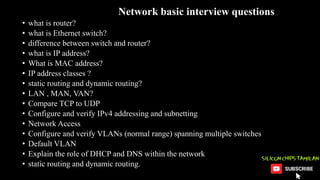
Network basic interview questions
• what is router?
• what is Ethernet switch?
• difference between switch and router?
• what is IP address?
• What is MAC address?
• IP address classes ?
• static routing and dynamic routing?
• LAN , MAN, VAN?
• Compare TCP to UDP
• Configure and verify IPv4 addressing and subnetting
• Network Access
• Configure and verify VLANs (normal range) spanning multiple switches
• Default VLAN
• Explain the role of DHCP and DNS within the network
• static routing and dynamic routing.
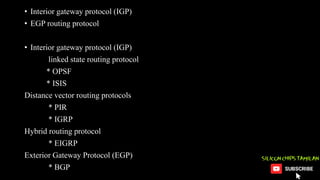
• Interior gateway protocol (IGP)
• EGP routing protocol
• Interior gateway protocol (IGP)
linked state routing protocol
* OPSF
* ISIS
Distance vector routing protocols
* PIR
* IGRP
Hybrid routing protocol
* EIGRP
Exterior Gateway Protocol (EGP)
* BGP
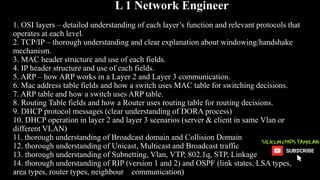
L 1 Network Engineer
1. OSI layers – detailed understanding of each layer’s function and relevant protocols that
operates at each level.
2. TCP/IP – thorough understanding and clear explanation about windowing/handshake
mechanism.
3. MAC header structure and use of each fields.
4. IP header structure and use of each fields.
5. ARP – how ARP works in a Layer 2 and Layer 3 communication.
6. Mac address table fields and how a switch uses MAC table for switching decisions.
7. ARP table and how a switch uses ARP table.
8. Routing Table fields and how a Router uses routing table for routing decisions.
9. DHCP protocol messages (clear understanding of DORA process)
10. DHCP operation in layer 2 and layer 3 scenarios (server & client in same Vlan or
different VLAN)
11. thorough understanding of Broadcast domain and Collision Domain
12. thorough understanding of Unicast, Multicast and Broadcast traffic
13. thorough understanding of Subnetting, Vlan, VTP, 802.1q, STP, Linkage
14. thorough understanding of RIP (version 1 and 2) and OSPF (link states, LSA types,
area types, router types, neighbour communication)
15. Difference between Routing and Routed protocols
16. Good troubleshooting approach (from Level 1 to 7 of OSI)
17. Troubleshoot/Diagnose the technical issues.
18. How ARP learns the mac address in same subnet and different subnet
19. Difference between hub,layer2 switch and layer 3 switch and router.
20. DHCP DORA process sender IP, mac and port number and destination IP, mac
and port number
21. OSI: how to troubleshoot in network with help of OSI model.
22. Data link header
23. Ip header
24. TCP header
25. SNMP, Netflow, syslog, monitoring applications
26. network virtualization technologies such as virtual firewalls, virtual load
balancers, MPLS VRFs
Network basic interview questions.

Network basic interview questions.

  • 1.
    L 1 NetworkEngineer Major interview questions
  • 2.
    Network basic interviewquestions • what is router? • what is Ethernet switch? • difference between switch and router? • what is IP address? • What is MAC address? • IP address classes ? • static routing and dynamic routing? • LAN , MAN, VAN? • Compare TCP to UDP • Configure and verify IPv4 addressing and subnetting • Network Access • Configure and verify VLANs (normal range) spanning multiple switches • Default VLAN • Explain the role of DHCP and DNS within the network • static routing and dynamic routing.
  • 3.
    • Interior gatewayprotocol (IGP) • EGP routing protocol • Interior gateway protocol (IGP) linked state routing protocol * OPSF * ISIS Distance vector routing protocols * PIR * IGRP Hybrid routing protocol * EIGRP Exterior Gateway Protocol (EGP) * BGP
  • 4.
    L 1 NetworkEngineer 1. OSI layers – detailed understanding of each layer’s function and relevant protocols that operates at each level. 2. TCP/IP – thorough understanding and clear explanation about windowing/handshake mechanism. 3. MAC header structure and use of each fields. 4. IP header structure and use of each fields. 5. ARP – how ARP works in a Layer 2 and Layer 3 communication. 6. Mac address table fields and how a switch uses MAC table for switching decisions. 7. ARP table and how a switch uses ARP table. 8. Routing Table fields and how a Router uses routing table for routing decisions. 9. DHCP protocol messages (clear understanding of DORA process) 10. DHCP operation in layer 2 and layer 3 scenarios (server & client in same Vlan or different VLAN) 11. thorough understanding of Broadcast domain and Collision Domain 12. thorough understanding of Unicast, Multicast and Broadcast traffic 13. thorough understanding of Subnetting, Vlan, VTP, 802.1q, STP, Linkage 14. thorough understanding of RIP (version 1 and 2) and OSPF (link states, LSA types, area types, router types, neighbour communication)
  • 5.
    15. Difference betweenRouting and Routed protocols 16. Good troubleshooting approach (from Level 1 to 7 of OSI) 17. Troubleshoot/Diagnose the technical issues. 18. How ARP learns the mac address in same subnet and different subnet 19. Difference between hub,layer2 switch and layer 3 switch and router. 20. DHCP DORA process sender IP, mac and port number and destination IP, mac and port number 21. OSI: how to troubleshoot in network with help of OSI model. 22. Data link header 23. Ip header 24. TCP header 25. SNMP, Netflow, syslog, monitoring applications 26. network virtualization technologies such as virtual firewalls, virtual load balancers, MPLS VRFs