ROTAVIRUS
Kuldeep Vyas
Asst. Prof Community Health
Nursing - I
1Kuldeep Vyas Asst. Prof CHN
INTRODUCTION
Rotaviruses are the major cause of diarrheal illness in
human infants in the world
Adults also get infected because of rotavirus
Young animals like calves and piglets are also
infected
Rotavirus infection spread easily and outbreaks
usually occur in the winter and early spring between
about November and April
Rotavirus infections often spread in settings where
many children's are together, such as daycare
centers
2Kuldeep Vyas Asst. Prof CHN
“TRANSMISSION OF
ROTAVIRUS”
Primary mode of rotavirus transmission is fecal to oral
Highly communicable and transmissible disease
Close person to person contact and environmental
surfaces are common vectors of transmission
Incubation period is 1-3 days
Large quantities of virus are shed in stool from just prior to onset
of symptoms until about 10 days after onset
Amount of virus shed in stool [10-100 billion virion/gram of
stool]infection
Amount of ingested virus required to cause infection as few as
10 infective virions
3Kuldeep Vyas Asst. Prof CHN
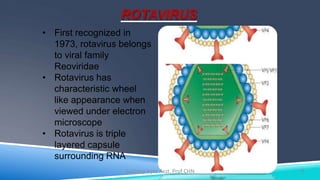
ROTAVIRUS
• First recognized in
1973, rotavirus belongs
to viral family
Reoviridae
• Rotavirus has
characteristic wheel
like appearance when
viewed under electron
microscope
• Rotavirus is triple
layered capsule
surrounding RNA
4Kuldeep Vyas Asst. Prof CHN
• The Rotavirus genome consist of 11 double stranded
RNA segments each encoding one viral proteins
• Scientist have describe seven Rotavirus group [A to
G]
• Only groups A, B AND C infect humans
• Group A which has multiple strains cause majority of
childhood infections
• Vaccine candidates are designed to protect against
group ARotaviruses
• The G type and P type define the serotype
• They are critical to a vaccine development because
they are the vaccine for stimulating a protective
immune response
5Kuldeep Vyas Asst. Prof CHN
“ SEROTYPES”
Serotypes are described as variations within species of bacteria or
viruses or among immune cells of different individuals
G1P[8] is the most common serotype worldwide and accounts
for over two thirds of rotavirus infections worldwide
Infections with G1,G2,G3,G4 AND G9 together comprise
almost 95% of rotavirus serotype observed
Because the two gene segments that encode these protein can
segregate independently, A typing system which consist of both G
and P type is used i.e.
G1P[8],G2P[4],G3P[8],G4P[8],G9P[8] and G9P[6]
6Kuldeep Vyas Asst. Prof CHN
STEPS IN VIRAL REPLICATION
1. Receptor mediated
endocytosis leading to
formation of endosome
2. Viral RNA dependent RNA
polymerase creates m RNA
transcript of double stranded
viral genome
3. Viral genome is in the core of
two layered protein shell called
as double layered particle
7Kuldeep Vyas Asst. Prof CHN
VIRAL REPLICATION
4. Third layer is disrupted
5. By remaining in the core, the viral RNA evades innate host immune
responses called RNA interference that are triggered by the presence of
double-stranded RNA
6. Viroplasm is formed around the cell nucleus as early as two hours
after virus infection, and consists of viral factories thought to be made by two
viral nonstructural proteins: NSP5 and NSP2
8Kuldeep Vyas Asst. Prof CHN
7. In this viroplasm RNA is replicated and the DLPs are assembled
8.The DLPs migrate to the endoplasmic reticulum where they obtain their
third, outer layer
9. Progeny viruses are released from the cell by lysis
9Kuldeep Vyas Asst. Prof CHN
WHY ROTAVIRUS INFECTION CAUSES DIARRHEA
Infection of villus epithelial cells causes cell destruction, decreased
absorption of salt and water and decreased dissachridase activity leading
to osmotic load in the gut lumen
 The osmotic load in the gut and increased fluid secretion leads to
diarrhea and without fluid replacement it will ultimately lead to
dehydration and acidosis
 Rotavirus induced gastroenteritis in children with immunodeficiency may
cause persistent infections lasting weeks or months
10Kuldeep Vyas Asst. Prof CHN
DIAGNOSIS OF ROTAVIRUS INFECTION
Diagnosis of infection with Rotavirus follows diagnosis of gastroenteritis of
severe diarrhea
Most children's are admitted to hospital with gastroenteritis are tested for
Rotavirus A
Specific diagnosis of infection with rotavirus A is made by finding the virus in
child’s stool by enzyme immunoassay
Children with immunodeficiency disorders may be treated with specific
rotavirus immunoglobulin preparation
11Kuldeep Vyas Asst. Prof CHN
DIAGNOSIS OF ROTAVIRUS
Laboratory diagnosis
Electron microscopy is used in the detection of
Virus in the stools which helps in early detection
Of disease
OTHER DIAGNOSIS METHOD INCLUDE
• ELISA
RAPID ANTIGEN DETECTION BY ELISA OF
ROTAVIRUS IN STOOL SAMPLES
• GENOTYPING 12Kuldeep Vyas Asst. Prof CHN
TREATMENT FOR ROTAVIRUS DIARRHEA
Therapy for rotavirus induced diarrhea involves replacement of fluid and
electrolyte loss during infection
ORAL REHYDRATION THERAPY is recommended in children with mild
or moderate dehydration
Fruit juices and soft drinks are not recommended due to there high
glucose content low sodium content and high osmolarity
 Antibiotics, antisecretory drugs, antimotility drugs, absorbents and
antiemetic’s
Do not clear acute infection but it prevents reinfection and reduce fluid
losses during rotavirus induced gastroenteritis and hence do not play role
in treatment
13Kuldeep Vyas Asst. Prof CHN
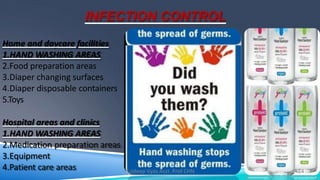
INFECTION CONTROL
Home and daycare facilities
1.HAND WASHING AREAS
2.Food preparation areas
3.Diaper changing surfaces
4.Diaper disposable containers
5.Toys
Hospital areas and clinics
1.HAND WASHING AREAS
2.Medication preparation areas
3.Equipment
4.Patient care areas 14Kuldeep Vyas Asst. Prof CHN
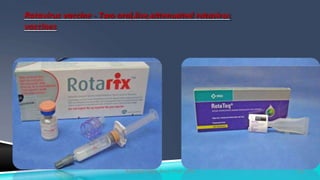
Rotavirus vaccine - Two oral,live,attenuated rotavirus
vaccines
15Kuldeep Vyas Asst. Prof CHN
16Kuldeep Vyas Asst. Prof CHN
INDIA UNVEILS FIRST INDIGENOUS ROTAVIRUS
VACCINE
Rotavirus responsible for approximately 4,53,000 child deaths due to
diarrhea globally each year
The Phase-III clinical trial of low cost Indian-made rotavirus vaccine
Rotavac has demonstrated strong efficacy and excellent safety
profile and if approved by the Drugs Controller General of India, it
would be available at Rs. 54 per dose.
Clinical study has demonstrated for the first time that Rotavac is
efficacious in preventing severe rotavirus diarrhea in low-resource
settings in India, and developing countries in Asia and Africa. Strain
diversity, too, has not apparently affected its efficacy.
17Kuldeep Vyas Asst. Prof CHN
Rotavirus is responsible for approximately 4,53,000 child deaths due to
diarrhea globally each year. It is particularly threatening in India where —
according to a recent study — around 1,00,000 children die each year
from severe diarrhea and dehydration caused by rotavirus.
India accounts for 22 per cent of the estimated global deaths from
diarrhea-causing rotavirus.
Rotavac is an oral vaccine and is administered to infants in a three-dose
course at the ages of 6, 10 and 14 weeks.
It is given alongside routine immunizations' in the Universal Immunization
Programed (UIP) vaccines recommended at these ages.
18Kuldeep Vyas Asst. Prof CHN
The randomized, double-blind, placebo-controlled phase-III clinical
trial enrolled 6,799 infants in India (aged six to seven weeks at the time
of enrolment) at three sites — the Centre for Health Research and
Development, Society for Applied Sciences, in New Delhi; Shirdi Sai
Baba Rural Hospital, KEM Hospital Research Centre in Vadu; and
Christian Medical College in Vellore.
Infants received Rotavac and the UIP vaccines, including the oral polio
vaccine (OPV).
Result showed that infants receiving OPV at the same time as Rotavac
generated comparable immune responses to all three polio serotypes
as the infants receiving OPV without Rotavac, supporting the
concurrent administration of OPV and Rotavac. 19Kuldeep Vyas Asst. Prof CHN
VACCINATING KIDS AGAINST ROTAVIRUS MAY
REDUCE RISK OF SEIZURES
The researchers found that children who were fully vaccinated
against rotavirus had an approximately 20 percent reduced risk of
seizure-related hospitalizations and emergency department visits
during the year following vaccination, compared to unvaccinated
children
Latest study estimated that rotavirus vaccination could potentially
save more than $7 million in U.S. health care costs each year by
preventing approximately 1,000 hospitalizations and 5,000 emergency
room visits for seizures among young children. "Caring for children
who have seizures can be expensive and emotionally taxing for
families," Dr. Payne said. "Seizures sometimes lead to painful
procedures, medication regimens, trips to the emergency room, or
20Kuldeep Vyas Asst. Prof CHN
THANK YOU...
21Kuldeep Vyas Asst. Prof CHN

Rota virus

  • 1.
    ROTAVIRUS Kuldeep Vyas Asst. ProfCommunity Health Nursing - I 1Kuldeep Vyas Asst. Prof CHN
  • 2.
    INTRODUCTION Rotaviruses are themajor cause of diarrheal illness in human infants in the world Adults also get infected because of rotavirus Young animals like calves and piglets are also infected Rotavirus infection spread easily and outbreaks usually occur in the winter and early spring between about November and April Rotavirus infections often spread in settings where many children's are together, such as daycare centers 2Kuldeep Vyas Asst. Prof CHN
  • 3.
    “TRANSMISSION OF ROTAVIRUS” Primary modeof rotavirus transmission is fecal to oral Highly communicable and transmissible disease Close person to person contact and environmental surfaces are common vectors of transmission Incubation period is 1-3 days Large quantities of virus are shed in stool from just prior to onset of symptoms until about 10 days after onset Amount of virus shed in stool [10-100 billion virion/gram of stool]infection Amount of ingested virus required to cause infection as few as 10 infective virions 3Kuldeep Vyas Asst. Prof CHN
  • 4.
    ROTAVIRUS • First recognizedin 1973, rotavirus belongs to viral family Reoviridae • Rotavirus has characteristic wheel like appearance when viewed under electron microscope • Rotavirus is triple layered capsule surrounding RNA 4Kuldeep Vyas Asst. Prof CHN
  • 5.
    • The Rotavirusgenome consist of 11 double stranded RNA segments each encoding one viral proteins • Scientist have describe seven Rotavirus group [A to G] • Only groups A, B AND C infect humans • Group A which has multiple strains cause majority of childhood infections • Vaccine candidates are designed to protect against group ARotaviruses • The G type and P type define the serotype • They are critical to a vaccine development because they are the vaccine for stimulating a protective immune response 5Kuldeep Vyas Asst. Prof CHN
  • 6.
    “ SEROTYPES” Serotypes aredescribed as variations within species of bacteria or viruses or among immune cells of different individuals G1P[8] is the most common serotype worldwide and accounts for over two thirds of rotavirus infections worldwide Infections with G1,G2,G3,G4 AND G9 together comprise almost 95% of rotavirus serotype observed Because the two gene segments that encode these protein can segregate independently, A typing system which consist of both G and P type is used i.e. G1P[8],G2P[4],G3P[8],G4P[8],G9P[8] and G9P[6] 6Kuldeep Vyas Asst. Prof CHN
  • 7.
    STEPS IN VIRALREPLICATION 1. Receptor mediated endocytosis leading to formation of endosome 2. Viral RNA dependent RNA polymerase creates m RNA transcript of double stranded viral genome 3. Viral genome is in the core of two layered protein shell called as double layered particle 7Kuldeep Vyas Asst. Prof CHN
  • 8.
    VIRAL REPLICATION 4. Thirdlayer is disrupted 5. By remaining in the core, the viral RNA evades innate host immune responses called RNA interference that are triggered by the presence of double-stranded RNA 6. Viroplasm is formed around the cell nucleus as early as two hours after virus infection, and consists of viral factories thought to be made by two viral nonstructural proteins: NSP5 and NSP2 8Kuldeep Vyas Asst. Prof CHN
  • 9.
    7. In thisviroplasm RNA is replicated and the DLPs are assembled 8.The DLPs migrate to the endoplasmic reticulum where they obtain their third, outer layer 9. Progeny viruses are released from the cell by lysis 9Kuldeep Vyas Asst. Prof CHN
  • 10.
    WHY ROTAVIRUS INFECTIONCAUSES DIARRHEA Infection of villus epithelial cells causes cell destruction, decreased absorption of salt and water and decreased dissachridase activity leading to osmotic load in the gut lumen  The osmotic load in the gut and increased fluid secretion leads to diarrhea and without fluid replacement it will ultimately lead to dehydration and acidosis  Rotavirus induced gastroenteritis in children with immunodeficiency may cause persistent infections lasting weeks or months 10Kuldeep Vyas Asst. Prof CHN
  • 11.
    DIAGNOSIS OF ROTAVIRUSINFECTION Diagnosis of infection with Rotavirus follows diagnosis of gastroenteritis of severe diarrhea Most children's are admitted to hospital with gastroenteritis are tested for Rotavirus A Specific diagnosis of infection with rotavirus A is made by finding the virus in child’s stool by enzyme immunoassay Children with immunodeficiency disorders may be treated with specific rotavirus immunoglobulin preparation 11Kuldeep Vyas Asst. Prof CHN
  • 12.
    DIAGNOSIS OF ROTAVIRUS Laboratorydiagnosis Electron microscopy is used in the detection of Virus in the stools which helps in early detection Of disease OTHER DIAGNOSIS METHOD INCLUDE • ELISA RAPID ANTIGEN DETECTION BY ELISA OF ROTAVIRUS IN STOOL SAMPLES • GENOTYPING 12Kuldeep Vyas Asst. Prof CHN
  • 13.
    TREATMENT FOR ROTAVIRUSDIARRHEA Therapy for rotavirus induced diarrhea involves replacement of fluid and electrolyte loss during infection ORAL REHYDRATION THERAPY is recommended in children with mild or moderate dehydration Fruit juices and soft drinks are not recommended due to there high glucose content low sodium content and high osmolarity  Antibiotics, antisecretory drugs, antimotility drugs, absorbents and antiemetic’s Do not clear acute infection but it prevents reinfection and reduce fluid losses during rotavirus induced gastroenteritis and hence do not play role in treatment 13Kuldeep Vyas Asst. Prof CHN
  • 14.
    INFECTION CONTROL Home anddaycare facilities 1.HAND WASHING AREAS 2.Food preparation areas 3.Diaper changing surfaces 4.Diaper disposable containers 5.Toys Hospital areas and clinics 1.HAND WASHING AREAS 2.Medication preparation areas 3.Equipment 4.Patient care areas 14Kuldeep Vyas Asst. Prof CHN
  • 15.
    Rotavirus vaccine -Two oral,live,attenuated rotavirus vaccines 15Kuldeep Vyas Asst. Prof CHN
  • 16.
  • 17.
    INDIA UNVEILS FIRSTINDIGENOUS ROTAVIRUS VACCINE Rotavirus responsible for approximately 4,53,000 child deaths due to diarrhea globally each year The Phase-III clinical trial of low cost Indian-made rotavirus vaccine Rotavac has demonstrated strong efficacy and excellent safety profile and if approved by the Drugs Controller General of India, it would be available at Rs. 54 per dose. Clinical study has demonstrated for the first time that Rotavac is efficacious in preventing severe rotavirus diarrhea in low-resource settings in India, and developing countries in Asia and Africa. Strain diversity, too, has not apparently affected its efficacy. 17Kuldeep Vyas Asst. Prof CHN
  • 18.
    Rotavirus is responsiblefor approximately 4,53,000 child deaths due to diarrhea globally each year. It is particularly threatening in India where — according to a recent study — around 1,00,000 children die each year from severe diarrhea and dehydration caused by rotavirus. India accounts for 22 per cent of the estimated global deaths from diarrhea-causing rotavirus. Rotavac is an oral vaccine and is administered to infants in a three-dose course at the ages of 6, 10 and 14 weeks. It is given alongside routine immunizations' in the Universal Immunization Programed (UIP) vaccines recommended at these ages. 18Kuldeep Vyas Asst. Prof CHN
  • 19.
    The randomized, double-blind,placebo-controlled phase-III clinical trial enrolled 6,799 infants in India (aged six to seven weeks at the time of enrolment) at three sites — the Centre for Health Research and Development, Society for Applied Sciences, in New Delhi; Shirdi Sai Baba Rural Hospital, KEM Hospital Research Centre in Vadu; and Christian Medical College in Vellore. Infants received Rotavac and the UIP vaccines, including the oral polio vaccine (OPV). Result showed that infants receiving OPV at the same time as Rotavac generated comparable immune responses to all three polio serotypes as the infants receiving OPV without Rotavac, supporting the concurrent administration of OPV and Rotavac. 19Kuldeep Vyas Asst. Prof CHN
  • 20.
    VACCINATING KIDS AGAINSTROTAVIRUS MAY REDUCE RISK OF SEIZURES The researchers found that children who were fully vaccinated against rotavirus had an approximately 20 percent reduced risk of seizure-related hospitalizations and emergency department visits during the year following vaccination, compared to unvaccinated children Latest study estimated that rotavirus vaccination could potentially save more than $7 million in U.S. health care costs each year by preventing approximately 1,000 hospitalizations and 5,000 emergency room visits for seizures among young children. "Caring for children who have seizures can be expensive and emotionally taxing for families," Dr. Payne said. "Seizures sometimes lead to painful procedures, medication regimens, trips to the emergency room, or 20Kuldeep Vyas Asst. Prof CHN
  • 21.