
INSURANCE ACT 1938
INTRODUCTION
 Insurance is the key to good financial planning. On one
hand, it safeguards your money and on the other, ensures
its growth, thus providing you with complete financial well
being.
 Dictionary of business and Finance defines “Insurance as
a form of contract agreement under which one party agrees
in return for a consideration to pay an agreed amount of
money to another party to make good a loss, damage or
injury to something of value in which the insured has a
interest as a result of some uncertain event. It is a device by
which loss likely to be caused by an uncertain event is
spread over a number of persons who are exposed to it and
who propose to insure themselves against such an event”.
DEFINITIONS
Definition of life Insurance:-
As per section 2(ii) of the Insurance Act 1938, “life
insurance business is the business of effecting contract
upon human life”.
Definition of General Insurance:-
General Insurance Corporation of India was formed in
pursuance of section 9 (1) of GIBNA. It was incorporated on
22 November 1972 under the Companies Act 1956 as a
private company limited by shares. GIC was formed for the
purpose of superintending , controlling and carrying on the
business of general insurance.
IMPORTANCE OF INSURANCE
 Provides protection against occurrence of
uncertain events.
 Device for eliminating risks and sharing losses.
 Co-operative method of spreading risks.
 Facilitates international trade.
 Serves as an agency of capital formation.
 Financial support.
 Medical support.
 Source of employment.
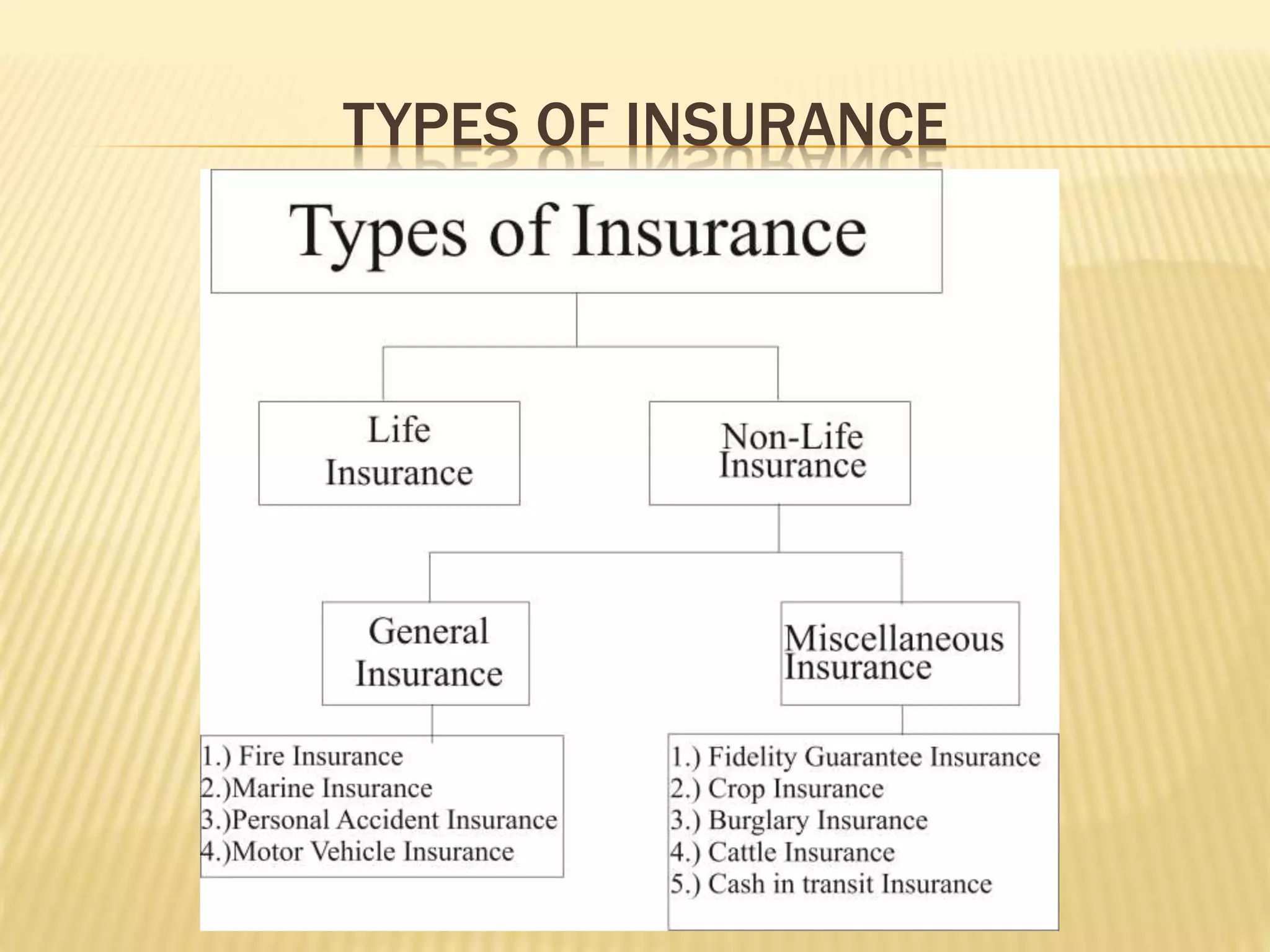
TYPES OF INSURANCE
PRINCIPLES OF INSURANCE
 Principle of Insurable interest.
 Principle of Utmost Good Faith.
 Principle of Indemnity.
 Principle of Subrogation.
 Principle of Contribution.
 Principle of Causa Proxima.
 Principle of Mitigation of Loss.
LIFE INSURANCE PLANS
 Term Insurance.
 Endowment Insurance Plan.
 Money Back Policy.
 Group Life Insurance.
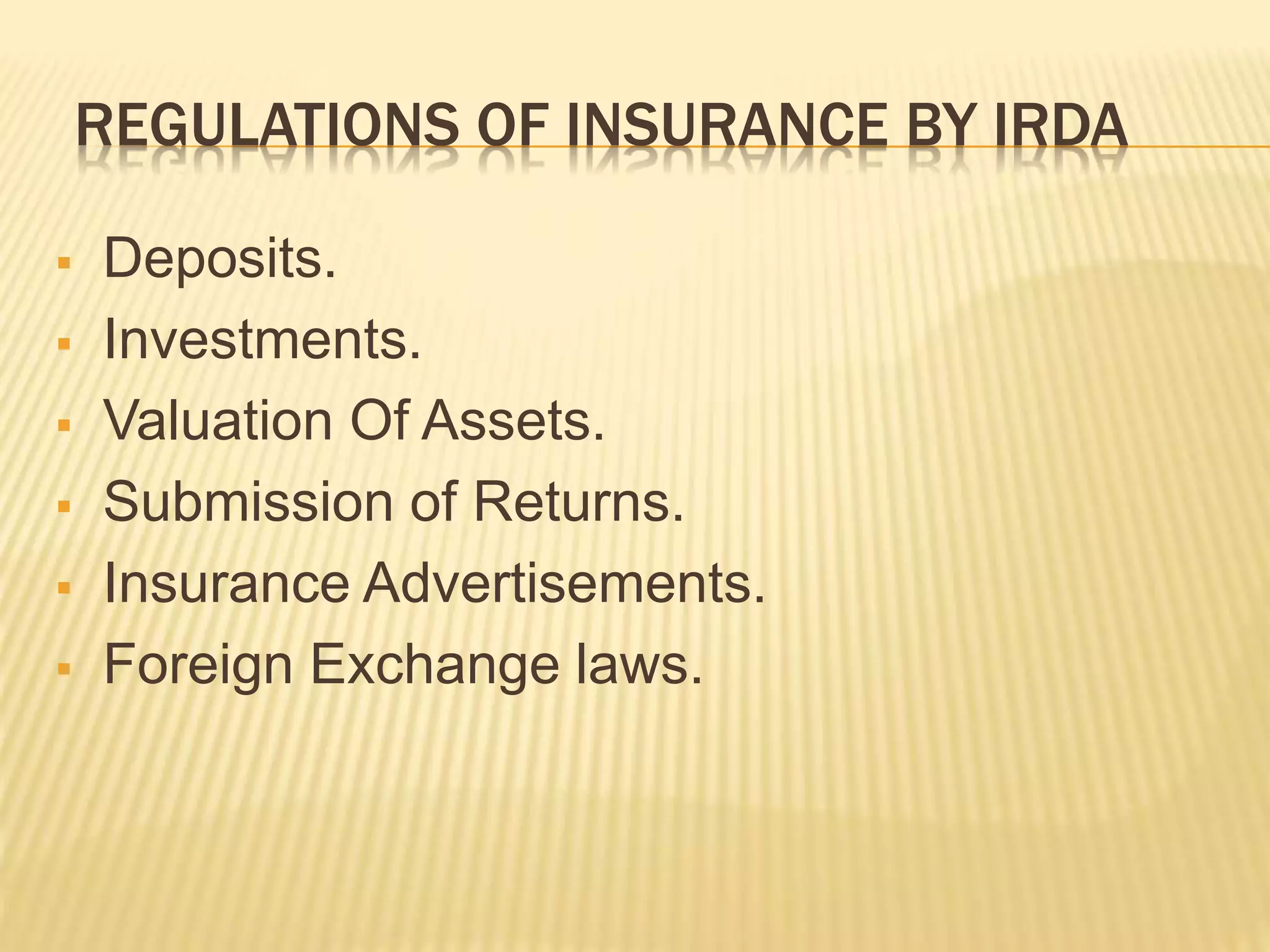
REGULATIONS OF INSURANCE BY IRDA
 Deposits.
 Investments.
 Valuation Of Assets.
 Submission of Returns.
 Insurance Advertisements.
 Foreign Exchange laws.
ACTS GOVERNING INSURANCE
 The insurance Act, 1938 to govern all form of insurance
and to provide strict control over insurance business.
 Insurance Regulatory and authority act, 1999 (to provide)
for the establishment of an authority to protect the interest
of the holder of insurance policy, to regulate, promote and
ensure orderly growth of insurance industry and for matter
connected therewith or incidental thereto and future to
amend the Insurance Act, 1938, the Life Insurance
Corporation Act, 1956 and the general insurance
business (Nationalization) act, 1972.
 The Actuaries Act, 2006 (An Act to provide for regulating
and developing the profession of Actuaries and for
matters connected therewith or incidental thereto).
INSURANCE LAW REGULATIONS
Insurance law regulations in India manage all
the matters related to various insurance
companies in the country. The concept of
insurance in India dates back to the ancient
period.
 Entry of Private Companies.
 Regulatory Authorities.
 Insurance Regulatory and Development
Authority.
INSURANCE REGULATORY & DEVELOPMENT
AUTHORITY
 Insurance Regulatory & Development
Authority is regulatory and development
authority under Government of India in order
to protect the interests of the policyholders
and to regulate, promote and ensure orderly
growth of the insurance industry.
 Powers and Functions of IRDA.
 Impact Of IRDA On Indian Insurance Sector.
CASE STUDY ON LIC .
CASE STUDY ON GIC.
Insurance act 1938
Insurance act 1938

Insurance act 1938

  • 1.
  • 2.
    INTRODUCTION  Insurance isthe key to good financial planning. On one hand, it safeguards your money and on the other, ensures its growth, thus providing you with complete financial well being.  Dictionary of business and Finance defines “Insurance as a form of contract agreement under which one party agrees in return for a consideration to pay an agreed amount of money to another party to make good a loss, damage or injury to something of value in which the insured has a interest as a result of some uncertain event. It is a device by which loss likely to be caused by an uncertain event is spread over a number of persons who are exposed to it and who propose to insure themselves against such an event”.
  • 3.
    DEFINITIONS Definition of lifeInsurance:- As per section 2(ii) of the Insurance Act 1938, “life insurance business is the business of effecting contract upon human life”. Definition of General Insurance:- General Insurance Corporation of India was formed in pursuance of section 9 (1) of GIBNA. It was incorporated on 22 November 1972 under the Companies Act 1956 as a private company limited by shares. GIC was formed for the purpose of superintending , controlling and carrying on the business of general insurance.
  • 4.
    IMPORTANCE OF INSURANCE Provides protection against occurrence of uncertain events.  Device for eliminating risks and sharing losses.  Co-operative method of spreading risks.  Facilitates international trade.  Serves as an agency of capital formation.  Financial support.  Medical support.  Source of employment.
  • 5.
  • 6.
    PRINCIPLES OF INSURANCE Principle of Insurable interest.  Principle of Utmost Good Faith.  Principle of Indemnity.  Principle of Subrogation.  Principle of Contribution.  Principle of Causa Proxima.  Principle of Mitigation of Loss.
  • 7.
    LIFE INSURANCE PLANS Term Insurance.  Endowment Insurance Plan.  Money Back Policy.  Group Life Insurance.
  • 8.
    REGULATIONS OF INSURANCEBY IRDA  Deposits.  Investments.  Valuation Of Assets.  Submission of Returns.  Insurance Advertisements.  Foreign Exchange laws.
  • 9.
    ACTS GOVERNING INSURANCE The insurance Act, 1938 to govern all form of insurance and to provide strict control over insurance business.  Insurance Regulatory and authority act, 1999 (to provide) for the establishment of an authority to protect the interest of the holder of insurance policy, to regulate, promote and ensure orderly growth of insurance industry and for matter connected therewith or incidental thereto and future to amend the Insurance Act, 1938, the Life Insurance Corporation Act, 1956 and the general insurance business (Nationalization) act, 1972.  The Actuaries Act, 2006 (An Act to provide for regulating and developing the profession of Actuaries and for matters connected therewith or incidental thereto).
  • 10.
    INSURANCE LAW REGULATIONS Insurancelaw regulations in India manage all the matters related to various insurance companies in the country. The concept of insurance in India dates back to the ancient period.  Entry of Private Companies.  Regulatory Authorities.  Insurance Regulatory and Development Authority.
  • 11.
    INSURANCE REGULATORY &DEVELOPMENT AUTHORITY  Insurance Regulatory & Development Authority is regulatory and development authority under Government of India in order to protect the interests of the policyholders and to regulate, promote and ensure orderly growth of the insurance industry.  Powers and Functions of IRDA.  Impact Of IRDA On Indian Insurance Sector.
  • 12.
  • 13.