This document provides an introduction to health informatics, including definitions of key terms, subdomains, and applications. It defines health informatics as the intersection of information science, computer science, and healthcare. The document outlines several subdomains including clinical informatics, medical informatics, nursing informatics, and bioinformatics. It also discusses some benefits and barriers to health information technology adoption, highlighting how tools like electronic health records and data warehouses can help improve decision making by generating and sharing health information.
Overview of the course objectives and introduction to health informatics including definitions.
Exploration of key terminologies, definitions, and the differences between informatics, information technology, information science, and computer science.
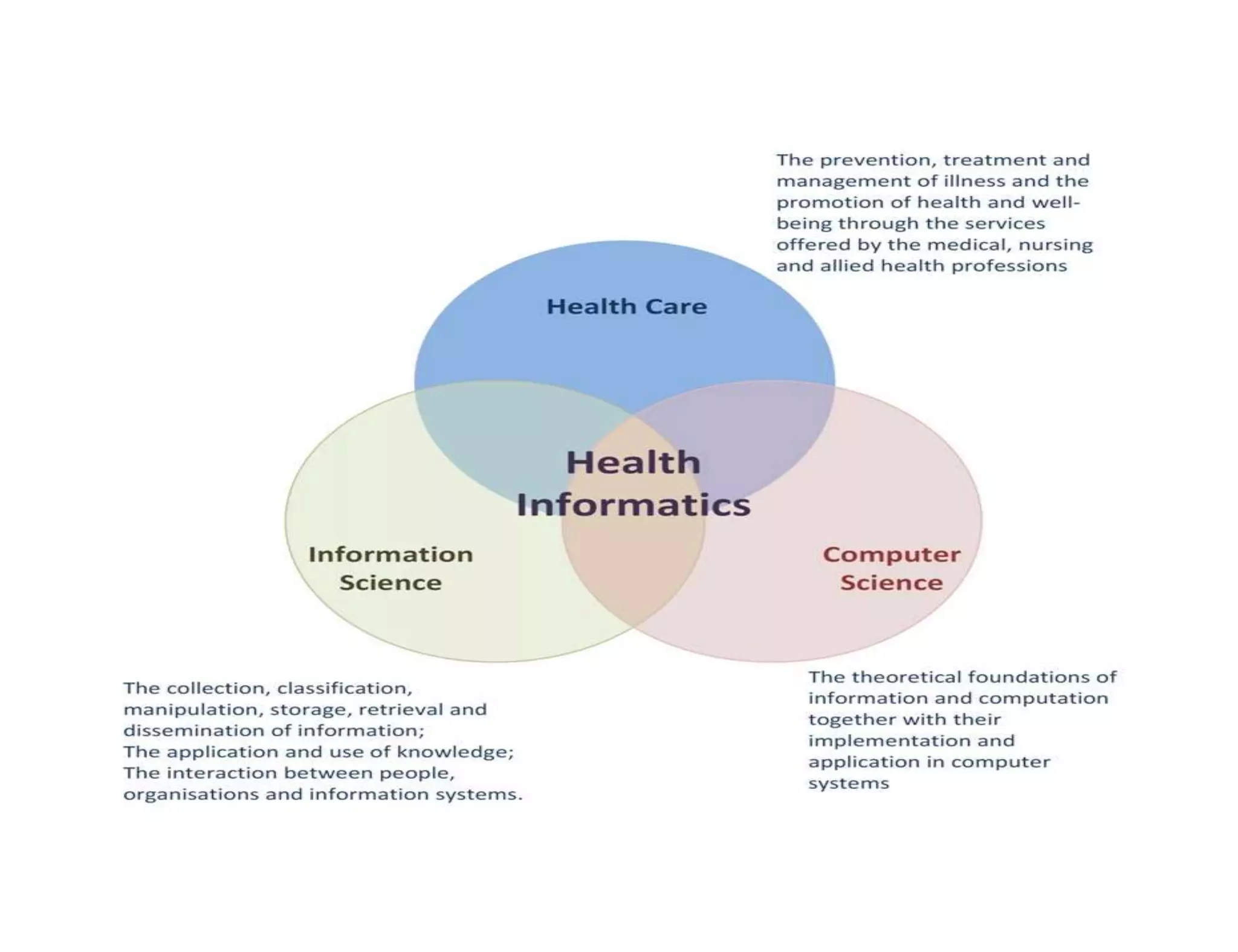
Defines health informatics and its relevance in healthcare, integrating information science and technology.
Detailed overview of various sub-domains including clinical, medical, nursing, public health, bioinformatics, and consumer health informatics.
Introduction to eHealth, EMR, mHealth, and telemedicine, explaining their roles and definitions in health informatics.
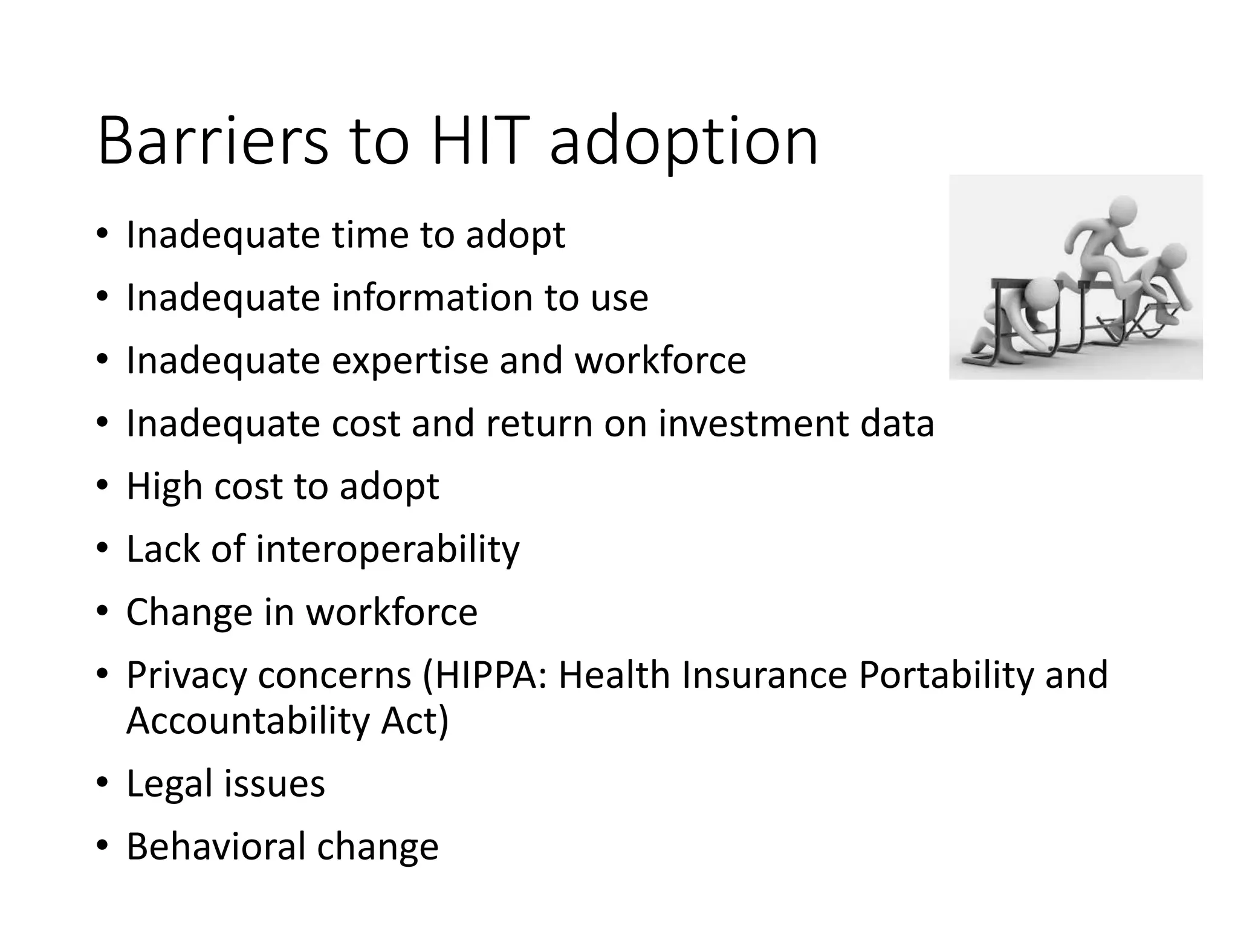
Identifies key players in health IT, the benefits of its adoption, and barriers to implementation.
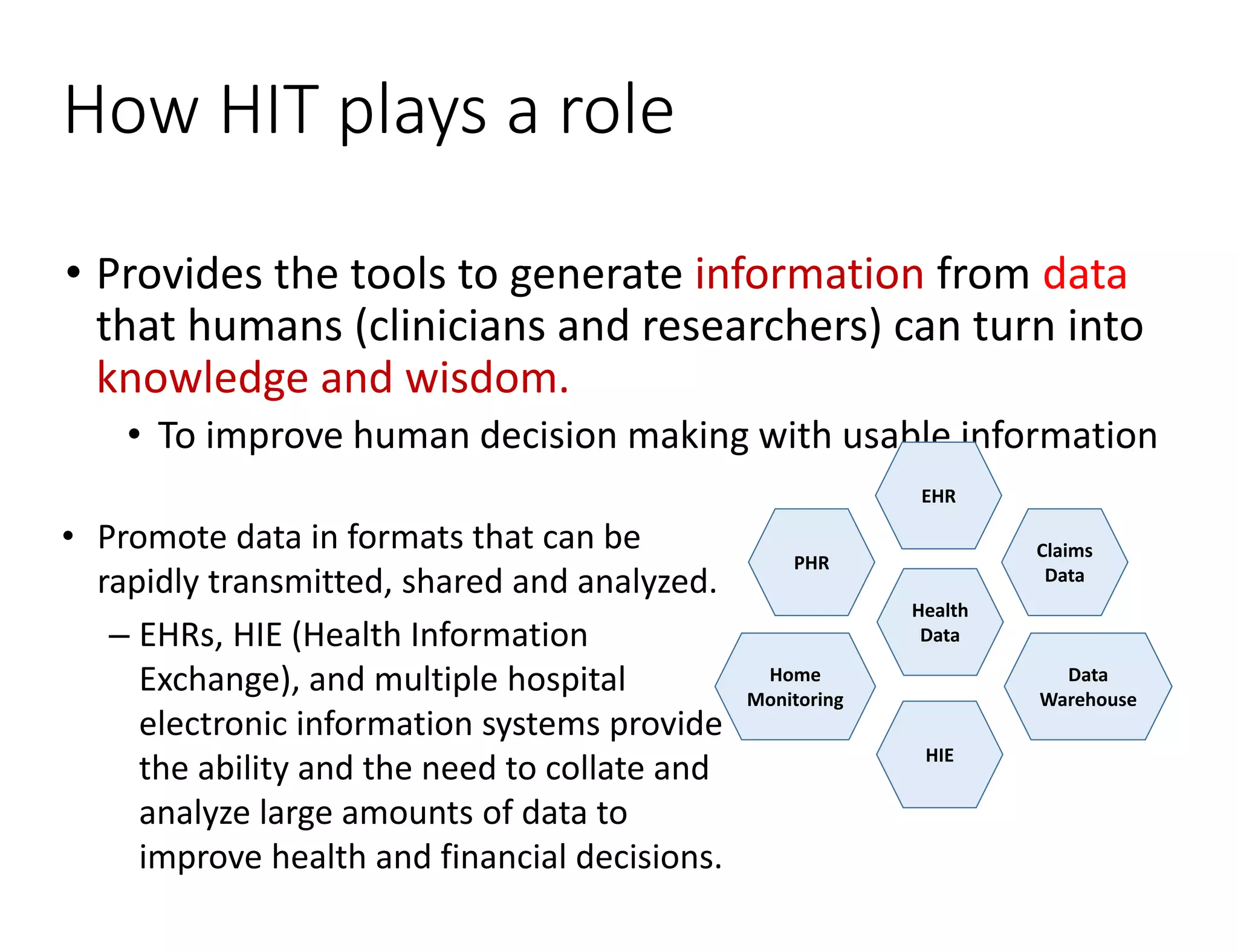
Discusses how HIT tools improve decision making through data, along with the 13 core objectives of meaningful use.
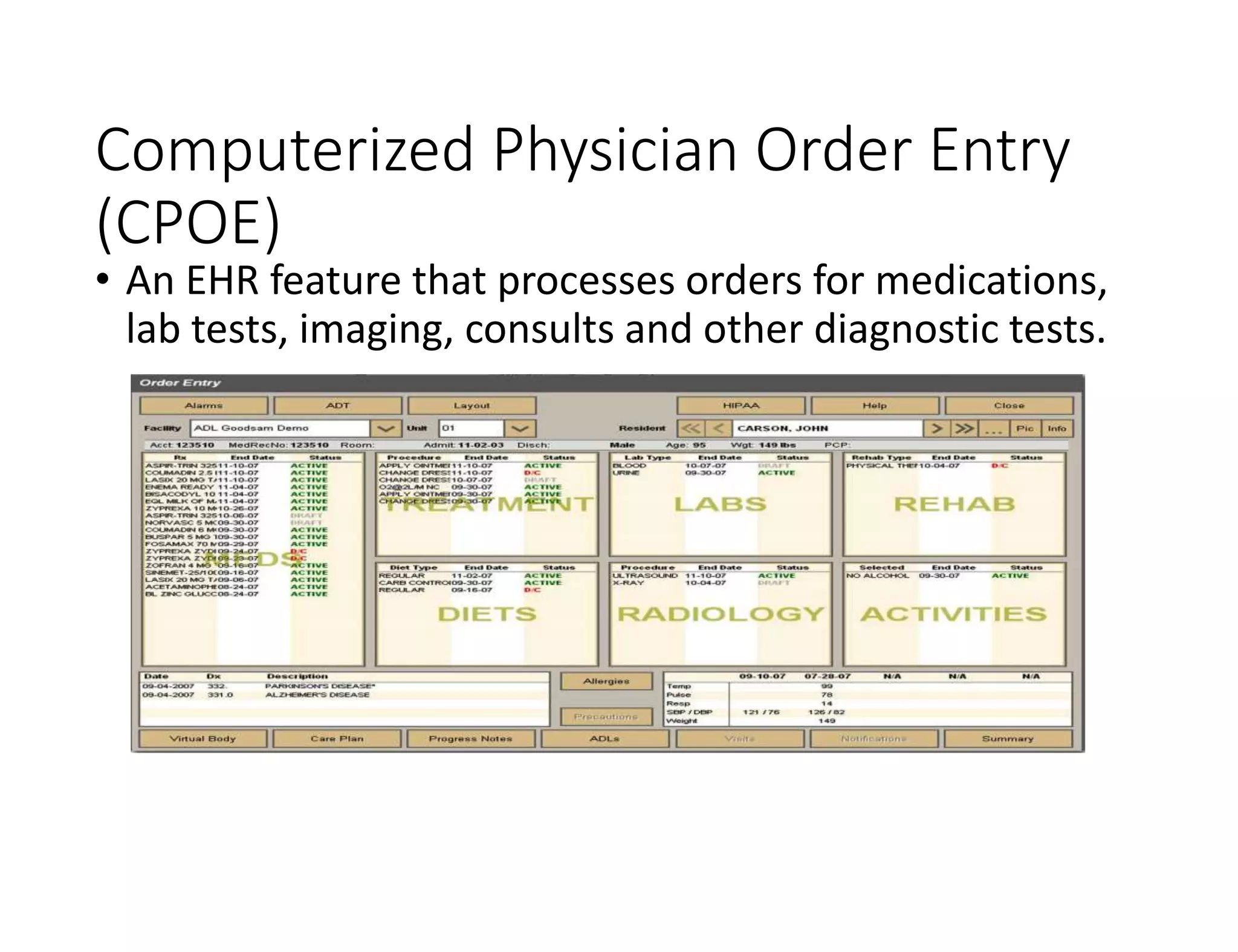
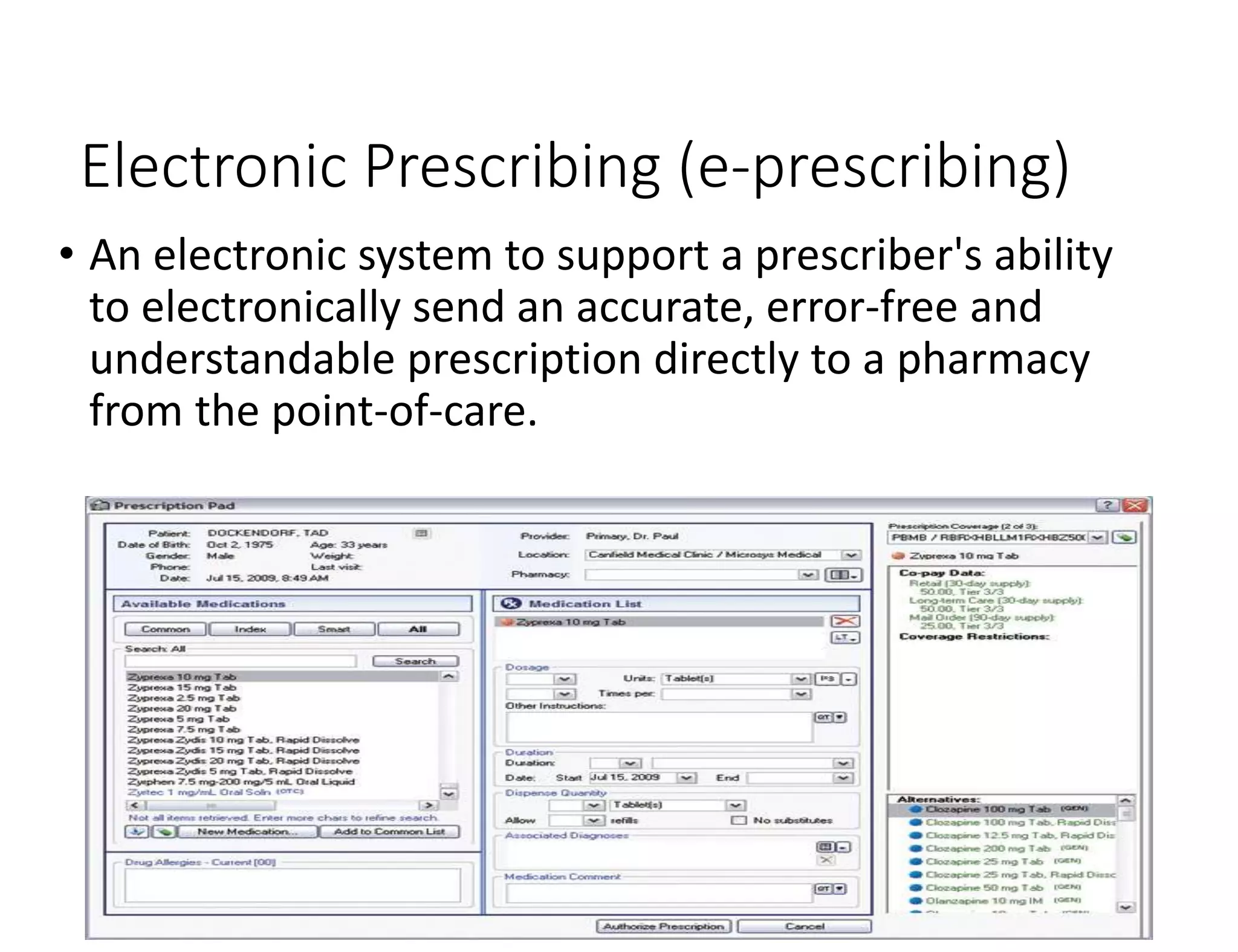
Details on Computerized Physician Order Entry (CPOE) and Electronic Prescribing (e-prescribing) functionalities.
Learning objectives
At theend of this lesson the student will able to:
•Define what health informatics is and discuss
its application
•Define common health informatics
terminologies
•Define the sub-domains of health informatics
and identify applications for each sub-domain
•Overview of health informatics
What is Informatics?
•Informatics is the application of
information technologies to optimize the
information management function within
an organization
• How does it differ from
> Information Technology?
> Information Science?
> Computer Science?
5.
Information Technology
• “isthe study, design, development,
implementation, support or
management of computer-based
information systems, particularly
software applications and computer
hardware’’
6.
Information Science
• “isan interdisciplinary science primarily
concerned with the analysis, collection,
classification, manipulation, storage,
retrieval and dissemination of
information”
(Merriam-Webster and American Heritage Dictionary)
7.
Computer Science
• “isthe study of the theoretical
foundations of information and
computation and of practical techniques
for their implementation and application
in computer systems”
(Denning et al.,
1989)
8.
What is Information?
•“Information is data that has been
processed into a form that is meaningful
to the recipient”
(Davis & Olson, 1985)
• What is the DIKW hierarchy?
9.
Information System
• Isany combination of information
technology and people's activities using
that technology to support operations,
management, and decision making
• In a broad sense, refers to the interaction
between people, algorithmic processes, data
and technology
• In a narrow sense, refers to the specific
application software that is used to store
data records in a computer system and
automate activities
10.
What is HealthInformatics?
• “The intersection of information science, computer
science, and health care”
(Wikipedia)
• Deals with the resources, devices, and methods
required to optimize the acquisition, storage,
retrieval, and use of information in health and
biomedicine
• The tools include computers, clinical guidelines,
formal medical terminologies, and information and
communication systems
12.
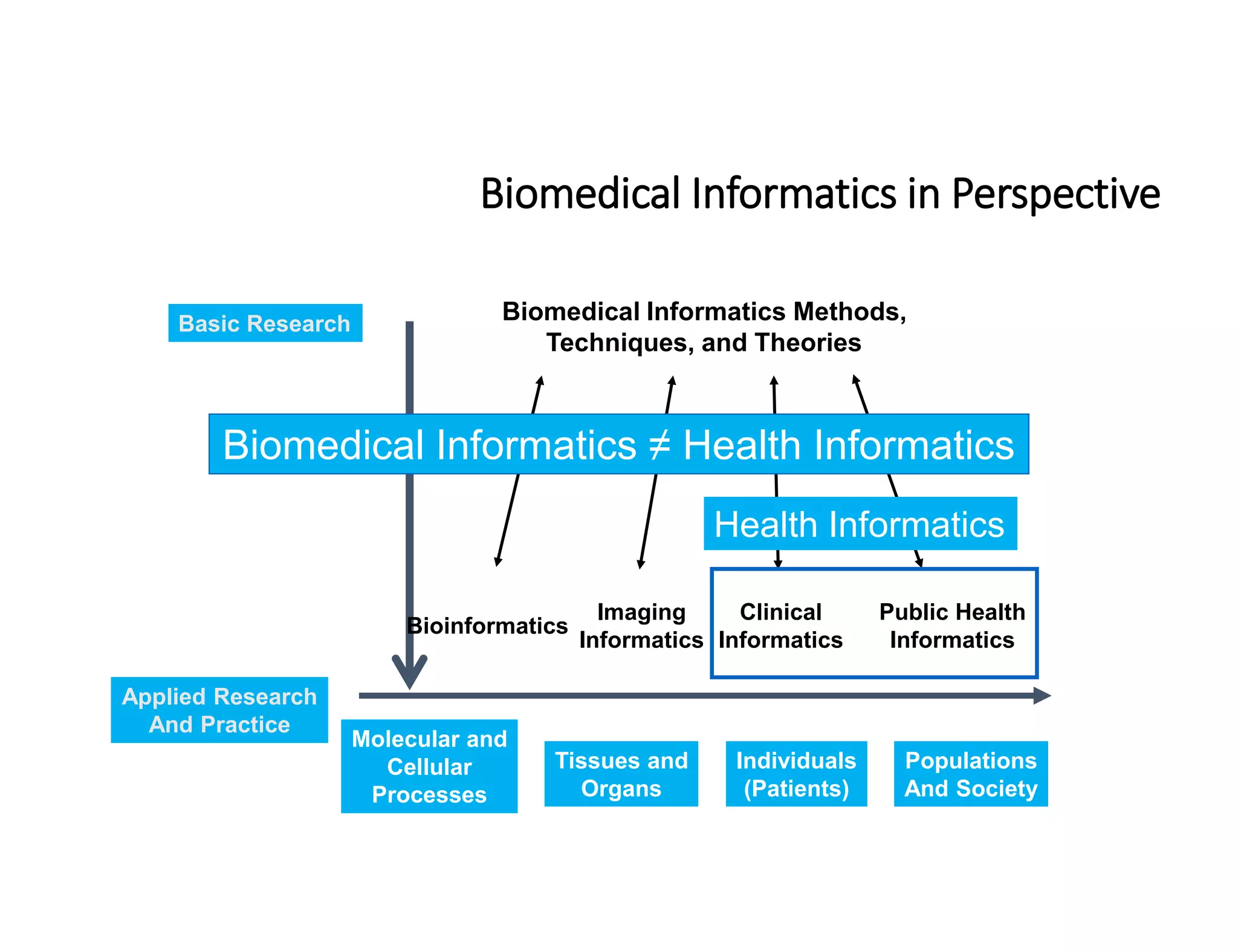
Biomedical Informatics inPerspective
Basic Research
Applied Research
And Practice
Biomedical Informatics Methods,
Techniques, and Theories
Imaging
Informatics
Clinical
Informatics
Bioinformatics
Public Health
Informatics
Molecular and
Cellular
Processes
Tissues and
Organs
Individuals
(Patients)
Populations
And Society
Biomedical Informatics ≠ Health Informatics
Health Informatics
13.
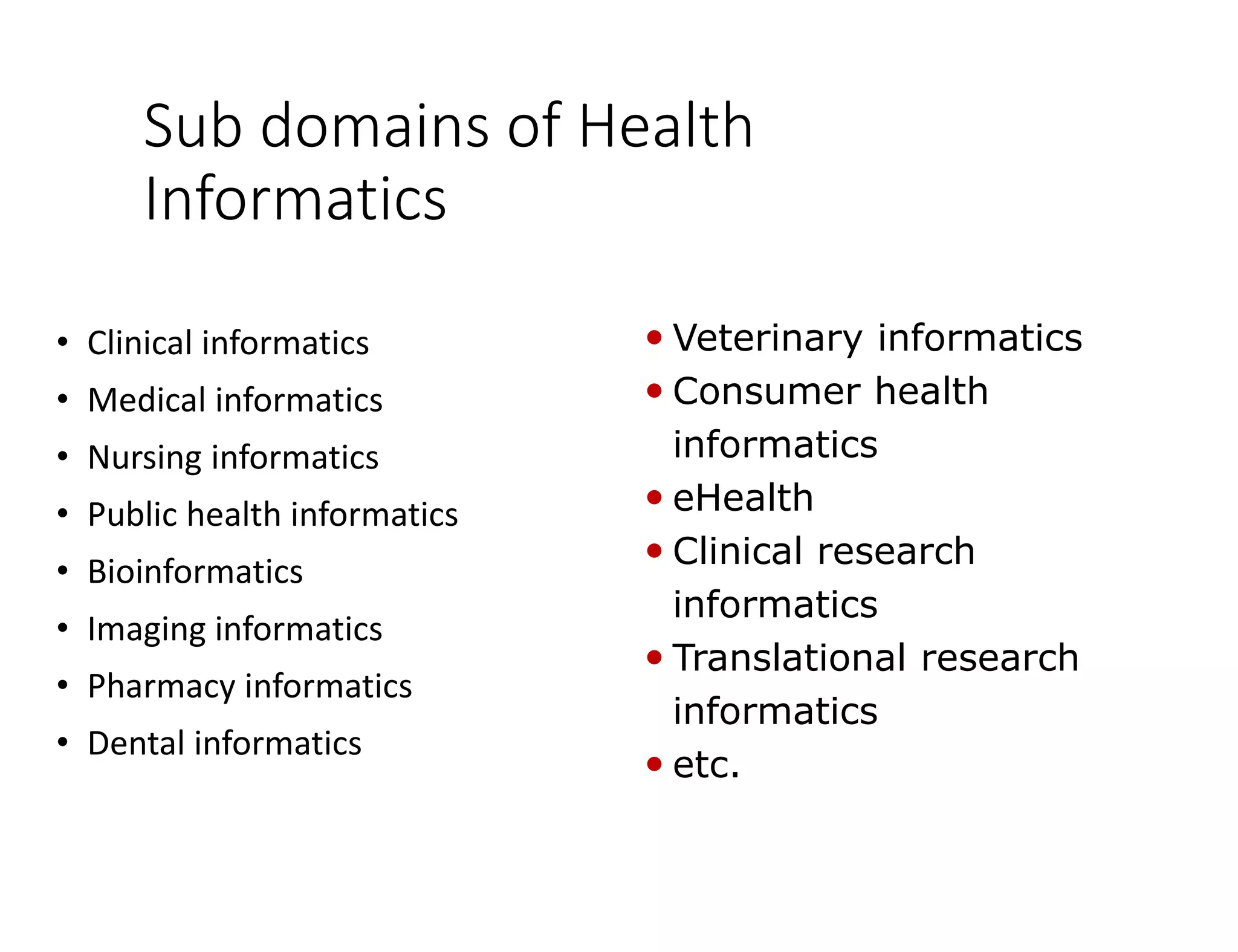
Sub domains ofHealth
Informatics
• Clinical informatics
• Medical informatics
• Nursing informatics
• Public health informatics
• Bioinformatics
• Imaging informatics
• Pharmacy informatics
• Dental informatics
Veterinary informatics
Consumer health
informatics
eHealth
Clinical research
informatics
Translational research
informatics
etc.
14.
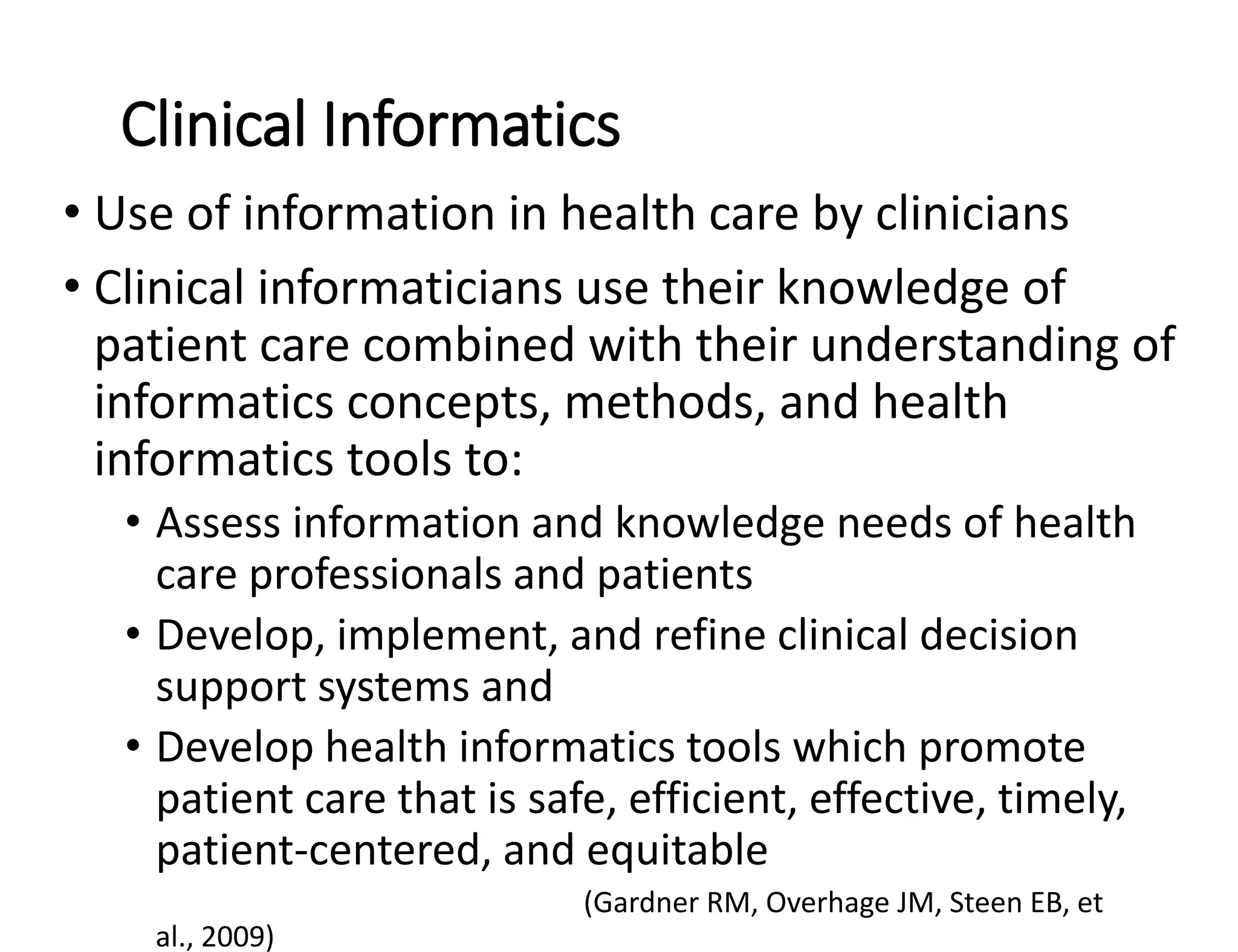
Clinical Informatics
• Useof information in health care by clinicians
• Clinical informaticians use their knowledge of
patient care combined with their understanding of
informatics concepts, methods, and health
informatics tools to:
• Assess information and knowledge needs of health
care professionals and patients
• Develop, implement, and refine clinical decision
support systems and
• Develop health informatics tools which promote
patient care that is safe, efficient, effective, timely,
patient-centered, and equitable
(Gardner RM, Overhage JM, Steen EB, et
al., 2009)
15.
Medical Informatics
• “MedicalInformatics is the branch of
science concerned with the use of
computers and communication technology
to acquire, store, analyze, communicate,
and display medical information and
knowledge to facilitate understanding and
improve the accuracy, timeliness, and
reliability of decision making”
(Warner, Sorenson and Bouhaddou, 1997)
16.
Nursing Informatics
• “acombination of computer science,
information science, and nursing science
designed to assist in the management
and processing of nursing data,
information, and knowledge to support
nursing practice, education, research,
and administration“
(Graves & Corcoran, 1989)
17.
Public Health Informatics
•“the systematic application of information and
computer science and technology to public
health practice, research and learning”
• Activities may include:
• Collection and storage of vital statistics
• Collection and reporting of
communicable diseases
• Disease surveillance
• Display disease statistics and trends
• Immunization
• Hospital statistics
(O’Carroll et al., 2002)
18.
Bioinformatics
• Bioinformatics, isthe application of statistics and computer
science to the field of molecular biology. It is also defined as
the sum of the computational approaches to analyze,
manage, and store biological data.
• Common activities in bioinformatics include:
• Mapping and analyzing DNA and protein
sequences
• Aligning different DNA and protein sequences
to compare them and
• Creating and viewing 3-D models of protein
structures
Wikipedia ,
MedicineNet.com
19.
Imaging Informatics
• Alsocalled Radiology Informatics or
Medical Imaging Informatics
• It is devoted to the study of how
information about and contained within
medical images is retrieved, analyzed,
enhanced, and exchanged throughout
the medical enterprise
(Branstetter, 2007)
20.
Pharmacy Informatics
• Isa sub-discipline of Health Informatics that
deals with the integration of information
technology and its applications into the
pharmaceutical practice
(University of Illinois at Chicago, 2009)
• Focuses on leveraging (influencing) technology
systems to ensure optimal patient safety,
compliance, and health outcomes
• Medication selection
• Use and
• Administration
21.
Dental Informatics
• Isthe application of computer and
information science to improve dental
practice, research, and program
administration
(Eisner 1992)
22.
Veterinary Informatics
• “Isthe discipline concerned with the
applications of information science,
engineering, and computer technology to
support veterinary teaching, research,
and practice”
(Association for Veterinary
Informatics)
23.
Consumer Health Informatics
•“the branch of medical informatics that analyses
consumers’ needs for information; studies and
implements methods of making information
accessible to consumers; and models and
integrates consumers’ preferences into medical
information systems”
(Eysenbach, 2000)
• A subspecialty of medical informatics
• Studies from a patient/consumer perspective the use of
electronic information
• Focuses on patients as the primary users of health
information
24.
eHealth
• eHealth isalso written “e-health”
• “is defined as the use of emerging
interactive technologies (e.g., Internet, CD-
ROMs, personal digital assistants,
interactive television and voice response
systems, computer kiosks, and mobile
computing) to enable health improvement
and health care services”
(Ahern et al.,
2006)
25.
Electronic Medical Records(EMR)
• The 2003 IOM Patient Safety Report describes an EMR as encompassing:
• “A longitudinal collection of electronic health information
for and about persons
• [immediate] Electronic access to person- and population-
level information by authorized users
• Provision of knowledge and decision-support systems
[that enhance the quality, safety, and efficiency of patient
care] and
• Support for efficient processes for health care delivery"
(IOM, 2003)
26.
mHealth
• “…the provisionof health-related services via mobile
communications”
(Vital Wave Consulting, 2009)
• mHealth applications include:
• the use of mobile devices in collecting community and
clinical health data
• delivery of healthcare information to practitioners,
researchers, and patients
• real-time (immediate) monitoring of patient vital signs and
direct provision of care (via mobile telemedicine)
27.
Telemedicine
• “the useof electronic signals to transfer
medical data from one site to another via
the internet, telephones, PCs, satellites, or
videoconferencing equipment in order to
improve access to health care”
(Brown, 1996)
• telemedicine can be
• As simple as two doctors talking about a
patient through the telephone or
• As complex as a sophisticated global hospital
enterprise network that supports real-time
remote surgical operations
28.
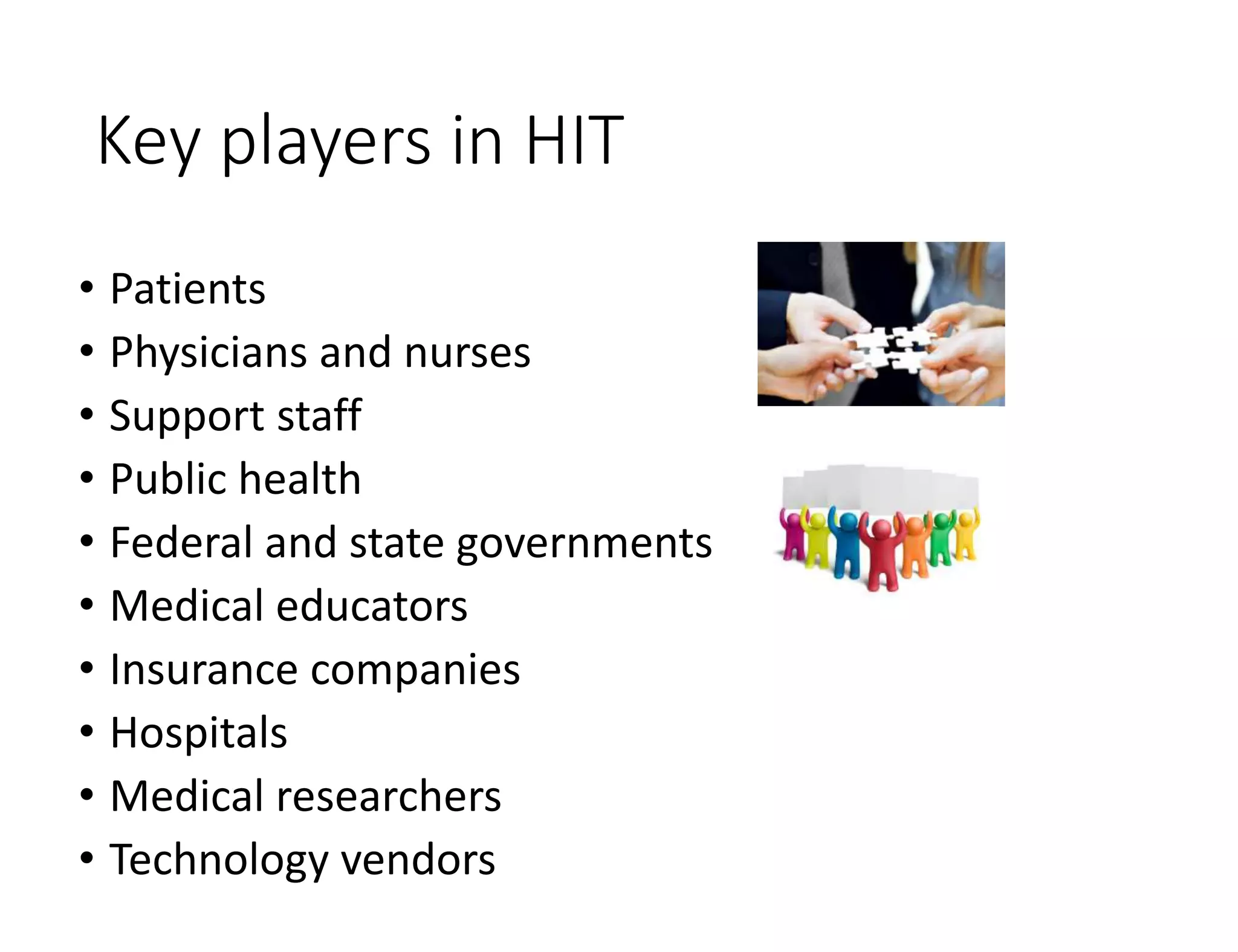
Key players inHIT
• Patients
• Physicians and nurses
• Support staff
• Public health
• Federal and state governments
• Medical educators
• Insurance companies
• Hospitals
• Medical researchers
• Technology vendors
29.
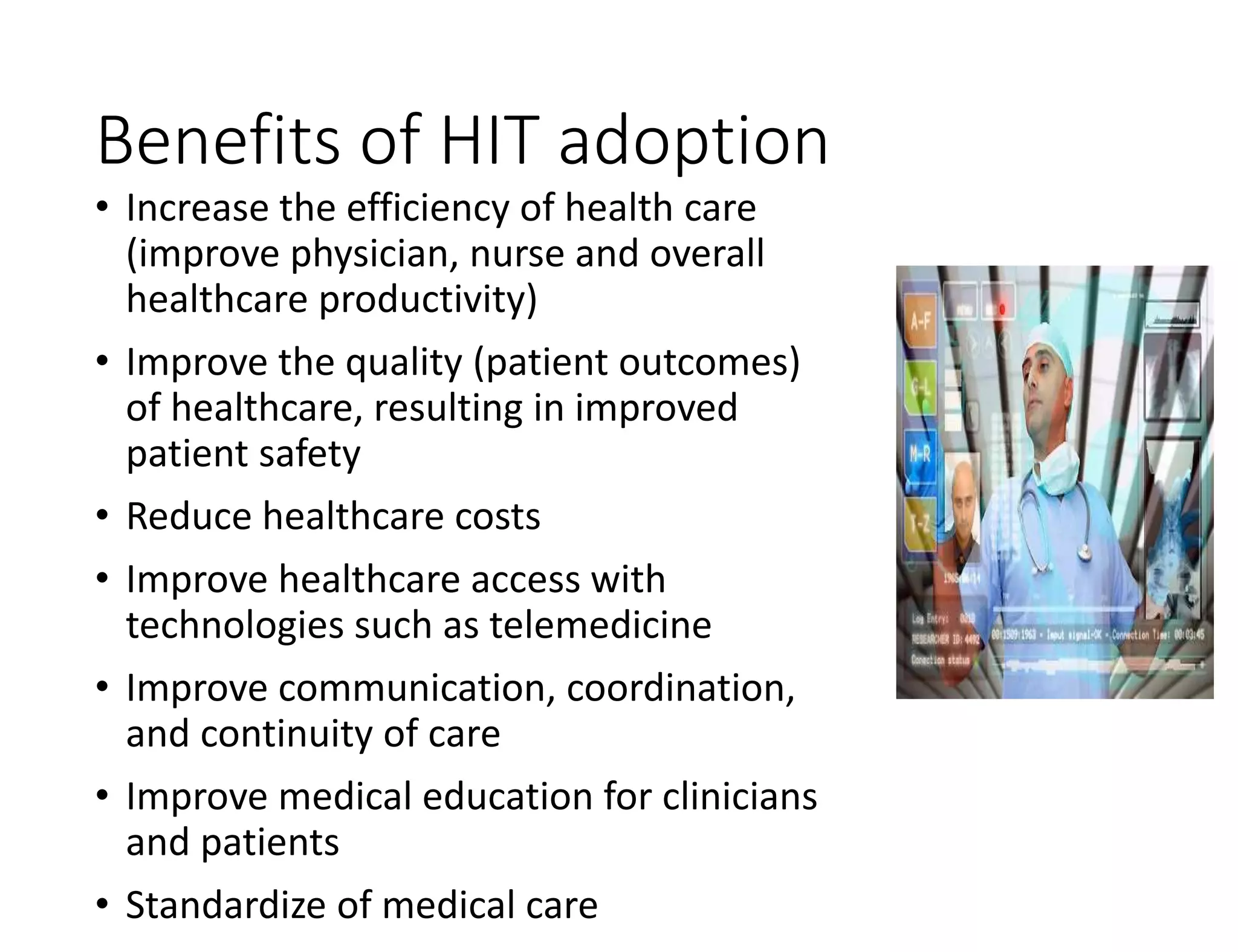
Benefits of HITadoption
• Increase the efficiency of health care
(improve physician, nurse and overall
healthcare productivity)
• Improve the quality (patient outcomes)
of healthcare, resulting in improved
patient safety
• Reduce healthcare costs
• Improve healthcare access with
technologies such as telemedicine
• Improve communication, coordination,
and continuity of care
• Improve medical education for clinicians
and patients
• Standardize of medical care
30.
Barriers to HITadoption
• Inadequate time to adopt
• Inadequate information to use
• Inadequate expertise and workforce
• Inadequate cost and return on investment data
• High cost to adopt
• Lack of interoperability
• Change in workforce
• Privacy concerns (HIPPA: Health Insurance Portability and
Accountability Act)
• Legal issues
• Behavioral change
31.
How HIT playsa role
• Provides the tools to generate information from data
that humans (clinicians and researchers) can turn into
knowledge and wisdom.
• To improve human decision making with usable information
Health
Data
EHR
Claims
Data
Data
Warehouse
HIE
Home
Monitoring
PHR
• Promote data in formats that can be
rapidly transmitted, shared and analyzed.
– EHRs, HIE (Health Information
Exchange), and multiple hospital
electronic information systems provide
the ability and the need to collate and
analyze large amounts of data to
improve health and financial decisions.
32.
Meaningful Use: 13Core Objectives
1. Computerized provider order entry (CPOE)
2. Drug-drug and drug-allergy checks
3. Maintain an up-to-date problem list of current and active
diagnoses
4. E-Prescribing (eRx)
5. Maintain active medication list
6. Maintain active medication allergy list
7. Record demographics
8. Record and chart changes in vital signs
9. Record smoking status for patients 13 years or older
10.Implement clinical decision support
11.Provide patients with the ability to view, download, or
transmit their health information online
12.Provide clinical summaries for patients for each office visit
13.Protect electronic health information
33.
Computerized Physician OrderEntry
(CPOE)
• An EHR feature that processes orders for medications,
lab tests, imaging, consults and other diagnostic tests.
34.
Electronic Prescribing (e-prescribing)
•An electronic system to support a prescriber's ability
to electronically send an accurate, error-free and
understandable prescription directly to a pharmacy
from the point-of-care.
![Electronic Medical Records (EMR)
• The 2003 IOM Patient Safety Report describes an EMR as encompassing:
• “A longitudinal collection of electronic health information
for and about persons
• [immediate] Electronic access to person- and population-
level information by authorized users
• Provision of knowledge and decision-support systems
[that enhance the quality, safety, and efficiency of patient
care] and
• Support for efficient processes for health care delivery"
(IOM, 2003)](https://image.slidesharecdn.com/3-221118190913-f292c5a1/75/Introduction-to-Health-Informatics-25-2048.jpg)