TRAINING
AND
DEVELOPMEN
Presented by: JEANA B. PAGSINOHIN
OUTLINE
Training and Development
 Introduction
 Definition of Terms
 Types of Training
 T&D Objectives and Importance
 T&D Methods
Design and Evaluation of Training
and Development Programs
INTRODUCTION
Human resource is one of the most significant assets a firm
must have. Consequently, the need for human resource
training and development must be considered. The success and
effectiveness of an organization depends on how far the efforts
of the employees of the organization are recognized by the
company. Training programs must be designed and delivered
to meet the needs of employees and the organization. Then the
planned employee development process can help equip them
with the new technological skills needed to improve their job
performance and prevent skills from becoming obsolete.
Moreover, policies and practices that support training and
development can affect employee activity levels, thereby
providing opportunities for them to participate, which will
increase employee commitment to the organization. This
practice of training and development is considered as a
message to employees that the organization values and cares
about their professional development.
TRAINING AND DEVELOPMENT
 is one of the main functions of the human resource
management.
Training refers to a systematic setup where
employees are instructed and taught matters of
technical knowledge related to their jobs. It focuses on
teaching employees how to use particular machine or
how to do specific tasks to increase efficiency.
Whereas, development refers to overall holistic and
educational growth of the employees. It is a planned
effort by the organization to improve HR competence
which is carried out continuously in the long term, to
ensure the availability of human resource in accordance
with the needs of the position, and is aimed at
improving individual performance which leads to
organizational performance.
 To increase the knowledge of employees
in doing specific jobs.
 To impart new skills among the
employees systematically so that they
learn quickly.
 To bring about change in attitudes of
the employees towards fellow workers,
supervisor, and the organization.
 To make the employees perform their
tasks efficiently and thus to check the
wastage of time and resources.
 To improve the overall performance of the
organization.
 To reduce the number of accidents by
providing safety trainings to the
employees.
 To prepare employees for the higher
jobs/positions.
TRAINING & DEVELOPMENT
OBJECTIVES
Increase productivity
Boost employee morale
Less supervision
Less wastage
Easy adaptability
Reduce turnover and
absenteeism
TRAINING & DEVELOPMENT
IMPORTANCE
Technical or Technology Training
Quality Training
Skills Training
Soft Skills Training
Professional and Legal Training
Team Training
Managerial Training
Safety Training
TYPES OF TRAINING
1. On-the-Job Training - is one way to
facilitate employee skills training. A
manager or someone with experience shows
the employee how to perform the actual job.
2. Mentoring and Coaching - is a process by
which an employee can be trained and
developed by an experienced person.
Normally, mentoring is used as a continuing
method to train and develop an employee.
TRAINING & DEVELOPMENT
METHODS
3. Brown Bag Lunch - is a training delivery
method meant to create an informal
atmosphere. As the name suggests, brown bag
lunch training is one in which the training
occurs during lunchtime, employees bring their
food, and someone presents training
information to them.
4. Web-Based Training Delivery -involves the
use of technology to facilitate training. There
are two types: First, synchronous learning uses
instructor-led facilitation. Second,
Asynchronous learning is self-directed, and
TRAINING & DEVELOPMENT
METHODS
5. Job Shadowing - is a training delivery
method that places an employee who
already has the skills with another
employee who wants to develop those
skills. Apprenticeships use job shadowing
as one type of training method.
6. Job Swapping - is a method for training in
which two employees agree to change jobs
for a period of time. This training would be
necessary to ensure that the employee
learns the skills needed to perform of the
new job.
TRAINING & DEVELOPMENT
METHODS
7. Vestibule Training Method - it is
performed near the worksite in conference
rooms, lecture rooms, and classrooms.
This might be an appropriate method to
deliver orientations and some skills-based
training.
8. International Assignment Training -
Since we are working within a global
economy, it might be necessary to provide
training to employees who are moving
overseas or working overseas. Ensuring
success overseas is reliant upon the local
TRAINING & DEVELOPMENT
METHODS
Design and Evaluation of Training and Development
Programs
Fig. 1 Training and Development Program Model
Organizational
Assessment
 determine the skills, knowledge,
and abilities a company needs to
meet its strategic objectives
 considers things such as
changing demographics and
technological trends
 looks at how the organization as
a whole can handle its
weaknesses while promoting
strengths.
Occupational (task) Assessment
 looks at the specific tasks, skills
knowledge, and abilities required to
do jobs within the organization.
NEEDS ASSESSMENT
The first step in developing a training program is to determine what the organization
needs in terms of training. There are three levels of training needs assessment:
 looks at the performance of an
individual employee and
determines what training should
be accomplished for that
individual.
Individual Assessment
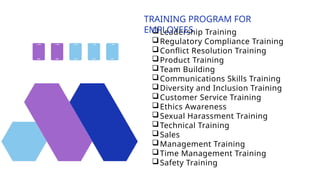
Leadership Training
Regulatory Compliance Training
Conflict Resolution Training
Product Training
Team Building
Communications Skills Training
Diversity and Inclusion Training
Customer Service Training
Ethics Awareness
Sexual Harassment Training
Technical Training
Sales
Management Training
Time Management Training
Safety Training
TRAINING PROGRAM FOR
EMPLOYEES
LEARNING OBJECTIVES
A learning objective is what you want the learner to be able to do, explain, or
demonstrate at the end of the training period. Good learning objectives are
performance based and clear, and the end result of the learning objective can be
observable or measured in some way.
Examples of learning objectives might include the following:
 Be able to explain the company policy on sexual harassment and give examples of sexual
harassment.
 Be able to show the proper way to take a customer’s order.
 Perform a variety of customer needs analyses using company software.
 Explain the safety procedure in handling chemicals.
 Be able to explain the types of communication styles and strategies to effectively deal with
each style.
 Demonstrate ethics when handling customer complaints.
LEARNING STYLES
An effective trainer tries to develop training to meet the three different learning styles:
1. Visual learner. A visual learner usually has a clear “picture” of an experience. A visual learner
often says things such as “I can see what you are saying” or “This looks good.” A visual learner is
best reached using graphics, pictures, and figures.
2. Auditory learner. An auditory learner learns by sound. An auditory learner might say, “If I hear
you right” or “What do you hear about this situation?” The auditory learner will learn by listening
to a lecture or to someone explaining how to do something.
3. Kinesthetic learner. A kinesthetic learner learns by developing feelings toward an experience.
These types of learners tend to learn by doing rather than listening or seeing someone else do it.
This type of learner will often say things such as “This feels right.”
DELIVERY MODE (T&D METHODS)
Depending on the type of training that needs to be delivered, you will likely choose a
different mode to deliver the training. An orientation might lend itself best to vestibule
training, while sexual harassment training may be better for web-based training. When
choosing a delivery mode, it is important to consider the audience and budget
constrictions.
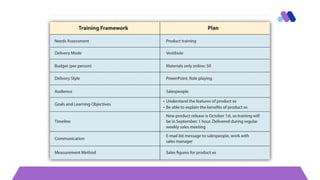
BUDGET
How much money do you think the training will cost? The type of training performed
will depend greatly on the budget. If you decide that web-based training is the right
delivery mode, but you don’t have the budget to pay the user fee for the platform, this
wouldn’t be the best option. Besides the actual cost of training, another cost
consideration is people’s time. If employees are in training for two hours, what is the
cost to the organization while they are not able to perform their job? Lists the actual
cost for materials, snacks, and other direct costs, also the indirect costs, such as
people’s time should be prepared.
DELIVERY STYLE
Taking into consideration the delivery method, what is the best style to deliver this training? It’s
also important to keep in mind that most people don’t learn through “death by PowerPoint”; they
learn in a variety of ways, such as auditory, kinesthetic, or visual. Considering this, what kinds of
ice breakers, breakout discussions, and activities can you incorporate to make the training as
interactive as possible? Role plays and other games can make the training fun for employees.
Many trainers implement online videos, podcasts, and other interactive media in their training
sessions. This ensures different learning styles are met and also makes the training more
interesting.
AUDIENCE CONSIDERATION
Considering your audience is an important aspect to training. How long have they been with the
organization, or are they new employees? What departments do they work in? Knowing the
answers to these questions can help you develop a relevant delivery style that makes for better
training.
CONTENT DEVELOPMENT
The content you want to deliver is perhaps one of the most important parts in training and one of
the most time-consuming to develop. Development of learning objectives or those things you
want your learners to know after the training makes for a more focused training. Think of learning
objectives as goals—what should someone know after completing this training?
Consideration of the learning methods you will use, such as discussion and role playing, will be
outlined in your content area. Development of content usually requires a development of
learning objectives and then a brief outline of the major topics you wish to cover. With that
outline, you can “fill in” the major topics with information. Based on this information, you can
develop modules or PowerPoint slides, activities, discussion questions, and other learning
techniques.
TIME LINES
For some types of training, time lines may be required to ensure the training has been done. This is often the
case for safety training; usually the training should be done before the employee starts. In other words, in what
time frame should an employee complete the training?
Another consideration regarding time lines is how much time you think you need to give the training. Perhaps
one hour will be enough, but sometimes, training may take a day or even a week. After you have developed
your training content, you will likely have a good idea as to how long it will take to deliver it. Consider the fact
that most people do not have a lot of time for training and keep the training time realistic and concise.
COMMUNICATION
Once you have developed your training, your next consideration is how you will communicate the available
training to employees. In a situation such as an orientation, you will need to communicate to managers, staff,
and anyone involved in the training the timing and confirm that it fits within their schedule. If it is an informal
training, such as a brown bag lunch, this might involve determining the days and times that most people are in
the office and might be able to participate. Because employees use Mondays and Fridays, respectively, to catch
up and finish up work for the week, these days tend to be the worst for training.
MEASURING EFFECTIVENESS
Fig. 2 KIRKPATRICK MODEL
THANK YOU!

training-and-development.HUman resource Management

  • 1.
  • 2.
    OUTLINE Training and Development Introduction  Definition of Terms  Types of Training  T&D Objectives and Importance  T&D Methods Design and Evaluation of Training and Development Programs
  • 3.
    INTRODUCTION Human resource isone of the most significant assets a firm must have. Consequently, the need for human resource training and development must be considered. The success and effectiveness of an organization depends on how far the efforts of the employees of the organization are recognized by the company. Training programs must be designed and delivered to meet the needs of employees and the organization. Then the planned employee development process can help equip them with the new technological skills needed to improve their job performance and prevent skills from becoming obsolete. Moreover, policies and practices that support training and development can affect employee activity levels, thereby providing opportunities for them to participate, which will increase employee commitment to the organization. This practice of training and development is considered as a message to employees that the organization values and cares about their professional development.
  • 4.
    TRAINING AND DEVELOPMENT is one of the main functions of the human resource management. Training refers to a systematic setup where employees are instructed and taught matters of technical knowledge related to their jobs. It focuses on teaching employees how to use particular machine or how to do specific tasks to increase efficiency. Whereas, development refers to overall holistic and educational growth of the employees. It is a planned effort by the organization to improve HR competence which is carried out continuously in the long term, to ensure the availability of human resource in accordance with the needs of the position, and is aimed at improving individual performance which leads to organizational performance.
  • 5.
     To increasethe knowledge of employees in doing specific jobs.  To impart new skills among the employees systematically so that they learn quickly.  To bring about change in attitudes of the employees towards fellow workers, supervisor, and the organization.  To make the employees perform their tasks efficiently and thus to check the wastage of time and resources.  To improve the overall performance of the organization.  To reduce the number of accidents by providing safety trainings to the employees.  To prepare employees for the higher jobs/positions. TRAINING & DEVELOPMENT OBJECTIVES
  • 6.
    Increase productivity Boost employeemorale Less supervision Less wastage Easy adaptability Reduce turnover and absenteeism TRAINING & DEVELOPMENT IMPORTANCE
  • 7.
    Technical or TechnologyTraining Quality Training Skills Training Soft Skills Training Professional and Legal Training Team Training Managerial Training Safety Training TYPES OF TRAINING
  • 8.
    1. On-the-Job Training- is one way to facilitate employee skills training. A manager or someone with experience shows the employee how to perform the actual job. 2. Mentoring and Coaching - is a process by which an employee can be trained and developed by an experienced person. Normally, mentoring is used as a continuing method to train and develop an employee. TRAINING & DEVELOPMENT METHODS
  • 9.
    3. Brown BagLunch - is a training delivery method meant to create an informal atmosphere. As the name suggests, brown bag lunch training is one in which the training occurs during lunchtime, employees bring their food, and someone presents training information to them. 4. Web-Based Training Delivery -involves the use of technology to facilitate training. There are two types: First, synchronous learning uses instructor-led facilitation. Second, Asynchronous learning is self-directed, and TRAINING & DEVELOPMENT METHODS
  • 10.
    5. Job Shadowing- is a training delivery method that places an employee who already has the skills with another employee who wants to develop those skills. Apprenticeships use job shadowing as one type of training method. 6. Job Swapping - is a method for training in which two employees agree to change jobs for a period of time. This training would be necessary to ensure that the employee learns the skills needed to perform of the new job. TRAINING & DEVELOPMENT METHODS
  • 11.
    7. Vestibule TrainingMethod - it is performed near the worksite in conference rooms, lecture rooms, and classrooms. This might be an appropriate method to deliver orientations and some skills-based training. 8. International Assignment Training - Since we are working within a global economy, it might be necessary to provide training to employees who are moving overseas or working overseas. Ensuring success overseas is reliant upon the local TRAINING & DEVELOPMENT METHODS
  • 12.
    Design and Evaluationof Training and Development Programs Fig. 1 Training and Development Program Model
  • 13.
    Organizational Assessment  determine theskills, knowledge, and abilities a company needs to meet its strategic objectives  considers things such as changing demographics and technological trends  looks at how the organization as a whole can handle its weaknesses while promoting strengths. Occupational (task) Assessment  looks at the specific tasks, skills knowledge, and abilities required to do jobs within the organization. NEEDS ASSESSMENT The first step in developing a training program is to determine what the organization needs in terms of training. There are three levels of training needs assessment:  looks at the performance of an individual employee and determines what training should be accomplished for that individual. Individual Assessment
  • 14.
    Leadership Training Regulatory ComplianceTraining Conflict Resolution Training Product Training Team Building Communications Skills Training Diversity and Inclusion Training Customer Service Training Ethics Awareness Sexual Harassment Training Technical Training Sales Management Training Time Management Training Safety Training TRAINING PROGRAM FOR EMPLOYEES
  • 15.
    LEARNING OBJECTIVES A learningobjective is what you want the learner to be able to do, explain, or demonstrate at the end of the training period. Good learning objectives are performance based and clear, and the end result of the learning objective can be observable or measured in some way. Examples of learning objectives might include the following:  Be able to explain the company policy on sexual harassment and give examples of sexual harassment.  Be able to show the proper way to take a customer’s order.  Perform a variety of customer needs analyses using company software.  Explain the safety procedure in handling chemicals.  Be able to explain the types of communication styles and strategies to effectively deal with each style.  Demonstrate ethics when handling customer complaints.
  • 16.
    LEARNING STYLES An effectivetrainer tries to develop training to meet the three different learning styles: 1. Visual learner. A visual learner usually has a clear “picture” of an experience. A visual learner often says things such as “I can see what you are saying” or “This looks good.” A visual learner is best reached using graphics, pictures, and figures. 2. Auditory learner. An auditory learner learns by sound. An auditory learner might say, “If I hear you right” or “What do you hear about this situation?” The auditory learner will learn by listening to a lecture or to someone explaining how to do something. 3. Kinesthetic learner. A kinesthetic learner learns by developing feelings toward an experience. These types of learners tend to learn by doing rather than listening or seeing someone else do it. This type of learner will often say things such as “This feels right.”
  • 17.
    DELIVERY MODE (T&DMETHODS) Depending on the type of training that needs to be delivered, you will likely choose a different mode to deliver the training. An orientation might lend itself best to vestibule training, while sexual harassment training may be better for web-based training. When choosing a delivery mode, it is important to consider the audience and budget constrictions. BUDGET How much money do you think the training will cost? The type of training performed will depend greatly on the budget. If you decide that web-based training is the right delivery mode, but you don’t have the budget to pay the user fee for the platform, this wouldn’t be the best option. Besides the actual cost of training, another cost consideration is people’s time. If employees are in training for two hours, what is the cost to the organization while they are not able to perform their job? Lists the actual cost for materials, snacks, and other direct costs, also the indirect costs, such as people’s time should be prepared.
  • 18.
    DELIVERY STYLE Taking intoconsideration the delivery method, what is the best style to deliver this training? It’s also important to keep in mind that most people don’t learn through “death by PowerPoint”; they learn in a variety of ways, such as auditory, kinesthetic, or visual. Considering this, what kinds of ice breakers, breakout discussions, and activities can you incorporate to make the training as interactive as possible? Role plays and other games can make the training fun for employees. Many trainers implement online videos, podcasts, and other interactive media in their training sessions. This ensures different learning styles are met and also makes the training more interesting. AUDIENCE CONSIDERATION Considering your audience is an important aspect to training. How long have they been with the organization, or are they new employees? What departments do they work in? Knowing the answers to these questions can help you develop a relevant delivery style that makes for better training.
  • 19.
    CONTENT DEVELOPMENT The contentyou want to deliver is perhaps one of the most important parts in training and one of the most time-consuming to develop. Development of learning objectives or those things you want your learners to know after the training makes for a more focused training. Think of learning objectives as goals—what should someone know after completing this training? Consideration of the learning methods you will use, such as discussion and role playing, will be outlined in your content area. Development of content usually requires a development of learning objectives and then a brief outline of the major topics you wish to cover. With that outline, you can “fill in” the major topics with information. Based on this information, you can develop modules or PowerPoint slides, activities, discussion questions, and other learning techniques.
  • 20.
    TIME LINES For sometypes of training, time lines may be required to ensure the training has been done. This is often the case for safety training; usually the training should be done before the employee starts. In other words, in what time frame should an employee complete the training? Another consideration regarding time lines is how much time you think you need to give the training. Perhaps one hour will be enough, but sometimes, training may take a day or even a week. After you have developed your training content, you will likely have a good idea as to how long it will take to deliver it. Consider the fact that most people do not have a lot of time for training and keep the training time realistic and concise. COMMUNICATION Once you have developed your training, your next consideration is how you will communicate the available training to employees. In a situation such as an orientation, you will need to communicate to managers, staff, and anyone involved in the training the timing and confirm that it fits within their schedule. If it is an informal training, such as a brown bag lunch, this might involve determining the days and times that most people are in the office and might be able to participate. Because employees use Mondays and Fridays, respectively, to catch up and finish up work for the week, these days tend to be the worst for training.
  • 21.
  • 25.