{
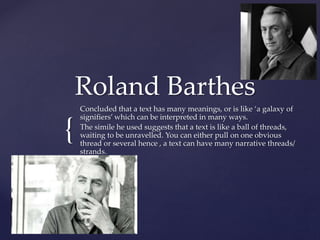
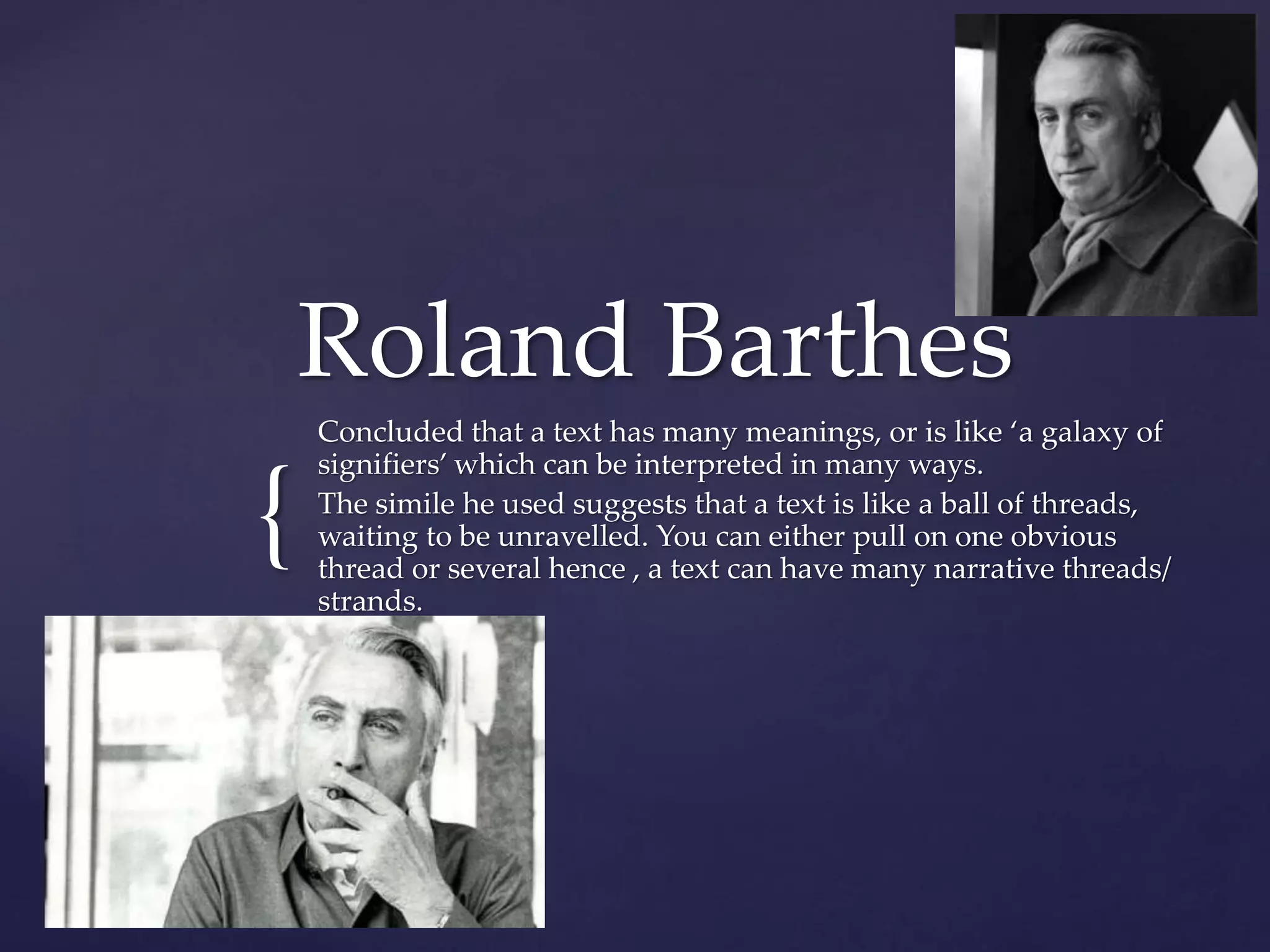
Roland Barthes
Concluded that a text has many meanings, or is like ‘a galaxy of
signifiers’ which can be interpreted in many ways.
The simile he used suggests that a text is like a ball of threads,
waiting to be unravelled. You can either pull on one obvious
thread or several hence , a text can have many narrative threads/
strands.
Semiologist
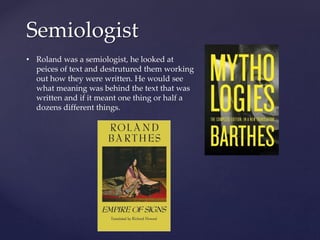
• Roland was a semiologist, he looked at
peices of text and destrutured them working
out how they were written. He would see
what meaning was behind the text that was
written and if it meant one thing or half a
dozens different things.
Mythologies
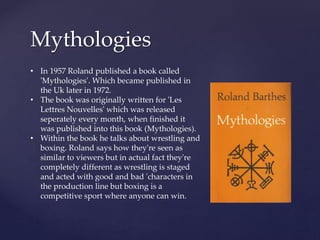
• In 1957 Roland published a book called
'Mythologies'. Which became published in
the Uk later in 1972.
• The book was originally written for 'Les
Lettres Nouvelles' which was released
seperately every month, when finished it
was published into this book (Mythologies).
• Within the book he talks about wrestling and
boxing. Roland says how they're seen as
similar to viewers but in actual fact they're
completely different as wrestling is staged
and acted with good and bad 'characters in
the production line but boxing is a
competitive sport where anyone can win.
• Bathes found out a variety of narrative codes, the most
used being action and enigma codes.
• The action codes helps the audience to interpret and
identify what’s about to happen.
• But in terms of CSI: Miami – Horato putting on his
glasses signifies to the audience that the opening titles
are about to begin (action code).
• Horatio’s opening line to each episode is serious in the
context of each episode, but can also be seen as
unintentionally humorous without context and not
understanding the narrative structure of the CSI
franchise.
The Action Code
• The enigma is created by the whole ‘who died and how
was he/ she murdered and by whom?’ This is the driving
force of the narrative and is what creates tension and
satisfies audiences demands.
• Combined with action codes, driving the plot forward,
audiences know by convention that by the end of the 1
hour episode, Horatio will have this man..
Other Barthes narrative codes:
• Symbols and signs – identifiers and clues that help the
audience piece together and understand the story.
• Cultural reference – As UK Media Students, CSI is very
different from an episode of the Bill, but programmes like
‘Walking The Dead’ have similar narratives and stock
characters.
The Enigma code
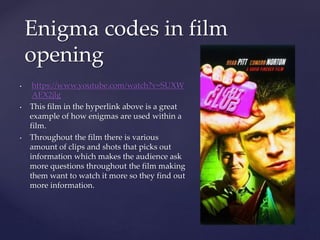
• https://www.youtube.com/watch?v=SUXW
AEX2jlg
• This film in the hyperlink above is a great
example of how enigmas are used within a
film.
• Throughout the film there is various
amount of clips and shots that picks out
information which makes the audience ask
more questions throughout the film making
them want to watch it more so they find out
more information.
Enigma codes in film
opening
The Semantic Code
• The destruction connotates and suggests additional meaning to what is
being said within a word.
• This is how authors are about to create a strong image to you with
words by using the right words in the right order.
• Elements used within semantic code are known as semes, which have a
connotation fuction in text which is where the more descriptive
meaning behind what is being said comes from.
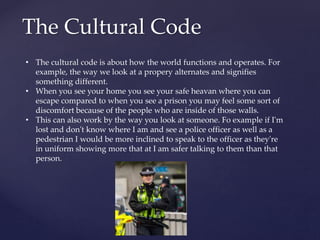
The Cultural Code
• The cultural code is about how the world functions and operates. For
example, the way we look at a propery alternates and signifies
something different.
• When you see your home you see your safe heavan where you can
escape compared to when you see a prison you may feel some sort of
discomfort because of the people who are inside of those walls.
• This can also work by the way you look at someone. Fo example if I'm
lost and don't know where I am and see a police officer as well as a
pedestrian I would be more inclined to speak to the officer as they're
in uniform showing more that at I am safer talking to them than that
person.
The Symbolic
• This is the most difficult codes out of Barthes five but through the use of
symbolism it helps create the structure of a peice of text.
• It does this by creating a better meaning to a peice of text making it
more appealing to read. This is because it is best known to be a deeper
and more educated meaning which organizes a semantic meaning.
• Barthes says that this meaning is shown by semantic connotations that
are special meanings written by the hand.

Roland Barthes Narratives

  • 1.
    { Roland Barthes Concluded thata text has many meanings, or is like ‘a galaxy of signifiers’ which can be interpreted in many ways. The simile he used suggests that a text is like a ball of threads, waiting to be unravelled. You can either pull on one obvious thread or several hence , a text can have many narrative threads/ strands.
  • 2.
    Semiologist • Roland wasa semiologist, he looked at peices of text and destrutured them working out how they were written. He would see what meaning was behind the text that was written and if it meant one thing or half a dozens different things.
  • 3.
    Mythologies • In 1957Roland published a book called 'Mythologies'. Which became published in the Uk later in 1972. • The book was originally written for 'Les Lettres Nouvelles' which was released seperately every month, when finished it was published into this book (Mythologies). • Within the book he talks about wrestling and boxing. Roland says how they're seen as similar to viewers but in actual fact they're completely different as wrestling is staged and acted with good and bad 'characters in the production line but boxing is a competitive sport where anyone can win.
  • 4.
    • Bathes foundout a variety of narrative codes, the most used being action and enigma codes. • The action codes helps the audience to interpret and identify what’s about to happen. • But in terms of CSI: Miami – Horato putting on his glasses signifies to the audience that the opening titles are about to begin (action code). • Horatio’s opening line to each episode is serious in the context of each episode, but can also be seen as unintentionally humorous without context and not understanding the narrative structure of the CSI franchise. The Action Code
  • 5.
    • The enigmais created by the whole ‘who died and how was he/ she murdered and by whom?’ This is the driving force of the narrative and is what creates tension and satisfies audiences demands. • Combined with action codes, driving the plot forward, audiences know by convention that by the end of the 1 hour episode, Horatio will have this man.. Other Barthes narrative codes: • Symbols and signs – identifiers and clues that help the audience piece together and understand the story. • Cultural reference – As UK Media Students, CSI is very different from an episode of the Bill, but programmes like ‘Walking The Dead’ have similar narratives and stock characters. The Enigma code
  • 6.
    • https://www.youtube.com/watch?v=SUXW AEX2jlg • Thisfilm in the hyperlink above is a great example of how enigmas are used within a film. • Throughout the film there is various amount of clips and shots that picks out information which makes the audience ask more questions throughout the film making them want to watch it more so they find out more information. Enigma codes in film opening
  • 7.
    The Semantic Code •The destruction connotates and suggests additional meaning to what is being said within a word. • This is how authors are about to create a strong image to you with words by using the right words in the right order. • Elements used within semantic code are known as semes, which have a connotation fuction in text which is where the more descriptive meaning behind what is being said comes from.
  • 8.
    The Cultural Code •The cultural code is about how the world functions and operates. For example, the way we look at a propery alternates and signifies something different. • When you see your home you see your safe heavan where you can escape compared to when you see a prison you may feel some sort of discomfort because of the people who are inside of those walls. • This can also work by the way you look at someone. Fo example if I'm lost and don't know where I am and see a police officer as well as a pedestrian I would be more inclined to speak to the officer as they're in uniform showing more that at I am safer talking to them than that person.
  • 9.
    The Symbolic • Thisis the most difficult codes out of Barthes five but through the use of symbolism it helps create the structure of a peice of text. • It does this by creating a better meaning to a peice of text making it more appealing to read. This is because it is best known to be a deeper and more educated meaning which organizes a semantic meaning. • Barthes says that this meaning is shown by semantic connotations that are special meanings written by the hand.