Levi-Strauss and Barthes 
narrative theory
Levi-Strauss and binary oppositions. 
• Claude Levi Strauss, a French theorist (not the jeans!) 
gave media studies a number of influential theories 
that help us to understand how meaning is 
established quickly in openings. 
• Binary Oppositions create meaning through 
establishing what something is not. We understand 
the world through a system of power weighted 
oppositions.
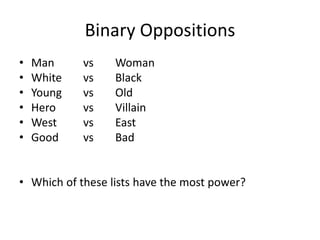
Binary Oppositions 
• Man vs Woman 
• White vs Black 
• Young vs Old 
• Hero vs Villain 
• West vs East 
• Good vs Bad 
• Which of these lists have the most power?
Theories of Narrative Claude LEVI-STRAUSS 
French structuralist, 1970s 
Claude Levi-Strauss is most noted for his theory of Binary 
Oppositions. 
In order to find those oppositions, Levi-Strauss was less 
interested in how events line up in the narrative 
structure to develop the plot, 
than paradigmatic relations i.e. those events and 
features that belong to the theme, especially within 
genre based texts.
Theories of Narrative Claude LEVI-STRAUSS 
French structuralist 
Levi-Strauss used the ‘Western’ film genre to develop his theory 
of Binary Oppositions. 
Homesteaders Native Americans 
Christian Pagan 
Domsetic Savage 
Weak Strong 
Garden Wilderness 
Inside society Outside society
Theories of Narrative Claude LEVI-STRAUSS 
French structuralist 
Levi-Strauss used the ‘Western’ film genre to develop his theory 
of Binary Oppositions. 
detective villain 
princess femme fatale? 
criminal ‘straight’ 
weak strong 
safe streets ‘mean streets’ 
sane mad 
poor ? rich
Theories of Narrative Claude LEVI-STRAUSS 
BLOG TASK: 
Explain what BINARY OPPOSITES are. 
French structuralist 
What binary oppositions can you think of from the crime or 
horror genres?
Roland Barthes 
(Basic Info) 
Roland Barthes was born on the 12th 
November 1915 and died at the age of 64 on 
the 25th March 1980. He was a French 
literary theorist, philosopher, critic, and 
semiotician (study of cultural signs and 
symbols). He explored a diverse range of 
fields and he influenced the development of 
schools.
Codes Theory 
Roland Barthes describes a text as: "a galaxy of 
signifiers, not a structure of signifieds; it has no 
beginning; it is reversible; we gain access to it by several 
entrances, none of which can be authoritatively 
declared to be the main one; the codes it mobilizes 
extend as far as the eye can read, they are 
indeterminable...the systems of meaning can take over 
this absolutely plural text, but their number is never 
closed, based as it is on the infinity of language..." (S/Z - 
1974 translation)
What he meant … 
• The text is like a tangled ball of threads 
• The thread needs to unravelled 
• Once unravelled, we encounter an absolute wide range 
of potential meanings. 
• We can start by looking at a narrative in one way, from 
one viewpoint, one set of previous experience, and 
create one meaning for that text. 
• You can continue by unravelling the narrative from a 
different angle and create an entirely different meaning.
“Barthes said that texts may 
be ´open´ or ´closed´”
Roland Barthes 
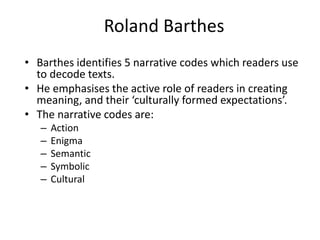
• Barthes identifies 5 narrative codes which readers use 
to decode texts. 
• He emphasises the active role of readers in creating 
meaning, and their ‘culturally formed expectations’. 
• The narrative codes are: 
– Action 
– Enigma 
– Semantic 
– Symbolic 
– Cultural
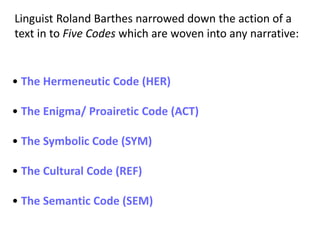
Linguist Roland Barthes narrowed down the action of a 
text in to Five Codes which are woven into any narrative: 
• The Hermeneutic Code (HER) 
• The Enigma/ Proairetic Code (ACT) 
• The Symbolic Code (SYM) 
• The Cultural Code (REF) 
• The Semantic Code (SEM)
The Hermeneutic Code (Action) 
Is the way the story avoids telling the truth or revealing 
all the facts, in order to drop clues in through out to help 
create mystery.
The Enigma 
The way the tension is built up and the audience is 
left guessing what happens next
The Semantic Code 
The semantic code points to any element in a text that 
suggests a particular, often additional meaning by way 
of connotation which the story suggests. 
Connotation= cultural/underlining meaning, what it 
symbolises.
The Symbolic Code 
This is very similar to the Semantic Code, but acts at a 
wider level, organizing semantic meanings into 
broader and deeper sets of meaning. This is typically 
done in the use of antithesis, where new meaning 
arises out of opposing and conflict ideas.
The Cultural Code 
Looks at the audiences wider cultural knowledge, 
morality and ideology.
Barthes – Narrative Codes 
• Action – Viewers are expected to connect different 
pieces of narrative (e.g. The boy is shown arguing on 
his phone – viewer assumes it is with his girlfriend). 
• Enigma – Will the jock and the geek get together? 
• Semantic – glasses, book, notepads, red car, uniforms, 
white dress/red dress 
• Symbolic – conflicts between male/female, 
popular/unpopular, different types of femininity 
• Cultural – the video draws on stereotypes/cliches of 
teen movies – jock, cheerleader, geek, girl next door, 
prom, etc.
Homework 
• Write up both theories. 
• Use a Disney film to demonstrate your 
understanding of Levi-Strauss.

Strauss and Barthes

  • 1.
    Levi-Strauss and Barthes narrative theory
  • 2.
    Levi-Strauss and binaryoppositions. • Claude Levi Strauss, a French theorist (not the jeans!) gave media studies a number of influential theories that help us to understand how meaning is established quickly in openings. • Binary Oppositions create meaning through establishing what something is not. We understand the world through a system of power weighted oppositions.
  • 3.
    Binary Oppositions •Man vs Woman • White vs Black • Young vs Old • Hero vs Villain • West vs East • Good vs Bad • Which of these lists have the most power?
  • 4.
    Theories of NarrativeClaude LEVI-STRAUSS French structuralist, 1970s Claude Levi-Strauss is most noted for his theory of Binary Oppositions. In order to find those oppositions, Levi-Strauss was less interested in how events line up in the narrative structure to develop the plot, than paradigmatic relations i.e. those events and features that belong to the theme, especially within genre based texts.
  • 5.
    Theories of NarrativeClaude LEVI-STRAUSS French structuralist Levi-Strauss used the ‘Western’ film genre to develop his theory of Binary Oppositions. Homesteaders Native Americans Christian Pagan Domsetic Savage Weak Strong Garden Wilderness Inside society Outside society
  • 6.
    Theories of NarrativeClaude LEVI-STRAUSS French structuralist Levi-Strauss used the ‘Western’ film genre to develop his theory of Binary Oppositions. detective villain princess femme fatale? criminal ‘straight’ weak strong safe streets ‘mean streets’ sane mad poor ? rich
  • 7.
    Theories of NarrativeClaude LEVI-STRAUSS BLOG TASK: Explain what BINARY OPPOSITES are. French structuralist What binary oppositions can you think of from the crime or horror genres?
  • 8.
    Roland Barthes (BasicInfo) Roland Barthes was born on the 12th November 1915 and died at the age of 64 on the 25th March 1980. He was a French literary theorist, philosopher, critic, and semiotician (study of cultural signs and symbols). He explored a diverse range of fields and he influenced the development of schools.
  • 9.
    Codes Theory RolandBarthes describes a text as: "a galaxy of signifiers, not a structure of signifieds; it has no beginning; it is reversible; we gain access to it by several entrances, none of which can be authoritatively declared to be the main one; the codes it mobilizes extend as far as the eye can read, they are indeterminable...the systems of meaning can take over this absolutely plural text, but their number is never closed, based as it is on the infinity of language..." (S/Z - 1974 translation)
  • 10.
    What he meant… • The text is like a tangled ball of threads • The thread needs to unravelled • Once unravelled, we encounter an absolute wide range of potential meanings. • We can start by looking at a narrative in one way, from one viewpoint, one set of previous experience, and create one meaning for that text. • You can continue by unravelling the narrative from a different angle and create an entirely different meaning.
  • 11.
    “Barthes said thattexts may be ´open´ or ´closed´”
  • 12.
    Roland Barthes •Barthes identifies 5 narrative codes which readers use to decode texts. • He emphasises the active role of readers in creating meaning, and their ‘culturally formed expectations’. • The narrative codes are: – Action – Enigma – Semantic – Symbolic – Cultural
  • 13.
    Linguist Roland Barthesnarrowed down the action of a text in to Five Codes which are woven into any narrative: • The Hermeneutic Code (HER) • The Enigma/ Proairetic Code (ACT) • The Symbolic Code (SYM) • The Cultural Code (REF) • The Semantic Code (SEM)
  • 14.
    The Hermeneutic Code(Action) Is the way the story avoids telling the truth or revealing all the facts, in order to drop clues in through out to help create mystery.
  • 15.
    The Enigma Theway the tension is built up and the audience is left guessing what happens next
  • 16.
    The Semantic Code The semantic code points to any element in a text that suggests a particular, often additional meaning by way of connotation which the story suggests. Connotation= cultural/underlining meaning, what it symbolises.
  • 17.
    The Symbolic Code This is very similar to the Semantic Code, but acts at a wider level, organizing semantic meanings into broader and deeper sets of meaning. This is typically done in the use of antithesis, where new meaning arises out of opposing and conflict ideas.
  • 18.
    The Cultural Code Looks at the audiences wider cultural knowledge, morality and ideology.
  • 19.
    Barthes – NarrativeCodes • Action – Viewers are expected to connect different pieces of narrative (e.g. The boy is shown arguing on his phone – viewer assumes it is with his girlfriend). • Enigma – Will the jock and the geek get together? • Semantic – glasses, book, notepads, red car, uniforms, white dress/red dress • Symbolic – conflicts between male/female, popular/unpopular, different types of femininity • Cultural – the video draws on stereotypes/cliches of teen movies – jock, cheerleader, geek, girl next door, prom, etc.
  • 20.
    Homework • Writeup both theories. • Use a Disney film to demonstrate your understanding of Levi-Strauss.