Pengantar Semiotika Grace Swestin Universitas Kristen Petra
Hari ini (4-3-2008) Lanskap teori komunikasi Tempat semiotika dalam teori komunikasi Semiotika: definisi Semiotika: konsep-konsep pengantar Jakobson’s model of communication Codes Anchorage (Roland Barthes) Order of signification Semiotika: konsep-konsep kunci
Komunikasi dan Teori Komunikasi Komunikasi: transmisi informasi dari satu pihak ke pihak yang lain Ilmu komunikasi adalah bidang ilmu yang relatif baru Maksim Laswell merupakan definisi :  who says what to whom with what effect Teori komunikasi: berfungsi untuk menggambarkan dan menjelaskan komunikasi
Lanskap Teori Komunikasi Communication Speech/ interpersonal communication Mass communication
COMMUNICATION RESEARCH Intercultural/ international communication Small group communication Communication technology Policy/legal studies of communication Telecommunication etc
Traditions of Communication Theory (Robert Craig) Rhetorical Semiotic Phenomenological Cybernetics Sociopsychological Sociocultural These traditions tend to reinforce one another. Each is also divided against the others but all are cohesive approaches to describing communication behavior.
SEMIOTICS Definition Semiotics studies media content and analyzes meaning in communication. Semiotics is basically defined as a theory of  signs .  It studies the processes of meaning making and seeks to break the code of  non-verbal meaning  that resides in the structure of communication. The goal of semiotics is to explain visual signs, i.e. to explain visual signs and how they perpetuate (or not) the dominant cultural values.
SEMIOTICS Introductory concepts Roman Jakobson’s model of communication Codes Anchorage (Roland Barthes)
Jakobson’s Model of Communication Addresser Addressee Message Context Contact Code
 
 
Codes  Codes: Objects, symbols or practices with generally agreed upon (consensual) meanings. Codes and communication: Every form of communication has its own systems of codes--objects, symbols, practices with consensually agreed upon meanings Codes are learned. Codes change as society changes Different societies have different norms or conventions of codes It is not about truth. It is about consensus.
 
Non-verbal codes (Michael Argyle) Facial Expression Gaze Bodily Posture Bodily Contact Spatial Behavior Clothes and Appearance Non-verbal aspects of speech
Anchorage   (Roland Barthes) Anchorage: the process of affixing meanings. In the context of the mass media, anchorage can be referred to as the process by which preferred meanings are encoded in various media texts.  Concepts involved in anchorage: Denotation: What the image is. Connotation: What the image means. The Polysemic Nature of Images: They are endowed with multiple, equally valid meanings
 
 
SEMIOTICS Key concepts Meaning resides in the structure of communication SIGN = Signifier + Signified
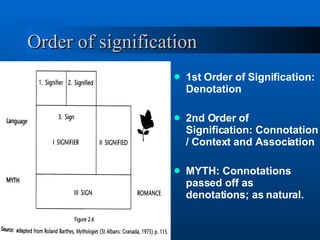
Order of signification 1st Order of Signification: Denotation 2nd Order of Signification: Connotation / Context and Association MYTH: Connotations passed off as denotations; as natural.

Semiotika

  • 1.
    Pengantar Semiotika GraceSwestin Universitas Kristen Petra
  • 2.
    Hari ini (4-3-2008)Lanskap teori komunikasi Tempat semiotika dalam teori komunikasi Semiotika: definisi Semiotika: konsep-konsep pengantar Jakobson’s model of communication Codes Anchorage (Roland Barthes) Order of signification Semiotika: konsep-konsep kunci
  • 3.
    Komunikasi dan TeoriKomunikasi Komunikasi: transmisi informasi dari satu pihak ke pihak yang lain Ilmu komunikasi adalah bidang ilmu yang relatif baru Maksim Laswell merupakan definisi : who says what to whom with what effect Teori komunikasi: berfungsi untuk menggambarkan dan menjelaskan komunikasi
  • 4.
    Lanskap Teori KomunikasiCommunication Speech/ interpersonal communication Mass communication
  • 5.
    COMMUNICATION RESEARCH Intercultural/international communication Small group communication Communication technology Policy/legal studies of communication Telecommunication etc
  • 6.
    Traditions of CommunicationTheory (Robert Craig) Rhetorical Semiotic Phenomenological Cybernetics Sociopsychological Sociocultural These traditions tend to reinforce one another. Each is also divided against the others but all are cohesive approaches to describing communication behavior.
  • 7.
    SEMIOTICS Definition Semioticsstudies media content and analyzes meaning in communication. Semiotics is basically defined as a theory of signs . It studies the processes of meaning making and seeks to break the code of non-verbal meaning that resides in the structure of communication. The goal of semiotics is to explain visual signs, i.e. to explain visual signs and how they perpetuate (or not) the dominant cultural values.
  • 8.
    SEMIOTICS Introductory conceptsRoman Jakobson’s model of communication Codes Anchorage (Roland Barthes)
  • 9.
    Jakobson’s Model ofCommunication Addresser Addressee Message Context Contact Code
  • 10.
  • 11.
  • 12.
    Codes Codes:Objects, symbols or practices with generally agreed upon (consensual) meanings. Codes and communication: Every form of communication has its own systems of codes--objects, symbols, practices with consensually agreed upon meanings Codes are learned. Codes change as society changes Different societies have different norms or conventions of codes It is not about truth. It is about consensus.
  • 13.
  • 14.
    Non-verbal codes (MichaelArgyle) Facial Expression Gaze Bodily Posture Bodily Contact Spatial Behavior Clothes and Appearance Non-verbal aspects of speech
  • 15.
    Anchorage (Roland Barthes) Anchorage: the process of affixing meanings. In the context of the mass media, anchorage can be referred to as the process by which preferred meanings are encoded in various media texts. Concepts involved in anchorage: Denotation: What the image is. Connotation: What the image means. The Polysemic Nature of Images: They are endowed with multiple, equally valid meanings
  • 16.
  • 17.
  • 18.
    SEMIOTICS Key conceptsMeaning resides in the structure of communication SIGN = Signifier + Signified
  • 19.
    Order of signification1st Order of Signification: Denotation 2nd Order of Signification: Connotation / Context and Association MYTH: Connotations passed off as denotations; as natural.