New Cultural Movements
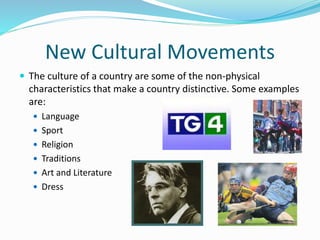
 The culture of a country are some of the non-physical
characteristics that make a country distinctive. Some examples
are:
 Language
 Sport
 Religion
 Traditions
 Art and Literature
 Dress
Anglicisation…
 This was the fear that Ireland was becoming more like
England every day – if we didn’t do something about it
we would be unfit to govern ourselves
 Most Unionists had no problem with this but Nationalists
didn’t like it and set up organisations to halt the spread of
English Influence
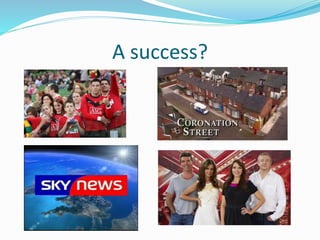
 Did they succeed?
A success?
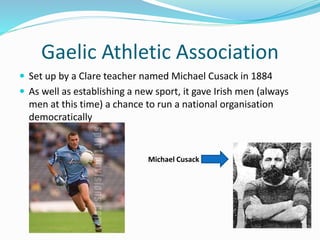
Gaelic Athletic Association
 Set up by a Clare teacher named Michael Cusack in 1884
 As well as establishing a new sport, it gave Irish men (always
men at this time) a chance to run a national organisation
democratically
Michael Cusack
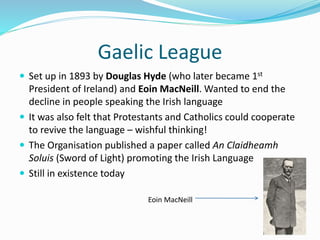
Gaelic League
 Set up in 1893 by Douglas Hyde (who later became 1st
President of Ireland) and Eoin MacNeill. Wanted to end the
decline in people speaking the Irish language
 It was also felt that Protestants and Catholics could cooperate
to revive the language – wishful thinking!
 The Organisation published a paper called An Claidheamh
Soluis (Sword of Light) promoting the Irish Language
 Still in existence today
Eoin MacNeill
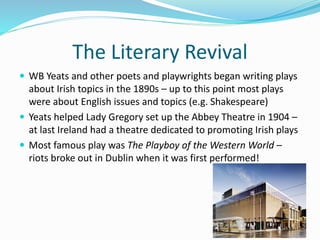
The Literary Revival
 WB Yeats and other poets and playwrights began writing plays
about Irish topics in the 1890s – up to this point most plays
were about English issues and topics (e.g. Shakespeare)
 Yeats helped Lady Gregory set up the Abbey Theatre in 1904 –
at last Ireland had a theatre dedicated to promoting Irish plays
 Most famous play was The Playboy of the Western World –
riots broke out in Dublin when it was first performed!
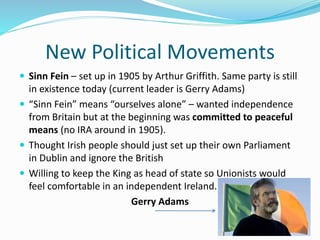
New Political Movements
 Sinn Fein – set up in 1905 by Arthur Griffith. Same party is still
in existence today (current leader is Gerry Adams)
 “Sinn Fein” means “ourselves alone” – wanted independence
from Britain but at the beginning was committed to peaceful
means (no IRA around in 1905).
 Thought Irish people should just set up their own Parliament
in Dublin and ignore the British
 Willing to keep the King as head of state so Unionists would
feel comfortable in an independent Ireland.
Gerry Adams
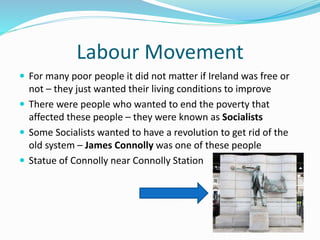
Labour Movement
 For many poor people it did not matter if Ireland was free or
not – they just wanted their living conditions to improve
 There were people who wanted to end the poverty that
affected these people – they were known as Socialists
 Some Socialists wanted to have a revolution to get rid of the
old system – James Connolly was one of these people
 Statue of Connolly near Connolly Station
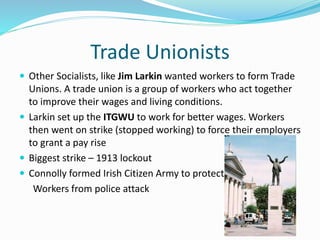
Trade Unionists
 Other Socialists, like Jim Larkin wanted workers to form Trade
Unions. A trade union is a group of workers who act together
to improve their wages and living conditions.
 Larkin set up the ITGWU to work for better wages. Workers
then went on strike (stopped working) to force their employers
to grant a pay rise
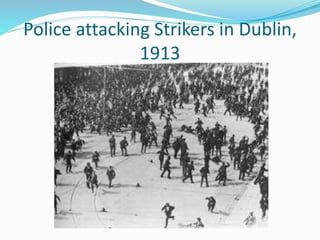
 Biggest strike – 1913 lockout
 Connolly formed Irish Citizen Army to protect
Workers from police attack
Police attacking Strikers in Dublin,
1913
Feminists
 At the beginning of the 20th Century women had no right to
vote in Ireland – Feminists wanted to change that.
 Hanna Sheehy Skeffington was the most prominent feminist.
She campaigned for “suffrage” – the right to vote
 Peaceful and violent protests were used to give people the
right to vote.
 Voting rights was finally granted to women in 1918 after World
War 1.
 http://www.youtube.com/watch?v=O9qI34r3Nqk

New movements in Ireland - The Buildup to the 1916 Rising

  • 2.
    New Cultural Movements The culture of a country are some of the non-physical characteristics that make a country distinctive. Some examples are:  Language  Sport  Religion  Traditions  Art and Literature  Dress
  • 3.
    Anglicisation…  This wasthe fear that Ireland was becoming more like England every day – if we didn’t do something about it we would be unfit to govern ourselves  Most Unionists had no problem with this but Nationalists didn’t like it and set up organisations to halt the spread of English Influence  Did they succeed?
  • 4.
  • 5.
    Gaelic Athletic Association Set up by a Clare teacher named Michael Cusack in 1884  As well as establishing a new sport, it gave Irish men (always men at this time) a chance to run a national organisation democratically Michael Cusack
  • 6.
    Gaelic League  Setup in 1893 by Douglas Hyde (who later became 1st President of Ireland) and Eoin MacNeill. Wanted to end the decline in people speaking the Irish language  It was also felt that Protestants and Catholics could cooperate to revive the language – wishful thinking!  The Organisation published a paper called An Claidheamh Soluis (Sword of Light) promoting the Irish Language  Still in existence today Eoin MacNeill
  • 7.
    The Literary Revival WB Yeats and other poets and playwrights began writing plays about Irish topics in the 1890s – up to this point most plays were about English issues and topics (e.g. Shakespeare)  Yeats helped Lady Gregory set up the Abbey Theatre in 1904 – at last Ireland had a theatre dedicated to promoting Irish plays  Most famous play was The Playboy of the Western World – riots broke out in Dublin when it was first performed!
  • 8.
    New Political Movements Sinn Fein – set up in 1905 by Arthur Griffith. Same party is still in existence today (current leader is Gerry Adams)  “Sinn Fein” means “ourselves alone” – wanted independence from Britain but at the beginning was committed to peaceful means (no IRA around in 1905).  Thought Irish people should just set up their own Parliament in Dublin and ignore the British  Willing to keep the King as head of state so Unionists would feel comfortable in an independent Ireland. Gerry Adams
  • 9.
    Labour Movement  Formany poor people it did not matter if Ireland was free or not – they just wanted their living conditions to improve  There were people who wanted to end the poverty that affected these people – they were known as Socialists  Some Socialists wanted to have a revolution to get rid of the old system – James Connolly was one of these people  Statue of Connolly near Connolly Station
  • 10.
    Trade Unionists  OtherSocialists, like Jim Larkin wanted workers to form Trade Unions. A trade union is a group of workers who act together to improve their wages and living conditions.  Larkin set up the ITGWU to work for better wages. Workers then went on strike (stopped working) to force their employers to grant a pay rise  Biggest strike – 1913 lockout  Connolly formed Irish Citizen Army to protect Workers from police attack
  • 11.
  • 12.
    Feminists  At thebeginning of the 20th Century women had no right to vote in Ireland – Feminists wanted to change that.  Hanna Sheehy Skeffington was the most prominent feminist. She campaigned for “suffrage” – the right to vote  Peaceful and violent protests were used to give people the right to vote.  Voting rights was finally granted to women in 1918 after World War 1.  http://www.youtube.com/watch?v=O9qI34r3Nqk