1 MILE ROCKPORT
WALKING TEST
Cardio-respiratory Fitness
 Cardiorespiratory fitness is important because it provides a measure of
how efficient the cardiovascular and the respiratory system must work
in order to take in and deliver oxygen to every cell in the body.
 During exercise, the demand for oxygen increases and so the
cardiorespiratory system must increase its workload in order to match
this demand.
 There is a positive correlation between oxygen demand and
workload/exercise intensity.
The maximal oxygen uptake or aerobic
capacity or VO2 max
 The maximal oxygen uptake (aerobic capacity, or VO2 max) is widely
accepted as the criterion measure of cardiorespiratory fitness.
 VO2 max is the maximum amount of oxygen that an individual can
consume, deliver and use in a minute to fuel intense physical activity or
exercise.
 Aerobic capacity is usually expressed as milliliters of oxygen used in
one minute per kilogram of body weight (ml/kg/min-1.0).
The maximal oxygen uptake or aerobic
capacity or VO2 max
 Most direct tests of VO2 max uses a gas analyzer and require that
the participant works to exhaustion.
 There is a positive and somewhat linear relationship between heart
rate and oxygen consumption
 Therefore, it is possible to estimate VO2 max using indirect tests like
Harvard Step Test and the 1-mile walking test without having to
subject participants to the physical stress and discomfort of a
maximal test.
THE ONE-MILE ROCKPORT
WALKING TEST
 The one-mile walking test is an evaluation of cardiovascular fitness,
that seeks to predict an individual’s aerobic capacity (VO2 max)
 The Rockport walking test was developed in 1986 by physiologists and
cardiologists at the Department of Exercise Science at the University of
Massachusetts at Amherst.
 The test is both indirect and sub-maximal in nature, making it
considerably easier to implement in field-based scenarios
THE ONE-MILE ROCKPORT
WALKING TEST
 The study found that there were no significant differences in
the number of points scored during the Rockport Test when
compared to the points scored in the 1.5-mile run.
 Furthermore, there were also no significant differences
between the average and predicted VO2 max.
THE ONE-MILE ROCKPORT WALKING TEST-
Target Group
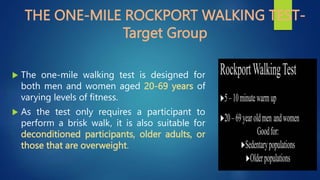
 The one-mile walking test is designed for
both men and women aged 20-69 years of
varying levels of fitness.
 As the test only requires a participant to
perform a brisk walk, it is also suitable for
deconditioned participants, older adults, or
those that are overweight.
THE ONE-MILE ROCKPORT WALKING TEST-
MATERIAL REQUIRED
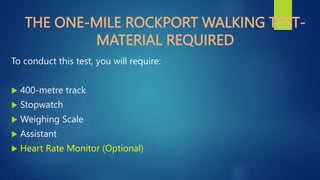
To conduct this test, you will require:
 400-metre track
 Stopwatch
 Weighing Scale
 Assistant
 Heart Rate Monitor (Optional)
THE ONE-MILE ROCKPORT WALKING TEST-
PROCEDURE
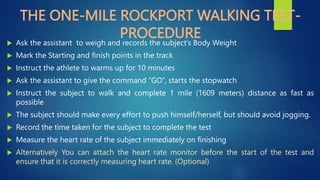
 Ask the assistant to weigh and records the subject’s Body Weight
 Mark the Starting and finish points in the track
 Instruct the athlete to warms up for 10 minutes
 Ask the assistant to give the command ā€œGOā€, starts the stopwatch
 Instruct the subject to walk and complete 1 mile (1609 meters) distance as fast as
possible
 The subject should make every effort to push himself/herself, but should avoid jogging.
 Record the time taken for the subject to complete the test
 Measure the heart rate of the subject immediately on finishing
 Alternatively You can attach the heart rate monitor before the start of the test and
ensure that it is correctly measuring heart rate. (Optional)
THE ONE-MILE ROCKPORT WALKING TEST-
ASSESSMENT
The formula (Kilne 1987) used to calculate VO2 max is:
 132.853 – (0.0769 Ɨ Weight) – (0.3877 Ɨ Age) + (6.315 Ɨ Gender) –
(3.2649 Ɨ Time) – (0.1565 Ɨ Heart rate)
Where:
 Weight is in pounds (lbs)
 Gender Male = 1 and Female = 0
 Time is expressed in minutes and 100ths of minutes
 Heart rate is in beats/minute
 Age is in years
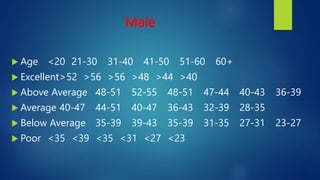
Male
 Age <20 21-30 31-40 41-50 51-60 60+
 Excellent>52 >56 >56 >48 >44 >40
 Above Average 48-51 52-55 48-51 47-44 40-43 36-39
 Average 40-47 44-51 40-47 36-43 32-39 28-35
 Below Average 35-39 39-43 35-39 31-35 27-31 23-27
 Poor <35 <39 <35 <31 <27 <23
Females
 Age <20 21-3031-4041-5051-6060+
 Excellent >48 >50 >48 >46 >44 >42
 Above Average42-4744-4942-4740-4538-4338-43
 Average 32-4134-4332-4130-3928-3726-35
 Below Average 27-3130-3327-3124-2921-2718-25
 Poor <27 <30 <27 <24 <21 <18
THE ONE-MILE ROCKPORT WALKING TEST-
ASSESSMENT
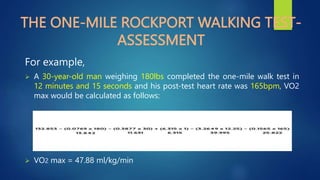
For example,
 A 30-year-old man weighing 180lbs completed the one-mile walk test in
12 minutes and 15 seconds and his post-test heart rate was 165bpm, VO2
max would be calculated as follows:
 VO2 max = 47.88 ml/kg/min
THE ONE-MILE ROCKPORT WALKING TEST-
ASSESSMENT
Advantages
 Minimal equipment required
 Simple to set up and conduct
 More than one subject can perform the test at the same time
Disadvantages
 Specific facilities required
 Assistant required to administer the test
THE ONE-MILE ROCKPORT WALKING TEST-
NORMATIVE DATA
 Once a VO2 max value has been calculated, refer to the
normative tables to determine an appropriate classification
 Analysis of the result is by comparing it with previous tests'
results. It is expected that, with appropriate training between
each test, the analysis would indicate an improvement.
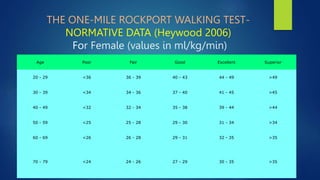
THE ONE-MILE ROCKPORT WALKING TEST-
NORMATIVE DATA (Heywood 2006)
For Female (values in ml/kg/min)
Age Poor Fair Good Excellent Superior
20 - 29 <36 36 - 39 40 - 43 44 - 49 >49
30 - 39 <34 34 - 36 37 - 40 41 - 45 >45
40 - 49 <32 32 - 34 35 - 38 39 - 44 >44
50 - 59 <25 25 - 28 29 - 30 31 - 34 >34
60 - 69 <26 26 - 28 29 - 31 32 - 35 >35
70 - 79 <24 24 - 26 27 - 29 30 - 35 >35
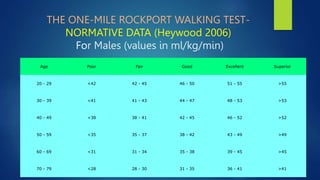
THE ONE-MILE ROCKPORT WALKING TEST-
NORMATIVE DATA (Heywood 2006)
For Males (values in ml/kg/min)
Age Poor Fair Good Excellent Superior
20 - 29 <42 42 - 45 46 - 50 51 - 55 >55
30 - 39 <41 41 - 43 44 - 47 48 - 53 >53
40 - 49 <38 38 - 41 42 - 45 46 - 52 >52
50 - 59 <35 35 - 37 38 - 42 43 - 49 >49
60 - 69 <31 31 - 34 35 - 38 39 - 45 >45
70 - 79 <28 28 - 30 31 - 35 36 - 41 >41
THE ONE-MILE ROCKPORT WALKING TEST
 Reliability
 Test reliability refers to the degree to which a test is consistent and stable in
measuring what it is intended to measure. Reliability will depend upon how strict the
test is conducted and the individual's level of motivation to perform the test. The
following link provides various factors that may influence the results and therefore,
the test reliability.
 Validity
 Test validity refers to how the test measures what it claims to measure and the
extent to which inferences, conclusions, and decisions made based on test scores
are appropriate and meaningful. This test provides a means to monitor training on
the athlete's physical development. For assessing your VO2 max see the VO2 max
normative data tables.

Rockport One mile test.pptx

  • 1.
  • 3.
    Cardio-respiratory Fitness  Cardiorespiratoryfitness is important because it provides a measure of how efficient the cardiovascular and the respiratory system must work in order to take in and deliver oxygen to every cell in the body.  During exercise, the demand for oxygen increases and so the cardiorespiratory system must increase its workload in order to match this demand.  There is a positive correlation between oxygen demand and workload/exercise intensity.
  • 4.
    The maximal oxygenuptake or aerobic capacity or VO2 max  The maximal oxygen uptake (aerobic capacity, or VO2 max) is widely accepted as the criterion measure of cardiorespiratory fitness.  VO2 max is the maximum amount of oxygen that an individual can consume, deliver and use in a minute to fuel intense physical activity or exercise.  Aerobic capacity is usually expressed as milliliters of oxygen used in one minute per kilogram of body weight (ml/kg/min-1.0).
  • 5.
    The maximal oxygenuptake or aerobic capacity or VO2 max  Most direct tests of VO2 max uses a gas analyzer and require that the participant works to exhaustion.  There is a positive and somewhat linear relationship between heart rate and oxygen consumption  Therefore, it is possible to estimate VO2 max using indirect tests like Harvard Step Test and the 1-mile walking test without having to subject participants to the physical stress and discomfort of a maximal test.
  • 6.
    THE ONE-MILE ROCKPORT WALKINGTEST  The one-mile walking test is an evaluation of cardiovascular fitness, that seeks to predict an individual’s aerobic capacity (VO2 max)  The Rockport walking test was developed in 1986 by physiologists and cardiologists at the Department of Exercise Science at the University of Massachusetts at Amherst.  The test is both indirect and sub-maximal in nature, making it considerably easier to implement in field-based scenarios
  • 7.
    THE ONE-MILE ROCKPORT WALKINGTEST  The study found that there were no significant differences in the number of points scored during the Rockport Test when compared to the points scored in the 1.5-mile run.  Furthermore, there were also no significant differences between the average and predicted VO2 max.
  • 8.
    THE ONE-MILE ROCKPORTWALKING TEST- Target Group  The one-mile walking test is designed for both men and women aged 20-69 years of varying levels of fitness.  As the test only requires a participant to perform a brisk walk, it is also suitable for deconditioned participants, older adults, or those that are overweight.
  • 9.
    THE ONE-MILE ROCKPORTWALKING TEST- MATERIAL REQUIRED To conduct this test, you will require:  400-metre track  Stopwatch  Weighing Scale  Assistant  Heart Rate Monitor (Optional)
  • 10.
    THE ONE-MILE ROCKPORTWALKING TEST- PROCEDURE  Ask the assistant to weigh and records the subject’s Body Weight  Mark the Starting and finish points in the track  Instruct the athlete to warms up for 10 minutes  Ask the assistant to give the command ā€œGOā€, starts the stopwatch  Instruct the subject to walk and complete 1 mile (1609 meters) distance as fast as possible  The subject should make every effort to push himself/herself, but should avoid jogging.  Record the time taken for the subject to complete the test  Measure the heart rate of the subject immediately on finishing  Alternatively You can attach the heart rate monitor before the start of the test and ensure that it is correctly measuring heart rate. (Optional)
  • 11.
    THE ONE-MILE ROCKPORTWALKING TEST- ASSESSMENT The formula (Kilne 1987) used to calculate VO2 max is:  132.853 – (0.0769 Ɨ Weight) – (0.3877 Ɨ Age) + (6.315 Ɨ Gender) – (3.2649 Ɨ Time) – (0.1565 Ɨ Heart rate) Where:  Weight is in pounds (lbs)  Gender Male = 1 and Female = 0  Time is expressed in minutes and 100ths of minutes  Heart rate is in beats/minute  Age is in years
  • 12.
    Male  Age <2021-30 31-40 41-50 51-60 60+  Excellent>52 >56 >56 >48 >44 >40  Above Average 48-51 52-55 48-51 47-44 40-43 36-39  Average 40-47 44-51 40-47 36-43 32-39 28-35  Below Average 35-39 39-43 35-39 31-35 27-31 23-27  Poor <35 <39 <35 <31 <27 <23
  • 13.
    Females  Age <2021-3031-4041-5051-6060+  Excellent >48 >50 >48 >46 >44 >42  Above Average42-4744-4942-4740-4538-4338-43  Average 32-4134-4332-4130-3928-3726-35  Below Average 27-3130-3327-3124-2921-2718-25  Poor <27 <30 <27 <24 <21 <18
  • 14.
    THE ONE-MILE ROCKPORTWALKING TEST- ASSESSMENT For example,  A 30-year-old man weighing 180lbs completed the one-mile walk test in 12 minutes and 15 seconds and his post-test heart rate was 165bpm, VO2 max would be calculated as follows:  VO2 max = 47.88 ml/kg/min
  • 15.
    THE ONE-MILE ROCKPORTWALKING TEST- ASSESSMENT Advantages  Minimal equipment required  Simple to set up and conduct  More than one subject can perform the test at the same time Disadvantages  Specific facilities required  Assistant required to administer the test
  • 16.
    THE ONE-MILE ROCKPORTWALKING TEST- NORMATIVE DATA  Once a VO2 max value has been calculated, refer to the normative tables to determine an appropriate classification  Analysis of the result is by comparing it with previous tests' results. It is expected that, with appropriate training between each test, the analysis would indicate an improvement.
  • 17.
    THE ONE-MILE ROCKPORTWALKING TEST- NORMATIVE DATA (Heywood 2006) For Female (values in ml/kg/min) Age Poor Fair Good Excellent Superior 20 - 29 <36 36 - 39 40 - 43 44 - 49 >49 30 - 39 <34 34 - 36 37 - 40 41 - 45 >45 40 - 49 <32 32 - 34 35 - 38 39 - 44 >44 50 - 59 <25 25 - 28 29 - 30 31 - 34 >34 60 - 69 <26 26 - 28 29 - 31 32 - 35 >35 70 - 79 <24 24 - 26 27 - 29 30 - 35 >35
  • 18.
    THE ONE-MILE ROCKPORTWALKING TEST- NORMATIVE DATA (Heywood 2006) For Males (values in ml/kg/min) Age Poor Fair Good Excellent Superior 20 - 29 <42 42 - 45 46 - 50 51 - 55 >55 30 - 39 <41 41 - 43 44 - 47 48 - 53 >53 40 - 49 <38 38 - 41 42 - 45 46 - 52 >52 50 - 59 <35 35 - 37 38 - 42 43 - 49 >49 60 - 69 <31 31 - 34 35 - 38 39 - 45 >45 70 - 79 <28 28 - 30 31 - 35 36 - 41 >41
  • 19.
    THE ONE-MILE ROCKPORTWALKING TEST  Reliability  Test reliability refers to the degree to which a test is consistent and stable in measuring what it is intended to measure. Reliability will depend upon how strict the test is conducted and the individual's level of motivation to perform the test. The following link provides various factors that may influence the results and therefore, the test reliability.  Validity  Test validity refers to how the test measures what it claims to measure and the extent to which inferences, conclusions, and decisions made based on test scores are appropriate and meaningful. This test provides a means to monitor training on the athlete's physical development. For assessing your VO2 max see the VO2 max normative data tables.