PRESENTATION
By – Tanisha Biswas
DEFINATION :
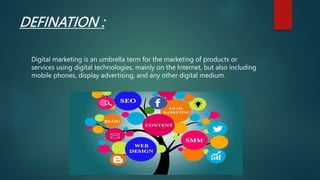
Digital marketing is an umbrella term for the marketing of products or
services using digital technologies, mainly on the Internet, but also including
mobile phones, display advertising, and any other digital medium.
BENEFITS OF DIGITAL MARKETING
 Connect with mobile customer.
 Use content to connect to consumers online.
 Track customers from the first interaction and throughout the entire
buyer's journey.
 Analyze and adapt easily.
 Become more competitive.
 Optimize for conversion.
 Realize higher ROI and revenue.
ABOUT E-COMMERCE:
 E-commerce is the activity of buying or selling of products on online
services or over the Internet. Electronic commerce draws on technologies
such as mobile commerce, electronic funds transfer, supply chain
management, Internet marketing, online transaction processing, electronic
data interchange (EDI), inventory management systems, and automated
data collection systems.
CONTENT:
 Timeline.
 Business Application.
 Government regulation.
 Forms.
 Global trends.
 Logistics.
 Impact on markets and retailers.
 Impact on customer.
 Impact on employment.
BENEFITS OF IT:
 Online shopping for retail sales direct to consumers via Web sites and mobile
apps, and conversational commerce via live chat, chatbots, and voice
assistants[3]
 Providing or participating in online marketplaces, which process third-party
business-to-consumer or consumer-to-consumer sales
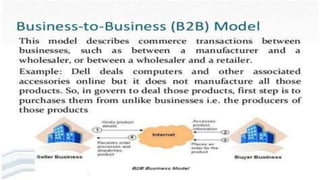
 Business-to-business buying and selling;
 Gathering and using demographic data through web contacts and social
media
 Business-to-business (B2B) electronic data interchange
 Marketing to prospective and established customers by e-mail or fax (for
example, with newsletters)
 Engaging in pretail for launching new products and services
 Online financial exchanges for currency exchanges or trading purposes.
FORMS :
 Contemporary electronic commerce can be classified into two categories.
The first category is business based on types of goods sold (involves
everything from ordering "digital" content for immediate online
consumption, to ordering conventional goods and services, to "meta"
services to facilitate other types of electronic commerce). The second
category is based on the nature of the participant (B2B, B2C, C2B and
C2C);[37]
 On the institutional level, big corporations and financial institutions use
the internet to exchange financial data to facilitate domestic and
international business. Data integrity and security are pressing issues for
electronic commerce.
 Aside from traditional e-commerce, the terms m-Commerce (mobile
commerce) as well (around 2013) t-Commerce[38] have also been used.
Global trends :
 In 2010, the United Kingdom had the highest per capita e-commerce
spending in the world.[39] As of 2013, the Czech Republic was the European
country where e-commerce delivers the biggest contribution to the
enterprises´ total revenue. Almost a quarter (24%) of the country's total
turnover is generated via the online channel.[40]
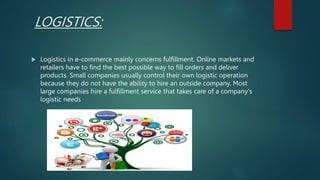
LOGISTICS:
 Logistics in e-commerce mainly concerns fulfillment. Online markets and
retailers have to find the best possible way to fill orders and deliver
products. Small companies usually control their own logistic operation
because they do not have the ability to hire an outside company. Most
large companies hire a fulfillment service that takes care of a company's
logistic needs
CHARACTERISTICS:
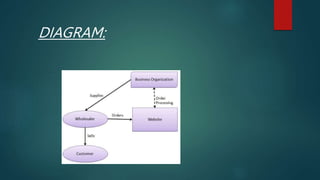
 Business to business model.
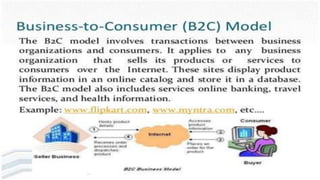
 Business to customer model.
 Customer to business model.
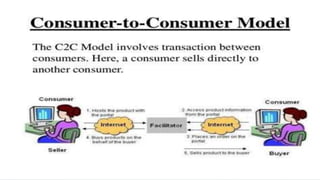
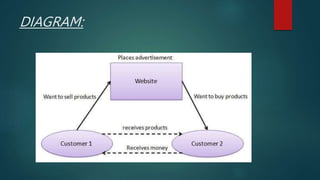
 Customer to customer model.
 Business to Government model.
 Customer to government model.
 Government to business model.
DIAGRAM:

DIGRAM:
DIAGRAM:
DIAGRAM:
presentation digital marketing.pptx

presentation digital marketing.pptx

  • 1.
  • 3.
    DEFINATION : Digital marketingis an umbrella term for the marketing of products or services using digital technologies, mainly on the Internet, but also including mobile phones, display advertising, and any other digital medium.
  • 4.
    BENEFITS OF DIGITALMARKETING  Connect with mobile customer.  Use content to connect to consumers online.  Track customers from the first interaction and throughout the entire buyer's journey.  Analyze and adapt easily.  Become more competitive.  Optimize for conversion.  Realize higher ROI and revenue.
  • 5.
    ABOUT E-COMMERCE:  E-commerceis the activity of buying or selling of products on online services or over the Internet. Electronic commerce draws on technologies such as mobile commerce, electronic funds transfer, supply chain management, Internet marketing, online transaction processing, electronic data interchange (EDI), inventory management systems, and automated data collection systems.
  • 6.
    CONTENT:  Timeline.  BusinessApplication.  Government regulation.  Forms.  Global trends.  Logistics.  Impact on markets and retailers.  Impact on customer.  Impact on employment.
  • 7.
    BENEFITS OF IT: Online shopping for retail sales direct to consumers via Web sites and mobile apps, and conversational commerce via live chat, chatbots, and voice assistants[3]  Providing or participating in online marketplaces, which process third-party business-to-consumer or consumer-to-consumer sales  Business-to-business buying and selling;  Gathering and using demographic data through web contacts and social media  Business-to-business (B2B) electronic data interchange  Marketing to prospective and established customers by e-mail or fax (for example, with newsletters)  Engaging in pretail for launching new products and services  Online financial exchanges for currency exchanges or trading purposes.
  • 8.
    FORMS :  Contemporaryelectronic commerce can be classified into two categories. The first category is business based on types of goods sold (involves everything from ordering "digital" content for immediate online consumption, to ordering conventional goods and services, to "meta" services to facilitate other types of electronic commerce). The second category is based on the nature of the participant (B2B, B2C, C2B and C2C);[37]  On the institutional level, big corporations and financial institutions use the internet to exchange financial data to facilitate domestic and international business. Data integrity and security are pressing issues for electronic commerce.  Aside from traditional e-commerce, the terms m-Commerce (mobile commerce) as well (around 2013) t-Commerce[38] have also been used.
  • 9.
    Global trends : In 2010, the United Kingdom had the highest per capita e-commerce spending in the world.[39] As of 2013, the Czech Republic was the European country where e-commerce delivers the biggest contribution to the enterprises´ total revenue. Almost a quarter (24%) of the country's total turnover is generated via the online channel.[40]
  • 10.
    LOGISTICS:  Logistics ine-commerce mainly concerns fulfillment. Online markets and retailers have to find the best possible way to fill orders and deliver products. Small companies usually control their own logistic operation because they do not have the ability to hire an outside company. Most large companies hire a fulfillment service that takes care of a company's logistic needs
  • 11.
    CHARACTERISTICS:  Business tobusiness model.  Business to customer model.  Customer to business model.  Customer to customer model.  Business to Government model.  Customer to government model.  Government to business model.
  • 13.
  • 14.
  • 15.
  • 17.
  • 19.