INDUSTRY ANALYSIS 
ON 
POWER 
By 
SIVA KUMAR(31)
INDIAN INDUSTRY 
• The electricity sector in India had an installed capacity of 
237.742 GW as of February 2014 
• the world's fourth largest Captive power plants generate 
an additional 39.375 GW. 
• Non Renewable Power Plants constitute 87.55% and 
Renewable Power Plants constitute 12.45% of total 
installed Capacity.
Indian Industry 
• India generated around 911 BU (911,652 MU i.e. 
911 TWH) of electricity during the 2012–13. 
• The total annual generation of electricity from all types of 
sources was 1053.9 Terawatt-hours(TWH) in 2012. 
• The total All India Installed Capacity of electric 
generating stations as on 31st March, 2013 was 
2,23,343.60 MW
TRENDS IN POWER INDUSTRY 
• The heart of the power plant - combustion gas reaches 
1,500 degrees C hot enough to melt some metals. 
• This hot gas races through the turbine, setting the 
special alloy turbine blades in rotation at speeds of over 
3,000 rpm. 
• This rotational energy is converted to electricity by the 
power generator fixed on the end of the turbine shaft. 
MHI's benchmark G-Series gas turbine generates around 
330MW of power, sufficient to provide electricity to 
40,000 homes
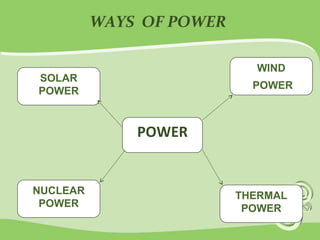
WAYS OF POWER 
POWER 
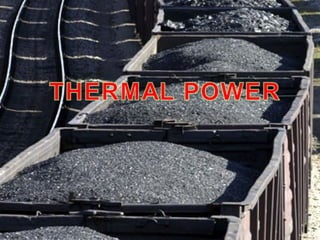
THERMAL 
POWER 
NUCLEAR 
POWER 
WIND 
SOLAR POWER 
POWER
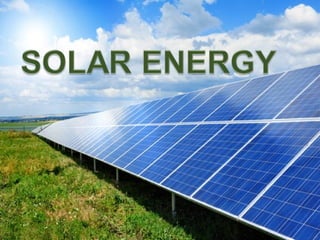
SOLAR POWER 
• Solar power is the conversion of sunlight into electricity, 
either directly using photovoltaics (PV), or indirectly 
using concentrated solar power (CSP). 
• The 354 MW SEGS CSP installations is the largest solar 
power plant in the world and is located in the Mojave 
Desert of California
Advantages 
• Solar power is pollution-free during use. 

• PV installations can operate for many years 
with little maintenance or intervention after their 
initial set-up 
• Solar electric generation is economically 
superior where grid connection or fuel transport 
is difficult, costly or impossible 
• Compared to fossil and nuclear energy sources, 
very little research money has been invested in 
the development of solar cells, so there is 
considerable room for improvement
Disadvantages 
• Solar electricity is more expensive than most 
other forms of small-scale alternative energy 
production 
• Solar electricity is not produced at night and is 
greatly reduced in cloudy conditions. 
• Solar cells produce DC which must be 
converted to AC. This incurs 4-12% losses 
• The efficiency of conversion of solar energy to 
useful energy is low
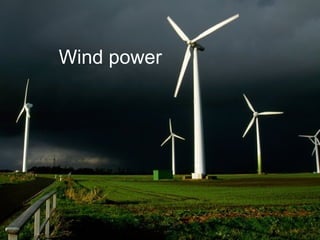
Wind power
Wind power 
• The development of wind power in 
India began in the 1990 
• India has the fifth largest installed wind 
power capacity in the world. 
• The total estimated capacity is 45000 
GW 
• As of 31 Dec 2013 the installed capacity 
of wind power in India was 20000 MW
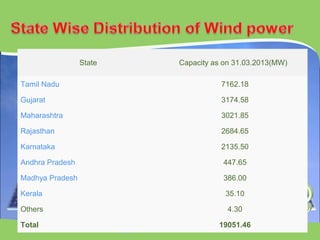
State Capacity as on 31.03.2013(MW) 
Tamil Nadu 7162.18 
Gujarat 3174.58 
Maharashtra 3021.85 
Rajasthan 2684.65 
Karnataka 2135.50 
Andhra Pradesh 447.65 
Madhya Pradesh 386.00 
Kerala 35.10 
Others 4.30 
Total 19051.46
NUCLEAR POWER IN INDIA 
• Fourth-largest source of electricity in India after thermal, 
hydroelectric and renewable sources. 
• India has 20 nuclear reactors in operation in 6 nuclear power 
plants, generating 4,780 MW. 
• 5 plants are under construction and are expected to generate 
an additional 2,720 MW. 
• Plans to increase nuclear power output to 64,000 MW by 
2032 
• Current electricity generation capacity from nuclear energy is 
approximately 4.2%.
NUCLEAR FUELS 
• The most common fissile nuclear fuel is 
Uranium 235. 
• Thorium can also be used as nuclear 
fuel. 
• Although not fissile itself, Th-232 will 
absorb slow neutrons to produce 
uranium-233 (U-233), which is fissile.
Coal Reserves in India 
• India has World’s Third Largest Coal Reserves 
• India has a hard coal reserves around 255 billion tons, 
of which 92 billion tons are proven 
• Hard coal deposit spread over 27 major coalfields, 
located mainly in Eastern and South- Central parts 
• The lignite reserves stand at a level around 36 billion 
tons, concentrated mainly in Tamil Nadu
Wide Range Technologies 
• Steam cycle facilities (most commonly 
used for large utilities) 
• Gas turbines (commonly used for 
moderate sized peaking facilities) 
• Cogeneration and combined cycle 
facility (the combination of gas turbines 
or internal combustion engines with heat 
recovery systems)
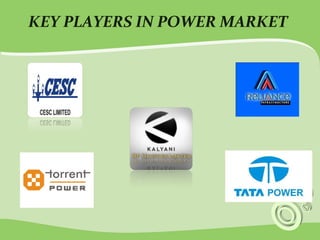
KEY PLAYERS IN POWER MARKET
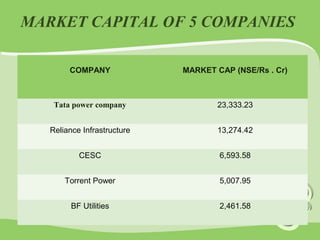
MARKET CAPITAL OF 5 COMPANIES 
COMPANY MARKET CAP (NSE/Rs . Cr) 
Tata power company 23,333.23 
Reliance Infrastructure 13,274.42 
CESC 6,593.58 
Torrent Power 5,007.95 
BF Utilities 2,461.58
BHARAT FORGE LIMITED(BFL) 
• The Company was incorporated on 
September 15, 2000 under the Companies 
Act, 1956 
• IT is a part of USD 2.4 
billion Kalyani Group 
• BFUL earlier operated in two 
Business segments 
Infrastructure Business and Investment 
Business
Calcutta Electric Supply Corporation 
• On 17 April 1899, the first thermal power plant of The 
Calcutta Electric Supply Corporation Limited was 
commissioned at Emambagh Lane near prince Ghat 
• The company was shifted to the Victoria House in 
Dharmatala, Kolkata in 1933, and still 
operates from this address.
Reliance infrastructure 
• Reliance Energy came into existence when it took over 
BSES in 2002. In April 2008, Reliance Energy changed its 
name to Reliance Infrastructure 
• The company is headed by Anil Ambani, The corporate 
headquarters is in Mumbai 
• The company is the sole distributor of electricity to 
consumers in the suburbs of Mumbai. It also runs power 
generation, transmission and distribution 
businesses in other parts of 
Maharastra Goa and Andhra pradesh
Torrent Power 
• Torrent Power is one of the leading brands in the Indian 
power sector, promoted by torrent group. 
• Torrent Power commences distribution operations in 
Agra, Uttar Pradesh effective from 1st April, 2010 
• First wind power project 
commissioned at Jamnagar.
Tata power 
• Tata Power is India’s largest integrated power company 
with a significant international presence. 
• Computerized Grid Control and Energy Management 
Systems. 
• Tata Power commissioned India’s first power plant- the 
hydro-electric station- in Khopoli (72 MW) in 1915, the 
second hydro station one in Bhivpuri 
(78 MW) in 1919 and the 3rd one in 
Bhira (300 MW) in 1922.
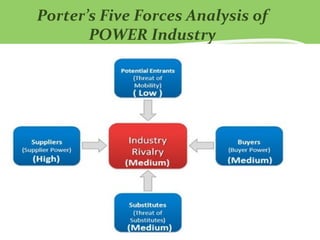
Porter’s Five Forces Analysis of 
POWER Industry
• Threat of New Entrants(Low ) 
 High capital requirement 
 Difficult access to distribution 
 Highly to manage 
 Threat of substitute products or services(low) 
 Power does not have substitute 
 It can be generated from different sources of energy 
 coal availability is limited and therefore power from nuclear, 
hydro and other renewable sources could be used as 
substitute for thermal power in future.
 Bargaining power of customers (buyers ) 
 Industrial consumers have huge demand for power power 
 Bargaining power is low 
 Government regulates the power sector to ensure supply 
of power 
 Bargaining power of suppliers(high) 
 Coal is majorly used for generation of power 
 Coal players are in dominant position. 
 However in present situation, the powerof suppliers is high
 Competitive rivalry within the Industry(medium) 
 No competitive rivalry as demand for power. 
 Cultural With government encouragement , private 
participation take advantage of huge demand of market
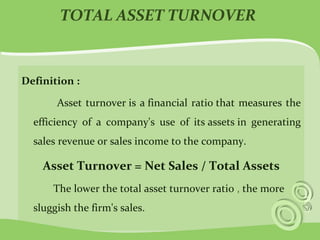
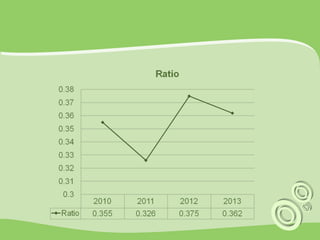
TOTAL ASSET TURNOVER 
Definition : 
Asset turnover is a financial ratio that measures the 
efficiency of a company's use of its assets in generating 
sales revenue or sales income to the company. 
Asset Turnover = Net Sales / Total Assets 
The lower the total asset turnover ratio , the more 
sluggish the firm's sales.
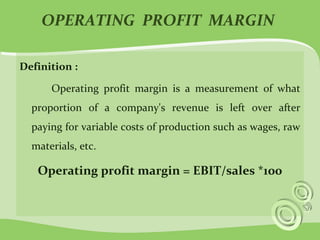
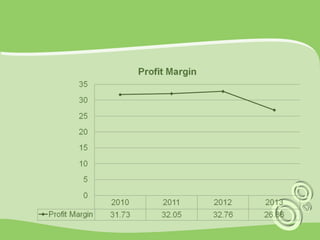
OPERATING PROFIT MARGIN 
Definition : 
Operating profit margin is a measurement of what 
proportion of a company's revenue is left over after 
paying for variable costs of production such as wages, raw 
materials, etc. 
Operating profit margin = EBIT/sales *100
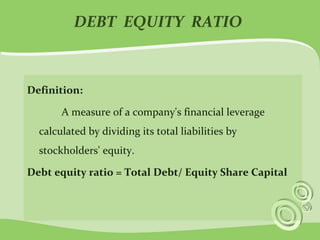
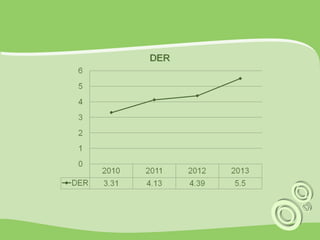
DEBT EQUITY RATIO 
Definition: 
A measure of a company's financial leverage 
calculated by dividing its total liabilities by 
stockholders' equity. 
Debt equity ratio = Total Debt/ Equity Share Capital
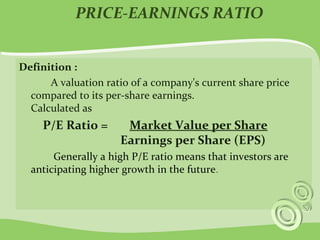
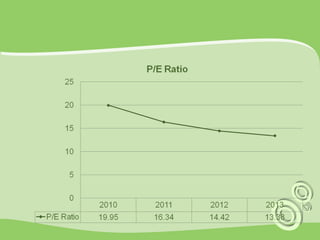
PRICE-EARNINGS RATIO 
Definition : 
A valuation ratio of a company's current share price 
compared to its per-share earnings. 
Calculated as 
P/E Ratio = Market Value per Share 
Earnings per Share (EPS) 
Generally a high P/E ratio means that investors are 
anticipating higher growth in the future.
Industrial Analysis on power Industry

Industrial Analysis on power Industry

  • 1.
    INDUSTRY ANALYSIS ON POWER By SIVA KUMAR(31)
  • 2.
    INDIAN INDUSTRY •The electricity sector in India had an installed capacity of 237.742 GW as of February 2014 • the world's fourth largest Captive power plants generate an additional 39.375 GW. • Non Renewable Power Plants constitute 87.55% and Renewable Power Plants constitute 12.45% of total installed Capacity.
  • 3.
    Indian Industry •India generated around 911 BU (911,652 MU i.e. 911 TWH) of electricity during the 2012–13. • The total annual generation of electricity from all types of sources was 1053.9 Terawatt-hours(TWH) in 2012. • The total All India Installed Capacity of electric generating stations as on 31st March, 2013 was 2,23,343.60 MW
  • 4.
    TRENDS IN POWERINDUSTRY • The heart of the power plant - combustion gas reaches 1,500 degrees C hot enough to melt some metals. • This hot gas races through the turbine, setting the special alloy turbine blades in rotation at speeds of over 3,000 rpm. • This rotational energy is converted to electricity by the power generator fixed on the end of the turbine shaft. MHI's benchmark G-Series gas turbine generates around 330MW of power, sufficient to provide electricity to 40,000 homes
  • 5.
    WAYS OF POWER POWER THERMAL POWER NUCLEAR POWER WIND SOLAR POWER POWER
  • 7.
    SOLAR POWER •Solar power is the conversion of sunlight into electricity, either directly using photovoltaics (PV), or indirectly using concentrated solar power (CSP). • The 354 MW SEGS CSP installations is the largest solar power plant in the world and is located in the Mojave Desert of California
  • 8.
    Advantages • Solarpower is pollution-free during use. • PV installations can operate for many years with little maintenance or intervention after their initial set-up • Solar electric generation is economically superior where grid connection or fuel transport is difficult, costly or impossible • Compared to fossil and nuclear energy sources, very little research money has been invested in the development of solar cells, so there is considerable room for improvement
  • 9.
    Disadvantages • Solarelectricity is more expensive than most other forms of small-scale alternative energy production • Solar electricity is not produced at night and is greatly reduced in cloudy conditions. • Solar cells produce DC which must be converted to AC. This incurs 4-12% losses • The efficiency of conversion of solar energy to useful energy is low
  • 10.
  • 11.
    Wind power •The development of wind power in India began in the 1990 • India has the fifth largest installed wind power capacity in the world. • The total estimated capacity is 45000 GW • As of 31 Dec 2013 the installed capacity of wind power in India was 20000 MW
  • 12.
    State Capacity ason 31.03.2013(MW) Tamil Nadu 7162.18 Gujarat 3174.58 Maharashtra 3021.85 Rajasthan 2684.65 Karnataka 2135.50 Andhra Pradesh 447.65 Madhya Pradesh 386.00 Kerala 35.10 Others 4.30 Total 19051.46
  • 14.
    NUCLEAR POWER ININDIA • Fourth-largest source of electricity in India after thermal, hydroelectric and renewable sources. • India has 20 nuclear reactors in operation in 6 nuclear power plants, generating 4,780 MW. • 5 plants are under construction and are expected to generate an additional 2,720 MW. • Plans to increase nuclear power output to 64,000 MW by 2032 • Current electricity generation capacity from nuclear energy is approximately 4.2%.
  • 15.
    NUCLEAR FUELS •The most common fissile nuclear fuel is Uranium 235. • Thorium can also be used as nuclear fuel. • Although not fissile itself, Th-232 will absorb slow neutrons to produce uranium-233 (U-233), which is fissile.
  • 17.
    Coal Reserves inIndia • India has World’s Third Largest Coal Reserves • India has a hard coal reserves around 255 billion tons, of which 92 billion tons are proven • Hard coal deposit spread over 27 major coalfields, located mainly in Eastern and South- Central parts • The lignite reserves stand at a level around 36 billion tons, concentrated mainly in Tamil Nadu
  • 18.
    Wide Range Technologies • Steam cycle facilities (most commonly used for large utilities) • Gas turbines (commonly used for moderate sized peaking facilities) • Cogeneration and combined cycle facility (the combination of gas turbines or internal combustion engines with heat recovery systems)
  • 19.
    KEY PLAYERS INPOWER MARKET
  • 20.
    MARKET CAPITAL OF5 COMPANIES COMPANY MARKET CAP (NSE/Rs . Cr) Tata power company 23,333.23 Reliance Infrastructure 13,274.42 CESC 6,593.58 Torrent Power 5,007.95 BF Utilities 2,461.58
  • 21.
    BHARAT FORGE LIMITED(BFL) • The Company was incorporated on September 15, 2000 under the Companies Act, 1956 • IT is a part of USD 2.4 billion Kalyani Group • BFUL earlier operated in two Business segments Infrastructure Business and Investment Business
  • 22.
    Calcutta Electric SupplyCorporation • On 17 April 1899, the first thermal power plant of The Calcutta Electric Supply Corporation Limited was commissioned at Emambagh Lane near prince Ghat • The company was shifted to the Victoria House in Dharmatala, Kolkata in 1933, and still operates from this address.
  • 23.
    Reliance infrastructure •Reliance Energy came into existence when it took over BSES in 2002. In April 2008, Reliance Energy changed its name to Reliance Infrastructure • The company is headed by Anil Ambani, The corporate headquarters is in Mumbai • The company is the sole distributor of electricity to consumers in the suburbs of Mumbai. It also runs power generation, transmission and distribution businesses in other parts of Maharastra Goa and Andhra pradesh
  • 24.
    Torrent Power •Torrent Power is one of the leading brands in the Indian power sector, promoted by torrent group. • Torrent Power commences distribution operations in Agra, Uttar Pradesh effective from 1st April, 2010 • First wind power project commissioned at Jamnagar.
  • 25.
    Tata power •Tata Power is India’s largest integrated power company with a significant international presence. • Computerized Grid Control and Energy Management Systems. • Tata Power commissioned India’s first power plant- the hydro-electric station- in Khopoli (72 MW) in 1915, the second hydro station one in Bhivpuri (78 MW) in 1919 and the 3rd one in Bhira (300 MW) in 1922.
  • 26.
    Porter’s Five ForcesAnalysis of POWER Industry
  • 27.
    • Threat ofNew Entrants(Low )  High capital requirement  Difficult access to distribution  Highly to manage  Threat of substitute products or services(low)  Power does not have substitute  It can be generated from different sources of energy  coal availability is limited and therefore power from nuclear, hydro and other renewable sources could be used as substitute for thermal power in future.
  • 28.
     Bargaining powerof customers (buyers )  Industrial consumers have huge demand for power power  Bargaining power is low  Government regulates the power sector to ensure supply of power  Bargaining power of suppliers(high)  Coal is majorly used for generation of power  Coal players are in dominant position.  However in present situation, the powerof suppliers is high
  • 29.
     Competitive rivalrywithin the Industry(medium)  No competitive rivalry as demand for power.  Cultural With government encouragement , private participation take advantage of huge demand of market
  • 30.
    TOTAL ASSET TURNOVER Definition : Asset turnover is a financial ratio that measures the efficiency of a company's use of its assets in generating sales revenue or sales income to the company. Asset Turnover = Net Sales / Total Assets The lower the total asset turnover ratio , the more sluggish the firm's sales.
  • 32.
    OPERATING PROFIT MARGIN Definition : Operating profit margin is a measurement of what proportion of a company's revenue is left over after paying for variable costs of production such as wages, raw materials, etc. Operating profit margin = EBIT/sales *100
  • 34.
    DEBT EQUITY RATIO Definition: A measure of a company's financial leverage calculated by dividing its total liabilities by stockholders' equity. Debt equity ratio = Total Debt/ Equity Share Capital
  • 36.
    PRICE-EARNINGS RATIO Definition: A valuation ratio of a company's current share price compared to its per-share earnings. Calculated as P/E Ratio = Market Value per Share Earnings per Share (EPS) Generally a high P/E ratio means that investors are anticipating higher growth in the future.