• The Expert Committee submitted the report in August’06.

• India needs to sustain 8-10% growth rate over the next 25
  years for eradicating poverty and meeting its human
  development goals.

•    This would require, at least, enhancing primary energy
    supply by 3-4 times and the electricity supply by 5 times ,of
    2003-04 level.


                             Integrated Energy Policy
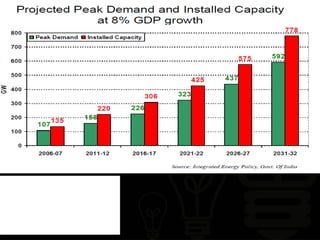
• Power generation capacity would need be in the order of
  8,00,000 MW in year 2031-32 from the current installed
  capacity of about 1,39,000 MW.

•    Main objectives have to be energy security, reliability,
    competitive prices and meeting lifeline energy needs in a
    technically    efficient, economically      viable   and
    environmentally sustainable manner.


                           Integrated Energy Policy
• National Electricity Policy (NEP)- notified in year
  2005.

• Competitive Bidding Guidelines – notified in year
  2005.

• Tariff Policy – notified in year 2006.

• Rural Electrification (RE) Policy – notified in year
  2006.


                             Electricity Act 2003
• Regulations for inter state transmission issued
  by CERC -2004.

• Open access to consumers above 1 MW within
  5 years (by January, 2009).

• Regulation for open access in distribution
  issued by 23 SERCs.

• 26 licenses awarded by CERC for inter state
  power trading.

                          Electricity Act 2003
• Present trading volume ~ 2.5% of total power
  generated.

• Theft of electricity made a cognizable & non- bail
  able offence.

• Commercial losses of state power utilities on the
  decline.


                           Electricity Act 2003
• Generating Capacity to be increased from 105,000 MW
  to 212,000 MW

• Share of the Private Sector to be increased from 10% to
  16.5%

• Hydel Generation to be increased from 25% to 30%.

• Inter-regional transfer capability to be increased from
  4850 MW to 30,000 MW.


                       Vision 2012 ( G O I )
                     “ Power for All by 2012 ”
• Recovery of the power cost through the realized tariff
  from 70% to 100%.

• T. & D. Losses to be reduced from 40% to 13%.

• 100% rural electrification from the existing 86%.

• Peak Energy Shortage to be brought down to 0 from the
  existing 13%.

• Average Energy Shortage to be brought down to 0 from
  the existing 8%.


                         Vision 2012 ( G O I )
                       “ Power for All by 2012 ”
• Major national effort to universalize access to electricity
  – 57% of rural households were without access in 2001.

•   Launched in 2005. Targets :
     • 1,00,000 un-electrified villages.
     • 78 million rural households in un-electrified and
     electrified villages.

•   Provides 90% capital subsidy. 100% capital subsidy for
    electrification of Below-Poverty-Line (BPL) rural
    households.


                                    Rural Electrification :
                             Rajiv Gandhi Gramin Vidyutikaran
                                      Yojana (RGGVY)
• 44,000 villages electrified. Another 22,000 villages covered
  under intensive electrification. About 2 million connections
  given.

• USD 1.5 billion invested. Another USD 6.75 billion
  provided.

•    National programme for Franchisee development
    launched.


                                 Rural Electrification :
                          Rajiv Gandhi Gramin Vidyutikaran
                                   Yojana (RGGVY)
• Franchisees in place in 14 states, covering 63,000 +
  villages.

•    Generated employment for villagers and improved
    consumer services.

•   Resulted in significant improvement in revenue collection.

• Some examples:
    • Dibrugarh 89%
    • Bulandshahar 100%
    • Bijapur 103%

                                   Rural Electrification :
                            Rajiv Gandhi Gramin Vidyutikaran
                                     Yojana (RGGVY)
• The Central Electricity Regulatory Commission
  established and functional

• 9 States have passed reform law.

• 9 States have unbundled State Electricity Boards.

• 21 States have constituted State Electricity
  Regulatory Commissions.

• 12 State Electricity Regulatory Commissions have
  issued tariff orders.


                                   Reforms - So Far
• Flagship programme of the Central Government
  to support States in strengthening distribution
  networks and improving operational efficiency.

• 571 projects totaling USD 4.3 billion sanctioned.

• 9 states demonstrated reduction in cash losses
  of USD 1.4 billion in last five years. USD 490
  million released cash incentive.


                     Accelerated Power Development
                                  and
                      Reforms Programme (APDRP)
• 100% feeder metering completed in 23 states.
  90%+ feeder metering in another 3 states.

• 100% consumer metering in 3 states.
  90%+ consumer metering in another 12 states.

• Aggregate Technical & Commercial (AT&C) losses
  brought down to below 20% in 212 APDRP towns.
  Below 15% AT&C losses in 169 towns. National
  average is about 34%.
                     Accelerated Power Development
                                  and
                      Reforms Programme (APDRP)
• Reduction of T. & D. losses to around 13%.

• Up-gradation of sub-transmission and distribution
  system.

• 100% metering (AMR – Automated Meter Reading)

• Renovation and modernization of power plants.

• Improving the quality and reliability of power supply

                              Restructuring of APDRP
• TOD – Time of the concept introduction.

• Bifurcate agricultural pumping load from the non-pumping load
  in all rural feeders.

• Investment Assistance
     25% grant, 25% loan from GOI.
     Balance 50% IG / FIs

• Incentive Scheme
     Reward for actual cash loss reduction

• Fund release based on achievement of milestones

                                 Restructuring of APDRP
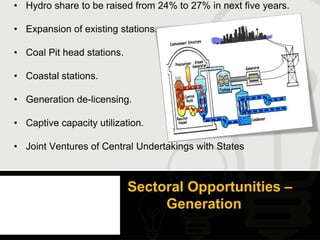
• Hydro share to be raised from 24% to 27% in next five years.

• Expansion of existing stations.

• Coal Pit head stations.

• Coastal stations.

• Generation de-licensing.

• Captive capacity utilization.

• Joint Ventures of Central Undertakings with States


                            Sectoral Opportunities –
                                 Generation
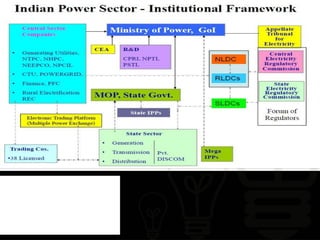
• National Grid
    4950 MW to 30,000 MW of interregional transfer capability
      by year 2012 .

• Technology up-gradation – 800 KV A.C. and 500 KV D.C.

• RLDCs modernization.

• Reliability improvement, reactive compensation.

• Private participation via
    Independent Power Transmission Co.
    Joint Venture with Power Grid

                         Sectoral Opportunities –
                             Transmission
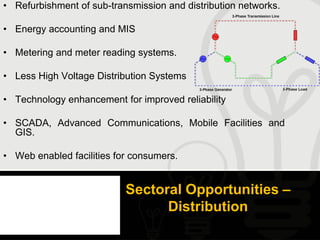
• Refurbishment of sub-transmission and distribution networks.

• Energy accounting and MIS

• Metering and meter reading systems.

• Less High Voltage Distribution Systems

• Technology enhancement for improved reliability

• SCADA, Advanced Communications, Mobile Facilities and
  GIS.

• Web enabled facilities for consumers.


                           Sectoral Opportunities –
                                 Distribution
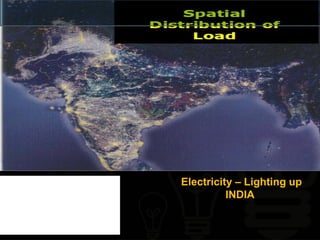
Electricity – Lighting up
          INDIA
Power Sector Reform in India

Power Sector Reform in India

  • 3.
    • The ExpertCommittee submitted the report in August’06. • India needs to sustain 8-10% growth rate over the next 25 years for eradicating poverty and meeting its human development goals. • This would require, at least, enhancing primary energy supply by 3-4 times and the electricity supply by 5 times ,of 2003-04 level. Integrated Energy Policy
  • 4.
    • Power generationcapacity would need be in the order of 8,00,000 MW in year 2031-32 from the current installed capacity of about 1,39,000 MW. • Main objectives have to be energy security, reliability, competitive prices and meeting lifeline energy needs in a technically efficient, economically viable and environmentally sustainable manner. Integrated Energy Policy
  • 8.
    • National ElectricityPolicy (NEP)- notified in year 2005. • Competitive Bidding Guidelines – notified in year 2005. • Tariff Policy – notified in year 2006. • Rural Electrification (RE) Policy – notified in year 2006. Electricity Act 2003
  • 9.
    • Regulations forinter state transmission issued by CERC -2004. • Open access to consumers above 1 MW within 5 years (by January, 2009). • Regulation for open access in distribution issued by 23 SERCs. • 26 licenses awarded by CERC for inter state power trading. Electricity Act 2003
  • 10.
    • Present tradingvolume ~ 2.5% of total power generated. • Theft of electricity made a cognizable & non- bail able offence. • Commercial losses of state power utilities on the decline. Electricity Act 2003
  • 11.
    • Generating Capacityto be increased from 105,000 MW to 212,000 MW • Share of the Private Sector to be increased from 10% to 16.5% • Hydel Generation to be increased from 25% to 30%. • Inter-regional transfer capability to be increased from 4850 MW to 30,000 MW. Vision 2012 ( G O I ) “ Power for All by 2012 ”
  • 12.
    • Recovery ofthe power cost through the realized tariff from 70% to 100%. • T. & D. Losses to be reduced from 40% to 13%. • 100% rural electrification from the existing 86%. • Peak Energy Shortage to be brought down to 0 from the existing 13%. • Average Energy Shortage to be brought down to 0 from the existing 8%. Vision 2012 ( G O I ) “ Power for All by 2012 ”
  • 13.
    • Major nationaleffort to universalize access to electricity – 57% of rural households were without access in 2001. • Launched in 2005. Targets : • 1,00,000 un-electrified villages. • 78 million rural households in un-electrified and electrified villages. • Provides 90% capital subsidy. 100% capital subsidy for electrification of Below-Poverty-Line (BPL) rural households. Rural Electrification : Rajiv Gandhi Gramin Vidyutikaran Yojana (RGGVY)
  • 14.
    • 44,000 villageselectrified. Another 22,000 villages covered under intensive electrification. About 2 million connections given. • USD 1.5 billion invested. Another USD 6.75 billion provided. • National programme for Franchisee development launched. Rural Electrification : Rajiv Gandhi Gramin Vidyutikaran Yojana (RGGVY)
  • 15.
    • Franchisees inplace in 14 states, covering 63,000 + villages. • Generated employment for villagers and improved consumer services. • Resulted in significant improvement in revenue collection. • Some examples: • Dibrugarh 89% • Bulandshahar 100% • Bijapur 103% Rural Electrification : Rajiv Gandhi Gramin Vidyutikaran Yojana (RGGVY)
  • 16.
    • The CentralElectricity Regulatory Commission established and functional • 9 States have passed reform law. • 9 States have unbundled State Electricity Boards. • 21 States have constituted State Electricity Regulatory Commissions. • 12 State Electricity Regulatory Commissions have issued tariff orders. Reforms - So Far
  • 17.
    • Flagship programmeof the Central Government to support States in strengthening distribution networks and improving operational efficiency. • 571 projects totaling USD 4.3 billion sanctioned. • 9 states demonstrated reduction in cash losses of USD 1.4 billion in last five years. USD 490 million released cash incentive. Accelerated Power Development and Reforms Programme (APDRP)
  • 18.
    • 100% feedermetering completed in 23 states. 90%+ feeder metering in another 3 states. • 100% consumer metering in 3 states. 90%+ consumer metering in another 12 states. • Aggregate Technical & Commercial (AT&C) losses brought down to below 20% in 212 APDRP towns. Below 15% AT&C losses in 169 towns. National average is about 34%. Accelerated Power Development and Reforms Programme (APDRP)
  • 19.
    • Reduction ofT. & D. losses to around 13%. • Up-gradation of sub-transmission and distribution system. • 100% metering (AMR – Automated Meter Reading) • Renovation and modernization of power plants. • Improving the quality and reliability of power supply Restructuring of APDRP
  • 20.
    • TOD –Time of the concept introduction. • Bifurcate agricultural pumping load from the non-pumping load in all rural feeders. • Investment Assistance  25% grant, 25% loan from GOI.  Balance 50% IG / FIs • Incentive Scheme  Reward for actual cash loss reduction • Fund release based on achievement of milestones Restructuring of APDRP
  • 21.
    • Hydro shareto be raised from 24% to 27% in next five years. • Expansion of existing stations. • Coal Pit head stations. • Coastal stations. • Generation de-licensing. • Captive capacity utilization. • Joint Ventures of Central Undertakings with States Sectoral Opportunities – Generation
  • 22.
    • National Grid  4950 MW to 30,000 MW of interregional transfer capability by year 2012 . • Technology up-gradation – 800 KV A.C. and 500 KV D.C. • RLDCs modernization. • Reliability improvement, reactive compensation. • Private participation via  Independent Power Transmission Co.  Joint Venture with Power Grid Sectoral Opportunities – Transmission
  • 23.
    • Refurbishment ofsub-transmission and distribution networks. • Energy accounting and MIS • Metering and meter reading systems. • Less High Voltage Distribution Systems • Technology enhancement for improved reliability • SCADA, Advanced Communications, Mobile Facilities and GIS. • Web enabled facilities for consumers. Sectoral Opportunities – Distribution
  • 24.