

Industry Analysis
Indian Power Sector
Arjun Yadav
IIM Indore, Mumbai
Key Success Factors
• Market Position: The company with strong operating

performance and favorable terms of services can position itself
better in the industry.

• Regulation: Since the industry is highly regulated, companies must
be able to comply with the regulations and be flexible to changes.

• Cost and Operation Management: Managing costs is an

important concern as selling prices are not flexible and fuel prices
are irregular. Downstream efficiencies for better transmission and
distribution. Operational success will lead to efficiency.

• Diversification: Companies need to diversify its market segments,
type of generation plants and location, in order to keep their
business sustainable.
PESTEL and Industry analysis
Political / Government policies Analysis:
• The low allocation of budget in power sector hampered the
rural & urban electrification, and power generation capacity.
• The different pricing regimes and distribution policies of state
governments further aggravated the power situation.
• As the state government paid these subsidies irregularly, the
SEBs did not plan any long term project implementation i.e.
capacity expansion, network extension, regular maintenance
and system improvement. This also affected the T&D losses of
SEBs.
PESTEL and Industry analysis
Economic Analysis:
• Multiple drivers (industrial expansion, growing per-capita
incomes) leading to growth in power demand - this is set to
continue in the future.
• During FY10–15, GDP growth is likely to average 8.0–8.5 %
• India set to become a global manufacturing hub with
investments across the value chain
• Power consumption estimated to increase from 821.2 TWh in
2013 to 1,433.2 TWh by 2022
• India’s power demand expected to rise up to 1,915 TWh by
FY22
PESTEL and Industry analysis
Technological Analysis:
• India to face significant challenges in achieving high
CO2 reduction in power generation, while also meeting the
predicted growth in demand and supply.
• Accelerated exploitation of natural resources and more trans
mission and distribution (T&D) capacity are essential to ove
rcome the current problems.
• Increased competition, additional equipment supply capacity
and other actions to involve the private sector can help to acc
elerate investments.
PESTEL and Industry analysis
Environmental Analysis:
•
•
•
•
•
•

Openness towards renewable energy
Effect on flora and fauna
Air and Water pollution
Social Analysis:
Waste Management
• Poor health level
Environment Laws
• Food insecurity
Poor health level
• Homelessness
• Loss of assets
• Landlessness
• Joblessness
PESTEL and Industry analysis
Legal & Regulatory Analysis:
• If government doesn’t own sufficient resources to develop
power projects, it has option to issue the license to others for
these projects.
• There is legal frame work for laying down wires and other
works but there was no regulation regarding the tariff, power
generation, and infrastructure development.
• There are some provisions to maintain the relationship
between licensee and consumer but there was no regulation
for efficiency of power plant, tariff, environmental issues, and
infrastructure development.
The value chain of the industry
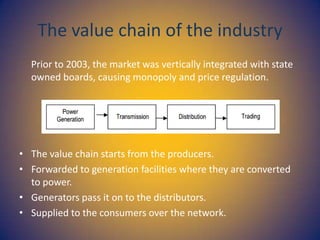
Prior to 2003, the market was vertically integrated with state
owned boards, causing monopoly and price regulation.

• The value chain starts from the producers.
• Forwarded to generation facilities where they are converted
to power.
• Generators pass it on to the distributors.
• Supplied to the consumers over the network.
Market Leader
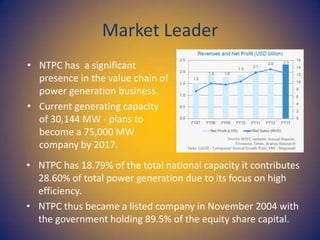
• NTPC has a significant
presence in the value chain of
power generation business.
• Current generating capacity
of 30,144 MW - plans to
become a 75,000 MW
company by 2017.
• NTPC has 18.79% of the total national capacity it contributes
28.60% of total power generation due to its focus on high
efficiency.
• NTPC thus became a listed company in November 2004 with
the government holding 89.5% of the equity share capital.
Second Largest Player
• Presence in all the segments of the power sector Generation (thermal, hydro, solar and wind),
Transmission, Distribution and Trading. It is one of the
largest renewable energy players in India.
• Its international presence includes strategic
investments and collaborations in other countries.
• With its track record of technology leadership, project
execution excellence, world class safety processes,
customer care and driving green initiatives, Tata Power
is poised for a multi-fold growth.

Indian Power Sector - Industry Analysis

  • 1.
    Industry Analysis Indian PowerSector Arjun Yadav IIM Indore, Mumbai
  • 2.
    Key Success Factors •Market Position: The company with strong operating performance and favorable terms of services can position itself better in the industry. • Regulation: Since the industry is highly regulated, companies must be able to comply with the regulations and be flexible to changes. • Cost and Operation Management: Managing costs is an important concern as selling prices are not flexible and fuel prices are irregular. Downstream efficiencies for better transmission and distribution. Operational success will lead to efficiency. • Diversification: Companies need to diversify its market segments, type of generation plants and location, in order to keep their business sustainable.
  • 3.
    PESTEL and Industryanalysis Political / Government policies Analysis: • The low allocation of budget in power sector hampered the rural & urban electrification, and power generation capacity. • The different pricing regimes and distribution policies of state governments further aggravated the power situation. • As the state government paid these subsidies irregularly, the SEBs did not plan any long term project implementation i.e. capacity expansion, network extension, regular maintenance and system improvement. This also affected the T&D losses of SEBs.
  • 4.
    PESTEL and Industryanalysis Economic Analysis: • Multiple drivers (industrial expansion, growing per-capita incomes) leading to growth in power demand - this is set to continue in the future. • During FY10–15, GDP growth is likely to average 8.0–8.5 % • India set to become a global manufacturing hub with investments across the value chain • Power consumption estimated to increase from 821.2 TWh in 2013 to 1,433.2 TWh by 2022 • India’s power demand expected to rise up to 1,915 TWh by FY22
  • 5.
    PESTEL and Industryanalysis Technological Analysis: • India to face significant challenges in achieving high CO2 reduction in power generation, while also meeting the predicted growth in demand and supply. • Accelerated exploitation of natural resources and more trans mission and distribution (T&D) capacity are essential to ove rcome the current problems. • Increased competition, additional equipment supply capacity and other actions to involve the private sector can help to acc elerate investments.
  • 6.
    PESTEL and Industryanalysis Environmental Analysis: • • • • • • Openness towards renewable energy Effect on flora and fauna Air and Water pollution Social Analysis: Waste Management • Poor health level Environment Laws • Food insecurity Poor health level • Homelessness • Loss of assets • Landlessness • Joblessness
  • 7.
    PESTEL and Industryanalysis Legal & Regulatory Analysis: • If government doesn’t own sufficient resources to develop power projects, it has option to issue the license to others for these projects. • There is legal frame work for laying down wires and other works but there was no regulation regarding the tariff, power generation, and infrastructure development. • There are some provisions to maintain the relationship between licensee and consumer but there was no regulation for efficiency of power plant, tariff, environmental issues, and infrastructure development.
  • 8.
    The value chainof the industry Prior to 2003, the market was vertically integrated with state owned boards, causing monopoly and price regulation. • The value chain starts from the producers. • Forwarded to generation facilities where they are converted to power. • Generators pass it on to the distributors. • Supplied to the consumers over the network.
  • 9.
    Market Leader • NTPChas a significant presence in the value chain of power generation business. • Current generating capacity of 30,144 MW - plans to become a 75,000 MW company by 2017. • NTPC has 18.79% of the total national capacity it contributes 28.60% of total power generation due to its focus on high efficiency. • NTPC thus became a listed company in November 2004 with the government holding 89.5% of the equity share capital.
  • 10.
    Second Largest Player •Presence in all the segments of the power sector Generation (thermal, hydro, solar and wind), Transmission, Distribution and Trading. It is one of the largest renewable energy players in India. • Its international presence includes strategic investments and collaborations in other countries. • With its track record of technology leadership, project execution excellence, world class safety processes, customer care and driving green initiatives, Tata Power is poised for a multi-fold growth.