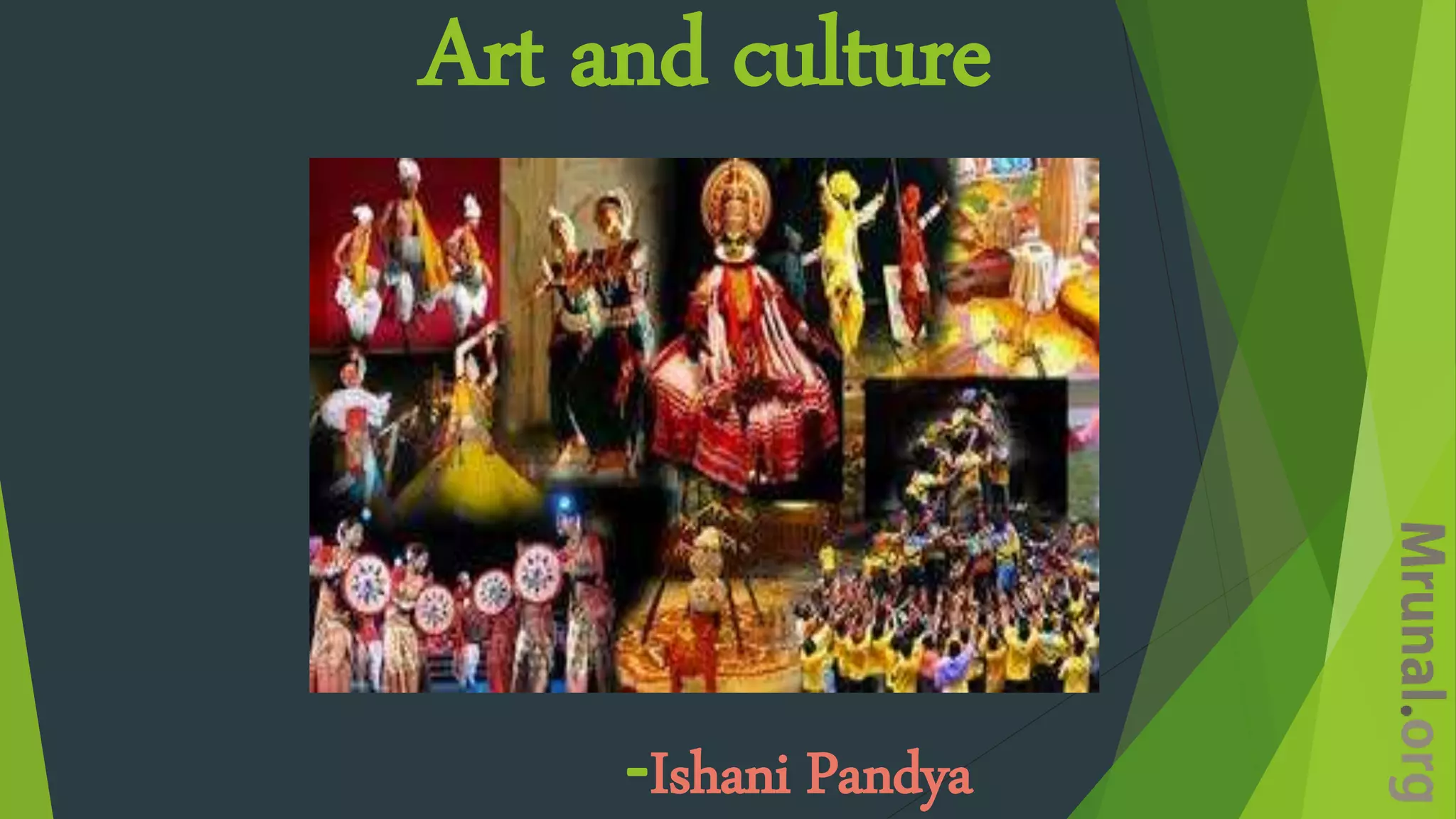









Art and culture
-Ishani Pandya
Slides are available on
mrunal.org
Introduction
 We can divide the subject in three parts for our convenience.
1.Visual arts
2.Performing arts
3.Miscellenous arts
1.Visual arts
architecture
sculpture
pottery
painting
2.Performing Arts
Indian Music
Dance forms
Indian theatre & drama
Indian puppetry
Indian circus
3.Miscelleneous Art forms
Religion Language Literature
cinema calendars philosophy
festivals fairs
Handicrafts
coinage
institutions
maths
&science
Medicine,
astronomy
Visual arts
1.Indian Architecture
2.Indian Sculpture
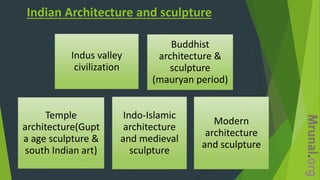
Indian Architecture and sculpture
Indus valley
civilization
Buddhist
architecture &
sculpture
(mauryan period)
Temple
architecture(Gupt
a age sculpture &
south Indian art)
Indo-Islamic
architecture
and medieval
sculpture
Modern
architecture
and sculpture
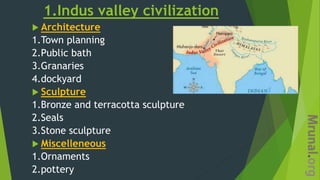
1.Indus valley civilization
 Architecture
1.Town planning
2.Public bath
3.Granaries
4.dockyard
 Sculpture
1.Bronze and terracotta sculpture
2.Seals
3.Stone sculpture
 Miscelleneous
1.Ornaments
2.pottery
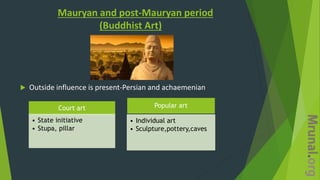
Mauryan and post-Mauryan period
(Buddhist Art)
 Outside influence is present-Persian and achaemenian
Court art
• State initiative
• Stupa, pillar
Popular art
• Individual art
• Sculpture,pottery,caves
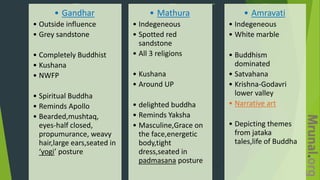
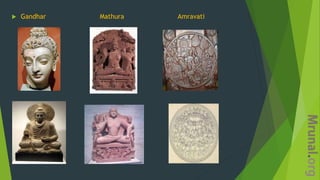
Gandhar
• Gandhar
• Outside influence
• Grey sandstone
• Completely Buddhist
• Kushana
• NWFP
• Spiritual Buddha
• Reminds Apollo
• Bearded,mushtaq,
eyes-half closed,
propumurance, weavy
hair,large ears,seated in
‘yogi’ posture
Mathura
• Mathura
• Indegeneous
• Spotted red
sandstone
• All 3 religions
• Kushana
• Around UP
• delighted buddha
• Reminds Yaksha
• Masculine,Grace on
the face,energetic
body,tight
dress,seated in
padmasana posture
Amravati
• Amravati
• Indegeneous
• White marble
• Buddhism
dominated
• Satvahana
• Krishna-Godavri
lower valley
• Narrative art
• Depicting themes
from jataka
tales,life of Buddha
 Gandhar Mathura Amravati
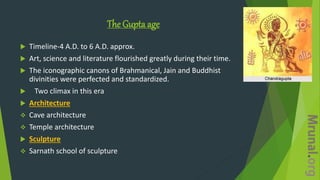
The Gupta age
 Timeline-4 A.D. to 6 A.D. approx.
 Art, science and literature flourished greatly during their time.
 The iconographic canons of Brahmanical, Jain and Buddhist
divinities were perfected and standardized.
 Two climax in this era
 Architecture
 Cave architecture
 Temple architecture
 Sculpture
 Sarnath school of sculpture
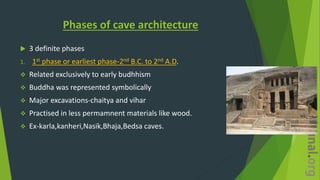
Phases of cave architecture
 3 definite phases
1. 1st phase or earliest phase-2nd B.C. to 2nd A.D.
 Related exclusively to early budhhism
 Buddha was represented symbolically
 Major excavations-chaitya and vihar
 Practised in less permamnent materials like wood.
 Ex-karla,kanheri,Nasik,Bhaja,Bedsa caves.
2nd phase-5th to 7th century
 Elimination of timber
 Introduction of the image of the Buddha
 The plan of excavations-specially for chaitya remained the
same as before.
 Vihar - some changes-housed the image of Budhha
3rd phase-or the last phase-7th to 10th century.
 The hindus and Jains extended the Buddhist architectural
tradition
 With some modifications-suitable to their rituals
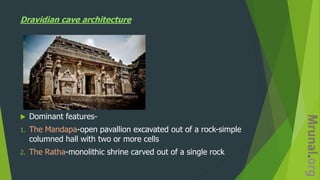
Dravidian cave architecture
 Dominant features-
1. The Mandapa-open pavallion excavated out of a rock-simple
columned hall with two or more cells
2. The Ratha-monolithic shrine carved out of a single rock
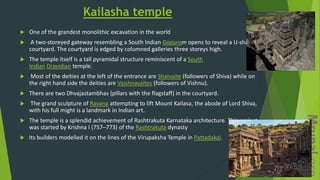
Kailasha temple
 One of the grandest monolithic excavation in the world
 A two-storeyed gateway resembling a South Indian Gopuram opens to reveal a U-shaped
courtyard. The courtyard is edged by columned galleries three storeys high.
 The temple itself is a tall pyramidal structure reminiscent of a South
Indian Dravidian temple.
 Most of the deities at the left of the entrance are Shaivaite (followers of Shiva) while on
the right hand side the deities are Vaishnavaites (followers of Vishnu).
 There are two Dhvajastambhas (pillars with the flagstaff) in the courtyard.
 The grand sculpture of Ravana attempting to lift Mount Kailasa, the abode of Lord Shiva,
with his full might is a landmark in Indian art.
 The temple is a splendid achievement of Rashtrakuta Karnataka architecture. This project
was started by Krishna I (757–773) of the Rashtrakuta dynasty
 Its builders modelled it on the lines of the Virupaksha Temple in Pattadakal.
Temple architecture
 Began and reached at climax during Gupta period
 The gupta period is described as classic-degree of perfection
 Perfect balance and harmony of all elements in style and iconography.
 Earlier developments
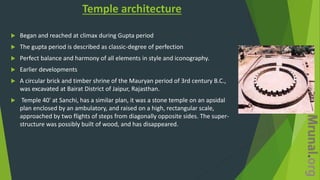
 A circular brick and timber shrine of the Mauryan period of 3rd century B.C.,
was excavated at Bairat District of Jaipur, Rajasthan.
 Temple 40' at Sanchi, has a similar plan, it was a stone temple on an apsidal
plan enclosed by an ambulatory, and raised on a high, rectangular scale,
approached by two flights of steps from diagonally opposite sides. The super-
structure was possibly built of wood, and has disappeared.
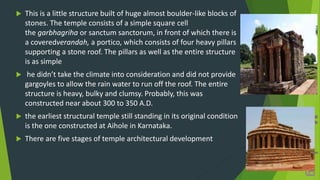
 This is a little structure built of huge almost boulder-like blocks of
stones. The temple consists of a simple square cell
the garbhagriha or sanctum sanctorum, in front of which there is
a coveredverandah, a portico, which consists of four heavy pillars
supporting a stone roof. The pillars as well as the entire structure
is as simple
 he didn’t take the climate into consideration and did not provide
gargoyles to allow the rain water to run off the roof. The entire
structure is heavy, bulky and clumsy. Probably, this was
constructed near about 300 to 350 A.D.
 the earliest structural temple still standing in its original condition
is the one constructed at Aihole in Karnataka.
 There are five stages of temple architectural development
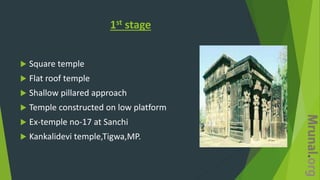
1st stage
 Square temple
 Flat roof temple
 Shallow pillared approach
 Temple constructed on low platform
 Ex-temple no-17 at Sanchi
 Kankalidevi temple,Tigwa,MP.
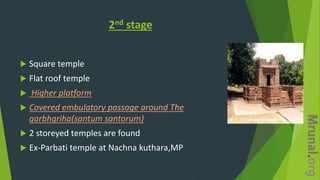
2nd stage
 Square temple
 Flat roof temple
 Higher platform
 Covered embulatory passage around The
garbhgriha(santum santorum)
 2 storeyed temples are found
 Ex-Parbati temple at Nachna kuthara,MP
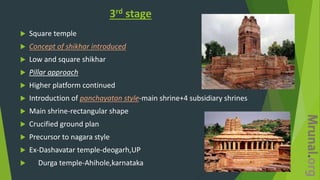
3rd stage
 Square temple
 Concept of shikhar introduced
 Low and square shikhar
 Pillar approach
 Higher platform continued
 Introduction of panchayatan style-main shrine+4 subsidiary shrines
 Main shrine-rectangular shape
 Crucified ground plan
 Precursor to nagara style
 Ex-Dashavatar temple-deogarh,UP
 Durga temple-Ahihole,karnataka
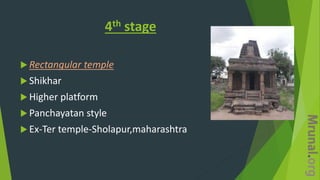
4th stage
 Rectangular temple
 Shikhar
 Higher platform
 Panchayatan style
 Ex-Ter temple-Sholapur,maharashtra
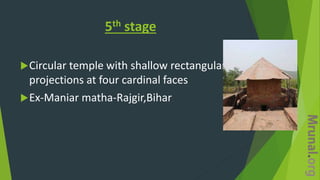
5th stage
Circular temple with shallow rectangular
projections at four cardinal faces
Ex-Maniar matha-Rajgir,Bihar
Styles of temples
 The Shilpashastra recognizes three styles along
with a geographical distribution of each.
1. Nagara style-northern region
2. Dravida style-southern region
3. Vesara style-region between the vindhyas and
the krishna
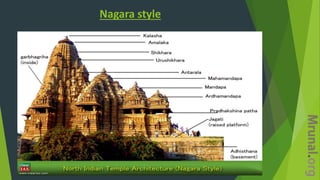
Nagara style
Nagara style
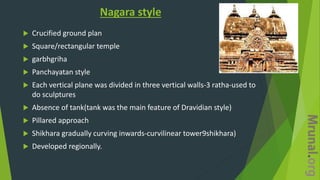
 Crucified ground plan
 Square/rectangular temple
 garbhgriha
 Panchayatan style
 Each vertical plane was divided in three vertical walls-3 ratha-used to
do sculptures
 Absence of tank(tank was the main feature of Dravidian style)
 Pillared approach
 Shikhara gradually curving inwards-curvilinear tower9shikhara)
 Developed regionally.
Three subschools
1. Odisha school
2. Chandella school/Khajuraho school
3. Solanki school-maru-gurjar school
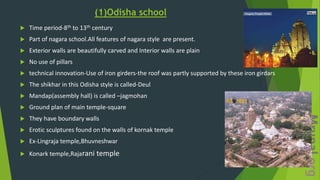
(1)Odisha school
 Time period-8th to 13th century
 Part of nagara school.All features of nagara style are present.
 Exterior walls are beautifully carved and Interior walls are plain
 No use of pillars
 technical innovation-Use of iron girders-the roof was partly supported by these iron girdars
 The shikhar in this Odisha style is called-Deul
 Mandap(assembly hall) is called –jagmohan
 Ground plan of main temple-square
 They have boundary walls
 Erotic sculptures found on the walls of kornak temple
 Ex-Lingraja temple,Bhuvneshwar
 Konark temple,Rajarani temple
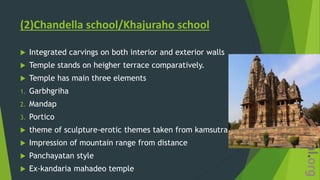
(2)Chandella school/Khajuraho school
 Integrated carvings on both interior and exterior walls
 Temple stands on heigher terrace comparatively.
 Temple has main three elements
1. Garbhgriha
2. Mandap
3. Portico
 theme of sculpture-erotic themes taken from kamsutra
 Impression of mountain range from distance
 Panchayatan style
 Ex-kandaria mahadeo temple
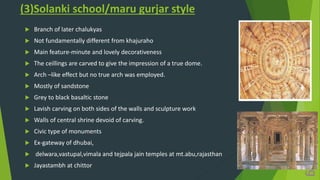
(3)Solanki school/maru gurjar style
 Branch of later chalukyas
 Not fundamentally different from khajuraho
 Main feature-minute and lovely decorativeness
 The ceillings are carved to give the impression of a true dome.
 Arch –like effect but no true arch was employed.
 Mostly of sandstone
 Grey to black basaltic stone
 Lavish carving on both sides of the walls and sculpture work
 Walls of central shrine devoid of carving.
 Civic type of monuments
 Ex-gateway of dhubai,
 delwara,vastupal,vimala and tejpala jain temples at mt.abu,rajasthan
 Jayastambh at chittor
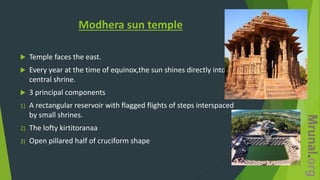
Modhera sun temple
 Temple faces the east.
 Every year at the time of equinox,the sun shines directly into this
central shrine.
 3 principal components
1) A rectangular reservoir with flagged flights of steps interspaced
by small shrines.
2) The lofty kirtitoranaa
3) Open pillared half of cruciform shape
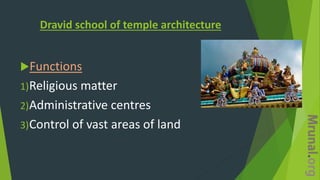
Dravid school of temple architecture
Functions
1)Religious matter
2)Administrative centres
3)Control of vast areas of land
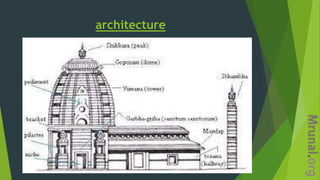
architecture
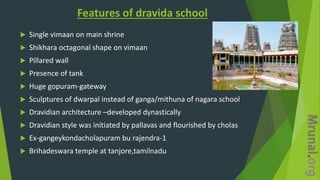
Features of dravida school
 Single vimaan on main shrine
 Shikhara octagonal shape on vimaan
 Pillared wall
 Presence of tank
 Huge gopuram-gateway
 Sculptures of dwarpal instead of ganga/mithuna of nagara school
 Dravidian architecture –developed dynastically
 Dravidian style was initiated by pallavas and flourished by cholas
 Ex-gangeykondacholapuram bu rajendra-1
 Brihadeswara temple at tanjore,tamilnadu
Four styles of Dravidian architecture
1)Pallava art
2)Chola art
3)Nayaka art
4)Vijayanagar art
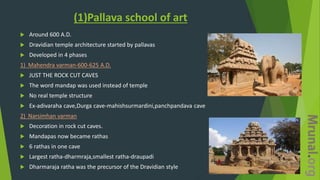
(1)Pallava school of art
 Around 600 A.D.
 Dravidian temple architecture started by pallavas
 Developed in 4 phases
1) Mahendra varman-600-625 A.D.
 JUST THE ROCK CUT CAVES
 The word mandap was used instead of temple
 No real temple structure
 Ex-adivaraha cave,Durga cave-mahishsurmardini,panchpandava cave
2) Narsimhan varman
 Decoration in rock cut caves.
 Mandapas now became rathas
 6 rathas in one cave
 Largest ratha-dharmraja,smallest ratha-draupadi
 Dharmaraja ratha was the precursor of the Dravidian style
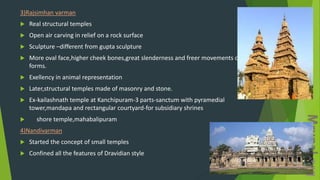
3)Rajsimhan varman
 Real structural temples
 Open air carving in relief on a rock surface
 Sculpture –different from gupta sculpture
 More oval face,higher cheek bones,great slenderness and freer movements of the
forms.
 Exellency in animal representation
 Later,structural temples made of masonry and stone.
 Ex-kailashnath temple at Kanchipuram-3 parts-sanctum with pyramedial
tower,mandapa and rectangular courtyard-for subsidiary shrines
 shore temple,mahabalipuram
4)Nandivarman
 Started the concept of small temples
 Confined all the features of Dravidian style
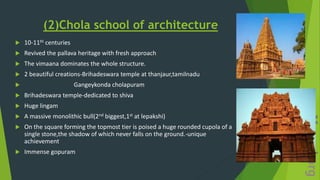
(2)Chola school of architecture
 10-11th centuries
 Revived the pallava heritage with fresh approach
 The vimaana dominates the whole structure.
 2 beautiful creations-Brihadeswara temple at thanjaur,tamilnadu
 Gangeykonda cholapuram
 Brihadeswara temple-dedicated to shiva
 Huge lingam
 A massive monolithic bull(2nd biggest,1st at lepakshi)
 On the square forming the topmost tier is poised a huge rounded cupola of a
single stone,the shadow of which never falls on the ground.-unique
achievement
 Immense gopuram
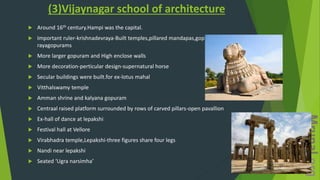
(3)Vijaynagar school of architecture
 Around 16th century.Hampi was the capital.
 Important ruler-krishnadevraya-Built temples,pillared mandapas,gopurams-called as
rayagopurams
 More larger gopuram and High enclose walls
 More decoration-perticular design-supernatural horse
 Secular buildings were built.for ex-lotus mahal
 Vitthalswamy temple
 Amman shrine and kalyana gopuram
 Centraal raised platform surrounded by rows of carved pillars-open pavallion
 Ex-hall of dance at lepakshi
 Festival hall at Vellore
 Virabhadra temple,Lepakshi-three figures share four legs
 Nandi near lepakshi
 Seated ‘Ugra narsimha’
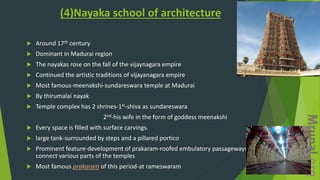
(4)Nayaka school of architecture
 Around 17th century
 Dominant in Madurai region
 The nayakas rose on the fall of the vijaynagara empire
 Continued the artistic traditions of vijayanagara empire
 Most famous-meenakshi-sundareswara temple at Madurai
 By thirumalai nayak
 Temple complex has 2 shrines-1st-shiva as sundareswara
2nd-his wife in the form of goddess meenakshi
 Every space is filled with surface carvings.
 large tank-surrounded by steps and a pillared portico
 Prominent feature-development of prakaram-roofed embulatory passageways-to
connect various parts of the temples
 Most famous prakaram of this period-at rameswaram
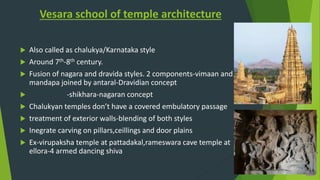
Vesara school of temple architecture
 Also called as chalukya/Karnataka style
 Around 7th-8th century.
 Fusion of nagara and dravida styles. 2 components-vimaan and
mandapa joined by antaral-Dravidian concept
 -shikhara-nagaran concept
 Chalukyan temples don’t have a covered embulatory passage
 treatment of exterior walls-blending of both styles
 Inegrate carving on pillars,ceillings and door plains
 Ex-virupaksha temple at pattadakal,rameswara cave temple at
ellora-4 armed dancing shiva
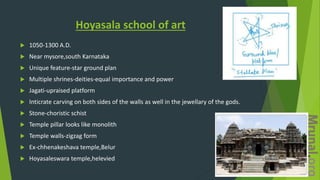
Hoyasala school of art
 1050-1300 A.D.
 Near mysore,south Karnataka
 Unique feature-star ground plan
 Multiple shrines-deities-equal importance and power
 Jagati-upraised platform
 Inticrate carving on both sides of the walls as well in the jewellary of the gods.
 Stone-choristic schist
 Temple pillar looks like monolith
 Temple walls-zigzag form
 Ex-chhenakeshava temple,Belur
 Hoyasaleswara temple,helevied
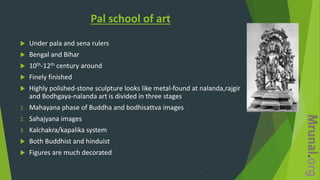
Pal school of art
 Under pala and sena rulers
 Bengal and Bihar
 10th-12th century around
 Finely finished
 Highly polished-stone sculpture looks like metal-found at nalanda,rajgir
and Bodhgaya-nalanda art is divided in three stages
1. Mahayana phase of Buddha and bodhisattva images
2. Sahajyana images
3. Kalchakra/kapalika system
 Both Buddhist and hinduist
 Figures are much decorated
Rashtrakuta school of art
 8th century
 Successors of chalukya
 Kailash temple at Ellora caves by Krishna-2
 Trimurti at elephant caves
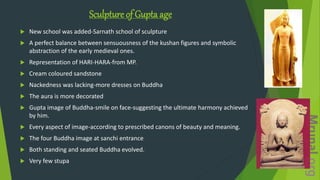
Sculpture of Gupta age
 New school was added-Sarnath school of sculpture
 A perfect balance between sensuousness of the kushan figures and symbolic
abstraction of the early medieval ones.
 Representation of HARI-HARA-from MP.
 Cream coloured sandstone
 Nackedness was lacking-more dresses on Buddha
 The aura is more decorated
 Gupta image of Buddha-smile on face-suggesting the ultimate harmony achieved
by him.
 Every aspect of image-according to prescribed canons of beauty and meaning.
 The four Buddha image at sanchi entrance
 Both standing and seated Buddha evolved.
 Very few stupa
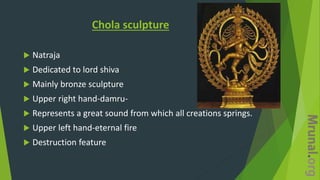
Chola sculpture
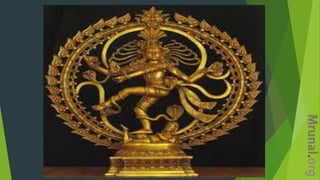
 Natraja
 Dedicated to lord shiva
 Mainly bronze sculpture
 Upper right hand-damru-
 Represents a great sound from which all creations springs.
 Upper left hand-eternal fire
 Destruction feature
 Lower right hand-gesture of benediction
 Lower left hand-moksha path
 Standing on dwarg-indivisual ego
 Mettler lock-ganga river
 Crescent moon-shine its all glory
 Small earing in one ear,big earing in the other-
ardhnarishwar
 Snake-represents kundalini
 Circle-unending cycles of life
Medieval Architecture
 Also known as Indo-Islamic Architecture
 Indo-Islamic architecture encompasses a wide range of styles from
various backgrounds that helped shape the architecture of the Indian
subcontinent from the advent of Islam in the Indian subcontinent
around the 7th century. It has left influences on modern
Indian, Pakistani and Bangladeshi architecture. Both secular and
religious buildings are influenced by Indo-Islamic architecture which
exhibit Indian, Islamic, Persian, Central Asian, Arabic and Ottoman
Turkish influences, many of which themselves were influenced by
Indian architecture through the spread of Indian culture before the
advent of Islam.
 Replaced the indian trabiate style with arcuate style
 Turks and Afghans Muslims having inherited a wealth of varied
designs from Sassanian and Byzantine empires and being
naturally endowed with good taste for buildings
 Ornamental decoration, open space for prayer toward
mecca(quibla), light and open, lesser decoration in prayer hall,
purdah hall system for females coming for prayer, tower/minaret
to call prayer(azaan),
 The Muslims, like the Romans, were also responsible for making
extensive use of concrete and lime mortar as an important factor
of construction and incidentally used lime as plaster and a base
for decoration which was incised into it and held enamel work on
tiles.
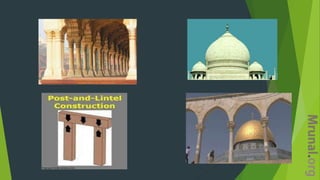
Trabeate style
• lintel
• Shikhar
• No use of minar
• Material-sand stone
Arcuate style
• Lintel replaced by arch
• Dome
• Concept of minar
• Material-brick,lime and
mortar-used for making
dome
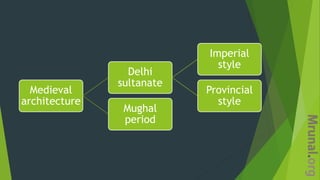
Medieval
architecture
Delhi
sultanate
Imperial
style
Provincial
style
Mughal
period
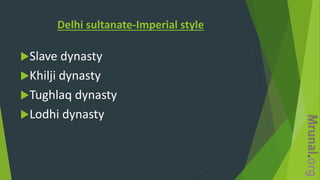
Delhi sultanate-Imperial style
Slave dynasty
Khilji dynasty
Tughlaq dynasty
Lodhi dynasty
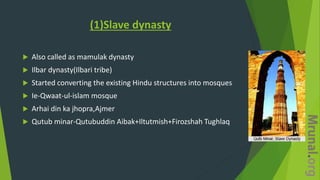
(1)Slave dynasty
 Also called as mamulak dynasty
 Ilbar dynasty(Ilbari tribe)
 Started converting the existing Hindu structures into mosques
 Ie-Qwaat-ul-islam mosque
 Arhai din ka jhopra,Ajmer
 Qutub minar-Qutubuddin Aibak+Iltutmish+Firozshah Tughlaq
(2)Khilji dynasty
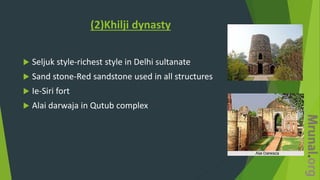
 Seljuk style-richest style in Delhi sultanate
 Sand stone-Red sandstone used in all structures
 Ie-Siri fort
 Alai darwaja in Qutub complex
(3)Tughlaq dynasty
 Crisis period
 Not much interested in architecture
 Focus on strength rather than beauty
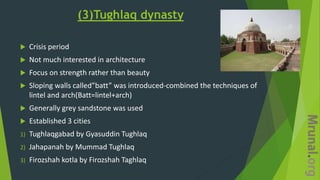
 Sloping walls called”batt” was introduced-combined the techniques of
lintel and arch(Batt=lintel+arch)
 Generally grey sandstone was used
 Established 3 cities
1) Tughlaqgabad by Gyasuddin Tughlaq
2) Jahapanah by Mummad Tughlaq
3) Firozshah kotla by Firozshah Taghlaq
Delhi
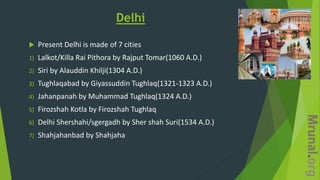
 Present Delhi is made of 7 cities
1) Lalkot/Killa Rai Pithora by Rajput Tomar(1060 A.D.)
2) Siri by Alauddin Khilji(1304 A.D.)
3) Tughlaqabad by Giyassuddin Tughlaq(1321-1323 A.D.)
4) Jahanpanah by Muhammad Tughlaq(1324 A.D.)
5) Firozshah Kotla by Firozshah Tughlaq
6) Delhi Shershahi/sgergadh by Sher shah Suri(1534 A.D.)
7) Shahjahanbad by Shahjaha
(4)Sayyid and Lodhi dynasty
 Unstable kingdom
 Scarcity of money
 Only tombs were made in this period
 Sikandar lodhi established the city of AGRA
 This architectural period during Sayyid and Lodhi dynasty was known as the
period of the macabre Concept of double dome was introduced by Lodhis
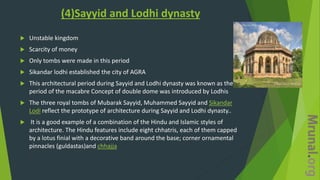
 The three royal tombs of Mubarak Sayyid, Muhammed Sayyid and Sikandar
Lodi reflect the prototype of architecture during Sayyid and Lodhi dynasty..
 It is a good example of a combination of the Hindu and Islamic styles of
architecture. The Hindu features include eight chhatris, each of them capped
by a lotus finial with a decorative band around the base; corner ornamental
pinnacles (guldastas)and chhajja
Tomb
 Hard structure
 Jali work
 Sayyids and Lodis constructedThe tombs in two different forms; one pattern was based
on octagonal plan surrounded by arched walkway with one storey in height and the
other one was based on square plan without walkway with two or three storey in
height.
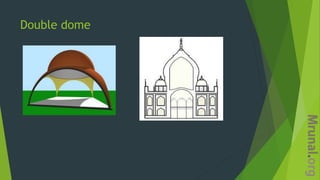
 Double Dome- A double dome is built of two layers. There is one layer inside which
provides ceiling to the interior of the building. The other layer is the outer one which
crowns the buildings. The devices of double dome enable the ceiling inside to be
placed lower and In better relation to the Interior space it covers.
 The attempts in the direction of Double Dome started with tomb of Taj Khan (1501 )
and the tomb of Sikandar Lodi (1518), both in Delhi. However, the fully mature form of
the double dome is seen, for the first time in India in the tomb of Humayun
 An important feature of the architecture during Sayyid and Lodi dynasty is the amazing
measurements of height and width to match with the structure of the basements.
Double dome
Delhi sultanate-Provincial styles
1)Bengal school
2)Malwa school
3)Jaunpur school
4)Bijapur school
(1)Bengal school of art
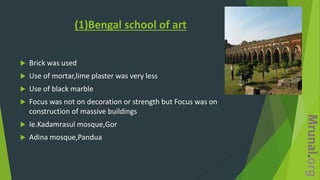
 Brick was used
 Use of mortar,lime plaster was very less
 Use of black marble
 Focus was not on decoration or strength but Focus was on
construction of massive buildings
 Ie.Kadamrasul mosque,Gor
 Adina mosque,Pandua
(2)Malwa school of Art
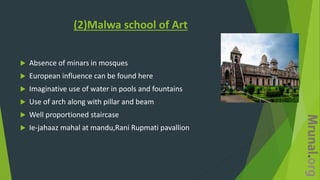
 Absence of minars in mosques
 European influence can be found here
 Imaginative use of water in pools and fountains
 Use of arch along with pillar and beam
 Well proportioned staircase
 Ie-jahaaz mahal at mandu,Rani Rupmati pavallion
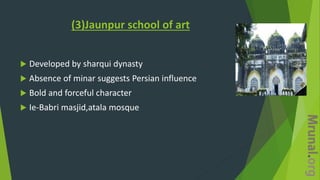
(3)Jaunpur school of art
 Developed by sharqui dynasty
 Absence of minar suggests Persian influence
 Bold and forceful character
 Ie-Babri masjid,atala mosque
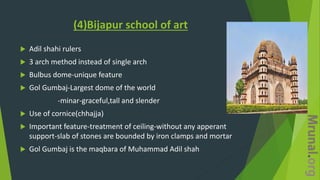
(4)Bijapur school of art
 Adil shahi rulers
 3 arch method instead of single arch
 Bulbus dome-unique feature
 Gol Gumbaj-Largest dome of the world
-minar-graceful,tall and slender
 Use of cornice(chhajja)
 Important feature-treatment of ceiling-without any apperant
support-slab of stones are bounded by iron clamps and mortar
 Gol Gumbaj is the maqbara of Muhammad Adil shah
Mughal period
 Indo-Islamic style fully developed under Mughals
Features of Indo-Islamic architecture
 Arch and dome method(arcuate style)
 Existence of minar
 Mortar used as a cementing agent to create arch and dome
 Avoided the representation of human beings
 Provided spaciousness,massiveness and breath to hindu architecture
 Use of calligraphy-pietradura technique
 Use of arabesque method
 Significance of light
 Symmetry
 Use of water in premises
 Foresightening technique
 Charbag style
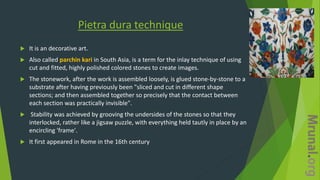
Pietra dura technique
 It is an decorative art.
 Also called parchin kari in South Asia, is a term for the inlay technique of using
cut and fitted, highly polished colored stones to create images.
 The stonework, after the work is assembled loosely, is glued stone-by-stone to a
substrate after having previously been "sliced and cut in different shape
sections; and then assembled together so precisely that the contact between
each section was practically invisible".
 Stability was achieved by grooving the undersides of the stones so that they
interlocked, rather like a jigsaw puzzle, with everything held tautly in place by an
encircling 'frame'.
 It first appeared in Rome in the 16th century
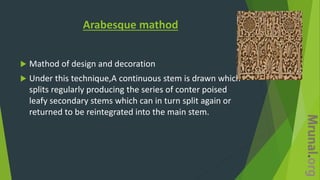
Arabesque mathod
 Mathod of design and decoration
 Under this technique,A continuous stem is drawn which
splits regularly producing the series of conter poised
leafy secondary stems which can in turn split again or
returned to be reintegrated into the main stem.
Use of water
 Cooling purpose
 Mirror image
 To add the beauty to the monument
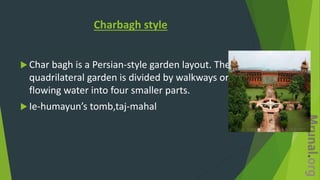
Charbagh style
 Char bagh is a Persian-style garden layout. The
quadrilateral garden is divided by walkways or
flowing water into four smaller parts.
 Ie-humayun’s tomb,taj-mahal
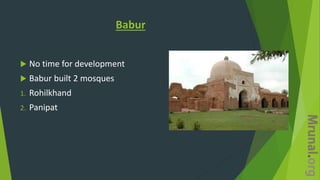
Babur
 No time for development
 Babur built 2 mosques
1. Rohilkhand
2. Panipat
Humayun
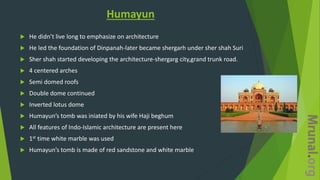
 He didn’t live long to emphasize on architecture
 He led the foundation of Dinpanah-later became shergarh under sher shah Suri
 Sher shah started developing the architecture-shergarg city,grand trunk road.
 4 centered arches
 Semi domed roofs
 Double dome continued
 Inverted lotus dome
 Humayun’s tomb was iniated by his wife Haji beghum
 All features of Indo-Islamic architecture are present here
 1st time white marble was used
 Humayun’s tomb is made of red sandstone and white marble
Akbar
 Thearchitecture of the Akbar period is characterized by a strength made
elegant and graceful by its rich decorative work, which reflects many
traditional Hindu elements.
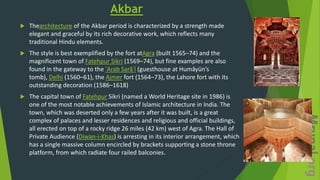
 The style is best exemplified by the fort atAgra (built 1565–74) and the
magnificent town of Fatehpur Sikri (1569–74), but fine examples are also
found in the gateway to the ʿArab Sarāʾī (guesthouse at Humāyūn’s
tomb), Delhi (1560–61), the Ajmer fort (1564–73), the Lahore fort with its
outstanding decoration (1586–1618)
 The capital town of Fatehpur Sikri (named a World Heritage site in 1986) is
one of the most notable achievements of Islamic architecture in India. The
town, which was deserted only a few years after it was built, is a great
complex of palaces and lesser residences and religious and official buildings,
all erected on top of a rocky ridge 26 miles (42 km) west of Agra. The Hall of
Private Audience (Diwan-i-Khas) is arresting in its interior arrangement, which
has a single massive column encircled by brackets supporting a stone throne
platform, from which radiate four railed balconies.
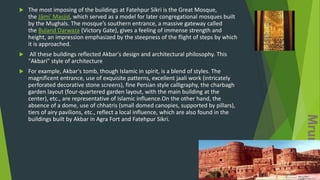
 The most imposing of the buildings at Fatehpur Sikri is the Great Mosque,
the Jāmiʿ Masjid, which served as a model for later congregational mosques built
by the Mughals. The mosque’s southern entrance, a massive gateway called
the Buland Darwaza (Victory Gate), gives a feeling of immense strength and
height, an impression emphasized by the steepness of the flight of steps by which
it is approached.
 All these buildings reflected Akbar's design and architectural philosophy. This
"Akbari" style of architecture
 For example, Akbar's tomb, though Islamic in spirit, is a blend of styles. The
magnificent entrance, use of exquisite patterns, excellent jaali work (intricately
perforated decorative stone screens), fine Persian style calligraphy, the charbagh
garden layout (four-quartered garden layout, with the main building at the
center), etc., are representative of Islamic influence.On the other hand, the
absence of a dome, use of chhatris (small domed canopies, supported by pillars),
tiers of airy pavilions, etc., reflect a local influence, which are also found in the
buildings built by Akbar in Agra Fort and Fatehpur Sikri.
 The employment of Hindu masons and architects who unconsciously introduced
in the Muslim buildings their own ideas of art.
 He established a public works department and his plans were carried out by his
able architects and engineers.
 Even Hindu buildings of Rajut at Amber and Jodhpur were influenced by the
Mughal style of Architecture. Not only civil buildings, but even the Hindu
temples could not escape the nationalizing effects of Akbar’s architecture.
While Akbar had freely borrowed from indigenous temple architecture, Hindu
temples erected during his reign did not fail to borrow some of the features of
the new eclectic style evolved at Agra and Fatehpur Sikri. Hindu temples at
Vrindaban show clearly that certain of their features are borrowed from the
contemporary style of the Mughals.
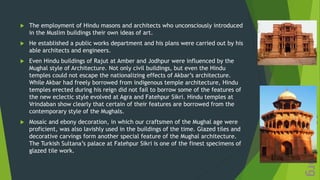
 Mosaic and ebony decoration, in which our craftsmen of the Mughal age were
proficient, was also lavishly used in the buildings of the time. Glazed tiles and
decorative carvings form another special feature of the Mughal architecture.
The Turkish Sultana’s palace at Fatehpur Sikri is one of the finest specimens of
glazed tile work.
 Haram
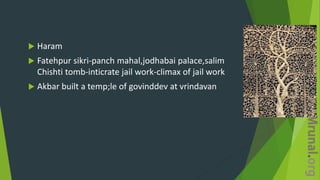
 Fatehpur sikri-panch mahal,jodhabai palace,salim
Chishti tomb-inticrate jail work-climax of jail work
 Akbar built a temp;le of govinddev at vrindavan
Jahangir
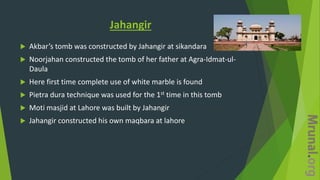
 Akbar’s tomb was constructed by Jahangir at sikandara
 Noorjahan constructed the tomb of her father at Agra-Idmat-ul-
Daula
 Here first time complete use of white marble is found
 Pietra dura technique was used for the 1st time in this tomb
 Moti masjid at Lahore was built by Jahangir
 Jahangir constructed his own maqbara at lahore
shahjahan
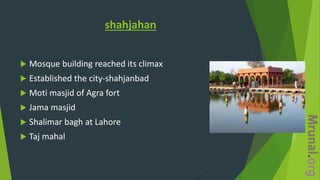
 Mosque building reached its climax
 Established the city-shahjanbad
 Moti masjid of Agra fort
 Jama masjid
 Shalimar bagh at Lahore
 Taj mahal
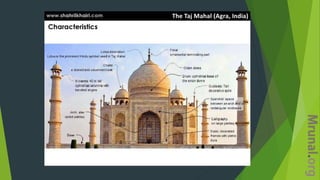
Taj Mahal
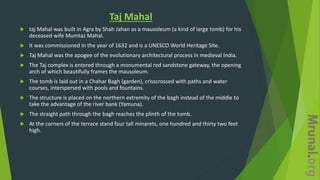
 taj Mahal was built in Agra by Shah Jahan as a mausoleum (a kind of large tomb) for his
deceased wife Mumtaz Mahal.
 It was commissioned in the year of 1632 and is a UNESCO World Heritage Site.
 Taj Mahal was the apogee of the evolutionary architectural process in medieval India.
 The Taj complex is entered through a monumental red sandstone gateway, the opening
arch of which beautifully frames the mausoleum.
 The tomb is laid out in a Chahar Bagh (garden), crisscrossed with paths and water
courses, interspersed with pools and fountains.
 The structure is placed on the northern extremity of the bagh instead of the middle to
take the advantage of the river bank (Yamuna).
 The straight path through the bagh reaches the plinth of the tomb.
 At the corners of the terrace stand four tall minarets, one hundred and thirty two feet
high.
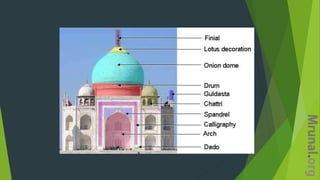
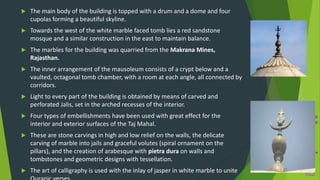
 The main body of the building is topped with a drum and a dome and four
cupolas forming a beautiful skyline.
 Towards the west of the white marble faced tomb lies a red sandstone
mosque and a similar construction in the east to maintain balance.
 The marbles for the building was quarried from the Makrana Mines,
Rajasthan.
 The inner arrangement of the mausoleum consists of a crypt below and a
vaulted, octagonal tomb chamber, with a room at each angle, all connected by
corridors.
 Light to every part of the building is obtained by means of carved and
perforated Jalis, set in the arched recesses of the interior.
 Four types of embellishments have been used with great effect for the
interior and exterior surfaces of the Taj Mahal.
 These are stone carvings in high and low relief on the walls, the delicate
carving of marble into jails and graceful volutes (spiral ornament on the
pillars), and the creation of arabesque with pietra dura on walls and
tombstones and geometric designs with tessellation.
 The art of calligraphy is used with the inlay of jasper in white marble to unite
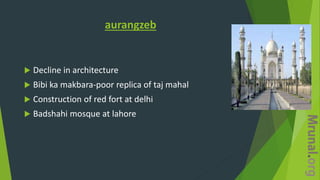
aurangzeb
 Decline in architecture
 Bibi ka makbara-poor replica of taj mahal
 Construction of red fort at delhi
 Badshahi mosque at lahore
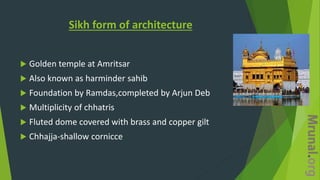
Sikh form of architecture
 Golden temple at Amritsar
 Also known as harminder sahib
 Foundation by Ramdas,completed by Arjun Deb
 Multiplicity of chhatris
 Fluted dome covered with brass and copper gilt
 Chhajja-shallow cornicce
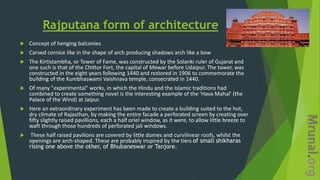
Rajputana form of architecture
 Concept of henging balconies
 Carved cornice like in the shape of arch producing shadows arch like a bow
 The Kirtistambha, or Tower of Fame, was constructed by the Solanki ruler of Gujarat and
one such is that of the Chittor Fort, the capital of Mewar before Udaipur. The tower, was
constructed in the eight years following 1440 and restored in 1906 to commemorate the
building of the Kumbhaswami Vaishnava temple, consecrated in 1440.
 Of many "experimental" works, in which the Hindu and the Islamic traditions had
combined to create something novel is the interesting example of the 'Hava Mahal' (the
Palace of the Wind) at Jaipur.
 Here an extraordinary experiment has been made to create a building suited to the hot,
dry climate of Rajasthan, by making the entire facade a perforated screen by creating over
fifty slightly raised pavillions, each a half oriel window, as it were, to allow little breeze to
waft through those hundreds of perforated jali windows.
 These half raised pavilions are covered by little domes and curvilinear roofs, whilst the
openings are arch-shaped. These are probably inspired by the tiers of small shikharas
rising one above the other, of Bhubaneswar or Tanjore.
Modern Indian architecture
 Two styles
1. Indo-gothic
2. Neo-roman
Iberian style vs Gothic style
Iberian style
• Iberian peninsula,portugese
church
• Lime stone and red sand
stone used
• Involved creation of new
shapes and structures
• No wooden roofs
• Expensive material
Gothic style
• Originated in france
• Brick used as a material
• Doesn’t involve new shape
structure but they
reinterpreted the existing
western style
• Wooden roofs
• Non expensive material
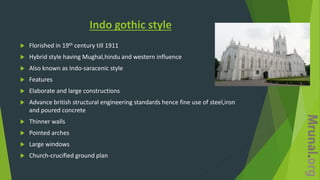
Indo gothic style
 Florished in 19th century till 1911
 Hybrid style having Mughal,hindu and western influence
 Also known as Indo-saracenic style
 Features
 Elaborate and large constructions
 Advance british structural engineering standards hence fine use of steel,iron
and poured concrete
 Thinner walls
 Pointed arches
 Large windows
 Church-crucified ground plan
 Examples
 St.poule’s cathredal,Kolkata
 Victoria memorial,Kolkata
 Gateway of india
 Laxmivilas palace
Neo roman style
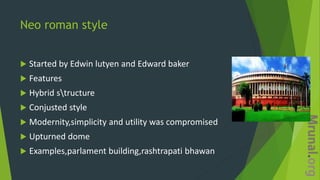
 Started by Edwin lutyen and Edward baker
 Features
 Hybrid structure
 Conjusted style
 Modernity,simplicity and utility was compromised
 Upturned dome
 Examples,parlament building,rashtrapati bhawan
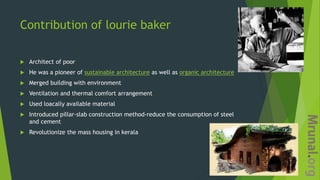
Contribution of lourie baker
 Architect of poor
 He was a pioneer of sustainable architecture as well as organic architecture
 Merged building with environment
 Ventilation and thermal comfort arrangement
 Used loacally available material
 Introduced pillar-slab construction method-reduce the consumption of steel
and cement
 Revolutionize the mass housing in kerala
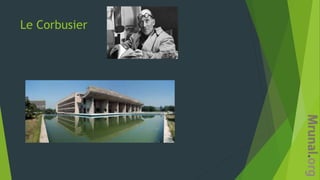
Le Corbusier
Green building in India
 A green building is one which uses less water, optimises energy efficiency, conserves natural
resources, generates less waste and provides healthier spaces for occupants, as compared to
a conventional building
 EDGE Program in India[edit]
 The IFC, a member of the World Bank Group, and the Confederation of Real Estate
Developers' Associations of India (CREDAI), apex body of private real estate developers, have
partnered to promote green buildings in the country through IFC’s EDGE certification. An MoU
was signed in the presence of Minister for Environment and ForestsPrakash
Javadekar on[2] November 25, 2014.
 The Indian Bureau of Energy Efficiency (BEE) launched the Energy Conservation Building Code
(ECBC).
 GRIHA is a rating tool that helps people assesses the performance of their building against
certain nationally acceptable benchmarks. It evaluates the environmental performance of a
building holistically over its entire life cycle, thereby providing a definitive standard for what
constitutes a ‘green building’. The rating system, based on accepted energy and
environmental principles, will seek to strike a balance between the established practices and
emerging concepts, both national and international.
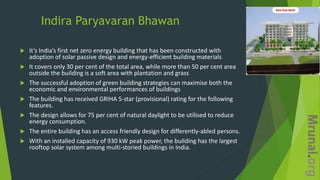
Indira Paryavaran Bhawan
 It’s India’s first net zero energy building that has been constructed with
adoption of solar passive design and energy-efficient building materials
 It covers only 30 per cent of the total area, while more than 50 per cent area
outside the building is a soft area with plantation and grass
 The successful adoption of green building strategies can maximise both the
economic and environmental performances of buildings
 The building has received GRIHA 5-star (provisional) rating for the following
features.
 The design allows for 75 per cent of natural daylight to be utilised to reduce
energy consumption.
 The entire building has an access friendly design for differently-abled persons.
 With an installed capacity of 930 kW peak power, the building has the largest
rooftop solar system among multi-storied buildings in India.
 The building is fully compliant with requirements of the Energy Conservation Building
Code of India (ECBC). Total energy savings of about 40 per cent have been achieved
through the adoption of energy efficient chilled beam system of air-conditioning. As per
this, air-conditioning is done by convection currents rather than airflow through air
handling units, and chilled water is circulated right up to the diffuser points unlike the
conventional systems.
 Green materials like fly ash bricks, regional building materials, materials with high
recyclable content, high reflectance terrace tiles and rock wool insulation of outer walls
have been used.
 Use of renewable bamboo jute composite material for doorframes and shutters.
 UPVC windows with hermetically sealed double glass. Calcium Silicate ceiling tiles with
high recyclable content and grass paver blocks on pavements and roads.
 Reduction in water consumption has been achieved by use of low-discharge water
fixtures, recycling of waste water through sewage treatment plant, use of plants with low
water demand in landscaping, use of geothermal cooling for HVAC system, rainwater
harvesting and use of curing compounds during construction.
 1Q. It is argued that there is a need to
re-write Indian history textbooks.
examine why and comment if such
have any merit. (200 Words)
 History is a means to understand our heritage and
strengthen our links with our ancestors. In that context it
is frequently argued that we need to rewrite Indian history
textbooks due to following reasons:
 There is excessive focus on political history while other
cultural, sociological, economic aspects have been
relatively neglected.
 There is a very strong focus on North and North Western
region to the detriment of other regions in the country.
 Often, myths and legends have been embellished as
popular fact without any strong basis in historical fact.
 New insights are gained from archaelogical sources, from
newly discovered documents, paintings etc. which needs
to be interpreted.
 Indian history mainly has narratives of two schools of thoughts - Marxist and
Colonial. There is a need to broaden the perspective by analysis through other
ideological prisms.
 In any field, revision and updation of text books should be an organic process
which keeps pace with the new discoveries. Hence, the demand for revision of
history textbooks is justified. However, there are few dangers associated with this
-
 While different perspectives on history can be there, the perspective of the
dominant group should not be used for the purpose of establishing a cultural
hegemony.
 The rewriting should be strictly based on facts and not myths or legends.
 The task should be entrusted to eminent historians which integrity and strong
credentials so that the task is not unduly politicised.
 Instead of 'rewriting' history books what is needed instead is addition of different
perspectives with critical analysis that brings new insights into the public domain
 1Q. ―The crisis in Indian museums is less of
resources and more of imagination and
commitment.‖ Critically comment. (200 Words)
 The dismal state of Indian museums especially the govt ones is no secret. Various
reasons can be attributed to it:-
 Mere collection of artefacts ignoring viewers' interest:-Museums should not be just a
place of repositories of objects. Efforts should be made to make it people friendly
so that they can connect to the place and engage with the rich collections.
 No skilled manpower:-Leading to sub standard maintenance, lighting and signage,
among other issues. Proper training has to be introduced for better handling of such
things.
 Lack of expertise:-Often responsibilities of museums are given to IAS officers who
are generalists and not any specialist. Barring few exceptions, it can be least
expected that they would come up with any imaginative idea. Many a times they
are given the responsibility of museums as a form of punishment which shows how
seriously the matter is being taken up.
 Lack of autonomy:-For effective functioning of the museums they have to be given
the much required autonomy lack of which leads to ad hoc arrangements.
 Few instances of collaboration with similar foreign organisations:-Such
collaborations help to bring in the much required expertise and knowledge in proper
handling of museums.
 Museums are guardians of objects of historical and cultural objects. However they
need to be handled intelligently in order for them to gain wide acceptance among
the people. A great collection with average people will give an average museum but
an average collection and great people often produces a great museum.

Art culture l2_ishani

  • 1.
  • 2.
    Slides are availableon mrunal.org
  • 3.
    Introduction  We candivide the subject in three parts for our convenience. 1.Visual arts 2.Performing arts 3.Miscellenous arts
  • 4.
  • 5.
    2.Performing Arts Indian Music Danceforms Indian theatre & drama Indian puppetry Indian circus
  • 6.
    3.Miscelleneous Art forms ReligionLanguage Literature cinema calendars philosophy festivals fairs Handicrafts coinage institutions maths &science Medicine, astronomy
  • 7.
  • 8.
    Indian Architecture andsculpture Indus valley civilization Buddhist architecture & sculpture (mauryan period) Temple architecture(Gupt a age sculpture & south Indian art) Indo-Islamic architecture and medieval sculpture Modern architecture and sculpture
  • 9.
    1.Indus valley civilization Architecture 1.Town planning 2.Public bath 3.Granaries 4.dockyard  Sculpture 1.Bronze and terracotta sculpture 2.Seals 3.Stone sculpture  Miscelleneous 1.Ornaments 2.pottery
  • 10.
    Mauryan and post-Mauryanperiod (Buddhist Art)  Outside influence is present-Persian and achaemenian Court art • State initiative • Stupa, pillar Popular art • Individual art • Sculpture,pottery,caves
  • 11.
    Gandhar • Gandhar • Outsideinfluence • Grey sandstone • Completely Buddhist • Kushana • NWFP • Spiritual Buddha • Reminds Apollo • Bearded,mushtaq, eyes-half closed, propumurance, weavy hair,large ears,seated in ‘yogi’ posture Mathura • Mathura • Indegeneous • Spotted red sandstone • All 3 religions • Kushana • Around UP • delighted buddha • Reminds Yaksha • Masculine,Grace on the face,energetic body,tight dress,seated in padmasana posture Amravati • Amravati • Indegeneous • White marble • Buddhism dominated • Satvahana • Krishna-Godavri lower valley • Narrative art • Depicting themes from jataka tales,life of Buddha
  • 12.
  • 13.
    The Gupta age Timeline-4 A.D. to 6 A.D. approx.  Art, science and literature flourished greatly during their time.  The iconographic canons of Brahmanical, Jain and Buddhist divinities were perfected and standardized.  Two climax in this era  Architecture  Cave architecture  Temple architecture  Sculpture  Sarnath school of sculpture
  • 14.
    Phases of cavearchitecture  3 definite phases 1. 1st phase or earliest phase-2nd B.C. to 2nd A.D.  Related exclusively to early budhhism  Buddha was represented symbolically  Major excavations-chaitya and vihar  Practised in less permamnent materials like wood.  Ex-karla,kanheri,Nasik,Bhaja,Bedsa caves.
  • 15.
    2nd phase-5th to7th century  Elimination of timber  Introduction of the image of the Buddha  The plan of excavations-specially for chaitya remained the same as before.  Vihar - some changes-housed the image of Budhha 3rd phase-or the last phase-7th to 10th century.  The hindus and Jains extended the Buddhist architectural tradition  With some modifications-suitable to their rituals
  • 16.
    Dravidian cave architecture Dominant features- 1. The Mandapa-open pavallion excavated out of a rock-simple columned hall with two or more cells 2. The Ratha-monolithic shrine carved out of a single rock
  • 17.
    Kailasha temple  Oneof the grandest monolithic excavation in the world  A two-storeyed gateway resembling a South Indian Gopuram opens to reveal a U-shaped courtyard. The courtyard is edged by columned galleries three storeys high.  The temple itself is a tall pyramidal structure reminiscent of a South Indian Dravidian temple.  Most of the deities at the left of the entrance are Shaivaite (followers of Shiva) while on the right hand side the deities are Vaishnavaites (followers of Vishnu).  There are two Dhvajastambhas (pillars with the flagstaff) in the courtyard.  The grand sculpture of Ravana attempting to lift Mount Kailasa, the abode of Lord Shiva, with his full might is a landmark in Indian art.  The temple is a splendid achievement of Rashtrakuta Karnataka architecture. This project was started by Krishna I (757–773) of the Rashtrakuta dynasty  Its builders modelled it on the lines of the Virupaksha Temple in Pattadakal.
  • 18.
    Temple architecture  Beganand reached at climax during Gupta period  The gupta period is described as classic-degree of perfection  Perfect balance and harmony of all elements in style and iconography.  Earlier developments  A circular brick and timber shrine of the Mauryan period of 3rd century B.C., was excavated at Bairat District of Jaipur, Rajasthan.  Temple 40' at Sanchi, has a similar plan, it was a stone temple on an apsidal plan enclosed by an ambulatory, and raised on a high, rectangular scale, approached by two flights of steps from diagonally opposite sides. The super- structure was possibly built of wood, and has disappeared.
  • 19.
     This isa little structure built of huge almost boulder-like blocks of stones. The temple consists of a simple square cell the garbhagriha or sanctum sanctorum, in front of which there is a coveredverandah, a portico, which consists of four heavy pillars supporting a stone roof. The pillars as well as the entire structure is as simple  he didn’t take the climate into consideration and did not provide gargoyles to allow the rain water to run off the roof. The entire structure is heavy, bulky and clumsy. Probably, this was constructed near about 300 to 350 A.D.  the earliest structural temple still standing in its original condition is the one constructed at Aihole in Karnataka.  There are five stages of temple architectural development
  • 20.
    1st stage  Squaretemple  Flat roof temple  Shallow pillared approach  Temple constructed on low platform  Ex-temple no-17 at Sanchi  Kankalidevi temple,Tigwa,MP.
  • 21.
    2nd stage  Squaretemple  Flat roof temple  Higher platform  Covered embulatory passage around The garbhgriha(santum santorum)  2 storeyed temples are found  Ex-Parbati temple at Nachna kuthara,MP
  • 22.
    3rd stage  Squaretemple  Concept of shikhar introduced  Low and square shikhar  Pillar approach  Higher platform continued  Introduction of panchayatan style-main shrine+4 subsidiary shrines  Main shrine-rectangular shape  Crucified ground plan  Precursor to nagara style  Ex-Dashavatar temple-deogarh,UP  Durga temple-Ahihole,karnataka
  • 23.
    4th stage  Rectangulartemple  Shikhar  Higher platform  Panchayatan style  Ex-Ter temple-Sholapur,maharashtra
  • 24.
    5th stage Circular templewith shallow rectangular projections at four cardinal faces Ex-Maniar matha-Rajgir,Bihar
  • 25.
    Styles of temples The Shilpashastra recognizes three styles along with a geographical distribution of each. 1. Nagara style-northern region 2. Dravida style-southern region 3. Vesara style-region between the vindhyas and the krishna
  • 26.
  • 27.
    Nagara style  Crucifiedground plan  Square/rectangular temple  garbhgriha  Panchayatan style  Each vertical plane was divided in three vertical walls-3 ratha-used to do sculptures  Absence of tank(tank was the main feature of Dravidian style)  Pillared approach  Shikhara gradually curving inwards-curvilinear tower9shikhara)  Developed regionally.
  • 28.
    Three subschools 1. Odishaschool 2. Chandella school/Khajuraho school 3. Solanki school-maru-gurjar school
  • 29.
    (1)Odisha school  Timeperiod-8th to 13th century  Part of nagara school.All features of nagara style are present.  Exterior walls are beautifully carved and Interior walls are plain  No use of pillars  technical innovation-Use of iron girders-the roof was partly supported by these iron girdars  The shikhar in this Odisha style is called-Deul  Mandap(assembly hall) is called –jagmohan  Ground plan of main temple-square  They have boundary walls  Erotic sculptures found on the walls of kornak temple  Ex-Lingraja temple,Bhuvneshwar  Konark temple,Rajarani temple
  • 30.
    (2)Chandella school/Khajuraho school Integrated carvings on both interior and exterior walls  Temple stands on heigher terrace comparatively.  Temple has main three elements 1. Garbhgriha 2. Mandap 3. Portico  theme of sculpture-erotic themes taken from kamsutra  Impression of mountain range from distance  Panchayatan style  Ex-kandaria mahadeo temple
  • 31.
    (3)Solanki school/maru gurjarstyle  Branch of later chalukyas  Not fundamentally different from khajuraho  Main feature-minute and lovely decorativeness  The ceillings are carved to give the impression of a true dome.  Arch –like effect but no true arch was employed.  Mostly of sandstone  Grey to black basaltic stone  Lavish carving on both sides of the walls and sculpture work  Walls of central shrine devoid of carving.  Civic type of monuments  Ex-gateway of dhubai,  delwara,vastupal,vimala and tejpala jain temples at mt.abu,rajasthan  Jayastambh at chittor
  • 32.
    Modhera sun temple Temple faces the east.  Every year at the time of equinox,the sun shines directly into this central shrine.  3 principal components 1) A rectangular reservoir with flagged flights of steps interspaced by small shrines. 2) The lofty kirtitoranaa 3) Open pillared half of cruciform shape
  • 33.
    Dravid school oftemple architecture Functions 1)Religious matter 2)Administrative centres 3)Control of vast areas of land
  • 34.
  • 35.
    Features of dravidaschool  Single vimaan on main shrine  Shikhara octagonal shape on vimaan  Pillared wall  Presence of tank  Huge gopuram-gateway  Sculptures of dwarpal instead of ganga/mithuna of nagara school  Dravidian architecture –developed dynastically  Dravidian style was initiated by pallavas and flourished by cholas  Ex-gangeykondacholapuram bu rajendra-1  Brihadeswara temple at tanjore,tamilnadu
  • 36.
    Four styles ofDravidian architecture 1)Pallava art 2)Chola art 3)Nayaka art 4)Vijayanagar art
  • 37.
    (1)Pallava school ofart  Around 600 A.D.  Dravidian temple architecture started by pallavas  Developed in 4 phases 1) Mahendra varman-600-625 A.D.  JUST THE ROCK CUT CAVES  The word mandap was used instead of temple  No real temple structure  Ex-adivaraha cave,Durga cave-mahishsurmardini,panchpandava cave 2) Narsimhan varman  Decoration in rock cut caves.  Mandapas now became rathas  6 rathas in one cave  Largest ratha-dharmraja,smallest ratha-draupadi  Dharmaraja ratha was the precursor of the Dravidian style
  • 38.
    3)Rajsimhan varman  Realstructural temples  Open air carving in relief on a rock surface  Sculpture –different from gupta sculpture  More oval face,higher cheek bones,great slenderness and freer movements of the forms.  Exellency in animal representation  Later,structural temples made of masonry and stone.  Ex-kailashnath temple at Kanchipuram-3 parts-sanctum with pyramedial tower,mandapa and rectangular courtyard-for subsidiary shrines  shore temple,mahabalipuram 4)Nandivarman  Started the concept of small temples  Confined all the features of Dravidian style
  • 39.
    (2)Chola school ofarchitecture  10-11th centuries  Revived the pallava heritage with fresh approach  The vimaana dominates the whole structure.  2 beautiful creations-Brihadeswara temple at thanjaur,tamilnadu  Gangeykonda cholapuram  Brihadeswara temple-dedicated to shiva  Huge lingam  A massive monolithic bull(2nd biggest,1st at lepakshi)  On the square forming the topmost tier is poised a huge rounded cupola of a single stone,the shadow of which never falls on the ground.-unique achievement  Immense gopuram
  • 40.
    (3)Vijaynagar school ofarchitecture  Around 16th century.Hampi was the capital.  Important ruler-krishnadevraya-Built temples,pillared mandapas,gopurams-called as rayagopurams  More larger gopuram and High enclose walls  More decoration-perticular design-supernatural horse  Secular buildings were built.for ex-lotus mahal  Vitthalswamy temple  Amman shrine and kalyana gopuram  Centraal raised platform surrounded by rows of carved pillars-open pavallion  Ex-hall of dance at lepakshi  Festival hall at Vellore  Virabhadra temple,Lepakshi-three figures share four legs  Nandi near lepakshi  Seated ‘Ugra narsimha’
  • 41.
    (4)Nayaka school ofarchitecture  Around 17th century  Dominant in Madurai region  The nayakas rose on the fall of the vijaynagara empire  Continued the artistic traditions of vijayanagara empire  Most famous-meenakshi-sundareswara temple at Madurai  By thirumalai nayak  Temple complex has 2 shrines-1st-shiva as sundareswara 2nd-his wife in the form of goddess meenakshi  Every space is filled with surface carvings.  large tank-surrounded by steps and a pillared portico  Prominent feature-development of prakaram-roofed embulatory passageways-to connect various parts of the temples  Most famous prakaram of this period-at rameswaram
  • 42.
    Vesara school oftemple architecture  Also called as chalukya/Karnataka style  Around 7th-8th century.  Fusion of nagara and dravida styles. 2 components-vimaan and mandapa joined by antaral-Dravidian concept  -shikhara-nagaran concept  Chalukyan temples don’t have a covered embulatory passage  treatment of exterior walls-blending of both styles  Inegrate carving on pillars,ceillings and door plains  Ex-virupaksha temple at pattadakal,rameswara cave temple at ellora-4 armed dancing shiva
  • 43.
    Hoyasala school ofart  1050-1300 A.D.  Near mysore,south Karnataka  Unique feature-star ground plan  Multiple shrines-deities-equal importance and power  Jagati-upraised platform  Inticrate carving on both sides of the walls as well in the jewellary of the gods.  Stone-choristic schist  Temple pillar looks like monolith  Temple walls-zigzag form  Ex-chhenakeshava temple,Belur  Hoyasaleswara temple,helevied
  • 44.
    Pal school ofart  Under pala and sena rulers  Bengal and Bihar  10th-12th century around  Finely finished  Highly polished-stone sculpture looks like metal-found at nalanda,rajgir and Bodhgaya-nalanda art is divided in three stages 1. Mahayana phase of Buddha and bodhisattva images 2. Sahajyana images 3. Kalchakra/kapalika system  Both Buddhist and hinduist  Figures are much decorated
  • 45.
    Rashtrakuta school ofart  8th century  Successors of chalukya  Kailash temple at Ellora caves by Krishna-2  Trimurti at elephant caves
  • 46.
    Sculpture of Guptaage  New school was added-Sarnath school of sculpture  A perfect balance between sensuousness of the kushan figures and symbolic abstraction of the early medieval ones.  Representation of HARI-HARA-from MP.  Cream coloured sandstone  Nackedness was lacking-more dresses on Buddha  The aura is more decorated  Gupta image of Buddha-smile on face-suggesting the ultimate harmony achieved by him.  Every aspect of image-according to prescribed canons of beauty and meaning.  The four Buddha image at sanchi entrance  Both standing and seated Buddha evolved.  Very few stupa
  • 47.
    Chola sculpture  Natraja Dedicated to lord shiva  Mainly bronze sculpture  Upper right hand-damru-  Represents a great sound from which all creations springs.  Upper left hand-eternal fire  Destruction feature
  • 49.
     Lower righthand-gesture of benediction  Lower left hand-moksha path  Standing on dwarg-indivisual ego  Mettler lock-ganga river  Crescent moon-shine its all glory  Small earing in one ear,big earing in the other- ardhnarishwar  Snake-represents kundalini  Circle-unending cycles of life
  • 50.
    Medieval Architecture  Alsoknown as Indo-Islamic Architecture  Indo-Islamic architecture encompasses a wide range of styles from various backgrounds that helped shape the architecture of the Indian subcontinent from the advent of Islam in the Indian subcontinent around the 7th century. It has left influences on modern Indian, Pakistani and Bangladeshi architecture. Both secular and religious buildings are influenced by Indo-Islamic architecture which exhibit Indian, Islamic, Persian, Central Asian, Arabic and Ottoman Turkish influences, many of which themselves were influenced by Indian architecture through the spread of Indian culture before the advent of Islam.  Replaced the indian trabiate style with arcuate style
  • 51.
     Turks andAfghans Muslims having inherited a wealth of varied designs from Sassanian and Byzantine empires and being naturally endowed with good taste for buildings  Ornamental decoration, open space for prayer toward mecca(quibla), light and open, lesser decoration in prayer hall, purdah hall system for females coming for prayer, tower/minaret to call prayer(azaan),  The Muslims, like the Romans, were also responsible for making extensive use of concrete and lime mortar as an important factor of construction and incidentally used lime as plaster and a base for decoration which was incised into it and held enamel work on tiles.
  • 52.
    Trabeate style • lintel •Shikhar • No use of minar • Material-sand stone Arcuate style • Lintel replaced by arch • Dome • Concept of minar • Material-brick,lime and mortar-used for making dome
  • 54.
  • 55.
    Delhi sultanate-Imperial style Slavedynasty Khilji dynasty Tughlaq dynasty Lodhi dynasty
  • 56.
    (1)Slave dynasty  Alsocalled as mamulak dynasty  Ilbar dynasty(Ilbari tribe)  Started converting the existing Hindu structures into mosques  Ie-Qwaat-ul-islam mosque  Arhai din ka jhopra,Ajmer  Qutub minar-Qutubuddin Aibak+Iltutmish+Firozshah Tughlaq
  • 57.
    (2)Khilji dynasty  Seljukstyle-richest style in Delhi sultanate  Sand stone-Red sandstone used in all structures  Ie-Siri fort  Alai darwaja in Qutub complex
  • 58.
    (3)Tughlaq dynasty  Crisisperiod  Not much interested in architecture  Focus on strength rather than beauty  Sloping walls called”batt” was introduced-combined the techniques of lintel and arch(Batt=lintel+arch)  Generally grey sandstone was used  Established 3 cities 1) Tughlaqgabad by Gyasuddin Tughlaq 2) Jahapanah by Mummad Tughlaq 3) Firozshah kotla by Firozshah Taghlaq
  • 59.
    Delhi  Present Delhiis made of 7 cities 1) Lalkot/Killa Rai Pithora by Rajput Tomar(1060 A.D.) 2) Siri by Alauddin Khilji(1304 A.D.) 3) Tughlaqabad by Giyassuddin Tughlaq(1321-1323 A.D.) 4) Jahanpanah by Muhammad Tughlaq(1324 A.D.) 5) Firozshah Kotla by Firozshah Tughlaq 6) Delhi Shershahi/sgergadh by Sher shah Suri(1534 A.D.) 7) Shahjahanbad by Shahjaha
  • 60.
    (4)Sayyid and Lodhidynasty  Unstable kingdom  Scarcity of money  Only tombs were made in this period  Sikandar lodhi established the city of AGRA  This architectural period during Sayyid and Lodhi dynasty was known as the period of the macabre Concept of double dome was introduced by Lodhis  The three royal tombs of Mubarak Sayyid, Muhammed Sayyid and Sikandar Lodi reflect the prototype of architecture during Sayyid and Lodhi dynasty..  It is a good example of a combination of the Hindu and Islamic styles of architecture. The Hindu features include eight chhatris, each of them capped by a lotus finial with a decorative band around the base; corner ornamental pinnacles (guldastas)and chhajja
  • 61.
    Tomb  Hard structure Jali work  Sayyids and Lodis constructedThe tombs in two different forms; one pattern was based on octagonal plan surrounded by arched walkway with one storey in height and the other one was based on square plan without walkway with two or three storey in height.  Double Dome- A double dome is built of two layers. There is one layer inside which provides ceiling to the interior of the building. The other layer is the outer one which crowns the buildings. The devices of double dome enable the ceiling inside to be placed lower and In better relation to the Interior space it covers.  The attempts in the direction of Double Dome started with tomb of Taj Khan (1501 ) and the tomb of Sikandar Lodi (1518), both in Delhi. However, the fully mature form of the double dome is seen, for the first time in India in the tomb of Humayun  An important feature of the architecture during Sayyid and Lodi dynasty is the amazing measurements of height and width to match with the structure of the basements.
  • 62.
  • 63.
    Delhi sultanate-Provincial styles 1)Bengalschool 2)Malwa school 3)Jaunpur school 4)Bijapur school
  • 64.
    (1)Bengal school ofart  Brick was used  Use of mortar,lime plaster was very less  Use of black marble  Focus was not on decoration or strength but Focus was on construction of massive buildings  Ie.Kadamrasul mosque,Gor  Adina mosque,Pandua
  • 65.
    (2)Malwa school ofArt  Absence of minars in mosques  European influence can be found here  Imaginative use of water in pools and fountains  Use of arch along with pillar and beam  Well proportioned staircase  Ie-jahaaz mahal at mandu,Rani Rupmati pavallion
  • 66.
    (3)Jaunpur school ofart  Developed by sharqui dynasty  Absence of minar suggests Persian influence  Bold and forceful character  Ie-Babri masjid,atala mosque
  • 67.
    (4)Bijapur school ofart  Adil shahi rulers  3 arch method instead of single arch  Bulbus dome-unique feature  Gol Gumbaj-Largest dome of the world -minar-graceful,tall and slender  Use of cornice(chhajja)  Important feature-treatment of ceiling-without any apperant support-slab of stones are bounded by iron clamps and mortar  Gol Gumbaj is the maqbara of Muhammad Adil shah
  • 68.
    Mughal period  Indo-Islamicstyle fully developed under Mughals Features of Indo-Islamic architecture  Arch and dome method(arcuate style)  Existence of minar  Mortar used as a cementing agent to create arch and dome  Avoided the representation of human beings  Provided spaciousness,massiveness and breath to hindu architecture  Use of calligraphy-pietradura technique  Use of arabesque method  Significance of light  Symmetry  Use of water in premises  Foresightening technique  Charbag style
  • 70.
    Pietra dura technique It is an decorative art.  Also called parchin kari in South Asia, is a term for the inlay technique of using cut and fitted, highly polished colored stones to create images.  The stonework, after the work is assembled loosely, is glued stone-by-stone to a substrate after having previously been "sliced and cut in different shape sections; and then assembled together so precisely that the contact between each section was practically invisible".  Stability was achieved by grooving the undersides of the stones so that they interlocked, rather like a jigsaw puzzle, with everything held tautly in place by an encircling 'frame'.  It first appeared in Rome in the 16th century
  • 71.
    Arabesque mathod  Mathodof design and decoration  Under this technique,A continuous stem is drawn which splits regularly producing the series of conter poised leafy secondary stems which can in turn split again or returned to be reintegrated into the main stem.
  • 72.
    Use of water Cooling purpose  Mirror image  To add the beauty to the monument
  • 73.
    Charbagh style  Charbagh is a Persian-style garden layout. The quadrilateral garden is divided by walkways or flowing water into four smaller parts.  Ie-humayun’s tomb,taj-mahal
  • 74.
    Babur  No timefor development  Babur built 2 mosques 1. Rohilkhand 2. Panipat
  • 75.
    Humayun  He didn’tlive long to emphasize on architecture  He led the foundation of Dinpanah-later became shergarh under sher shah Suri  Sher shah started developing the architecture-shergarg city,grand trunk road.  4 centered arches  Semi domed roofs  Double dome continued  Inverted lotus dome  Humayun’s tomb was iniated by his wife Haji beghum  All features of Indo-Islamic architecture are present here  1st time white marble was used  Humayun’s tomb is made of red sandstone and white marble
  • 76.
    Akbar  Thearchitecture ofthe Akbar period is characterized by a strength made elegant and graceful by its rich decorative work, which reflects many traditional Hindu elements.  The style is best exemplified by the fort atAgra (built 1565–74) and the magnificent town of Fatehpur Sikri (1569–74), but fine examples are also found in the gateway to the ʿArab Sarāʾī (guesthouse at Humāyūn’s tomb), Delhi (1560–61), the Ajmer fort (1564–73), the Lahore fort with its outstanding decoration (1586–1618)  The capital town of Fatehpur Sikri (named a World Heritage site in 1986) is one of the most notable achievements of Islamic architecture in India. The town, which was deserted only a few years after it was built, is a great complex of palaces and lesser residences and religious and official buildings, all erected on top of a rocky ridge 26 miles (42 km) west of Agra. The Hall of Private Audience (Diwan-i-Khas) is arresting in its interior arrangement, which has a single massive column encircled by brackets supporting a stone throne platform, from which radiate four railed balconies.
  • 77.
     The mostimposing of the buildings at Fatehpur Sikri is the Great Mosque, the Jāmiʿ Masjid, which served as a model for later congregational mosques built by the Mughals. The mosque’s southern entrance, a massive gateway called the Buland Darwaza (Victory Gate), gives a feeling of immense strength and height, an impression emphasized by the steepness of the flight of steps by which it is approached.  All these buildings reflected Akbar's design and architectural philosophy. This "Akbari" style of architecture  For example, Akbar's tomb, though Islamic in spirit, is a blend of styles. The magnificent entrance, use of exquisite patterns, excellent jaali work (intricately perforated decorative stone screens), fine Persian style calligraphy, the charbagh garden layout (four-quartered garden layout, with the main building at the center), etc., are representative of Islamic influence.On the other hand, the absence of a dome, use of chhatris (small domed canopies, supported by pillars), tiers of airy pavilions, etc., reflect a local influence, which are also found in the buildings built by Akbar in Agra Fort and Fatehpur Sikri.
  • 78.
     The employmentof Hindu masons and architects who unconsciously introduced in the Muslim buildings their own ideas of art.  He established a public works department and his plans were carried out by his able architects and engineers.  Even Hindu buildings of Rajut at Amber and Jodhpur were influenced by the Mughal style of Architecture. Not only civil buildings, but even the Hindu temples could not escape the nationalizing effects of Akbar’s architecture. While Akbar had freely borrowed from indigenous temple architecture, Hindu temples erected during his reign did not fail to borrow some of the features of the new eclectic style evolved at Agra and Fatehpur Sikri. Hindu temples at Vrindaban show clearly that certain of their features are borrowed from the contemporary style of the Mughals.  Mosaic and ebony decoration, in which our craftsmen of the Mughal age were proficient, was also lavishly used in the buildings of the time. Glazed tiles and decorative carvings form another special feature of the Mughal architecture. The Turkish Sultana’s palace at Fatehpur Sikri is one of the finest specimens of glazed tile work.
  • 79.
     Haram  Fatehpursikri-panch mahal,jodhabai palace,salim Chishti tomb-inticrate jail work-climax of jail work  Akbar built a temp;le of govinddev at vrindavan
  • 80.
    Jahangir  Akbar’s tombwas constructed by Jahangir at sikandara  Noorjahan constructed the tomb of her father at Agra-Idmat-ul- Daula  Here first time complete use of white marble is found  Pietra dura technique was used for the 1st time in this tomb  Moti masjid at Lahore was built by Jahangir  Jahangir constructed his own maqbara at lahore
  • 81.
    shahjahan  Mosque buildingreached its climax  Established the city-shahjanbad  Moti masjid of Agra fort  Jama masjid  Shalimar bagh at Lahore  Taj mahal
  • 82.
    Taj Mahal  tajMahal was built in Agra by Shah Jahan as a mausoleum (a kind of large tomb) for his deceased wife Mumtaz Mahal.  It was commissioned in the year of 1632 and is a UNESCO World Heritage Site.  Taj Mahal was the apogee of the evolutionary architectural process in medieval India.  The Taj complex is entered through a monumental red sandstone gateway, the opening arch of which beautifully frames the mausoleum.  The tomb is laid out in a Chahar Bagh (garden), crisscrossed with paths and water courses, interspersed with pools and fountains.  The structure is placed on the northern extremity of the bagh instead of the middle to take the advantage of the river bank (Yamuna).  The straight path through the bagh reaches the plinth of the tomb.  At the corners of the terrace stand four tall minarets, one hundred and thirty two feet high.
  • 84.
     The mainbody of the building is topped with a drum and a dome and four cupolas forming a beautiful skyline.  Towards the west of the white marble faced tomb lies a red sandstone mosque and a similar construction in the east to maintain balance.  The marbles for the building was quarried from the Makrana Mines, Rajasthan.  The inner arrangement of the mausoleum consists of a crypt below and a vaulted, octagonal tomb chamber, with a room at each angle, all connected by corridors.  Light to every part of the building is obtained by means of carved and perforated Jalis, set in the arched recesses of the interior.  Four types of embellishments have been used with great effect for the interior and exterior surfaces of the Taj Mahal.  These are stone carvings in high and low relief on the walls, the delicate carving of marble into jails and graceful volutes (spiral ornament on the pillars), and the creation of arabesque with pietra dura on walls and tombstones and geometric designs with tessellation.  The art of calligraphy is used with the inlay of jasper in white marble to unite
  • 85.
    aurangzeb  Decline inarchitecture  Bibi ka makbara-poor replica of taj mahal  Construction of red fort at delhi  Badshahi mosque at lahore
  • 86.
    Sikh form ofarchitecture  Golden temple at Amritsar  Also known as harminder sahib  Foundation by Ramdas,completed by Arjun Deb  Multiplicity of chhatris  Fluted dome covered with brass and copper gilt  Chhajja-shallow cornicce
  • 87.
    Rajputana form ofarchitecture  Concept of henging balconies  Carved cornice like in the shape of arch producing shadows arch like a bow  The Kirtistambha, or Tower of Fame, was constructed by the Solanki ruler of Gujarat and one such is that of the Chittor Fort, the capital of Mewar before Udaipur. The tower, was constructed in the eight years following 1440 and restored in 1906 to commemorate the building of the Kumbhaswami Vaishnava temple, consecrated in 1440.  Of many "experimental" works, in which the Hindu and the Islamic traditions had combined to create something novel is the interesting example of the 'Hava Mahal' (the Palace of the Wind) at Jaipur.  Here an extraordinary experiment has been made to create a building suited to the hot, dry climate of Rajasthan, by making the entire facade a perforated screen by creating over fifty slightly raised pavillions, each a half oriel window, as it were, to allow little breeze to waft through those hundreds of perforated jali windows.  These half raised pavilions are covered by little domes and curvilinear roofs, whilst the openings are arch-shaped. These are probably inspired by the tiers of small shikharas rising one above the other, of Bhubaneswar or Tanjore.
  • 88.
    Modern Indian architecture Two styles 1. Indo-gothic 2. Neo-roman
  • 89.
    Iberian style vsGothic style Iberian style • Iberian peninsula,portugese church • Lime stone and red sand stone used • Involved creation of new shapes and structures • No wooden roofs • Expensive material Gothic style • Originated in france • Brick used as a material • Doesn’t involve new shape structure but they reinterpreted the existing western style • Wooden roofs • Non expensive material
  • 91.
    Indo gothic style Florished in 19th century till 1911  Hybrid style having Mughal,hindu and western influence  Also known as Indo-saracenic style  Features  Elaborate and large constructions  Advance british structural engineering standards hence fine use of steel,iron and poured concrete  Thinner walls  Pointed arches  Large windows  Church-crucified ground plan
  • 92.
     Examples  St.poule’scathredal,Kolkata  Victoria memorial,Kolkata  Gateway of india  Laxmivilas palace
  • 93.
    Neo roman style Started by Edwin lutyen and Edward baker  Features  Hybrid structure  Conjusted style  Modernity,simplicity and utility was compromised  Upturned dome  Examples,parlament building,rashtrapati bhawan
  • 94.
    Contribution of louriebaker  Architect of poor  He was a pioneer of sustainable architecture as well as organic architecture  Merged building with environment  Ventilation and thermal comfort arrangement  Used loacally available material  Introduced pillar-slab construction method-reduce the consumption of steel and cement  Revolutionize the mass housing in kerala
  • 95.
  • 96.
    Green building inIndia  A green building is one which uses less water, optimises energy efficiency, conserves natural resources, generates less waste and provides healthier spaces for occupants, as compared to a conventional building  EDGE Program in India[edit]  The IFC, a member of the World Bank Group, and the Confederation of Real Estate Developers' Associations of India (CREDAI), apex body of private real estate developers, have partnered to promote green buildings in the country through IFC’s EDGE certification. An MoU was signed in the presence of Minister for Environment and ForestsPrakash Javadekar on[2] November 25, 2014.  The Indian Bureau of Energy Efficiency (BEE) launched the Energy Conservation Building Code (ECBC).  GRIHA is a rating tool that helps people assesses the performance of their building against certain nationally acceptable benchmarks. It evaluates the environmental performance of a building holistically over its entire life cycle, thereby providing a definitive standard for what constitutes a ‘green building’. The rating system, based on accepted energy and environmental principles, will seek to strike a balance between the established practices and emerging concepts, both national and international.
  • 97.
    Indira Paryavaran Bhawan It’s India’s first net zero energy building that has been constructed with adoption of solar passive design and energy-efficient building materials  It covers only 30 per cent of the total area, while more than 50 per cent area outside the building is a soft area with plantation and grass  The successful adoption of green building strategies can maximise both the economic and environmental performances of buildings  The building has received GRIHA 5-star (provisional) rating for the following features.  The design allows for 75 per cent of natural daylight to be utilised to reduce energy consumption.  The entire building has an access friendly design for differently-abled persons.  With an installed capacity of 930 kW peak power, the building has the largest rooftop solar system among multi-storied buildings in India.
  • 98.
     The buildingis fully compliant with requirements of the Energy Conservation Building Code of India (ECBC). Total energy savings of about 40 per cent have been achieved through the adoption of energy efficient chilled beam system of air-conditioning. As per this, air-conditioning is done by convection currents rather than airflow through air handling units, and chilled water is circulated right up to the diffuser points unlike the conventional systems.  Green materials like fly ash bricks, regional building materials, materials with high recyclable content, high reflectance terrace tiles and rock wool insulation of outer walls have been used.  Use of renewable bamboo jute composite material for doorframes and shutters.  UPVC windows with hermetically sealed double glass. Calcium Silicate ceiling tiles with high recyclable content and grass paver blocks on pavements and roads.  Reduction in water consumption has been achieved by use of low-discharge water fixtures, recycling of waste water through sewage treatment plant, use of plants with low water demand in landscaping, use of geothermal cooling for HVAC system, rainwater harvesting and use of curing compounds during construction.
  • 99.
     1Q. Itis argued that there is a need to re-write Indian history textbooks. examine why and comment if such have any merit. (200 Words)
  • 100.
     History isa means to understand our heritage and strengthen our links with our ancestors. In that context it is frequently argued that we need to rewrite Indian history textbooks due to following reasons:  There is excessive focus on political history while other cultural, sociological, economic aspects have been relatively neglected.  There is a very strong focus on North and North Western region to the detriment of other regions in the country.  Often, myths and legends have been embellished as popular fact without any strong basis in historical fact.  New insights are gained from archaelogical sources, from newly discovered documents, paintings etc. which needs to be interpreted.
  • 101.
     Indian historymainly has narratives of two schools of thoughts - Marxist and Colonial. There is a need to broaden the perspective by analysis through other ideological prisms.  In any field, revision and updation of text books should be an organic process which keeps pace with the new discoveries. Hence, the demand for revision of history textbooks is justified. However, there are few dangers associated with this -  While different perspectives on history can be there, the perspective of the dominant group should not be used for the purpose of establishing a cultural hegemony.  The rewriting should be strictly based on facts and not myths or legends.  The task should be entrusted to eminent historians which integrity and strong credentials so that the task is not unduly politicised.  Instead of 'rewriting' history books what is needed instead is addition of different perspectives with critical analysis that brings new insights into the public domain
  • 102.
     1Q. ―Thecrisis in Indian museums is less of resources and more of imagination and commitment.‖ Critically comment. (200 Words)
  • 103.
     The dismalstate of Indian museums especially the govt ones is no secret. Various reasons can be attributed to it:-  Mere collection of artefacts ignoring viewers' interest:-Museums should not be just a place of repositories of objects. Efforts should be made to make it people friendly so that they can connect to the place and engage with the rich collections.  No skilled manpower:-Leading to sub standard maintenance, lighting and signage, among other issues. Proper training has to be introduced for better handling of such things.  Lack of expertise:-Often responsibilities of museums are given to IAS officers who are generalists and not any specialist. Barring few exceptions, it can be least expected that they would come up with any imaginative idea. Many a times they are given the responsibility of museums as a form of punishment which shows how seriously the matter is being taken up.  Lack of autonomy:-For effective functioning of the museums they have to be given the much required autonomy lack of which leads to ad hoc arrangements.  Few instances of collaboration with similar foreign organisations:-Such collaborations help to bring in the much required expertise and knowledge in proper handling of museums.  Museums are guardians of objects of historical and cultural objects. However they need to be handled intelligently in order for them to gain wide acceptance among the people. A great collection with average people will give an average museum but an average collection and great people often produces a great museum.