Basugaon College
Guided By: Presented By:
Panja Rani Basumatary Asmod Ali Mondal
Asst. Professor ,BCA Department Roll No: UG109P210002
Presentation
On
Robotics
Content
• Introduction
• What is Robotics
• History
• The Three Laws Of Robotics
• Why Robotics ?
• Types of ROBOTS
• Components of ROBOTS
• Advantages
• Future Prospects
• Reference
Introduction
• With growing developments in the field of
mechatronics and mathematic modeling,
robotics has come a long way.
• From an iron piece that could move only a few
inches, there are now machines capable of
jumping from high-rise buildings, detecting
landmines, performing operations and
troubleshooting.
What is Robotics
• The word robotics is used to collectivily define
a field in engineering that covers the
mimicking of various human characteristics.
• Sound concepts in many engineering
disciplines is needed for working in this field.
• It find its uses in all aspects of our.
History
• The term ‘robot’ got prominence way back in
the 1950s when Karl Capek in his play
Rossum’s Universal Robots denoted the birth
of a superior race that had intelligence similar
to that of humans.
• Later on Issac Asimov introduced his laws of
robots and finally Eric Elenberger, who is
considered as the father of robotics, introduced
real time robots to the world.
The Three Laws Of Robotics
• A robot may not injure a human being, or,
through inaction allow a human being to come
to harm.
• A robot must obey the orders given it by
human beings except where such orders would
conflict with the First Law.
• A robot must protect its own existence s long
as such protection does not conflict with the
First or Second Law.
Why Robotics ?
• Speed.
• It can work hazardous/dangerous environment.
• To perform repetitive task.
• Efficiency
• Accuracy
• Adaptability
Types of Robots
• Mobile Robots
• Rolling Robots
• Walking Robots
• Stationary Robots
• Autonomous Robots
• Remote-control Robots
Mobile Robots
• Mobile robots are able to move, usually they perform
task such as search areas. A prime example is the
Mars Explorer, specifically designed to roam the
mars surface.
• Mobile robots are a great help to such collapsed
building for survivors Mobile robots are used for task
where people cannot go. Either because it is too
dangerous of because people cannot reach the area
that needs to be searched.
Rolling Robots
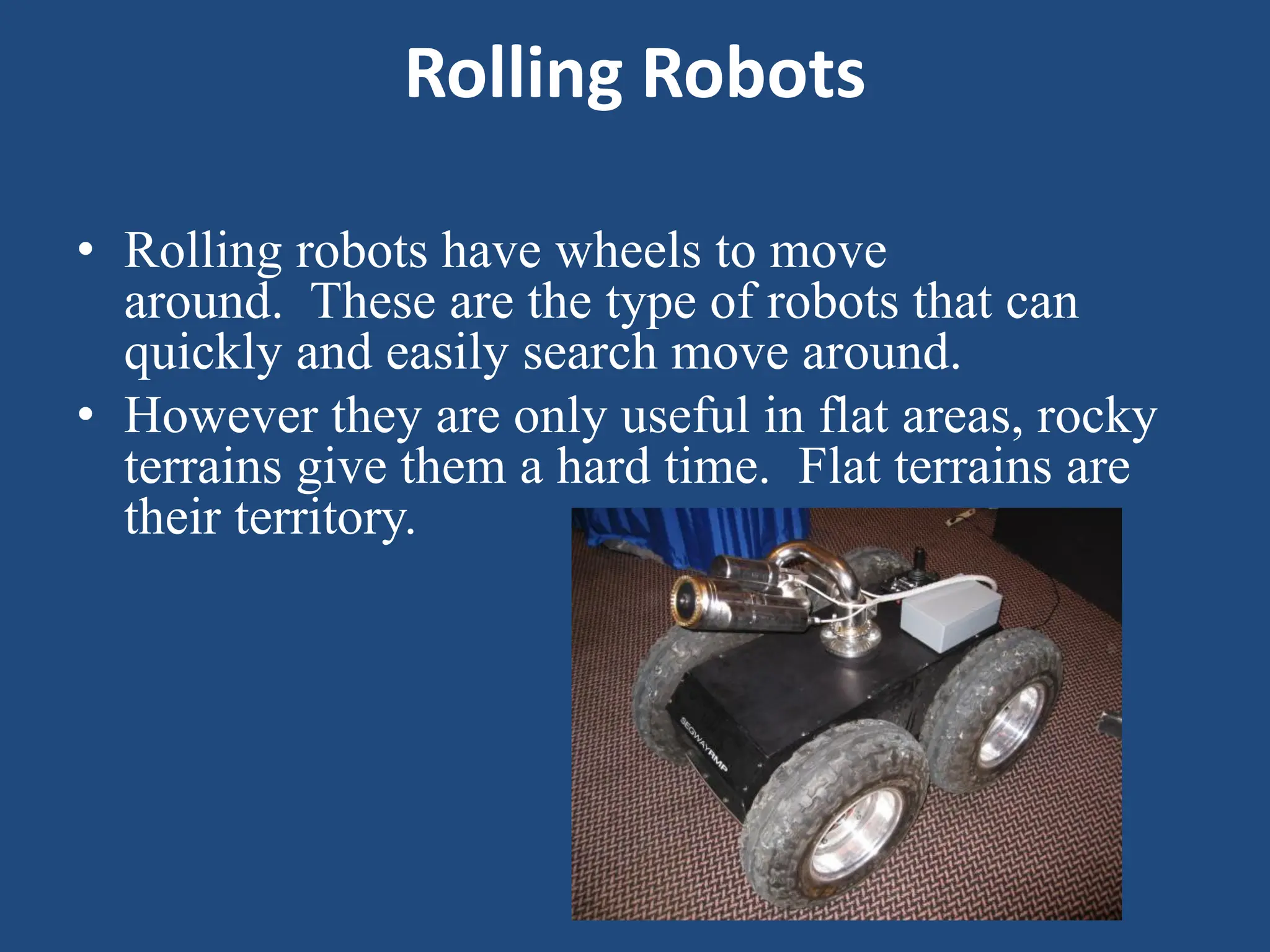
• Rolling robots have wheels to move
around. These are the type of robots that can
quickly and easily search move around.
• However they are only useful in flat areas, rocky
terrains give them a hard time. Flat terrains are
their territory.
Walking Robots
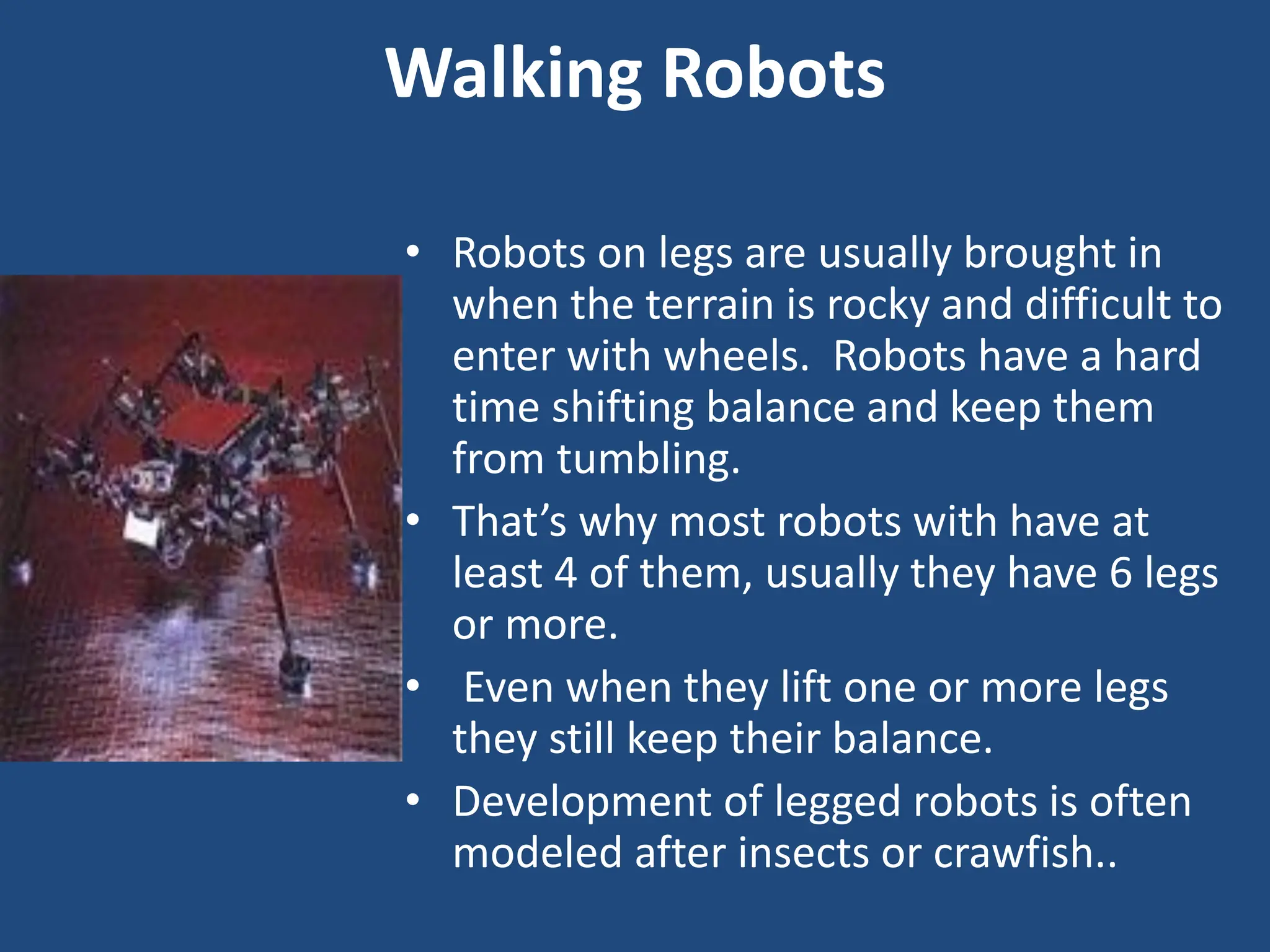
• Robots on legs are usually brought in
when the terrain is rocky and difficult to
enter with wheels. Robots have a hard
time shifting balance and keep them
from tumbling.
• That’s why most robots with have at
least 4 of them, usually they have 6 legs
or more.
• Even when they lift one or more legs
they still keep their balance.
• Development of legged robots is often
modeled after insects or crawfish..
Stationary Robots
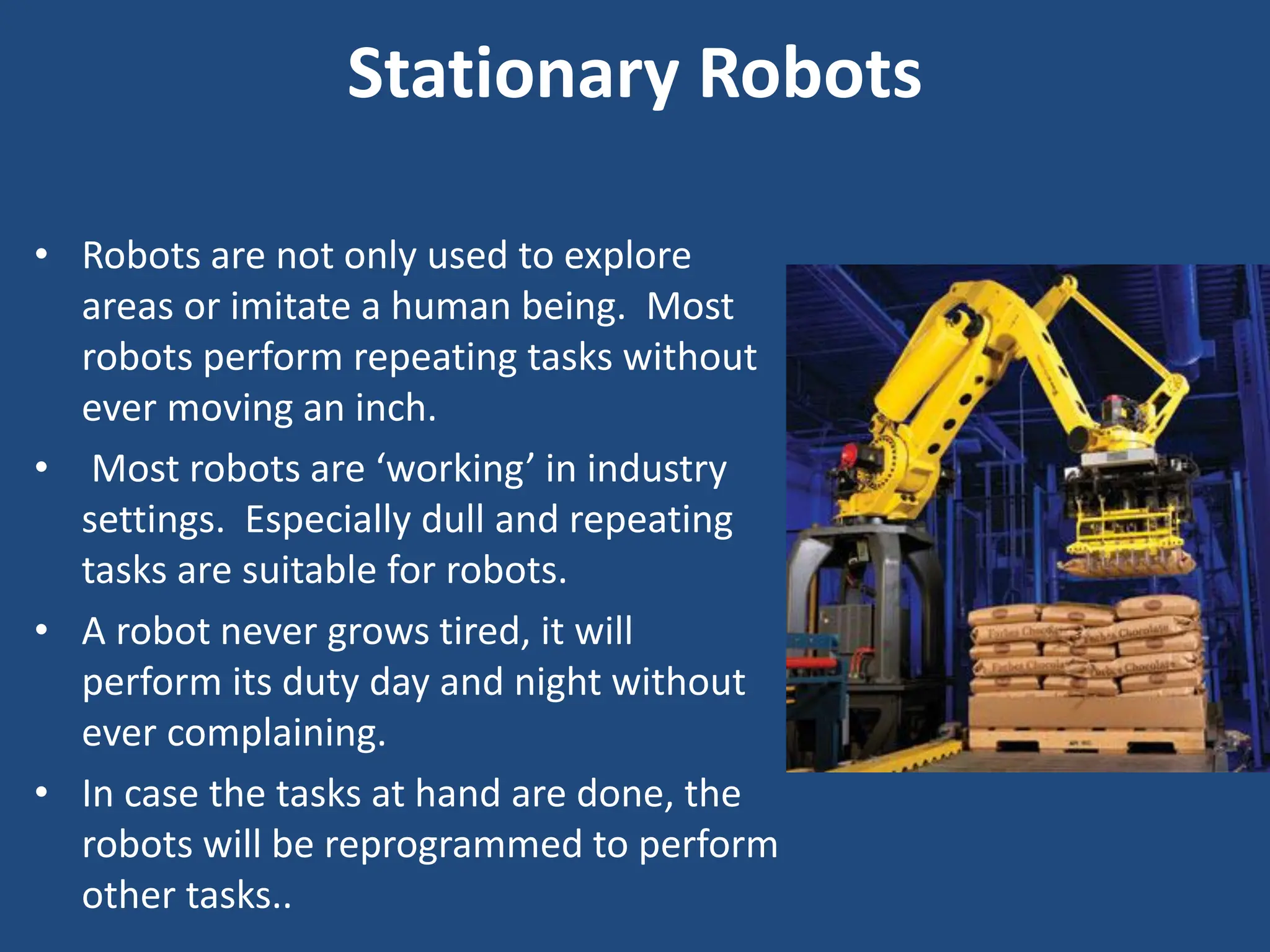
• Robots are not only used to explore
areas or imitate a human being. Most
robots perform repeating tasks without
ever moving an inch.
• Most robots are ‘working’ in industry
settings. Especially dull and repeating
tasks are suitable for robots.
• A robot never grows tired, it will
perform its duty day and night without
ever complaining.
• In case the tasks at hand are done, the
robots will be reprogrammed to perform
other tasks..
Autonomous Robots
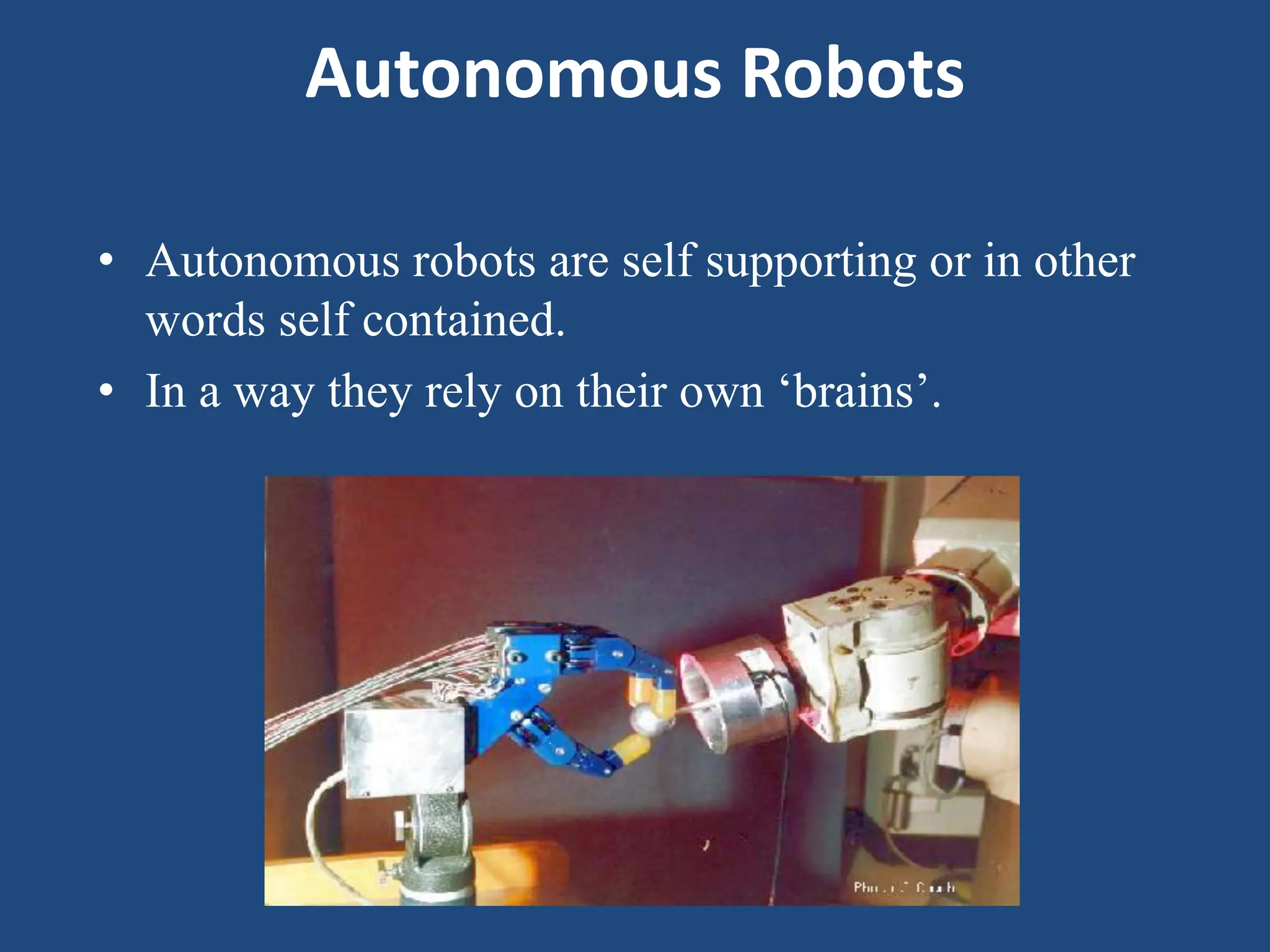
• Autonomous robots are self supporting or in other
words self contained.
• In a way they rely on their own ‘brains’.
Remote-control Robots
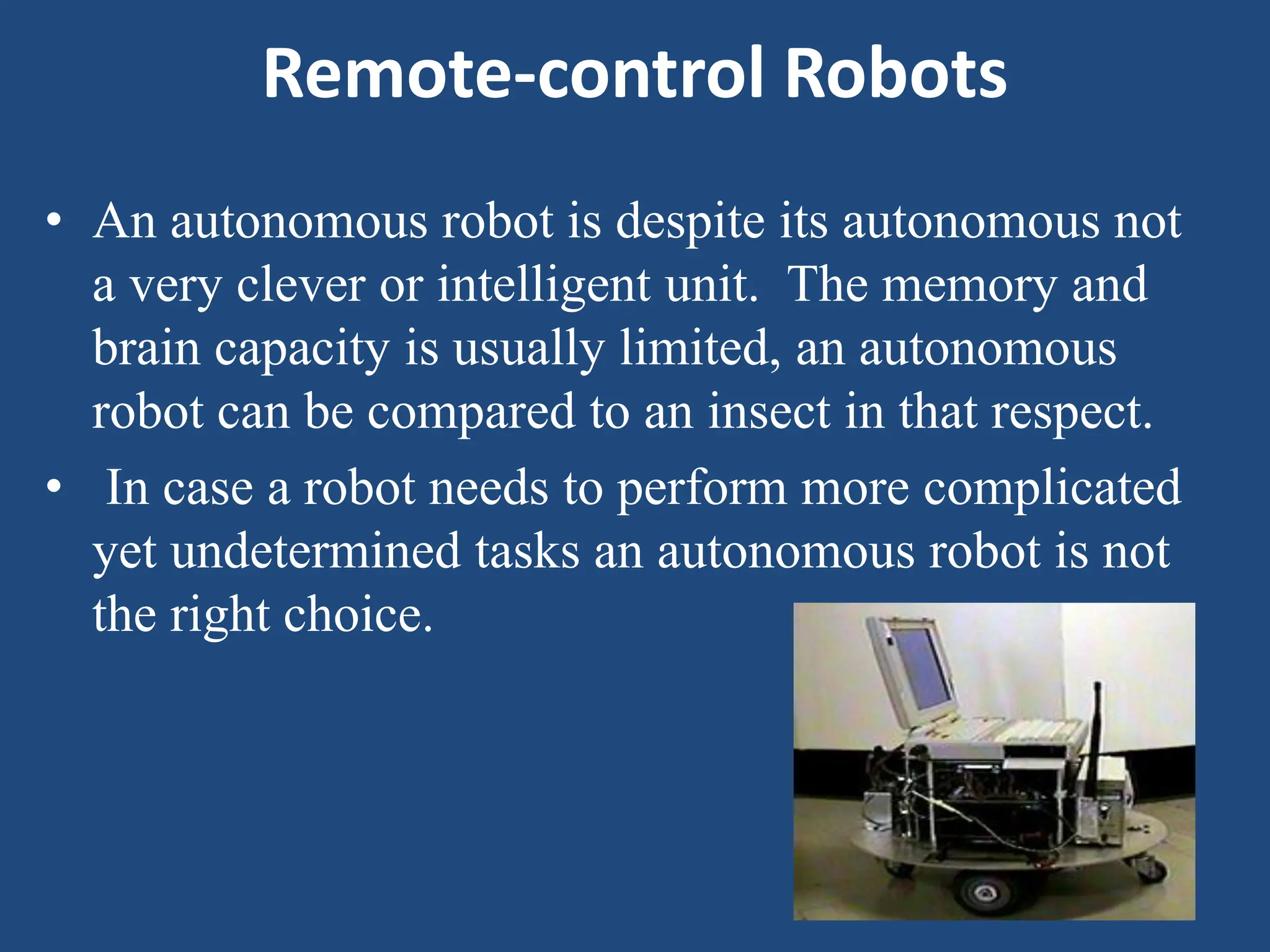
• An autonomous robot is despite its autonomous not
a very clever or intelligent unit. The memory and
brain capacity is usually limited, an autonomous
robot can be compared to an insect in that respect.
• In case a robot needs to perform more complicated
yet undetermined tasks an autonomous robot is not
the right choice.
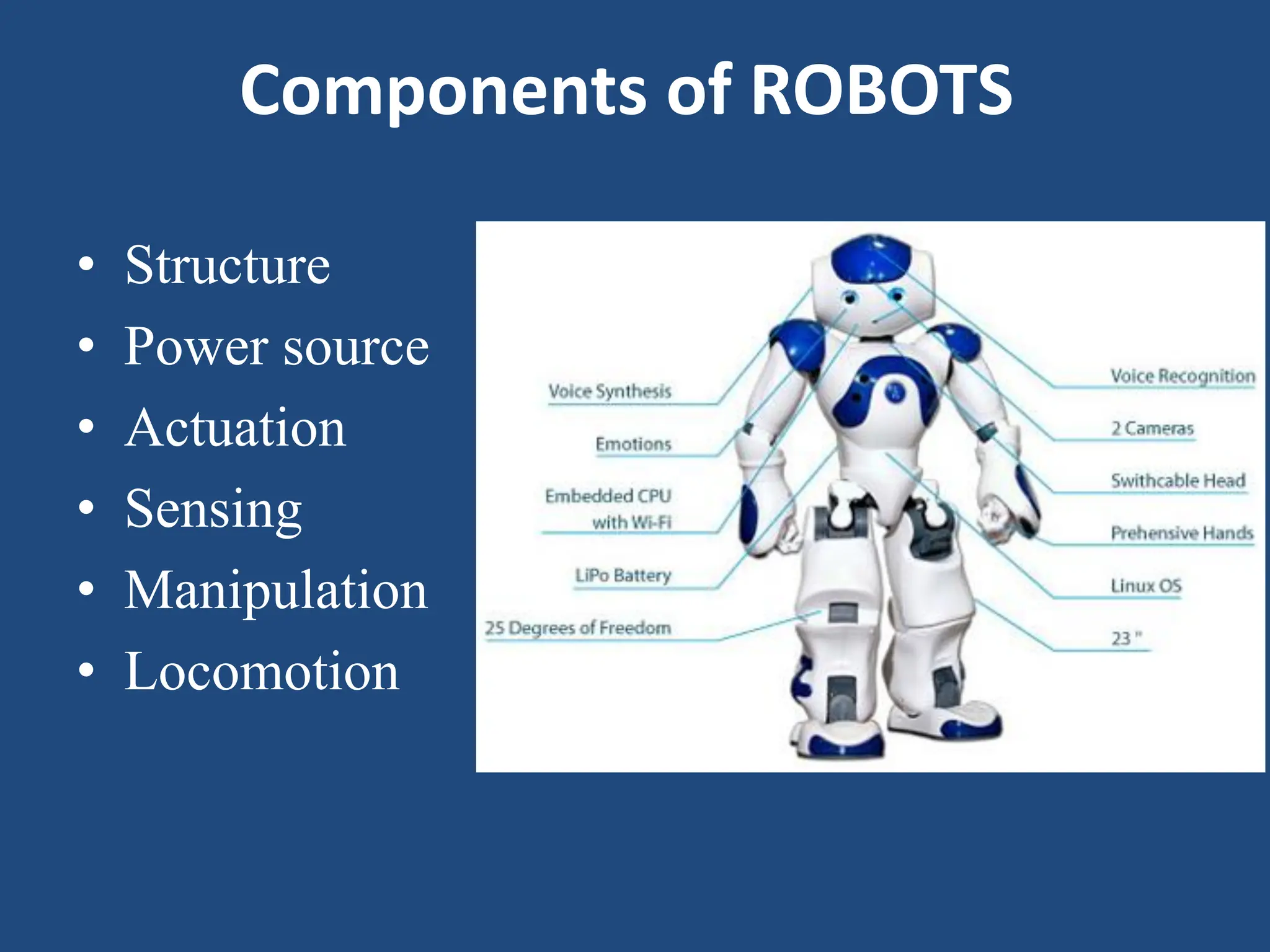
Components of ROBOTS
• Structure
• Power source
• Actuation
• Sensing
• Manipulation
• Locomotion
Structure
• The structure of a robot is usually mostly
mechanical and can be called a kinematic
chain.
• The chain is formed of links (its bones),
actuators (its muscles), and joints which can
allow one or more degrees of freedom.
Power source
• Suitable power supply is needed to run the motors and
associated circuitry
• Typical power requirement ranges from 3V to 24V DC
• 220V AC supply must be modified to suit the needs of
our machine
• Batteries can also be used to run robots
• Robots are driven by different motors :-
o DC Motors
o Stepper Motors
o Servo Motors
Actuation
• Actuators are the "muscles" of a robot, the
parts which convert stored energy into
movement.
• The most popular actuators are electric
motors.
Manipulation
• Robots which must work in the real world require
some way to manipulate objects; pick up, modify,
destroy, or otherwise have an effect.
• Thus the 'hands' of a robot are often referred to as end
effectors, while the arm is referred to as a
manipulator.
• Some manipulators are:
oMechanical Grippers
oVacuum Grippers
oGeneral purpose effectors
Locomotion
• It is concerned with the motion of the robot.
• Robot contains different types of drives:-
oDifferential drive
oCar type
oSkid steer drive
oSynchronous drive
oPivot drive
oArticulated drive
oPivot drive
Advantages
•Revolution in Medical science and Health care
systems.
•New & wide scope in Education & Training.
•A good help in Nuclear industry.
•Used tremendously in Sports activities.
•Play the role of an efficient assistance in Research and
Development sciences.
•Can very well handle household business.
Future Prospects
• Scientists say that it is possible that a robot brain will
exist by 2019 .
• Vernor Vinge has suggested that a moment may come
when computers and robots are smarter than humans.
• In 2009, some robots acquired various forms of semi-
autonomy, including being able to find power sources on
their own.
• The Association for the Advancement of Artificial
Intelligence has researched on this problem.
Reference
• www.google.com
• www.wikipedia.com
• www.studymafia.org
Thanks You

Asmod Ali Mondal On Robotics.pdf full details

  • 1.
    Basugaon College Guided By:Presented By: Panja Rani Basumatary Asmod Ali Mondal Asst. Professor ,BCA Department Roll No: UG109P210002 Presentation On Robotics
  • 2.
    Content • Introduction • Whatis Robotics • History • The Three Laws Of Robotics • Why Robotics ? • Types of ROBOTS • Components of ROBOTS • Advantages • Future Prospects • Reference
  • 3.
    Introduction • With growingdevelopments in the field of mechatronics and mathematic modeling, robotics has come a long way. • From an iron piece that could move only a few inches, there are now machines capable of jumping from high-rise buildings, detecting landmines, performing operations and troubleshooting.
  • 4.
    What is Robotics •The word robotics is used to collectivily define a field in engineering that covers the mimicking of various human characteristics. • Sound concepts in many engineering disciplines is needed for working in this field. • It find its uses in all aspects of our.
  • 5.
    History • The term‘robot’ got prominence way back in the 1950s when Karl Capek in his play Rossum’s Universal Robots denoted the birth of a superior race that had intelligence similar to that of humans. • Later on Issac Asimov introduced his laws of robots and finally Eric Elenberger, who is considered as the father of robotics, introduced real time robots to the world.
  • 6.
    The Three LawsOf Robotics • A robot may not injure a human being, or, through inaction allow a human being to come to harm. • A robot must obey the orders given it by human beings except where such orders would conflict with the First Law. • A robot must protect its own existence s long as such protection does not conflict with the First or Second Law.
  • 7.
    Why Robotics ? •Speed. • It can work hazardous/dangerous environment. • To perform repetitive task. • Efficiency • Accuracy • Adaptability
  • 8.
    Types of Robots •Mobile Robots • Rolling Robots • Walking Robots • Stationary Robots • Autonomous Robots • Remote-control Robots
  • 9.
    Mobile Robots • Mobilerobots are able to move, usually they perform task such as search areas. A prime example is the Mars Explorer, specifically designed to roam the mars surface. • Mobile robots are a great help to such collapsed building for survivors Mobile robots are used for task where people cannot go. Either because it is too dangerous of because people cannot reach the area that needs to be searched.
  • 10.
    Rolling Robots • Rollingrobots have wheels to move around. These are the type of robots that can quickly and easily search move around. • However they are only useful in flat areas, rocky terrains give them a hard time. Flat terrains are their territory.
  • 11.
    Walking Robots • Robotson legs are usually brought in when the terrain is rocky and difficult to enter with wheels. Robots have a hard time shifting balance and keep them from tumbling. • That’s why most robots with have at least 4 of them, usually they have 6 legs or more. • Even when they lift one or more legs they still keep their balance. • Development of legged robots is often modeled after insects or crawfish..
  • 12.
    Stationary Robots • Robotsare not only used to explore areas or imitate a human being. Most robots perform repeating tasks without ever moving an inch. • Most robots are ‘working’ in industry settings. Especially dull and repeating tasks are suitable for robots. • A robot never grows tired, it will perform its duty day and night without ever complaining. • In case the tasks at hand are done, the robots will be reprogrammed to perform other tasks..
  • 13.
    Autonomous Robots • Autonomousrobots are self supporting or in other words self contained. • In a way they rely on their own ‘brains’.
  • 14.
    Remote-control Robots • Anautonomous robot is despite its autonomous not a very clever or intelligent unit. The memory and brain capacity is usually limited, an autonomous robot can be compared to an insect in that respect. • In case a robot needs to perform more complicated yet undetermined tasks an autonomous robot is not the right choice.
  • 15.
    Components of ROBOTS •Structure • Power source • Actuation • Sensing • Manipulation • Locomotion
  • 16.
    Structure • The structureof a robot is usually mostly mechanical and can be called a kinematic chain. • The chain is formed of links (its bones), actuators (its muscles), and joints which can allow one or more degrees of freedom.
  • 17.
    Power source • Suitablepower supply is needed to run the motors and associated circuitry • Typical power requirement ranges from 3V to 24V DC • 220V AC supply must be modified to suit the needs of our machine • Batteries can also be used to run robots • Robots are driven by different motors :- o DC Motors o Stepper Motors o Servo Motors
  • 18.
    Actuation • Actuators arethe "muscles" of a robot, the parts which convert stored energy into movement. • The most popular actuators are electric motors.
  • 19.
    Manipulation • Robots whichmust work in the real world require some way to manipulate objects; pick up, modify, destroy, or otherwise have an effect. • Thus the 'hands' of a robot are often referred to as end effectors, while the arm is referred to as a manipulator. • Some manipulators are: oMechanical Grippers oVacuum Grippers oGeneral purpose effectors
  • 20.
    Locomotion • It isconcerned with the motion of the robot. • Robot contains different types of drives:- oDifferential drive oCar type oSkid steer drive oSynchronous drive oPivot drive oArticulated drive oPivot drive
  • 21.
    Advantages •Revolution in Medicalscience and Health care systems. •New & wide scope in Education & Training. •A good help in Nuclear industry. •Used tremendously in Sports activities. •Play the role of an efficient assistance in Research and Development sciences. •Can very well handle household business.
  • 22.
    Future Prospects • Scientistssay that it is possible that a robot brain will exist by 2019 . • Vernor Vinge has suggested that a moment may come when computers and robots are smarter than humans. • In 2009, some robots acquired various forms of semi- autonomy, including being able to find power sources on their own. • The Association for the Advancement of Artificial Intelligence has researched on this problem.
  • 23.
  • 24.