WELCOME
 Introduction
 Topic Covered
 How Robots Work
 Need of Robotic Agriculture
 Types of Robots
 Robots used in Agriculture
 Future Scope
 Advantages and disadvantages
 Conclusion
Introduction
Robots:-
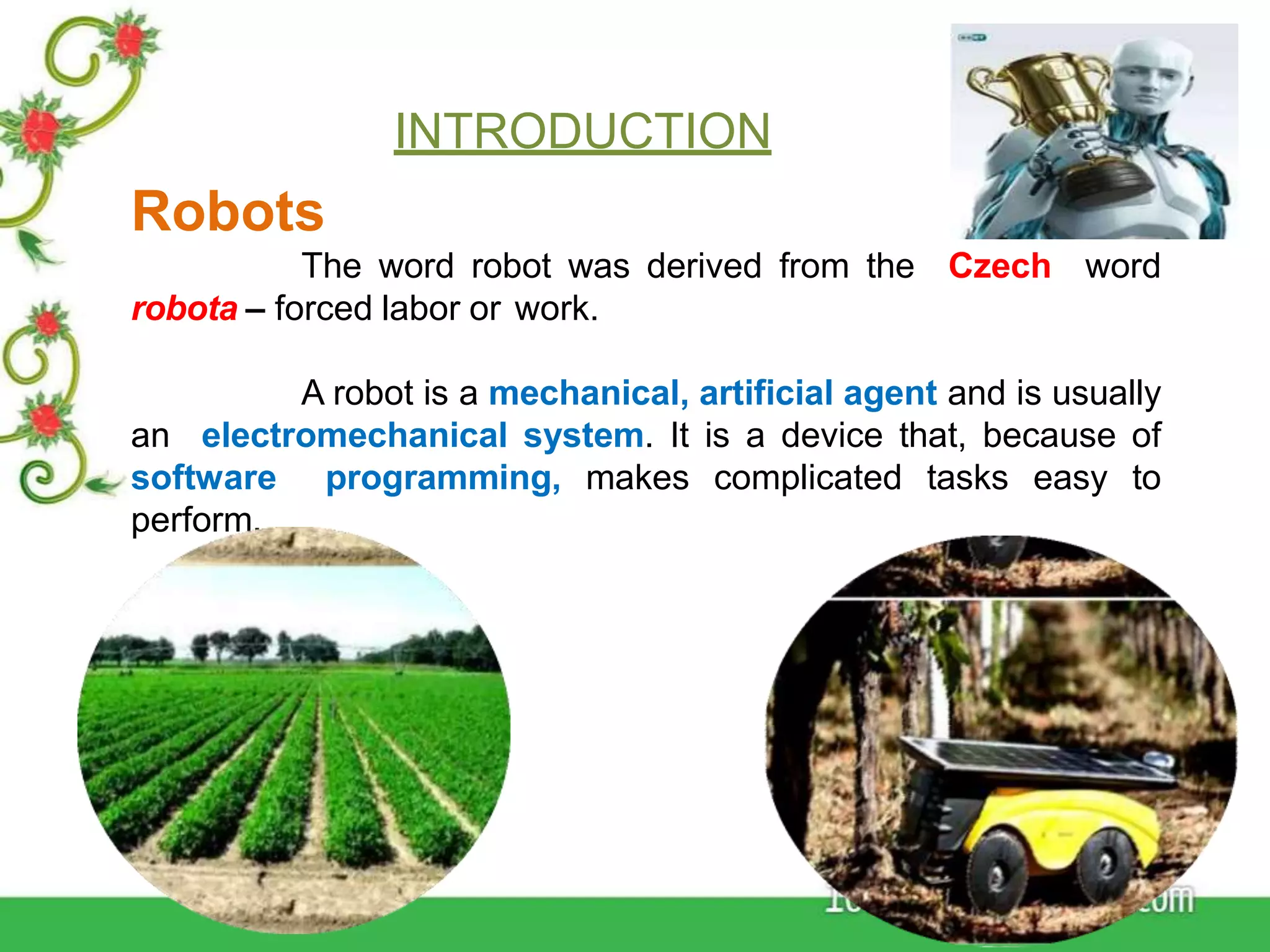
The word robot was derived from the Czech word
robota – forced labor orwork.
A robot is a mechanical, artificial agent and is usually an
electromechanical system. It is a device that, because of software
programming, makes complicated tasks easy to perform.
Robots
The word robot was derived from the Czech word
robota – forced labor or work.
A robot is a mechanical, artificial agent and is usually
an electromechanical system. It is a device that, because of
software programming, makes complicated tasks easy to
perform.
INTRODUCTION
Agriculture robots
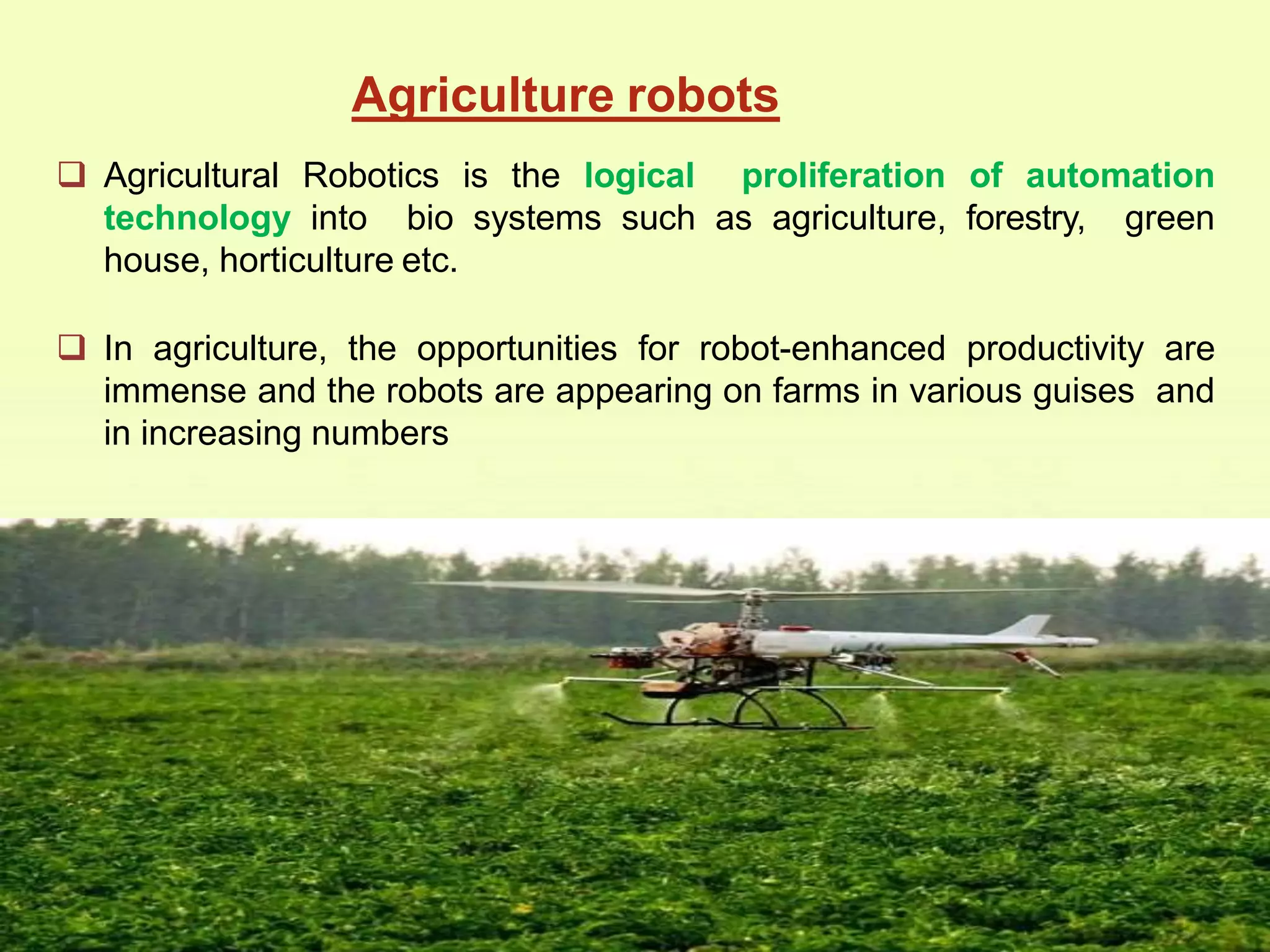
 Agricultural Robotics is the logical proliferation of automation
technology into bio systems such as agriculture, forestry, green
house, horticulture etc.
 In agriculture, the opportunities for robot-enhanced productivity are
immense and the robots are appearing on farms in various guises and
in increasing numbers
 To Study focus on the economic feasibility of applying
autonomous robotic vehicles.
 To review of robot usage and outcome of using robots in
agriculture.
 To know how crop production could be automated in the
future.
 Robots can move and sense.
 They require multiple sensors and controls that allow them
to move in an unknown environment.
Robots usually have five parts
1) Sensors
2) Controller/Computer
3) Drive/Actuator
4) Arm
5) End-effectors
 The sensors send information in the form of electronic signals
back to thecontroller.
 Sensors can give the robot controller information about its
surroundings.
 It is also called as computer.
 The controller functions as the "brain" of the robot.
 The controller also allows the robot to be networked to
other systems, so that it may work together with other
machines, processes, or robots.
 The drive or actuator is the “engine” of the robot.
 An actuator is defined as “a mechanical device that
produces motion.”





Hydraulic motor
Pneumatic motor
Stepper motor
Dc motor
Servo motor
 Usually, a robot’s arm is like a human arm with a
shoulder, elbow and fingers.
 The arm is the part of the robot that positions the end-effectors
and sensors to do their pre- programmed business.
 The end effectors means the last link (or end) of the robot.
 At this endpoint the tools are attached. In a wider sense, end effectors can
be seen as the part of a robot that interacts with the work environment.
Gripper Vaccum pump
Difference between automized
and conventional techniques
Conventional techniques depend on
human power and old techniques
Robots can work non stop, humans need
rest
Human may not be able to work in
hazardous environments
large sized wheels required in muddy soils,
robots small sized wheels perform well.
Robot scouts get detailed info about crop
Robots can detect presence of diseases,
weeds, insect infestations and other stress
conditions.
The lightweight of the robots do not
compact the soil as larger machinery does
Power Machinery power Human power and old
techniques
Work Capacity High Low (Human need
rest)
Time Less More
Product Quality High Low
Cost of Cultivation Initially high but in
long run low
Initially Low but In
Long run High
Yield High Low
Spraying Robot
Techniques involving
Agricultural Robots
 Processes like
ploughing, seeding, fertilizing, weeding, harvesting, spraying etc.
require large amount man power. Hence in order to reduce this
need, and save time and money, robots are employed.
MF- Scamp robots for scouting,
weeding and harvesting
 Speed
 Can work in hazardous/dangerous
 Can do repetitive tasks
 Can do work with accuracy
 Sustain domestic agriculture
 Facilitates 24 hr operations
 Improves safety
 Reduces labour needs
 Reduces chemical usage
Autonomous robots
 Work completely under the control of a computer
program.
Tele-controlled robots/ Remote-controlled
 Work under the control of
humans or computer
programs.
 Robots are controlled by
humans with a controller
such as a joystick or other
hand-held device.
1. Demeter
2. Weed control robot
3. Forester robot
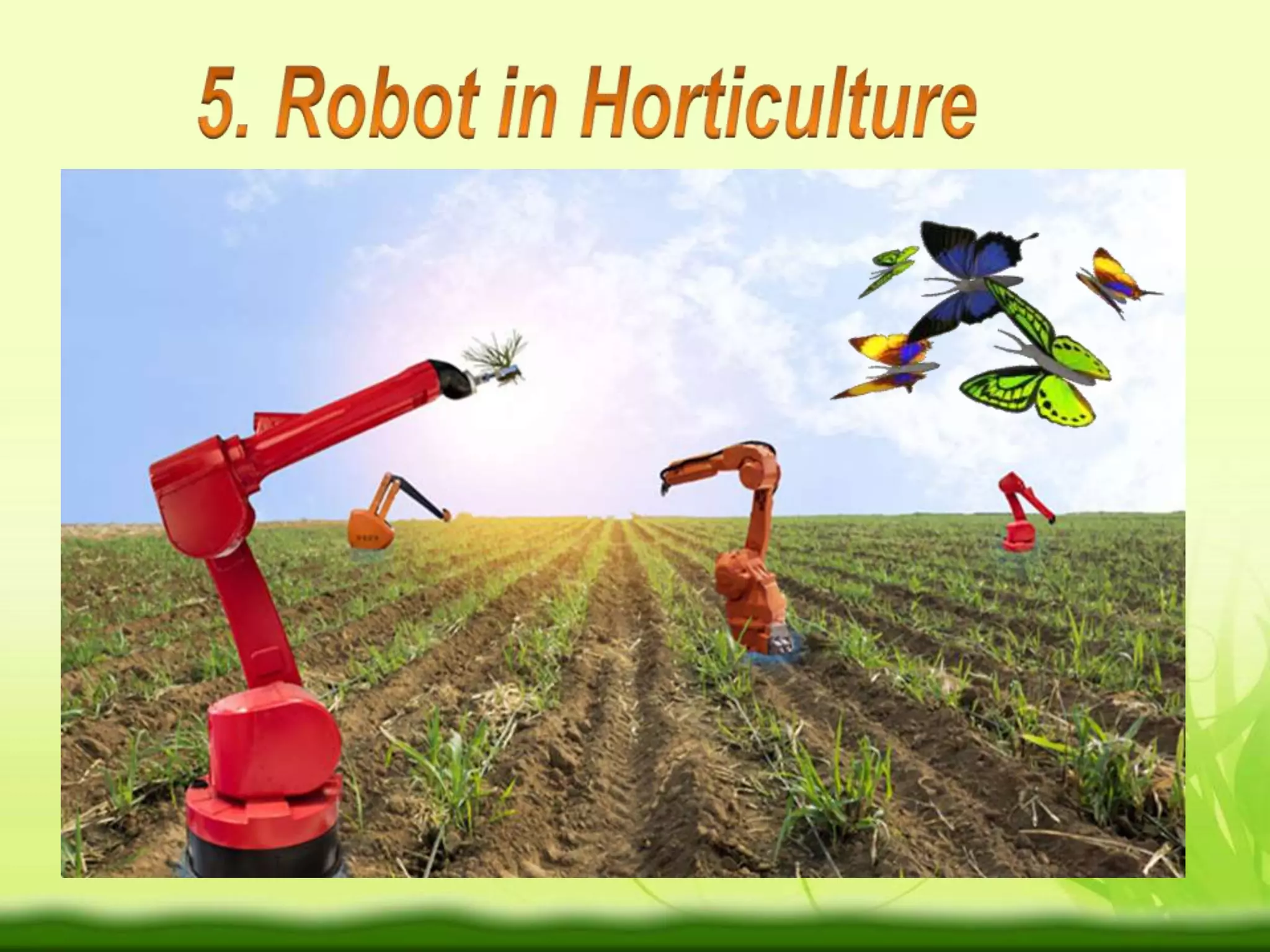
4. Robot in horticulture.
5. Fruit picking robot
6. Drones
 Demeter is capable of planning harvesting operations
for entire field and driven by remote control.
 Demeter is a robot that can cut crops it looks like a
normal harvester, but can drive by itself without any
human supervision.
Source: Tom Pilarski et al.,(2002)
Source: David Slaughter et al.,(2008)
 Weed identification is based on color
photography.
 A four-wheel-drive weed-seeking
robot was developed by the Danish
Farm Research Authority.
 The task of the weed removing
device is to remove or destroy the
weed.
 An intelligent hoe uses vision
systems to identify the row of crops,
and steer itself accurately between
them, considerably reducing the
need for herbicides.
Source: Pedersen et al., (2006)
 Pick ripe fruit without damaging the
branches or leaves of the tree.
 The robot can distinguish between
fruit and leaves by using video
image capturing.
 If a match is obtained, the fruit
is picked.
 Mobility is a priority and the robots
must be able to access all areas
of the tree being harvested.
Source: Ashwini.K (2016)
 This is a special type of robot used for cutting
up of wood, tending trees, and pruning of X-
mass tree.
 The forester robot having six legs moves
wonders in the forest.
 It is used for harvesting pulp and hard wood
in the forests.
Source: Koteswara et al. (2014)
Model : TC-158N
Brand : TIAN CHEN
Origin : Made In China
Category : Horticulture & robotic lawn mower,
robotic grass cutter and auto garden mower
Price : US $534 / pc
Cutting height : 3cm-4cm
Cutting speed : 20m/min
Hill capability : 30degree max slope
Wireless remote
control distance : 6m
Type of battery : lithium and lead-acid
Charging time : 3hours
Average working time : 2-3hours
 Robot is used in lawns to cut
the grass in lawns. It can cut
any lawn and maintain of its
geometric shape
 Robot is used to Color, weight,
health and size of fruit or
vegetable are automatically
detected by sensors after
which a robotic arm puts the
right produce in right trey.
 To get a bird’s eye view of the land offers a quick and easy
way to check on the progress of crops and determine where
they may need to replant or direct pesticide applications.
 It is also used for weed, pest and disease control.
Source :Anderson,C, (2014)
Future Scope
 It is expected that it can be used in
agriculture for the control of weed and
insects.
 The robot suit is designed specifically to help out with
tough agricultural work like pulling radishes.
 The suit has eight motors fitted over the shoulders
elbows, back and knees to provide a power boost to the
wearer.
 The current model weighs 55 pounds and uses 16
sensors to function.
Vitirover solar Robot
 A French company designs a smart autonomous robot called
vitirover.
 Vitirover solar Robot used in Vines to Cuts Grass And Weeds
 The little robot uses the sun power to the electrical motors.
 Using a solar panel this agricultural autonomous machine could work
for hundred hours without rest.
 It could cuts grass and weeds to within 2-3 cm of vine and has a
speed that allows him to work 500 meters per hour.
Name of the Company : Green Robot Machinery Private Limited
Name of Founder : Manohar Sambandam
City : Bengaluru
Industry : Agriculture
Crop : cotton
Robot : GRoboMac
Target : 500kg/day
practices : Harvesting,
Pruning and Weeding.
 In the fully-automated Farm of the Future, dedicated robots will take
on farming jobs that once could be done only by people.
 It is not just on the ground that technology promises to transform
farming. Unmanned Air Vehicles, or drones, are also coming into play
on farms.
Alex Thomasson 2015
 Robots can work 24 hours a day, every day without rest.
 Robots don’t need to be paid wage (so money is saved).
 Robots are extremely accurate compared to humans,
so product quality is high.
 Robots can perform tasks more quickly than humans,
so more products can be made.
 Robots can work in very dangerous conditions.
 It can reduce up to 97% of farm’s use ofpesticide.
 Energy issues, costly.
 People are made unemployed because robots are doing their
job.
 Robots are very expensive and it can take more time to pay
for them.
 lack of decision-making power.
 Agriculture robots can reduce the cost of cultivation by controlling
the high cost of labor, efficient use of fertilizers, pesticides.
 Workload on farmers minimized by using these type of robots, and it
have to complete field operation at the time.
 The higher quality products can be obtained by this technique and
it is best for future farming.
1) Pilarski, Mike Happold, Henning Pangels, Mark Ollis, Kerien Fitzpatrick and Antony
Stentz, The Demeter System for Automated Harvesting ,robotics Institute, Carnegie
Mellon UniTomversity, autonomous robots 13(1)9-20,july (2002).
2) David Slaughter, Downey, Giles, Autonomous robotic Weed Control System, Computers
and Electronics in Agriculture 61(1):63-78, April(2008).
3) Ashwini.K, Survey Paper on Fruit Picking Robots, International Journal of Computer
Science and Mobile Computing IJCSMC, vol5, issue 1, January 2016, pg 96-101.
4) Anderson,C, Agricultural drones, Technology Review, 117,58-60, May (2014)
.http://search.proquest.com/docview/15341-43322/
5) P. Akella, M. Peshkin, E. Colgate, W. Wannasuphoprasit, N. Nagesh, J. Wells, S. Holland,
T. Pearson, and B. Peacock, “Robots for the automobile assembly line,” in Proceedings
1999. IEEE International Conference on Robotics and Automation(Cat. No.99CH36288C).
IEEE. [Online]. Available: https://doi.org/10.1109/robot.1999.770061.
Robotics in Agriculture

Robotics in Agriculture

  • 1.
  • 4.
     Introduction  TopicCovered  How Robots Work  Need of Robotic Agriculture  Types of Robots  Robots used in Agriculture  Future Scope  Advantages and disadvantages  Conclusion
  • 5.
    Introduction Robots:- The word robotwas derived from the Czech word robota – forced labor orwork. A robot is a mechanical, artificial agent and is usually an electromechanical system. It is a device that, because of software programming, makes complicated tasks easy to perform. Robots The word robot was derived from the Czech word robota – forced labor or work. A robot is a mechanical, artificial agent and is usually an electromechanical system. It is a device that, because of software programming, makes complicated tasks easy to perform. INTRODUCTION
  • 6.
    Agriculture robots  AgriculturalRobotics is the logical proliferation of automation technology into bio systems such as agriculture, forestry, green house, horticulture etc.  In agriculture, the opportunities for robot-enhanced productivity are immense and the robots are appearing on farms in various guises and in increasing numbers
  • 7.
     To Studyfocus on the economic feasibility of applying autonomous robotic vehicles.  To review of robot usage and outcome of using robots in agriculture.  To know how crop production could be automated in the future.
  • 8.
     Robots canmove and sense.  They require multiple sensors and controls that allow them to move in an unknown environment.
  • 9.
    Robots usually havefive parts 1) Sensors 2) Controller/Computer 3) Drive/Actuator 4) Arm 5) End-effectors
  • 10.
     The sensorssend information in the form of electronic signals back to thecontroller.  Sensors can give the robot controller information about its surroundings.
  • 11.
     It isalso called as computer.  The controller functions as the "brain" of the robot.  The controller also allows the robot to be networked to other systems, so that it may work together with other machines, processes, or robots.
  • 12.
     The driveor actuator is the “engine” of the robot.  An actuator is defined as “a mechanical device that produces motion.”      Hydraulic motor Pneumatic motor Stepper motor Dc motor Servo motor
  • 13.
     Usually, arobot’s arm is like a human arm with a shoulder, elbow and fingers.  The arm is the part of the robot that positions the end-effectors and sensors to do their pre- programmed business.
  • 14.
     The endeffectors means the last link (or end) of the robot.  At this endpoint the tools are attached. In a wider sense, end effectors can be seen as the part of a robot that interacts with the work environment. Gripper Vaccum pump
  • 15.
    Difference between automized andconventional techniques Conventional techniques depend on human power and old techniques Robots can work non stop, humans need rest Human may not be able to work in hazardous environments large sized wheels required in muddy soils, robots small sized wheels perform well. Robot scouts get detailed info about crop Robots can detect presence of diseases, weeds, insect infestations and other stress conditions. The lightweight of the robots do not compact the soil as larger machinery does
  • 16.
    Power Machinery powerHuman power and old techniques Work Capacity High Low (Human need rest) Time Less More Product Quality High Low Cost of Cultivation Initially high but in long run low Initially Low but In Long run High Yield High Low
  • 17.
    Spraying Robot Techniques involving AgriculturalRobots  Processes like ploughing, seeding, fertilizing, weeding, harvesting, spraying etc. require large amount man power. Hence in order to reduce this need, and save time and money, robots are employed. MF- Scamp robots for scouting, weeding and harvesting
  • 18.
     Speed  Canwork in hazardous/dangerous  Can do repetitive tasks  Can do work with accuracy  Sustain domestic agriculture  Facilitates 24 hr operations  Improves safety  Reduces labour needs  Reduces chemical usage
  • 20.
    Autonomous robots  Workcompletely under the control of a computer program. Tele-controlled robots/ Remote-controlled  Work under the control of humans or computer programs.  Robots are controlled by humans with a controller such as a joystick or other hand-held device.
  • 21.
    1. Demeter 2. Weedcontrol robot 3. Forester robot 4. Robot in horticulture. 5. Fruit picking robot 6. Drones
  • 22.
     Demeter iscapable of planning harvesting operations for entire field and driven by remote control.  Demeter is a robot that can cut crops it looks like a normal harvester, but can drive by itself without any human supervision. Source: Tom Pilarski et al.,(2002)
  • 23.
    Source: David Slaughteret al.,(2008)  Weed identification is based on color photography.  A four-wheel-drive weed-seeking robot was developed by the Danish Farm Research Authority.  The task of the weed removing device is to remove or destroy the weed.  An intelligent hoe uses vision systems to identify the row of crops, and steer itself accurately between them, considerably reducing the need for herbicides.
  • 26.
  • 27.
     Pick ripefruit without damaging the branches or leaves of the tree.  The robot can distinguish between fruit and leaves by using video image capturing.  If a match is obtained, the fruit is picked.  Mobility is a priority and the robots must be able to access all areas of the tree being harvested. Source: Ashwini.K (2016)
  • 30.
     This isa special type of robot used for cutting up of wood, tending trees, and pruning of X- mass tree.  The forester robot having six legs moves wonders in the forest.  It is used for harvesting pulp and hard wood in the forests.
  • 31.
  • 33.
    Model : TC-158N Brand: TIAN CHEN Origin : Made In China Category : Horticulture & robotic lawn mower, robotic grass cutter and auto garden mower Price : US $534 / pc Cutting height : 3cm-4cm Cutting speed : 20m/min Hill capability : 30degree max slope Wireless remote control distance : 6m Type of battery : lithium and lead-acid Charging time : 3hours Average working time : 2-3hours
  • 34.
     Robot isused in lawns to cut the grass in lawns. It can cut any lawn and maintain of its geometric shape  Robot is used to Color, weight, health and size of fruit or vegetable are automatically detected by sensors after which a robotic arm puts the right produce in right trey.
  • 35.
     To geta bird’s eye view of the land offers a quick and easy way to check on the progress of crops and determine where they may need to replant or direct pesticide applications.  It is also used for weed, pest and disease control. Source :Anderson,C, (2014)
  • 37.
  • 39.
     It isexpected that it can be used in agriculture for the control of weed and insects.
  • 40.
     The robotsuit is designed specifically to help out with tough agricultural work like pulling radishes.  The suit has eight motors fitted over the shoulders elbows, back and knees to provide a power boost to the wearer.  The current model weighs 55 pounds and uses 16 sensors to function.
  • 42.
    Vitirover solar Robot A French company designs a smart autonomous robot called vitirover.  Vitirover solar Robot used in Vines to Cuts Grass And Weeds  The little robot uses the sun power to the electrical motors.  Using a solar panel this agricultural autonomous machine could work for hundred hours without rest.  It could cuts grass and weeds to within 2-3 cm of vine and has a speed that allows him to work 500 meters per hour.
  • 45.
    Name of theCompany : Green Robot Machinery Private Limited Name of Founder : Manohar Sambandam City : Bengaluru Industry : Agriculture Crop : cotton Robot : GRoboMac Target : 500kg/day practices : Harvesting, Pruning and Weeding.
  • 59.
     In thefully-automated Farm of the Future, dedicated robots will take on farming jobs that once could be done only by people.  It is not just on the ground that technology promises to transform farming. Unmanned Air Vehicles, or drones, are also coming into play on farms.
  • 60.
  • 62.
     Robots canwork 24 hours a day, every day without rest.  Robots don’t need to be paid wage (so money is saved).  Robots are extremely accurate compared to humans, so product quality is high.  Robots can perform tasks more quickly than humans, so more products can be made.  Robots can work in very dangerous conditions.  It can reduce up to 97% of farm’s use ofpesticide.
  • 63.
     Energy issues,costly.  People are made unemployed because robots are doing their job.  Robots are very expensive and it can take more time to pay for them.  lack of decision-making power.
  • 64.
     Agriculture robotscan reduce the cost of cultivation by controlling the high cost of labor, efficient use of fertilizers, pesticides.  Workload on farmers minimized by using these type of robots, and it have to complete field operation at the time.  The higher quality products can be obtained by this technique and it is best for future farming.
  • 65.
    1) Pilarski, MikeHappold, Henning Pangels, Mark Ollis, Kerien Fitzpatrick and Antony Stentz, The Demeter System for Automated Harvesting ,robotics Institute, Carnegie Mellon UniTomversity, autonomous robots 13(1)9-20,july (2002). 2) David Slaughter, Downey, Giles, Autonomous robotic Weed Control System, Computers and Electronics in Agriculture 61(1):63-78, April(2008). 3) Ashwini.K, Survey Paper on Fruit Picking Robots, International Journal of Computer Science and Mobile Computing IJCSMC, vol5, issue 1, January 2016, pg 96-101. 4) Anderson,C, Agricultural drones, Technology Review, 117,58-60, May (2014) .http://search.proquest.com/docview/15341-43322/ 5) P. Akella, M. Peshkin, E. Colgate, W. Wannasuphoprasit, N. Nagesh, J. Wells, S. Holland, T. Pearson, and B. Peacock, “Robots for the automobile assembly line,” in Proceedings 1999. IEEE International Conference on Robotics and Automation(Cat. No.99CH36288C). IEEE. [Online]. Available: https://doi.org/10.1109/robot.1999.770061.