International Research Journal of Engineering and Technology (IRJET) e-ISSN: 2395-0056
Volume: 09 Issue: 07 | July 2022 www.irjet.net p-ISSN: 2395-0072
© 2022, IRJET | Impact Factor value: 7.529 | ISO 9001:2008 Certified Journal | Page 1151
Multifunctional Agribot using Android for Small Plantations
Adarsh A koushik1, Akash R2, Archana B H3, Likitha V4, Chandru A S5
1Adarsh A Koushik: Student, Dept. of ISE, NIE-IT, Mysore, Karnataka, India
2Akash R: Student, Dept. of ISE, NIE-IT, Mysore, Karnataka, India
3Archana B H: Student, Dept. of ISE, NIE-IT, Mysore, Karnataka, India
4Likitha V: Student, Dept. of ISE, NIE-IT, Mysore, Karnataka, India
5Chandru A S (co-author): Assistant Professor, Dept. of ISE, NIE-IT, Mysore, Karnataka, India
---------------------------------------------------------------------***---------------------------------------------------------------------
Abstract –
Robotics in engineering is fascinating that provides many
opportunities for research. In addition, the development of
technology in recent years has led to intelligent mobilerobots.
They may be sent to hard places instead of people either
because they are dangerous or because they are difficult to
access. However, controlling theserobotsisadifficulttaskthat
involves knowledge in various fields such as robotics,
automation, programming, electronics, etc. This project aims
to develop a robot that can perform operations such as
automatic plowing, seed dosing, fruit picking and pesticide
spraying. For manual control, the robot uses a Bluetooth
pairing application as a control device and helps to navigate
the robot outside the field. Farmers today spendalotofmoney
on machines that help them reduce labor and increase crop
yields, but the profit and efficiency are very low.
Key Words: Robotics, Farming, Bluetooth, DC motor,
Servomotor, automation
1. INTRODUCTION
Robotics plays a significant role inagricultural production
and management. In agriculture, time-saving autonomous
technology is needed to make farm management efficient.
Researchers are now focusing on various operational
parameters of agriculture to designautonomousagricultural
vehicles, as conventional agricultural machinery is
dependent on crop and topology.Robotslikethesearepretty
much perfect replacements for human power as they deploy
unmanned sensing and machine systems.
The overall goal of this project is to provide a synthesis of
research findings on the economics of field crop robotics.
The specific objectives were to: a) list and summarize
publicly available research on the economics of field crop
robotics, b) identify research gaps and needs related to crop
robotics, and c) suggest research topics that require urgent
attention. This review contributes to the science by
summarizing what has been accumulated about the
economics of crop robots, proposing mechanisms for how
these facts fit together, and identifying gaps in the science.
Primarily, this study focuses on profitability at the farm
level, since without profitability, cropping robots will not be
widely used and the expected environmental,social andfood
security benefits will not be achieved. When the benefits of
potentially profitable autonomous crop technologies were
identified, environmental, social and food security benefits
were noted.
In this, robots are evolved to concentrate effectively and
are also anticipated to perform operations autonomously.
The proposed idea implements a robot to perform functions
similar as planting, watering, fertilizing, watching crops.
These functions can be integrated into one robotandlatterly
performed. The robot is anticipated to perform functions
similar as planting, watering, fertilizing, covering,
autonomously in the field.
The main goal of agricultural automation knowledge
development is to alleviate labor energy. Advances in
automation and artificial intelligence offer solutions in
precision agriculture. Work related to scattering, collection,
unwanted plant control. To restore effectiveness.Therobots
were designed based on flexible automatic bending joints.
Instrumental robotics applications that are moving around
the world to cover other fields with robotics required,
replacing human operators are providing efficient results in
myriad problems with higher competence. The advanced
idea of our paper is to automate the process of planting,
cultivating, pesticide spraying and tunneling to reduce
humanoid effort and increase harvest. Seed cultivation is
done robotically using a DC motor. The distance between
two seeds is measured and varied using a microcontroller.It
is also possible to grow different types of seeds with
dissimilar spacing.Theproposedidea includesa sprayerthat
would serve to reduce fertilizer wastage, which is done by
spraying the appropriate amount of fertilizer required for a
particular crop. The process mode can be changed using
instructions existing in the robot application. Any nonlinear
relationship between inputs andoutputsiscontrolledbythis
system. The next step is to develop a more advanced GPS
system that increases accuracy. The direction of the robot
can be controlled using rectangular geometry
International Research Journal of Engineering and Technology (IRJET) e-ISSN: 2395-0056
Volume: 09 Issue: 07 | July 2022 www.irjet.net p-ISSN: 2395-0072
© 2022, IRJET | Impact Factor value: 7.529 | ISO 9001:2008 Certified Journal | Page 1152
2. OPERATION OF AUTONOMOUS MULTIPURPOSE
AGRICULTURAL ROBOT
1.seeding 2.glass land slicing 3.cultivating 4.reaping
5.shoveling 6.pesticide scattering 7. monitoring
1. The automation decreases the agriculturist labours with
fast speed by propagating 4 discordances at a time with line
shadowing. firstly, the seeds are stored in the vessel also it
will be spread across the fieldwithapplicabledetainmentsas
mentioned in the corresponding program.
2. Grass slice and unwanted plant junking Undesirable plant
in the estate damages the main crop and performance as a
barricade for development of the crop also decreases the
yield of the field.
3. The main perception of cultivating is to turn over the
advanced bed of the slush, transferring superior nutrient
contents to the face of the soil and making the nutritive soil
for the purpose of husbandry.
4. Picking is the act of taking away crop from field it was
growing and moving it to a defended point for processing,
nursing or packing.
5. Digging is actually the combination of two processes, the
first being the breaking or cutting the face of the soil and the
alternate the dumping and redirection of the material set up
there.
6. In order to give safety to the farmers from fungicide
infections and its sidegoods,robotswillbereplacingworkers
for the estate exertion.
7. This bot also includes timetotimemonitoringofestateand
give security alert to owner in case of buttinsky presence in
farmland.
These functions can be integrated into a single vehicle and
also be performed, which ismore effective and cost effective.
3. METHODOLOGY
3.1 System Requirements
Hardware Specifications
• Weed cutter
• Planning plate
• Rotatory blade
• Flexible pipe
• IR(8051) Sensor and SST controller
• GSM(Global System for Mobile Communication)
• Control Unit
• Servo Motors
• Power supply circuit
• Perforated plough
• Water tank
• Submersible mini water pump
• IOT transmitter & receiver
Software Specifications
• Operating System : Windows 10
• Keil Microvision 4
• Embedded C
• SST Bootstrap Loader
• Android Sdk
• Eclipse
• Embedded Java
3.2 Problem Statement
• In traditional farming separate machinery need to be
used for each cultivational activity like rotary tiller for
ploughing, manual seeding, rollers for levelling the soil,
pumping water, weed cutting machinery whichincludes
more labour work.
• However, in recent years this has been overcome by
robots that can perform only single or dual tasksbutare
not costeffective.
• As better yielding for crops is earned by farmers, there
starts the risk of burglar activity which needs to be
considered to save one's livelihood.
3.3 Proposed Methodology
• The proposed idea implements the vehicle to perform
the functions such as ploughing, seed sowing, mud
leveling, creating heap, digging holes, water
pumping, pesticide spraying and weed cutting.
• These functions can be integrated into a single vehicle
and then be performed, which is more efficientand cost
effective.
This bot also includes time to time monitoring of farm and
provide security alert to owner in case of intruder
presence in farmland.
International Research Journal of Engineering and Technology (IRJET) e-ISSN: 2395-0056
Volume: 09 Issue: 07 | July 2022 www.irjet.net p-ISSN: 2395-0072
© 2022, IRJET | Impact Factor value: 7.529 | ISO 9001:2008 Certified Journal | Page 1153
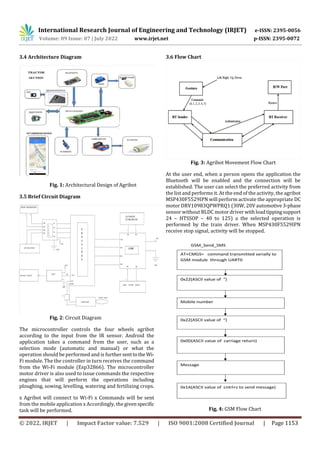
3.4 Architecture Diagram
Fig. 1: Architectural Design of Agribot
3.5 Brief Circuit Diagram
Fig. 2: Circuit Diagram
The microcontroller controls the four wheels agribot
according to the input from the IR sensor. Android the
application takes a command from the user, such as a
selection mode (automatic and manual) or what the
operation should be performed and is furthersenttothe Wi-
Fi module. The the controller in turn receives the command
from the Wi-Fi module (Esp32866). The microcontroller
motor driver is also used to issue commands the respective
engines that will perform the operations including
ploughing, sowing, levelling, watering and fertilizing crops.
x Agribot will connect to Wi-Fi x Commands will be sent
from the mobile application x Accordingly, the givenspecific
task will be performed.
3.6 Flow Chart
Fig. 3: Agribot Movement Flow Chart
At the user end, when a person opens the application the
Bluetooth will be enabled and the connection will be
established. The user can select the preferred activity from
the list and performs it. At the end of the activity, the agribot
MSP430F5529IPN will perform activate the appropriate DC
motor DRV10983QPWPRQ1 (30W, 20V automotive3-phase
sensor without BLDC motor driverwithloadtippingsupport
24 – HTSSOP – 40 to 125) a the selected operation is
performed by the train driver. When MSP430F5529IPN
receive stop signal, activity will be stopped.
Fig. 4: GSM Flow Chart
International Research Journal of Engineering and Technology (IRJET) e-ISSN: 2395-0056
Volume: 09 Issue: 07 | July 2022 www.irjet.net p-ISSN: 2395-0072
© 2022, IRJET | Impact Factor value: 7.529 | ISO 9001:2008 Certified Journal | Page 1154
GSM, a digital mobile communicationstandarddeveloped by
theEuropean TelecommunicationsStandardInstitute(ETSI),
has been espoused by further than 100countriesworldwide.
GSM standard outfit occupies more than 80 of the current
global cellular mobile communication outfit request. It's
presently the most extensively used mobile phonestandard.
China has establisheda GSMmobilecommunication network
covering the entire country. Short communication service(
SMS) is a value-added service of the GSM system. It uses the
signaling channel to transmit information, and its
transcharge mode is to be stored and encouraged first, that
is, after the short communication is transferred out, it'll be
stored in the short communication center( SMC) first and
also for- shielded by SMC to the receiver. SMS are
transmitted through a wireless control channel, which can
be stored and encouraged through SMC. The system of
getting SMS about the vehicle position on the mobile
outstation is to set up a short communication broadcast
monitor on the Android outstation. When a new
communication is received, themonitoringsystemcancover
the content of the SMS latitude/ longitude that has been
formatted on the tackle, parsed it, and uprooted the latitude
and longitude in the content byusingthewordhousekeeper-
acter prisoner. After that, it's passed to the exertion in the
display chart.
The communication between the GSM module and the main
chip is realized through a periodical harborage, and the
program prosecution inflow is shown in Fig. 4.
Fig. 5: Model of the Agribot
Table I: Comparison Between Traditional And Modern
Method
4. CONCLUSION
This project is primarily based on minimizing manpower
and equipment costs. An attempthasbeenmadetodevelopa
Bluetooth-controlled agricultural robot that performs
ploughing, sowing seeds and levelling mud. The proposed
system is powered by a battery and controlled by a
Bluetooth device. With the help of this robot, the farmer can
do other side work in addition to operating the robot. By
doing multiple activities simultaneously, a farmer can
increase his income, resulting in the development of the
Indian economy.
The advantage of this system is the reductionof labourcosts
and time. In this work, a robot is built and established to
perform automatic and manual sowing, irrigation and
fertilization in the field of agriculture. The robot is expected
to support farmers in making their farms more efficient.
It can help farmers in the initial stage of farming.
REFERENCES
[1] Siddharth gupta, pooja a Kulkarni “IoT Based
Multipurpose Agribot with Field MonitoringSystem”inIEEE
on 2020
[2] Shweta Madiwalar,Sunita Meti, Nikhila Domanal, Kaveri
ugare "A Survey on Solar Powered Autonomous
Multipurpose Agricultural Robot" in IEEE conference on
2020
[3] Dr. Chanda V Reddy, Anudheep R,HMVishal,Harshitha S,
Sai Spoorthi N "Agro bot" in on International Advanced
Research Journal in Science, Engineering and Technology
Vol. 8, Issue 8, August 2021
[4] Chandana R, Nisha M, Pavitra B "A Multipurpose
Agricultural Robot for Automatic Ploughing , Seeding and
Plant Health Monitoring" on IETE – 2020 Conference
Proceedings
International Research Journal of Engineering and Technology (IRJET) e-ISSN: 2395-0056
Volume: 09 Issue: 07 | July 2022 www.irjet.net p-ISSN: 2395-0072
© 2022, IRJET | Impact Factor value: 7.529 | ISO 9001:2008 Certified Journal | Page 1155
[5] Arpit Sharma,Reetesh Verma,Saurabh Gupta and
Sukhdeep Kaur Bhatia "Android Phone Controlled Robot
Using Bluetooth" on International Journal of Electronic and
Electrical Engineering.
[6] Md. Didarul Islam Sujon, Rumman Nasir, Mahbube
Mozammel Ibne Habib, Majedul Islam Nomaan, Jayasree
Baidya, Md. Rezaul Islam "Agribot: Arduino Controlled
Autonomous Multi-Purpose FarmMachineryRobotforSmall
to Medium Scale Cultivation " on 2018 International
Conference on Intelligent Autonomous Systems
[7] Akshay Y. Kachor,Ketaki Ghodinde "Design of
microcontroller based agribot forfertigationandplantation"
on e International Conference on Intelligent Computing and
Control Systems (ICICCS 2019)
[8] Gowtham kumar S N, Anand G Warrier, Chirag B Shetty,
Gerard Elston Shawn D’souza "Multipurpose Agricultural
Robot" on International ResearchJournal ofEngineeringand
Technology (IRJET) Volume: 06 Issue: 04 | Apr 2019
[9] Vishnu Prakash K, Sathish Kumar V, Venkatesh P,
Chandran A, “Design and fabrication of multipurpose
agricultural robot”, International Journal of Advanced
Science and Engineering Research, Volume: 1, Issue: 1, June
2016, ISSN: 2455 9288.
[10] Nithin P V, Shivaprakash S, “Multipurpose agricultural
robot”, International Journal of Engineering Research, ISSN:
2319-6890)(online),2347-5013(print) Volume No.5 Issue:
Special 6, pp: 1129 - 1254.
[11] Mahesh.R.Pundkar, a seed-sowing machinea review,
IJESS Volume3, Issue3 ISSN:2249.
[12] Mr.Sagar R. Chavan, Prof. Rahul D. Shelke, Prof.
Shrinivas R. Zanwar, “Enhanced agriculture robotic system”,
International journal of engineering sciences & research
technology, ISSN: 2277-9655.

Multifunctional Agribot using Android for Small Plantations

  • 1.
    International Research Journalof Engineering and Technology (IRJET) e-ISSN: 2395-0056 Volume: 09 Issue: 07 | July 2022 www.irjet.net p-ISSN: 2395-0072 © 2022, IRJET | Impact Factor value: 7.529 | ISO 9001:2008 Certified Journal | Page 1151 Multifunctional Agribot using Android for Small Plantations Adarsh A koushik1, Akash R2, Archana B H3, Likitha V4, Chandru A S5 1Adarsh A Koushik: Student, Dept. of ISE, NIE-IT, Mysore, Karnataka, India 2Akash R: Student, Dept. of ISE, NIE-IT, Mysore, Karnataka, India 3Archana B H: Student, Dept. of ISE, NIE-IT, Mysore, Karnataka, India 4Likitha V: Student, Dept. of ISE, NIE-IT, Mysore, Karnataka, India 5Chandru A S (co-author): Assistant Professor, Dept. of ISE, NIE-IT, Mysore, Karnataka, India ---------------------------------------------------------------------***--------------------------------------------------------------------- Abstract – Robotics in engineering is fascinating that provides many opportunities for research. In addition, the development of technology in recent years has led to intelligent mobilerobots. They may be sent to hard places instead of people either because they are dangerous or because they are difficult to access. However, controlling theserobotsisadifficulttaskthat involves knowledge in various fields such as robotics, automation, programming, electronics, etc. This project aims to develop a robot that can perform operations such as automatic plowing, seed dosing, fruit picking and pesticide spraying. For manual control, the robot uses a Bluetooth pairing application as a control device and helps to navigate the robot outside the field. Farmers today spendalotofmoney on machines that help them reduce labor and increase crop yields, but the profit and efficiency are very low. Key Words: Robotics, Farming, Bluetooth, DC motor, Servomotor, automation 1. INTRODUCTION Robotics plays a significant role inagricultural production and management. In agriculture, time-saving autonomous technology is needed to make farm management efficient. Researchers are now focusing on various operational parameters of agriculture to designautonomousagricultural vehicles, as conventional agricultural machinery is dependent on crop and topology.Robotslikethesearepretty much perfect replacements for human power as they deploy unmanned sensing and machine systems. The overall goal of this project is to provide a synthesis of research findings on the economics of field crop robotics. The specific objectives were to: a) list and summarize publicly available research on the economics of field crop robotics, b) identify research gaps and needs related to crop robotics, and c) suggest research topics that require urgent attention. This review contributes to the science by summarizing what has been accumulated about the economics of crop robots, proposing mechanisms for how these facts fit together, and identifying gaps in the science. Primarily, this study focuses on profitability at the farm level, since without profitability, cropping robots will not be widely used and the expected environmental,social andfood security benefits will not be achieved. When the benefits of potentially profitable autonomous crop technologies were identified, environmental, social and food security benefits were noted. In this, robots are evolved to concentrate effectively and are also anticipated to perform operations autonomously. The proposed idea implements a robot to perform functions similar as planting, watering, fertilizing, watching crops. These functions can be integrated into one robotandlatterly performed. The robot is anticipated to perform functions similar as planting, watering, fertilizing, covering, autonomously in the field. The main goal of agricultural automation knowledge development is to alleviate labor energy. Advances in automation and artificial intelligence offer solutions in precision agriculture. Work related to scattering, collection, unwanted plant control. To restore effectiveness.Therobots were designed based on flexible automatic bending joints. Instrumental robotics applications that are moving around the world to cover other fields with robotics required, replacing human operators are providing efficient results in myriad problems with higher competence. The advanced idea of our paper is to automate the process of planting, cultivating, pesticide spraying and tunneling to reduce humanoid effort and increase harvest. Seed cultivation is done robotically using a DC motor. The distance between two seeds is measured and varied using a microcontroller.It is also possible to grow different types of seeds with dissimilar spacing.Theproposedidea includesa sprayerthat would serve to reduce fertilizer wastage, which is done by spraying the appropriate amount of fertilizer required for a particular crop. The process mode can be changed using instructions existing in the robot application. Any nonlinear relationship between inputs andoutputsiscontrolledbythis system. The next step is to develop a more advanced GPS system that increases accuracy. The direction of the robot can be controlled using rectangular geometry
  • 2.
    International Research Journalof Engineering and Technology (IRJET) e-ISSN: 2395-0056 Volume: 09 Issue: 07 | July 2022 www.irjet.net p-ISSN: 2395-0072 © 2022, IRJET | Impact Factor value: 7.529 | ISO 9001:2008 Certified Journal | Page 1152 2. OPERATION OF AUTONOMOUS MULTIPURPOSE AGRICULTURAL ROBOT 1.seeding 2.glass land slicing 3.cultivating 4.reaping 5.shoveling 6.pesticide scattering 7. monitoring 1. The automation decreases the agriculturist labours with fast speed by propagating 4 discordances at a time with line shadowing. firstly, the seeds are stored in the vessel also it will be spread across the fieldwithapplicabledetainmentsas mentioned in the corresponding program. 2. Grass slice and unwanted plant junking Undesirable plant in the estate damages the main crop and performance as a barricade for development of the crop also decreases the yield of the field. 3. The main perception of cultivating is to turn over the advanced bed of the slush, transferring superior nutrient contents to the face of the soil and making the nutritive soil for the purpose of husbandry. 4. Picking is the act of taking away crop from field it was growing and moving it to a defended point for processing, nursing or packing. 5. Digging is actually the combination of two processes, the first being the breaking or cutting the face of the soil and the alternate the dumping and redirection of the material set up there. 6. In order to give safety to the farmers from fungicide infections and its sidegoods,robotswillbereplacingworkers for the estate exertion. 7. This bot also includes timetotimemonitoringofestateand give security alert to owner in case of buttinsky presence in farmland. These functions can be integrated into a single vehicle and also be performed, which ismore effective and cost effective. 3. METHODOLOGY 3.1 System Requirements Hardware Specifications • Weed cutter • Planning plate • Rotatory blade • Flexible pipe • IR(8051) Sensor and SST controller • GSM(Global System for Mobile Communication) • Control Unit • Servo Motors • Power supply circuit • Perforated plough • Water tank • Submersible mini water pump • IOT transmitter & receiver Software Specifications • Operating System : Windows 10 • Keil Microvision 4 • Embedded C • SST Bootstrap Loader • Android Sdk • Eclipse • Embedded Java 3.2 Problem Statement • In traditional farming separate machinery need to be used for each cultivational activity like rotary tiller for ploughing, manual seeding, rollers for levelling the soil, pumping water, weed cutting machinery whichincludes more labour work. • However, in recent years this has been overcome by robots that can perform only single or dual tasksbutare not costeffective. • As better yielding for crops is earned by farmers, there starts the risk of burglar activity which needs to be considered to save one's livelihood. 3.3 Proposed Methodology • The proposed idea implements the vehicle to perform the functions such as ploughing, seed sowing, mud leveling, creating heap, digging holes, water pumping, pesticide spraying and weed cutting. • These functions can be integrated into a single vehicle and then be performed, which is more efficientand cost effective. This bot also includes time to time monitoring of farm and provide security alert to owner in case of intruder presence in farmland.
  • 3.
    International Research Journalof Engineering and Technology (IRJET) e-ISSN: 2395-0056 Volume: 09 Issue: 07 | July 2022 www.irjet.net p-ISSN: 2395-0072 © 2022, IRJET | Impact Factor value: 7.529 | ISO 9001:2008 Certified Journal | Page 1153 3.4 Architecture Diagram Fig. 1: Architectural Design of Agribot 3.5 Brief Circuit Diagram Fig. 2: Circuit Diagram The microcontroller controls the four wheels agribot according to the input from the IR sensor. Android the application takes a command from the user, such as a selection mode (automatic and manual) or what the operation should be performed and is furthersenttothe Wi- Fi module. The the controller in turn receives the command from the Wi-Fi module (Esp32866). The microcontroller motor driver is also used to issue commands the respective engines that will perform the operations including ploughing, sowing, levelling, watering and fertilizing crops. x Agribot will connect to Wi-Fi x Commands will be sent from the mobile application x Accordingly, the givenspecific task will be performed. 3.6 Flow Chart Fig. 3: Agribot Movement Flow Chart At the user end, when a person opens the application the Bluetooth will be enabled and the connection will be established. The user can select the preferred activity from the list and performs it. At the end of the activity, the agribot MSP430F5529IPN will perform activate the appropriate DC motor DRV10983QPWPRQ1 (30W, 20V automotive3-phase sensor without BLDC motor driverwithloadtippingsupport 24 – HTSSOP – 40 to 125) a the selected operation is performed by the train driver. When MSP430F5529IPN receive stop signal, activity will be stopped. Fig. 4: GSM Flow Chart
  • 4.
    International Research Journalof Engineering and Technology (IRJET) e-ISSN: 2395-0056 Volume: 09 Issue: 07 | July 2022 www.irjet.net p-ISSN: 2395-0072 © 2022, IRJET | Impact Factor value: 7.529 | ISO 9001:2008 Certified Journal | Page 1154 GSM, a digital mobile communicationstandarddeveloped by theEuropean TelecommunicationsStandardInstitute(ETSI), has been espoused by further than 100countriesworldwide. GSM standard outfit occupies more than 80 of the current global cellular mobile communication outfit request. It's presently the most extensively used mobile phonestandard. China has establisheda GSMmobilecommunication network covering the entire country. Short communication service( SMS) is a value-added service of the GSM system. It uses the signaling channel to transmit information, and its transcharge mode is to be stored and encouraged first, that is, after the short communication is transferred out, it'll be stored in the short communication center( SMC) first and also for- shielded by SMC to the receiver. SMS are transmitted through a wireless control channel, which can be stored and encouraged through SMC. The system of getting SMS about the vehicle position on the mobile outstation is to set up a short communication broadcast monitor on the Android outstation. When a new communication is received, themonitoringsystemcancover the content of the SMS latitude/ longitude that has been formatted on the tackle, parsed it, and uprooted the latitude and longitude in the content byusingthewordhousekeeper- acter prisoner. After that, it's passed to the exertion in the display chart. The communication between the GSM module and the main chip is realized through a periodical harborage, and the program prosecution inflow is shown in Fig. 4. Fig. 5: Model of the Agribot Table I: Comparison Between Traditional And Modern Method 4. CONCLUSION This project is primarily based on minimizing manpower and equipment costs. An attempthasbeenmadetodevelopa Bluetooth-controlled agricultural robot that performs ploughing, sowing seeds and levelling mud. The proposed system is powered by a battery and controlled by a Bluetooth device. With the help of this robot, the farmer can do other side work in addition to operating the robot. By doing multiple activities simultaneously, a farmer can increase his income, resulting in the development of the Indian economy. The advantage of this system is the reductionof labourcosts and time. In this work, a robot is built and established to perform automatic and manual sowing, irrigation and fertilization in the field of agriculture. The robot is expected to support farmers in making their farms more efficient. It can help farmers in the initial stage of farming. REFERENCES [1] Siddharth gupta, pooja a Kulkarni “IoT Based Multipurpose Agribot with Field MonitoringSystem”inIEEE on 2020 [2] Shweta Madiwalar,Sunita Meti, Nikhila Domanal, Kaveri ugare "A Survey on Solar Powered Autonomous Multipurpose Agricultural Robot" in IEEE conference on 2020 [3] Dr. Chanda V Reddy, Anudheep R,HMVishal,Harshitha S, Sai Spoorthi N "Agro bot" in on International Advanced Research Journal in Science, Engineering and Technology Vol. 8, Issue 8, August 2021 [4] Chandana R, Nisha M, Pavitra B "A Multipurpose Agricultural Robot for Automatic Ploughing , Seeding and Plant Health Monitoring" on IETE – 2020 Conference Proceedings
  • 5.
    International Research Journalof Engineering and Technology (IRJET) e-ISSN: 2395-0056 Volume: 09 Issue: 07 | July 2022 www.irjet.net p-ISSN: 2395-0072 © 2022, IRJET | Impact Factor value: 7.529 | ISO 9001:2008 Certified Journal | Page 1155 [5] Arpit Sharma,Reetesh Verma,Saurabh Gupta and Sukhdeep Kaur Bhatia "Android Phone Controlled Robot Using Bluetooth" on International Journal of Electronic and Electrical Engineering. [6] Md. Didarul Islam Sujon, Rumman Nasir, Mahbube Mozammel Ibne Habib, Majedul Islam Nomaan, Jayasree Baidya, Md. Rezaul Islam "Agribot: Arduino Controlled Autonomous Multi-Purpose FarmMachineryRobotforSmall to Medium Scale Cultivation " on 2018 International Conference on Intelligent Autonomous Systems [7] Akshay Y. Kachor,Ketaki Ghodinde "Design of microcontroller based agribot forfertigationandplantation" on e International Conference on Intelligent Computing and Control Systems (ICICCS 2019) [8] Gowtham kumar S N, Anand G Warrier, Chirag B Shetty, Gerard Elston Shawn D’souza "Multipurpose Agricultural Robot" on International ResearchJournal ofEngineeringand Technology (IRJET) Volume: 06 Issue: 04 | Apr 2019 [9] Vishnu Prakash K, Sathish Kumar V, Venkatesh P, Chandran A, “Design and fabrication of multipurpose agricultural robot”, International Journal of Advanced Science and Engineering Research, Volume: 1, Issue: 1, June 2016, ISSN: 2455 9288. [10] Nithin P V, Shivaprakash S, “Multipurpose agricultural robot”, International Journal of Engineering Research, ISSN: 2319-6890)(online),2347-5013(print) Volume No.5 Issue: Special 6, pp: 1129 - 1254. [11] Mahesh.R.Pundkar, a seed-sowing machinea review, IJESS Volume3, Issue3 ISSN:2249. [12] Mr.Sagar R. Chavan, Prof. Rahul D. Shelke, Prof. Shrinivas R. Zanwar, “Enhanced agriculture robotic system”, International journal of engineering sciences & research technology, ISSN: 2277-9655.