
DinukaW. Mendis 
HND Computing & System Development 
Batch 54 – 2014 ©
What is a robot? 
A machine or a device consisting of electronic, 
electrical, or mechanical units that capable of 
performing a variety of often complex human 
tasks on command or by being programed by a 
computer.
Robotic history 
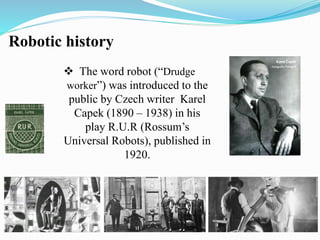
 The word robot (“Drudge 
worker”) was introduced to the 
public by Czech writer Karel 
Capek (1890 – 1938) in his 
play R.U.R (Rossum’s 
Universal Robots), published in 
1920.
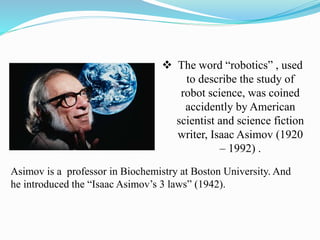
 The word “robotics” , used 
to describe the study of 
robot science, was coined 
accidently by American 
scientist and science fiction 
writer, Isaac Asimov (1920 
– 1992) . 
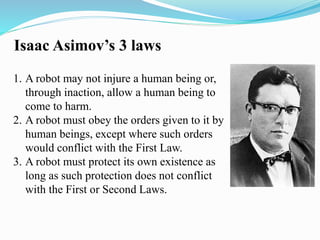
Asimov is a professor in Biochemistry at Boston University. And 
he introduced the “Isaac Asimov’s 3 laws” (1942).
Isaac Asimov’s 3 laws 
1. A robot may not injure a human being or, 
through inaction, allow a human being to 
come to harm. 
2. A robot must obey the orders given to it by 
human beings, except where such orders 
would conflict with the First Law. 
3. A robot must protect its own existence as 
long as such protection does not conflict 
with the First or Second Laws.
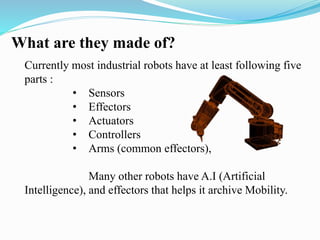
What are they made of? 
Currently most industrial robots have at least following five 
parts : 
• Sensors 
• Effectors 
• Actuators 
• Controllers 
• Arms (common effectors), 
Many other robots have A.I (Artificial 
Intelligence), and effectors that helps it archive Mobility.
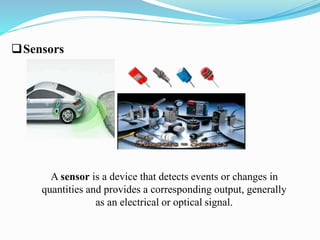
Sensors 
A sensor is a device that detects events or changes in 
quantities and provides a corresponding output, generally 
as an electrical or optical signal.
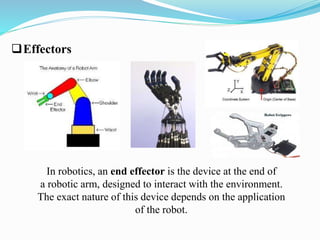
Effectors 
In robotics, an end effector is the device at the end of 
a robotic arm, designed to interact with the environment. 
The exact nature of this device depends on the application 
of the robot.
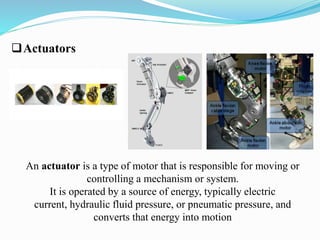
Actuators 
An actuator is a type of motor that is responsible for moving or 
controlling a mechanism or system. 
It is operated by a source of energy, typically electric 
current, hydraulic fluid pressure, or pneumatic pressure, and 
converts that energy into motion
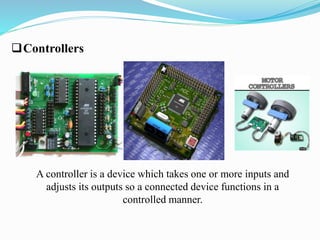
Controllers 
A controller is a device which takes one or more inputs and 
adjusts its outputs so a connected device functions in a 
controlled manner.
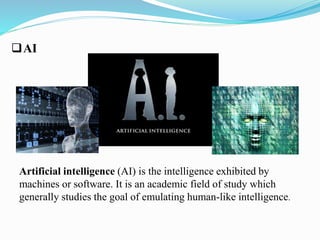
AI 
Artificial intelligence (AI) is the intelligence exhibited by 
machines or software. It is an academic field of study which 
generally studies the goal of emulating human-like intelligence.
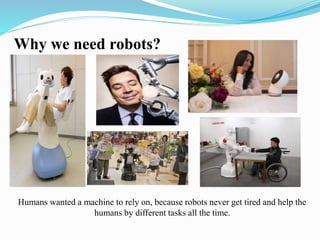
Why we need robots? 
Humans wanted a machine to rely on, because robots never get tired and help the 
humans by different tasks all the time.
Types of robots 
The most common types of robots are... 
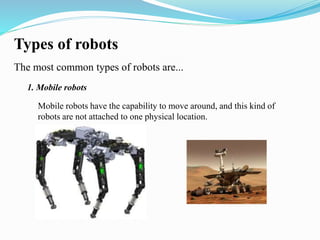
1. Mobile robots 
Mobile robots have the capability to move around, and this kind of 
robots are not attached to one physical location.
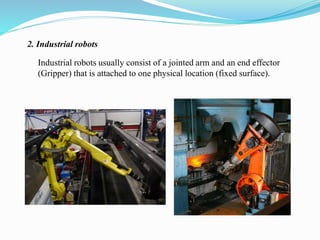
2. Industrial robots 
Industrial robots usually consist of a jointed arm and an end effector 
(Gripper) that is attached to one physical location (fixed surface).
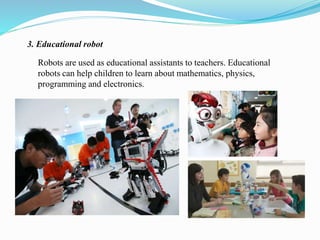
3. Educational robot 
Robots are used as educational assistants to teachers. Educational 
robots can help children to learn about mathematics, physics, 
programming and electronics.
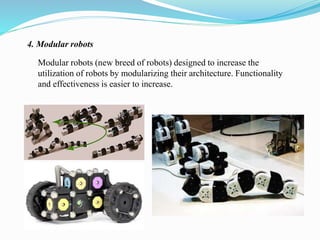
4. Modular robots 
Modular robots (new breed of robots) designed to increase the 
utilization of robots by modularizing their architecture. Functionality 
and effectiveness is easier to increase.
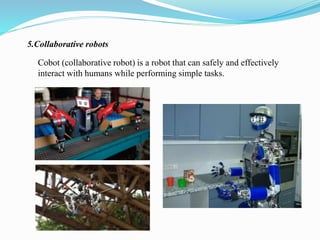
5.Collaborative robots 
Cobot (collaborative robot) is a robot that can safely and effectively 
interact with humans while performing simple tasks.
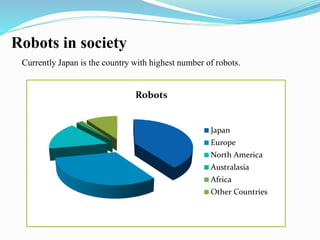
Robots in society 
Currently Japan is the country with highest number of robots. 
Robots 
Japan 
Europe 
North America 
Australasia 
Africa 
Other Countries
Advantages… 
1. Robots produce more accurate and high quality work. 
2. Robots rarely make mistakes and are more precise than human workers. 
3. They can produce a greater quantity in a short amount of time. 
4. They can work at a constant speed with no breaks, days off, or holiday time. 
5. They can perform applications with more repeatability than humans. 
6. Robots save workers from performing dangerous tasks. 
7. They can work in hazardous conditions, such as poor lighting, toxic 
chemicals, or tight spaces. 
8. They are capable of lifting heavy loads without injury or tiring. 
9. Robots increase worker safety by preventing accidents since humans are not 
performing risky jobs. 
10. Work cells provide safety features, separating the worker from harms way. 
11. Robots save time by being able to produce a greater magnitude of products 
12. They also reduce the amount of wasted material used due to their accuracy 
13. Robots save companies money in the long run with quick ROIs (return on 
investment), fewer worker injuries (reducing or eliminating worker’s 
comp), and with using less materials.
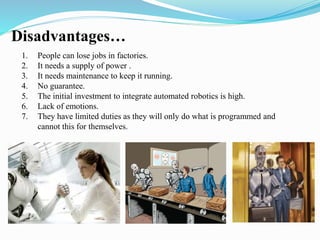
Disadvantages… 
1. People can lose jobs in factories. 
2. It needs a supply of power . 
3. It needs maintenance to keep it running. 
4. No guarantee. 
5. The initial investment to integrate automated robotics is high. 
6. Lack of emotions. 
7. They have limited duties as they will only do what is programmed and 
cannot this for themselves.
Thank You!

Robots

  • 1.
    DinukaW. Mendis HNDComputing & System Development Batch 54 – 2014 ©
  • 2.
    What is arobot? A machine or a device consisting of electronic, electrical, or mechanical units that capable of performing a variety of often complex human tasks on command or by being programed by a computer.
  • 3.
    Robotic history The word robot (“Drudge worker”) was introduced to the public by Czech writer Karel Capek (1890 – 1938) in his play R.U.R (Rossum’s Universal Robots), published in 1920.
  • 4.
     The word“robotics” , used to describe the study of robot science, was coined accidently by American scientist and science fiction writer, Isaac Asimov (1920 – 1992) . Asimov is a professor in Biochemistry at Boston University. And he introduced the “Isaac Asimov’s 3 laws” (1942).
  • 5.
    Isaac Asimov’s 3laws 1. A robot may not injure a human being or, through inaction, allow a human being to come to harm. 2. A robot must obey the orders given to it by human beings, except where such orders would conflict with the First Law. 3. A robot must protect its own existence as long as such protection does not conflict with the First or Second Laws.
  • 6.
    What are theymade of? Currently most industrial robots have at least following five parts : • Sensors • Effectors • Actuators • Controllers • Arms (common effectors), Many other robots have A.I (Artificial Intelligence), and effectors that helps it archive Mobility.
  • 7.
    Sensors A sensoris a device that detects events or changes in quantities and provides a corresponding output, generally as an electrical or optical signal.
  • 8.
    Effectors In robotics,an end effector is the device at the end of a robotic arm, designed to interact with the environment. The exact nature of this device depends on the application of the robot.
  • 9.
    Actuators An actuatoris a type of motor that is responsible for moving or controlling a mechanism or system. It is operated by a source of energy, typically electric current, hydraulic fluid pressure, or pneumatic pressure, and converts that energy into motion
  • 10.
    Controllers A controlleris a device which takes one or more inputs and adjusts its outputs so a connected device functions in a controlled manner.
  • 11.
    AI Artificial intelligence(AI) is the intelligence exhibited by machines or software. It is an academic field of study which generally studies the goal of emulating human-like intelligence.
  • 12.
    Why we needrobots? Humans wanted a machine to rely on, because robots never get tired and help the humans by different tasks all the time.
  • 13.
    Types of robots The most common types of robots are... 1. Mobile robots Mobile robots have the capability to move around, and this kind of robots are not attached to one physical location.
  • 14.
    2. Industrial robots Industrial robots usually consist of a jointed arm and an end effector (Gripper) that is attached to one physical location (fixed surface).
  • 15.
    3. Educational robot Robots are used as educational assistants to teachers. Educational robots can help children to learn about mathematics, physics, programming and electronics.
  • 16.
    4. Modular robots Modular robots (new breed of robots) designed to increase the utilization of robots by modularizing their architecture. Functionality and effectiveness is easier to increase.
  • 17.
    5.Collaborative robots Cobot(collaborative robot) is a robot that can safely and effectively interact with humans while performing simple tasks.
  • 18.
    Robots in society Currently Japan is the country with highest number of robots. Robots Japan Europe North America Australasia Africa Other Countries
  • 19.
    Advantages… 1. Robotsproduce more accurate and high quality work. 2. Robots rarely make mistakes and are more precise than human workers. 3. They can produce a greater quantity in a short amount of time. 4. They can work at a constant speed with no breaks, days off, or holiday time. 5. They can perform applications with more repeatability than humans. 6. Robots save workers from performing dangerous tasks. 7. They can work in hazardous conditions, such as poor lighting, toxic chemicals, or tight spaces. 8. They are capable of lifting heavy loads without injury or tiring. 9. Robots increase worker safety by preventing accidents since humans are not performing risky jobs. 10. Work cells provide safety features, separating the worker from harms way. 11. Robots save time by being able to produce a greater magnitude of products 12. They also reduce the amount of wasted material used due to their accuracy 13. Robots save companies money in the long run with quick ROIs (return on investment), fewer worker injuries (reducing or eliminating worker’s comp), and with using less materials.
  • 20.
    Disadvantages… 1. Peoplecan lose jobs in factories. 2. It needs a supply of power . 3. It needs maintenance to keep it running. 4. No guarantee. 5. The initial investment to integrate automated robotics is high. 6. Lack of emotions. 7. They have limited duties as they will only do what is programmed and cannot this for themselves.
  • 21.