Prepared by:
Gil Niño B. Agnabo -- BS ECE 3A
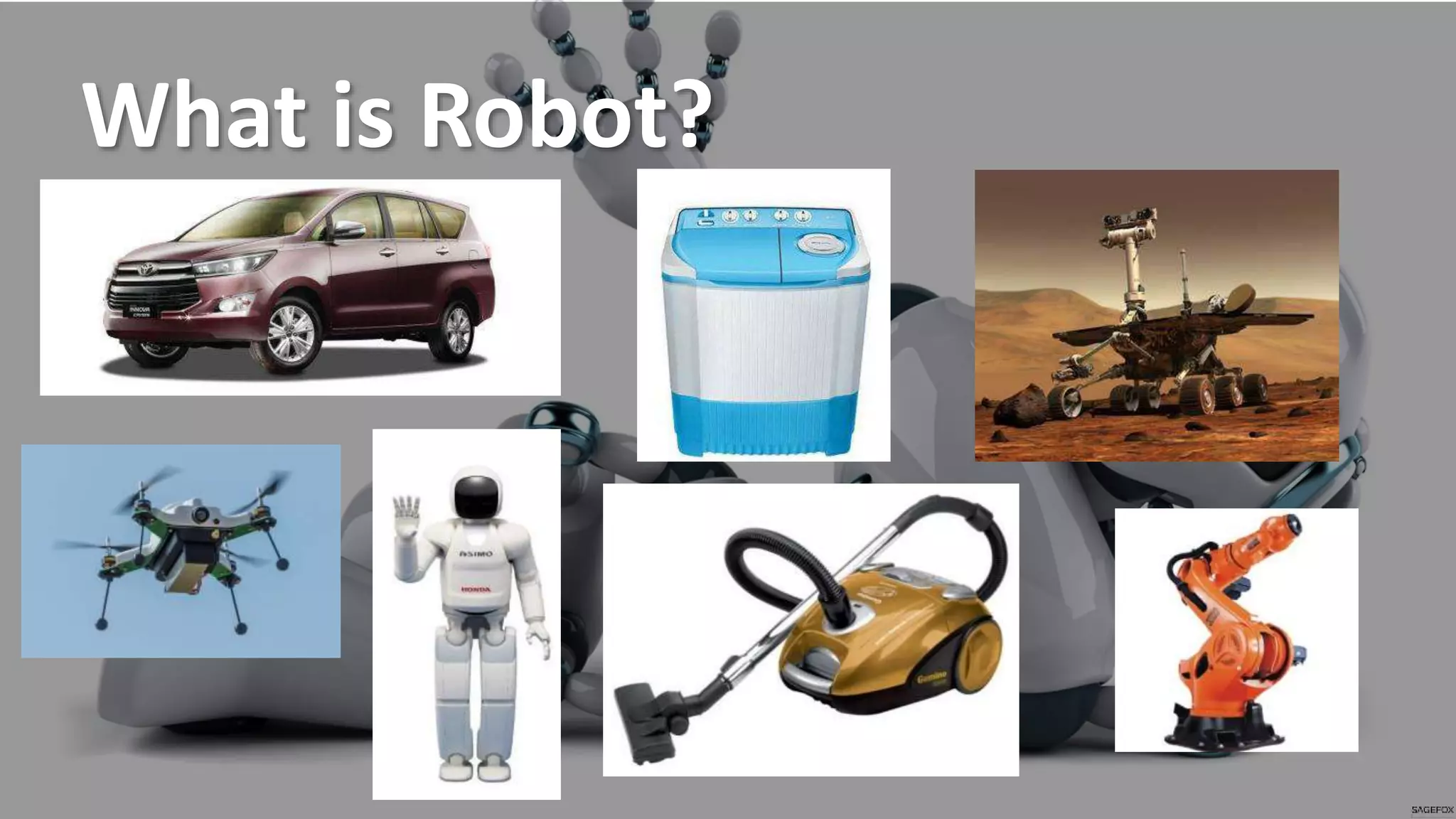
What is Robot?
• Word robot
was coined
by a Czech
novelist Karel
Capek(1920)
• Robot in
Czech is a
word for
worker or
servant
• In a broad
sense, any
autonomous
machine can
be called a
robot.
What is Robot?
A robot is a reprogrammable,
multifunctional manipulator designed to
move material, parts, tools or specialized
devices through variable programmed
motions for the performance of a variety
of tasks: Robot Institute of America, 1979
To be called a robot, a machine must possess
some or all of the following essential
characteristics:
◦Movement
◦Sensing and manipulating the environment
◦Display some kind of ‘intelligence’
(galileo.org/robotics)
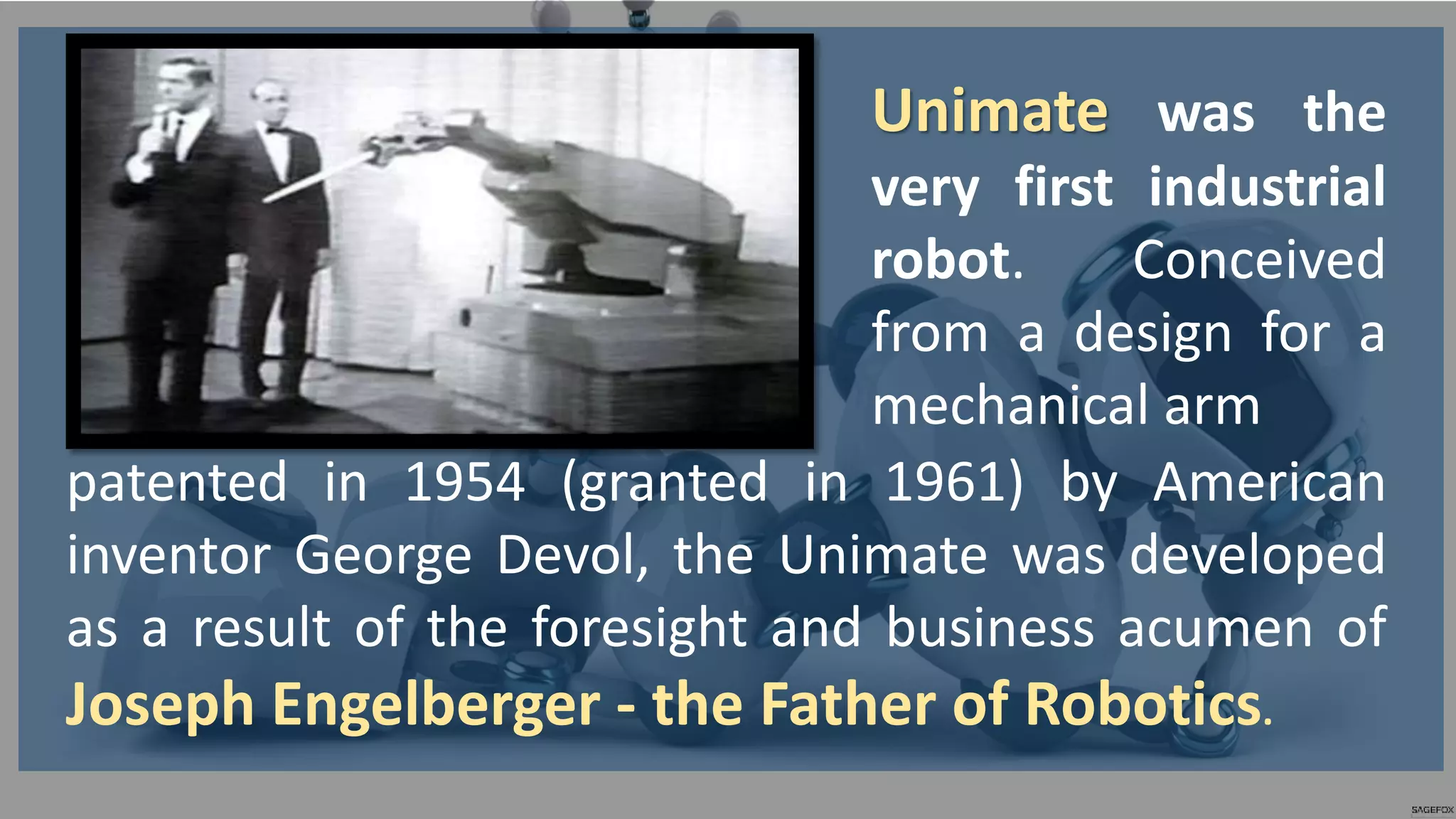
patented in 1954 (granted in 1961) by American
inventor George Devol, the Unimate was developed
as a result of the foresight and business acumen of
Joseph Engelberger - the Father of Robotics.
Unimate was the
very first industrial
robot. Conceived
from a design for a
mechanical arm
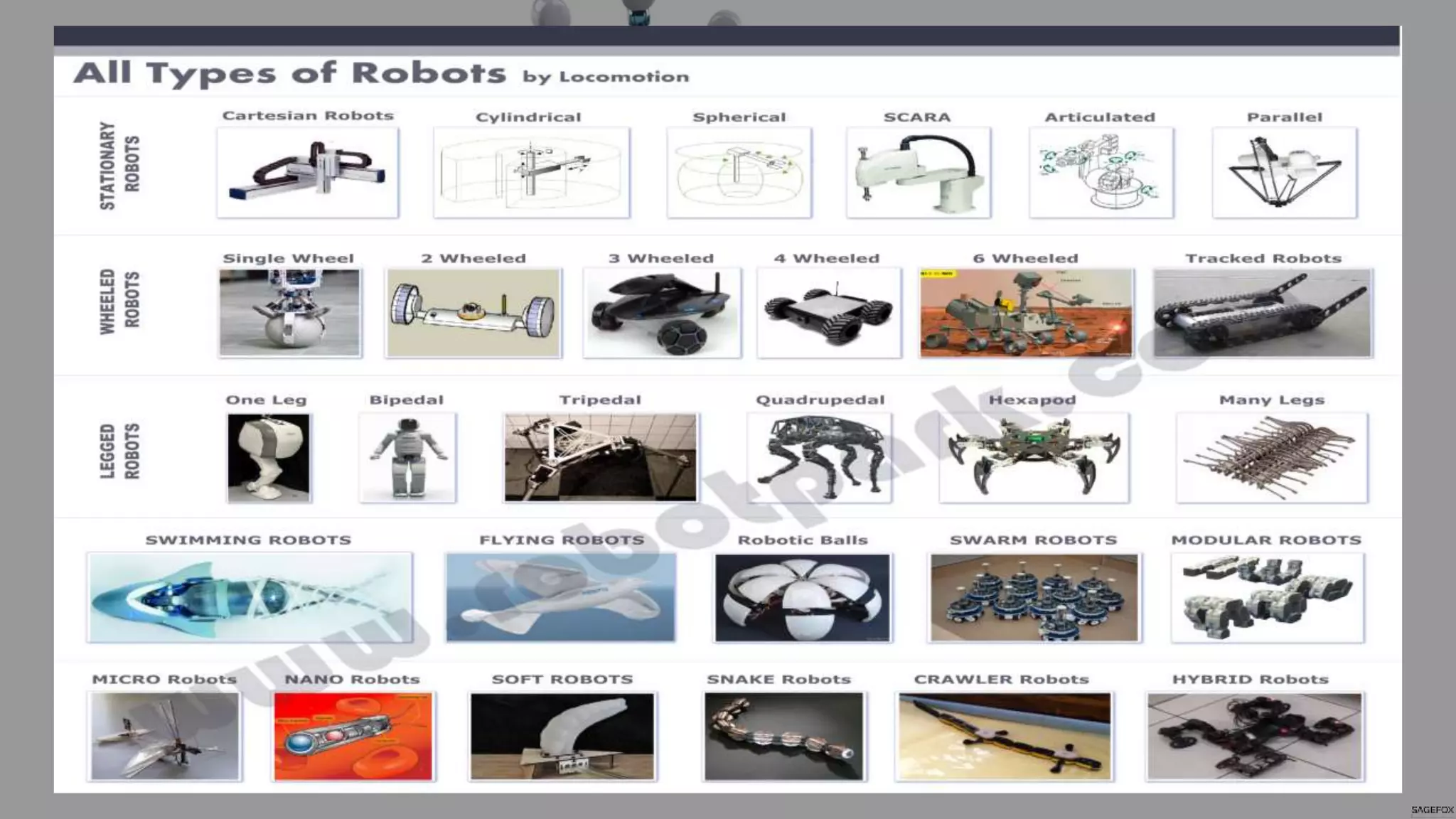
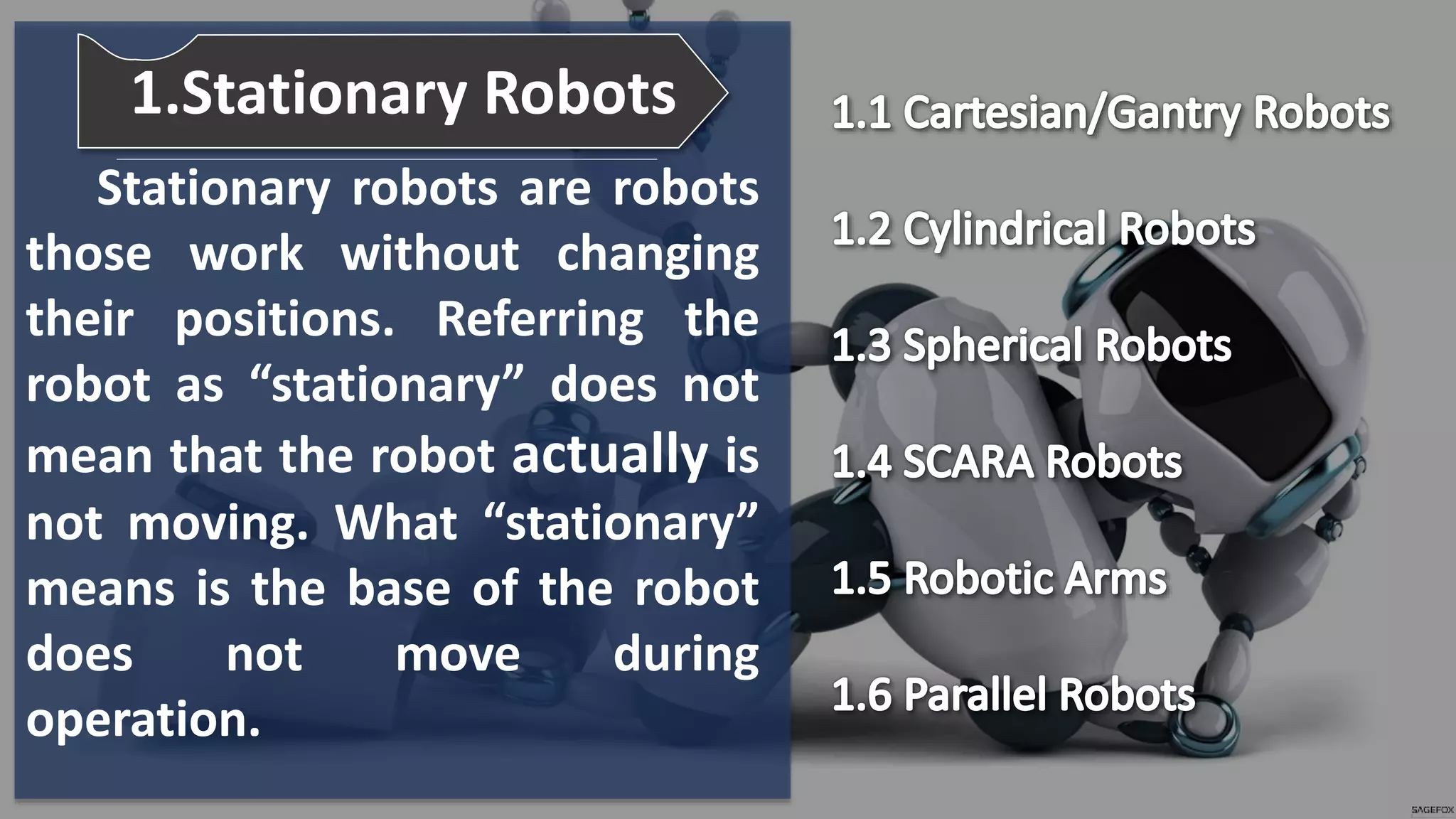
Stationary robots are robots
those work without changing
their positions. Referring the
robot as “stationary” does not
mean that the robot actually is
not moving. What “stationary”
means is the base of the robot
does not move during
operation.
1.Stationary Robots
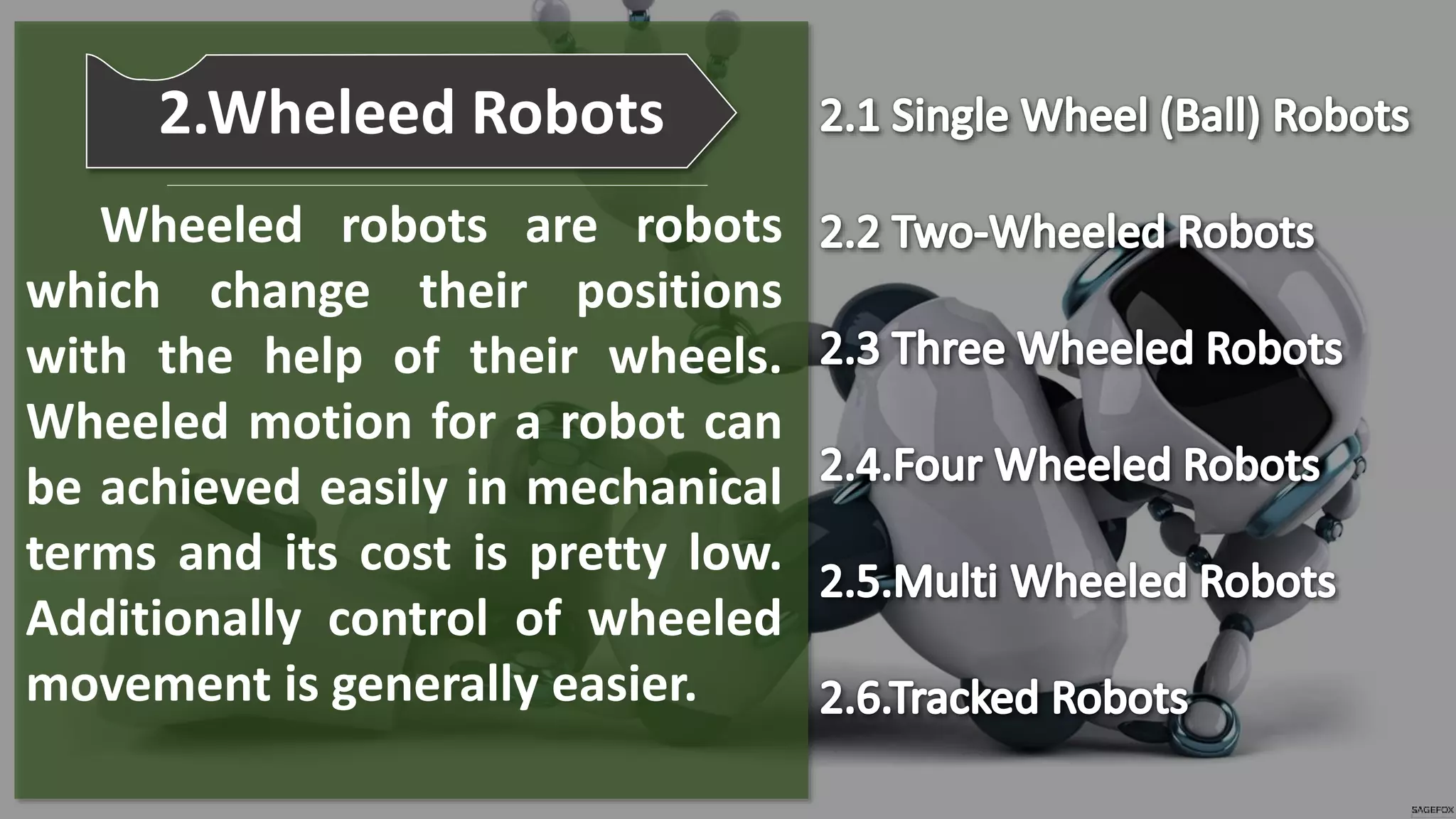
Wheeled robots are robots
which change their positions
with the help of their wheels.
Wheeled motion for a robot can
be achieved easily in mechanical
terms and its cost is pretty low.
Additionally control of wheeled
movement is generally easier.
2.Wheleed Robots
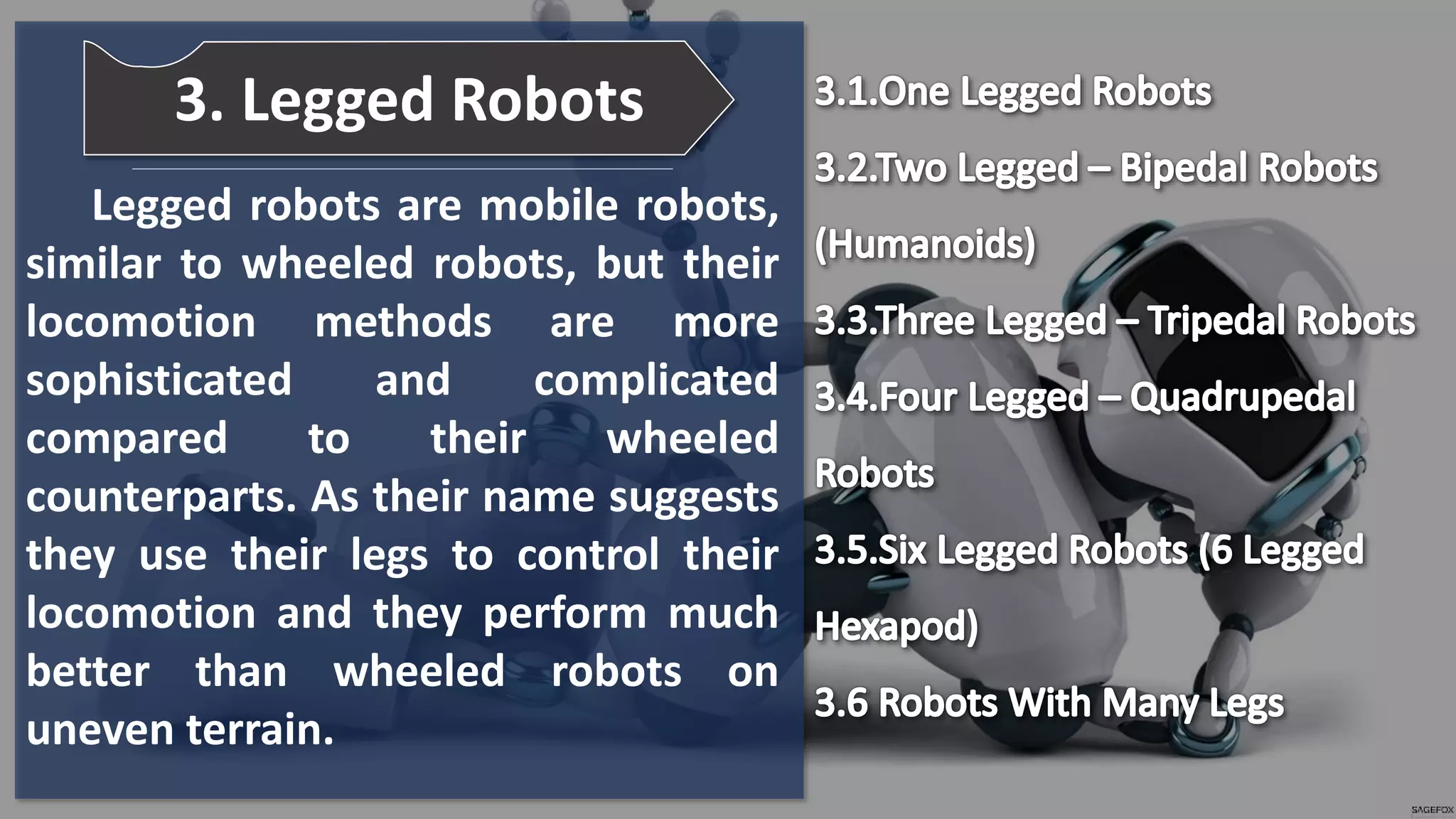
Legged robots are mobile robots,
similar to wheeled robots, but their
locomotion methods are more
sophisticated and complicated
compared to their wheeled
counterparts. As their name suggests
they use their legs to control their
locomotion and they perform much
better than wheeled robots on
uneven terrain.
3. Legged Robots
Swimming robots are robots which
move underwater. These robots are
generally inspired by fish and they use
their fin-like actuators to maneuver in
water..
4.Swimming Robots – Robot Fish
Flying robots are robots that float
and maneuver on air using their plane-
like or bird/insect-like wings, propellers
or balloons. Examples of these robots
are airplane robots, bird/insect inspired
wing flapping robots, propeller based
multicopters and balloon robots.
5.Flying Robots
6.Rolling Robotic Balls (Mobile Spherical
Robots)
Swarm robots are robotic systems
which consist of multiple small robots.
These robots structurally does not create a
single united robot, but operates as their
robot modules operate cooperatively.
Although similar to modular robotic
systems, elements of swarm robots have
much less functionality and herd
configurations does not create new robots.
7.Swarm Robots
Similar to swarm robots, modular robotic
systems also have multiple robots in their
configurations. Modules of these systems are more
functional compared to a robotic herd. For example
a single module of a modular robotic system can
have self-mobility and it can operate alone. The
power of modular robotics comes from its versatility
in its configurations. Modules of a modular robotic
system can create very different configurations and
the robots created this way can have very distinct
abilities.
8.Modular Robots
By definiton micro robots term is used
to specify both robots that have dimensions
on micrometer scale and robots that can
operate on micrometer resolution.
Therefore both possibly very big stationary
robots that can manipulate their
environment on a micrometer scale and
small robots that are actually measured by
micrometers are called micro motors.
9.Micro Robots
Similar to micro robots nano robots
also defined a bit vaguely. The term
nano robot both defines very small
robots which have nano meter scaled
dimensions and robots those can
manipulate their environment with a
nano meter scale resolution regardless
of their actual sizes.
10.Nano Robots
Soft/elastic robots, are
new introductions to
robotics. These robots are
generally bio-inspired. Most
applications are inspired
from squids or inchworms
both structurally and
functionally.
11.Soft Elastic Robots
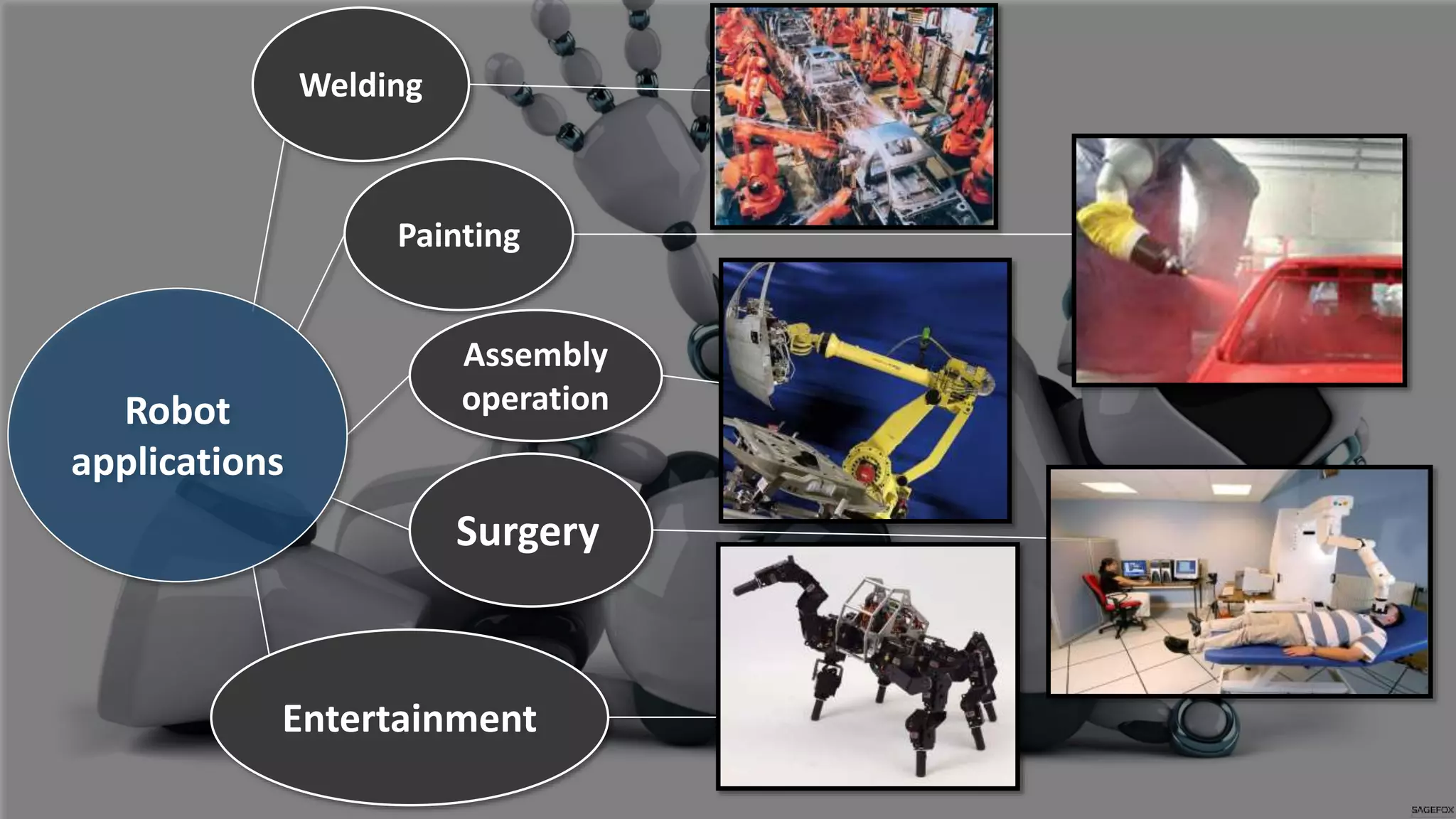
Robot
applications
Welding
Painting
Surgery
Entertainment
Assembly
operation
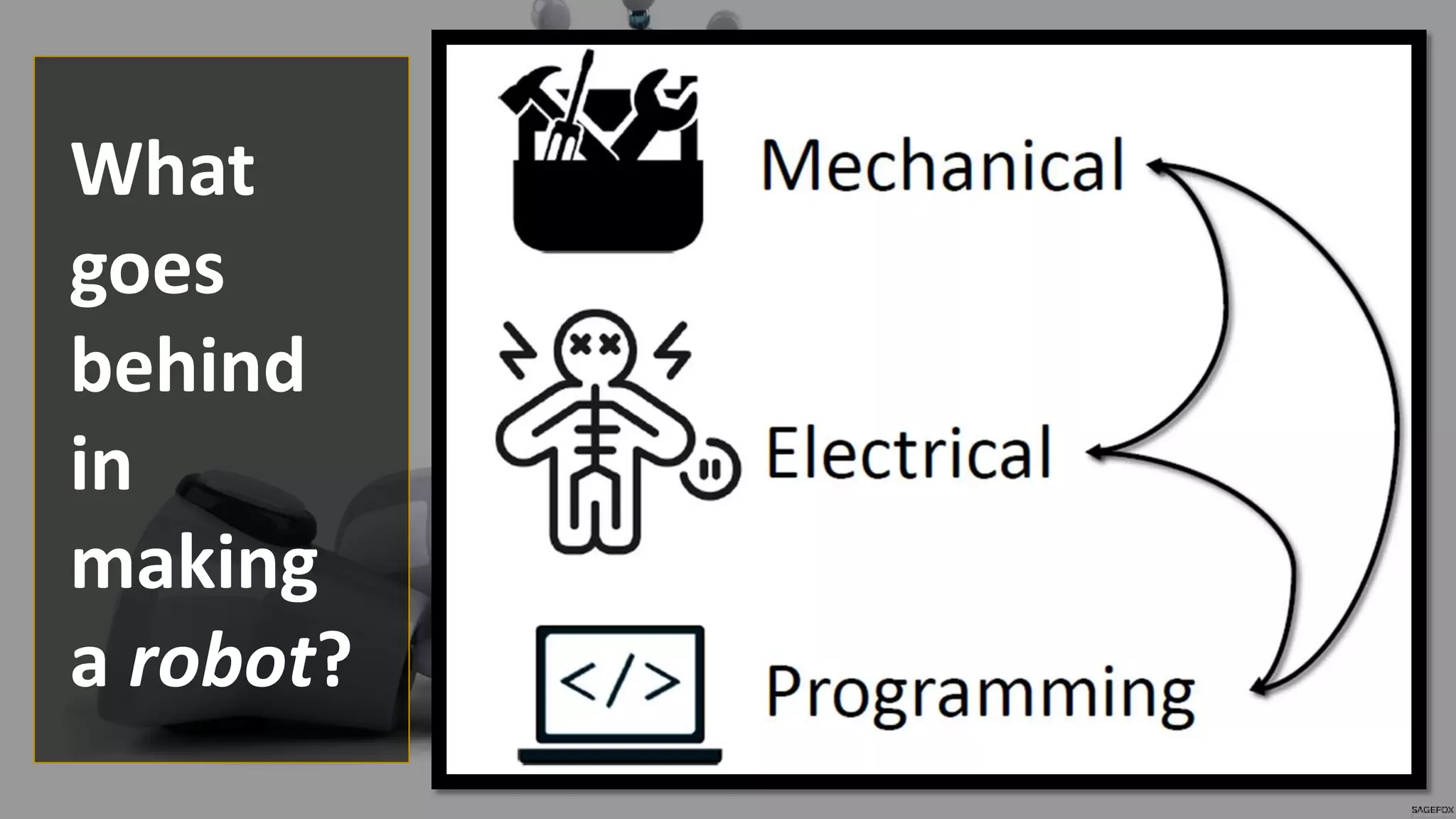
What
goes
behind
in
making
a robot?
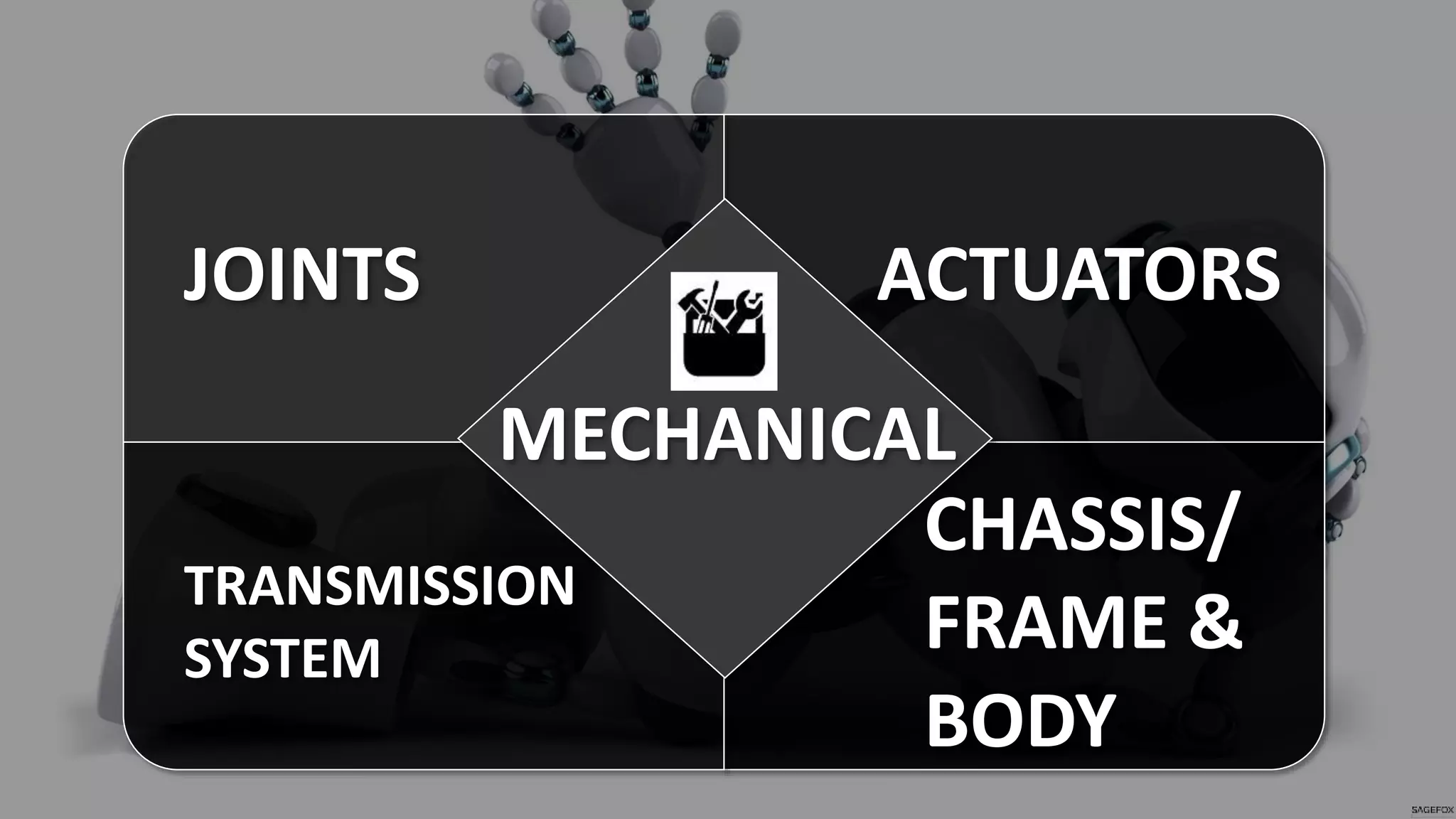
MECHANICAL
CHASSIS/
FRAME &
BODY
ACTUATORSJOINTS
TRANSMISSION
SYSTEM
The Robot Joints is the important
element in a robot which helps the
links to travel in different kind of
movements.
JOINTS
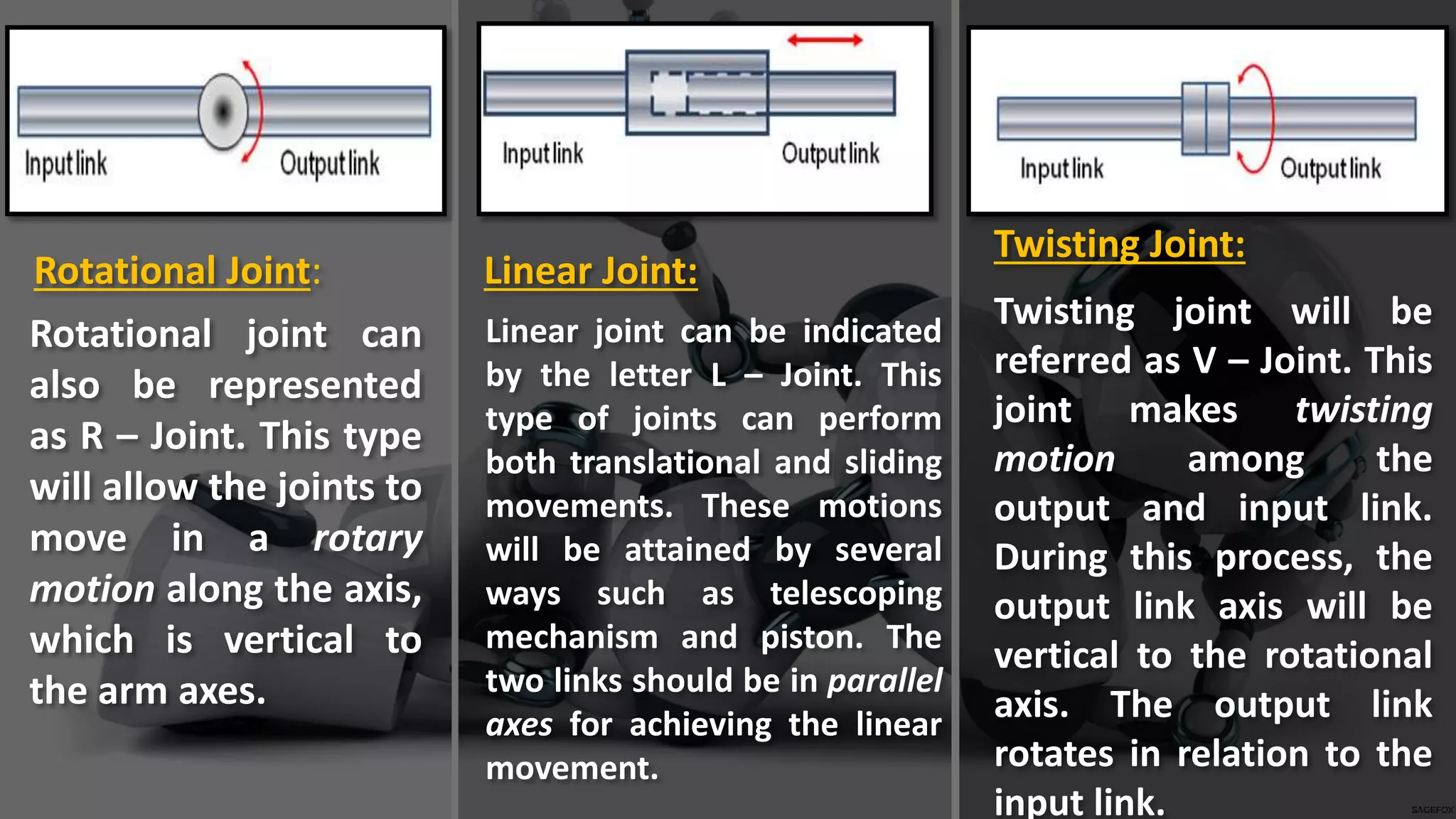
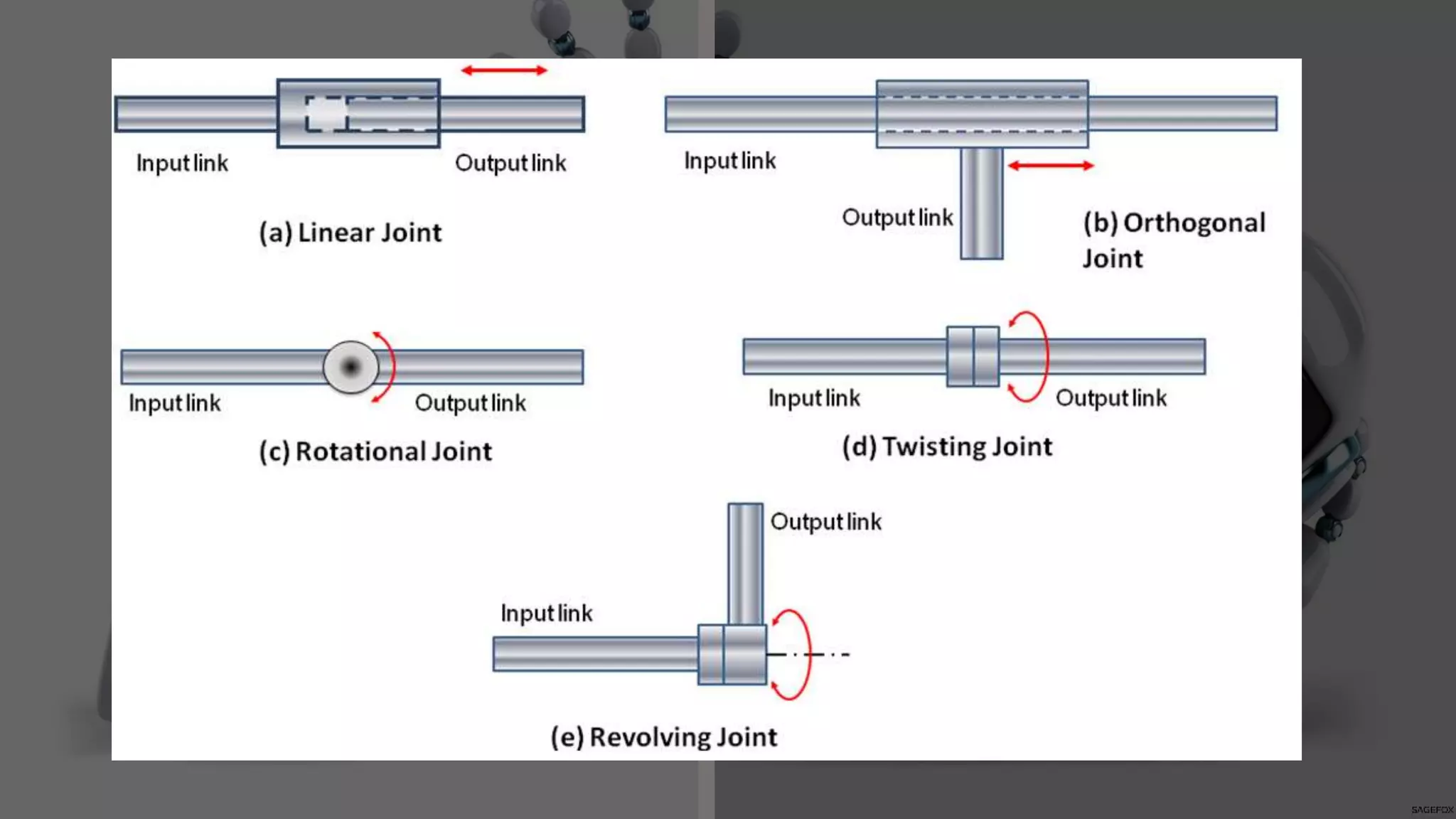
Rotational joint can
also be represented
as R – Joint. This type
will allow the joints to
move in a rotary
motion along the axis,
which is vertical to
the arm axes.
Linear joint can be indicated
by the letter L – Joint. This
type of joints can perform
both translational and sliding
movements. These motions
will be attained by several
ways such as telescoping
mechanism and piston. The
two links should be in parallel
axes for achieving the linear
movement.
Twisting joint will be
referred as V – Joint. This
joint makes twisting
motion among the
output and input link.
During this process, the
output link axis will be
vertical to the rotational
axis. The output link
rotates in relation to the
input link.
Rotational Joint: Linear Joint:
Twisting Joint:
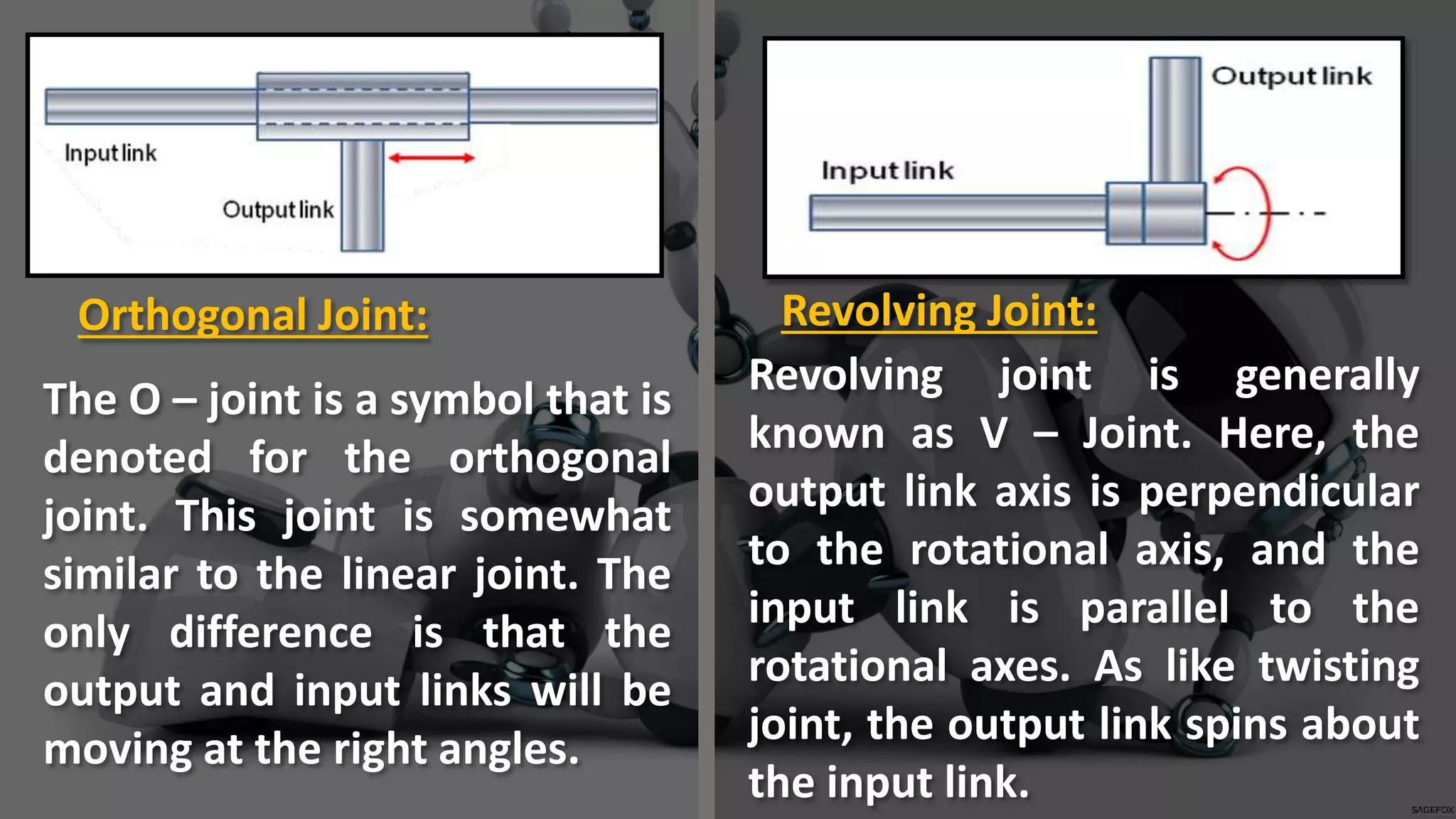
The O – joint is a symbol that is
denoted for the orthogonal
joint. This joint is somewhat
similar to the linear joint. The
only difference is that the
output and input links will be
moving at the right angles.
Revolving joint is generally
known as V – Joint. Here, the
output link axis is perpendicular
to the rotational axis, and the
input link is parallel to the
rotational axes. As like twisting
joint, the output link spins about
the input link.
Orthogonal Joint: Revolving Joint:
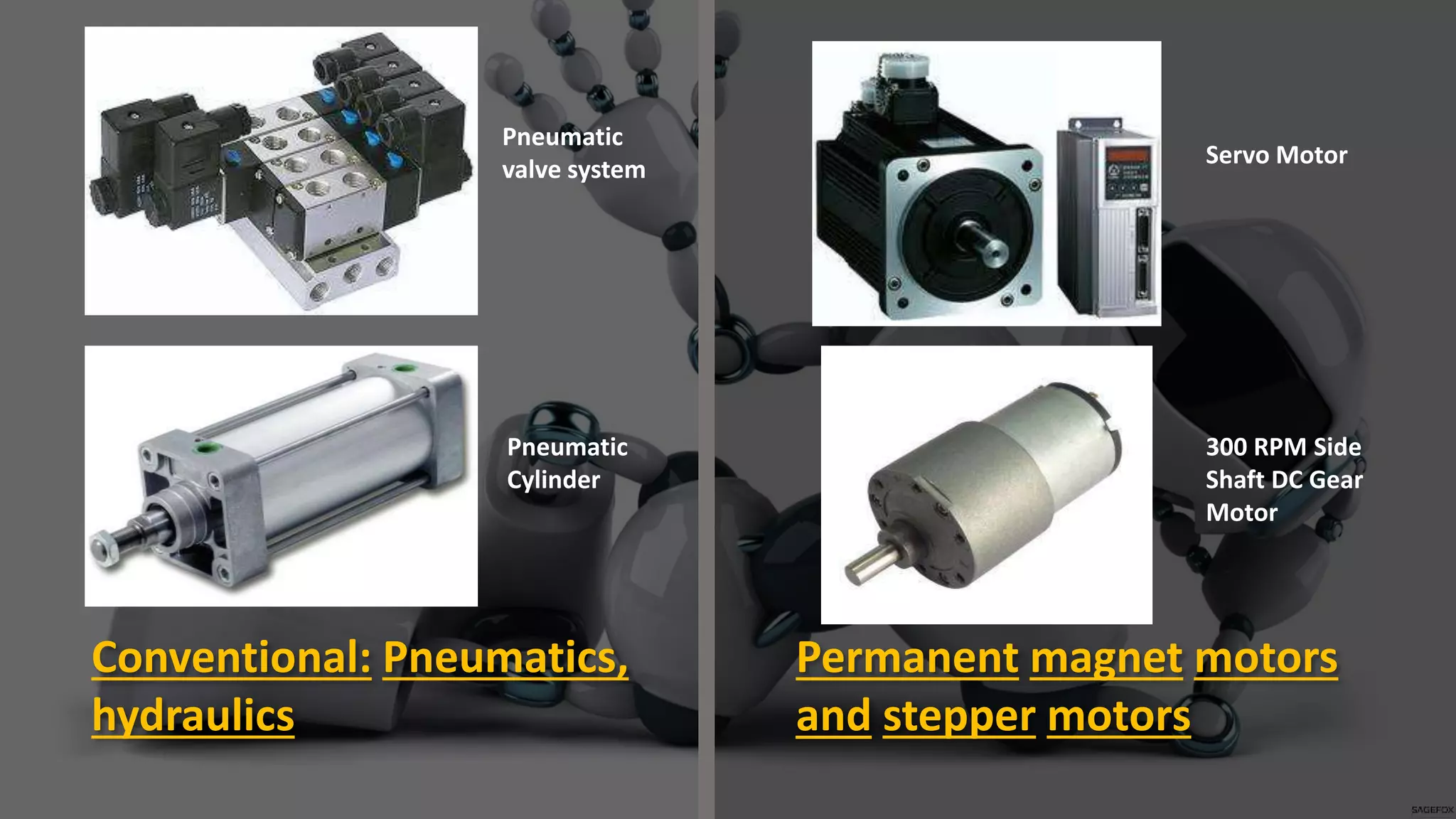
Actuators are essentially the prime
movers providing linear force and
motion.
ACTUATORS
Conventional: Pneumatics,
hydraulics
Permanent magnet motors
and stepper motors
Pneumatic
valve system
Pneumatic
Cylinder
Servo Motor
300 RPM Side
Shaft DC Gear
Motor
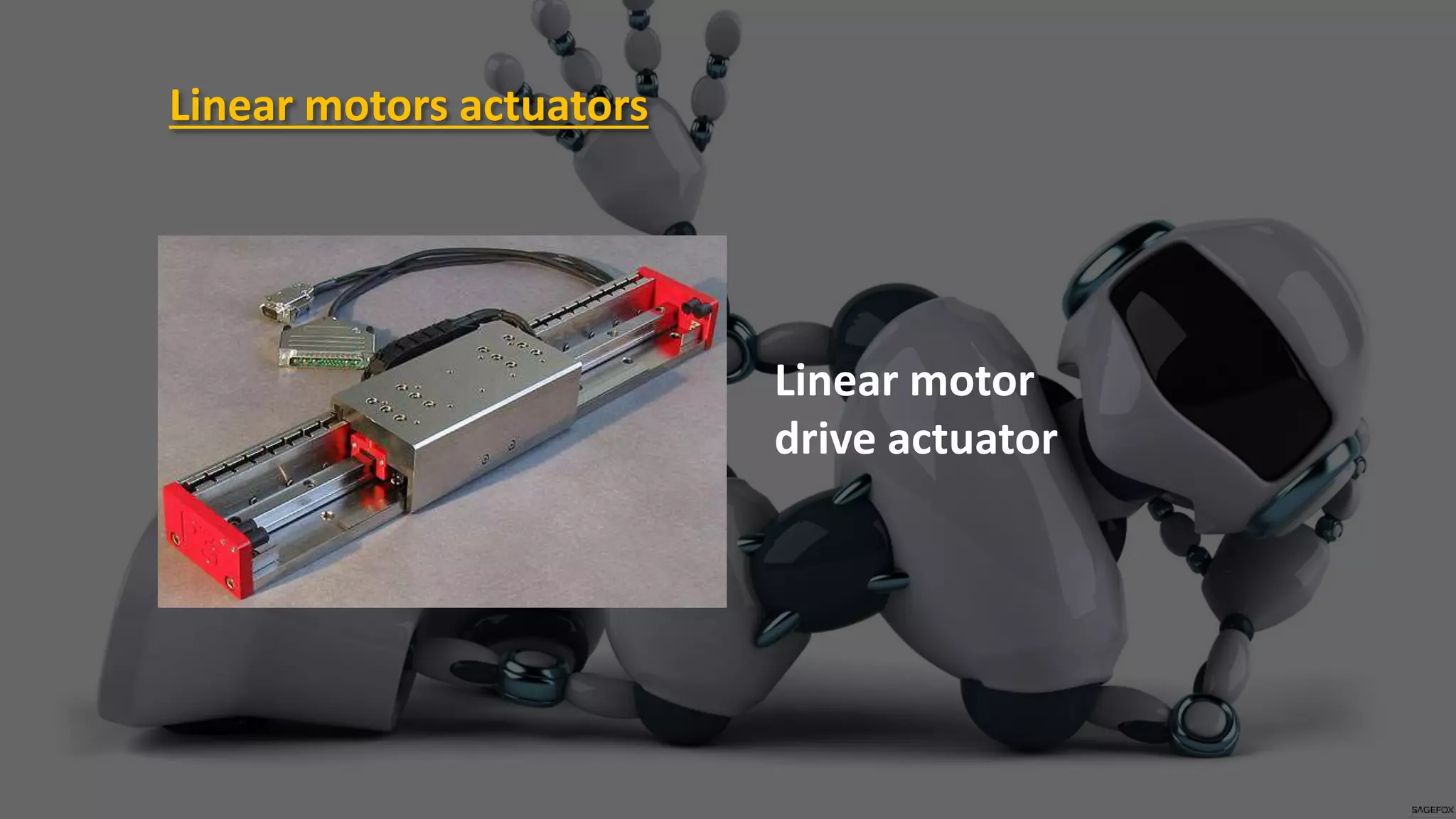
Linear motors actuators
Linear motor
drive actuator
It is used to distribute the force or
connect actuators to every part of
the robot.
TRANSMISSION SYSTEM
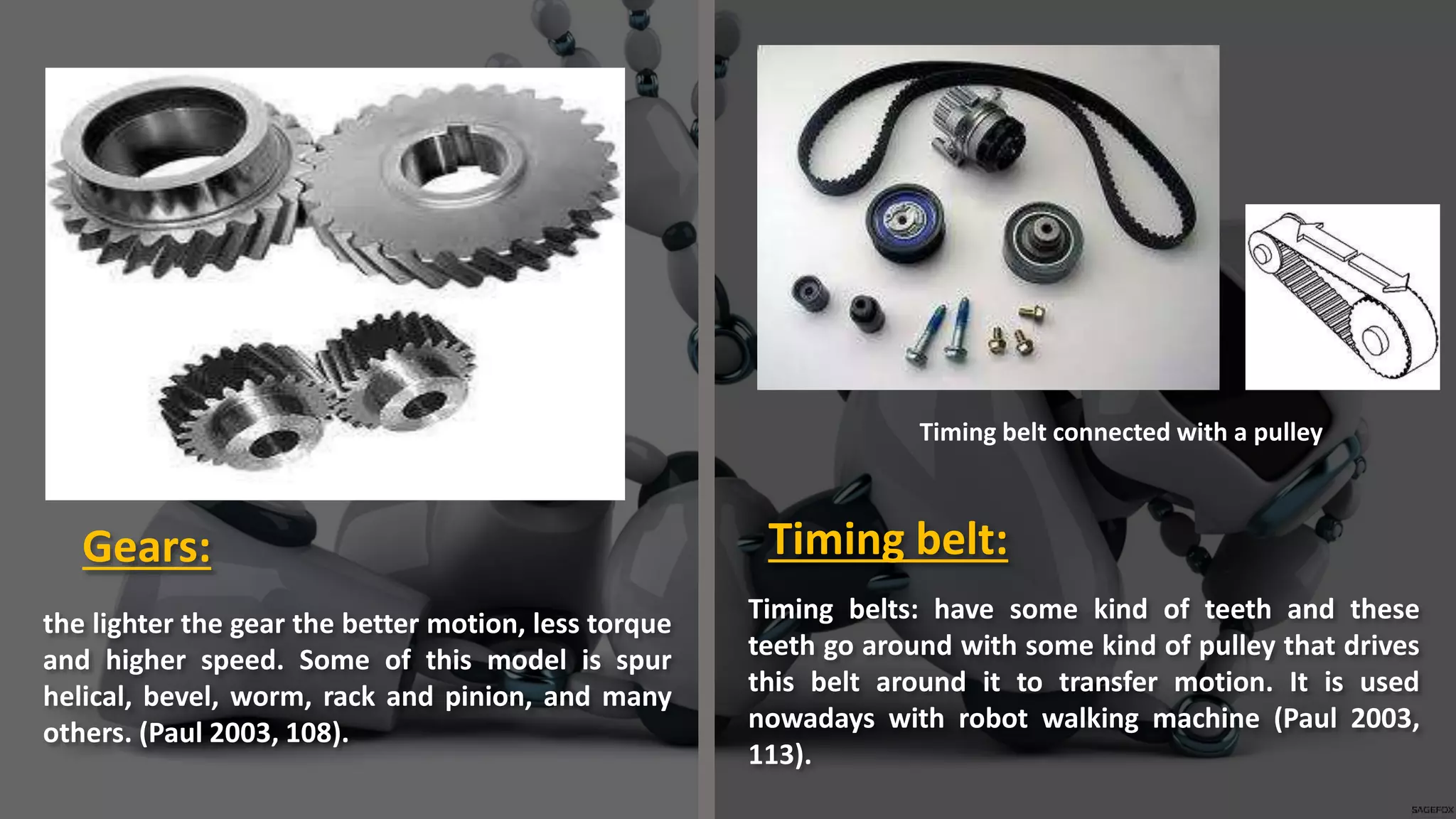
the lighter the gear the better motion, less torque
and higher speed. Some of this model is spur
helical, bevel, worm, rack and pinion, and many
others. (Paul 2003, 108).
Timing belts: have some kind of teeth and these
teeth go around with some kind of pulley that drives
this belt around it to transfer motion. It is used
nowadays with robot walking machine (Paul 2003,
113).
Gears: Timing belt:
Timing belt connected with a pulley
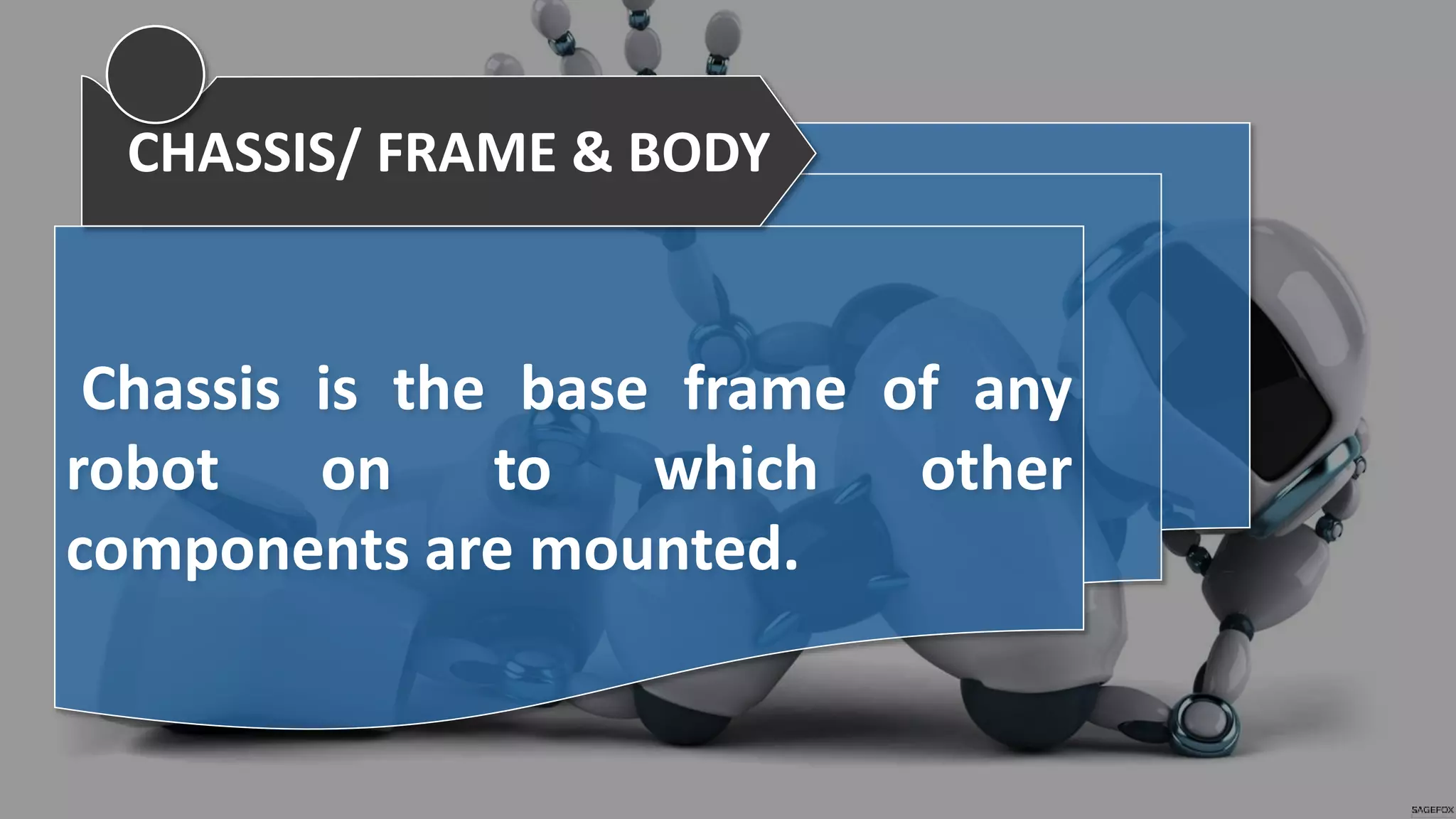
Chains:
Metal belts, cables
and pulleys:
Linkages:
Robot example of linkages between
a servo motor and pulleys
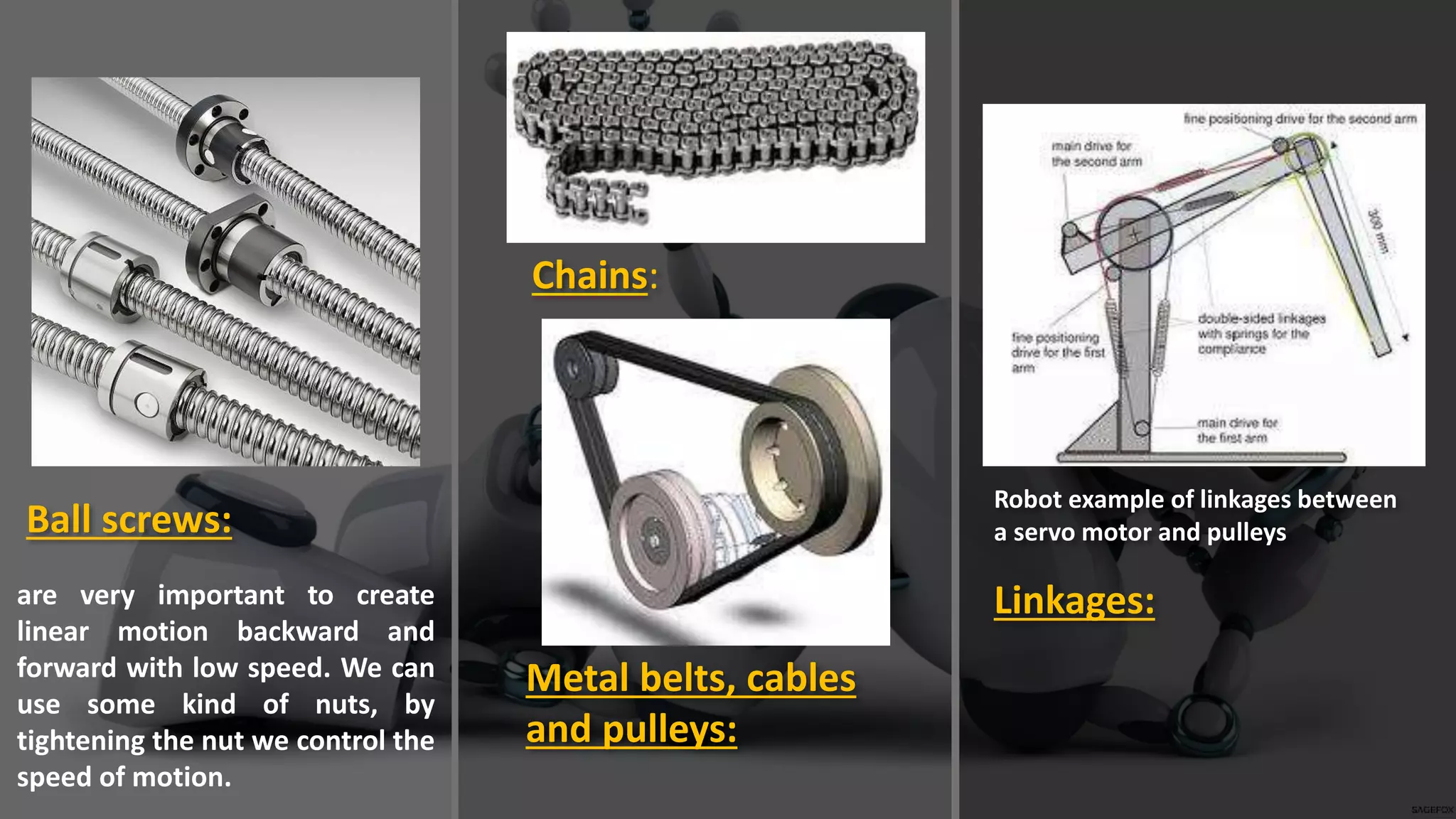
are very important to create
linear motion backward and
forward with low speed. We can
use some kind of nuts, by
tightening the nut we control the
speed of motion.
Ball screws:
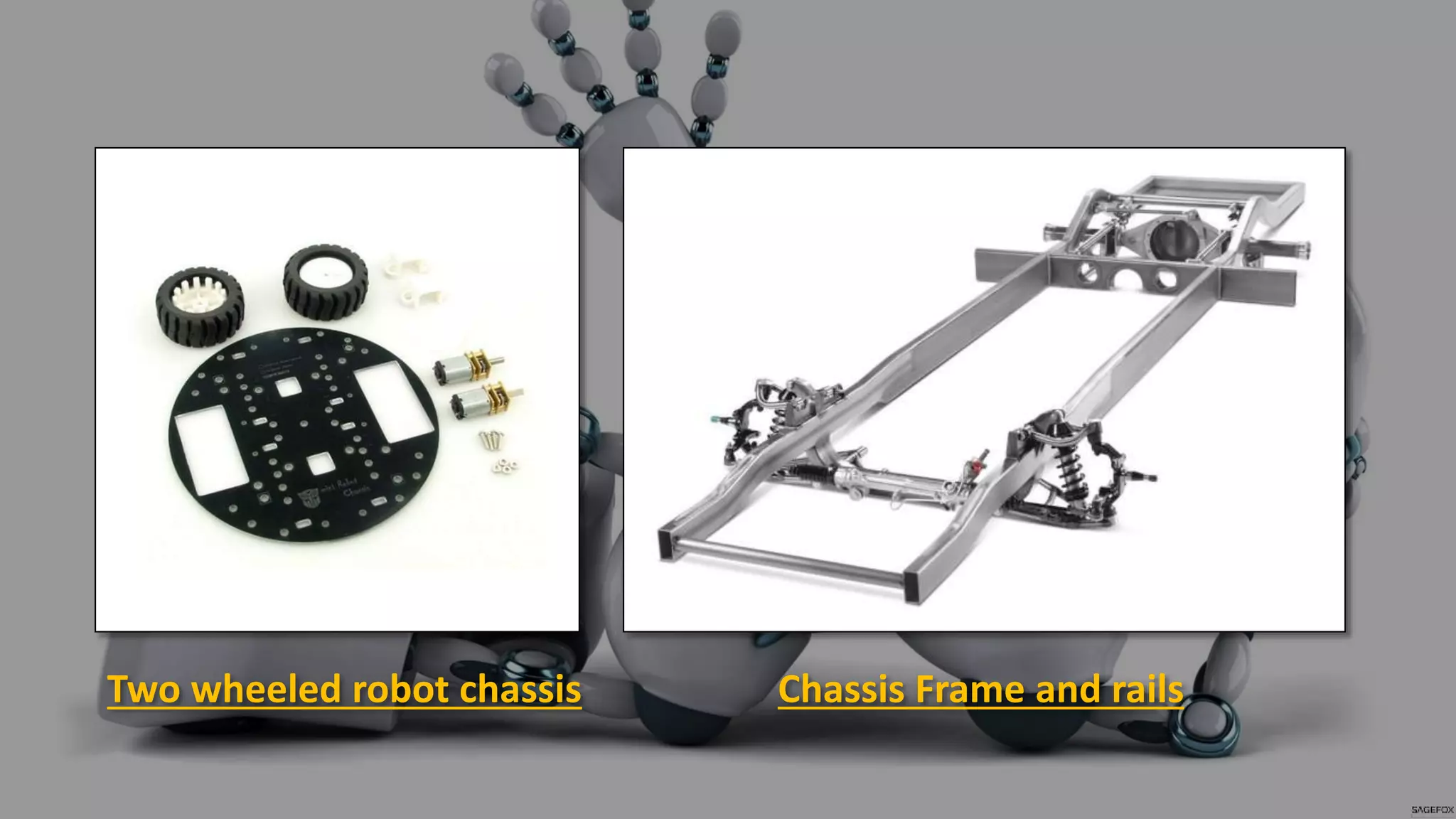
Chassis is the base frame of any
robot on to which other
components are mounted.
CHASSIS/ FRAME & BODY
Two wheeled robot chassis Chassis Frame and rails
ELECTRICAL
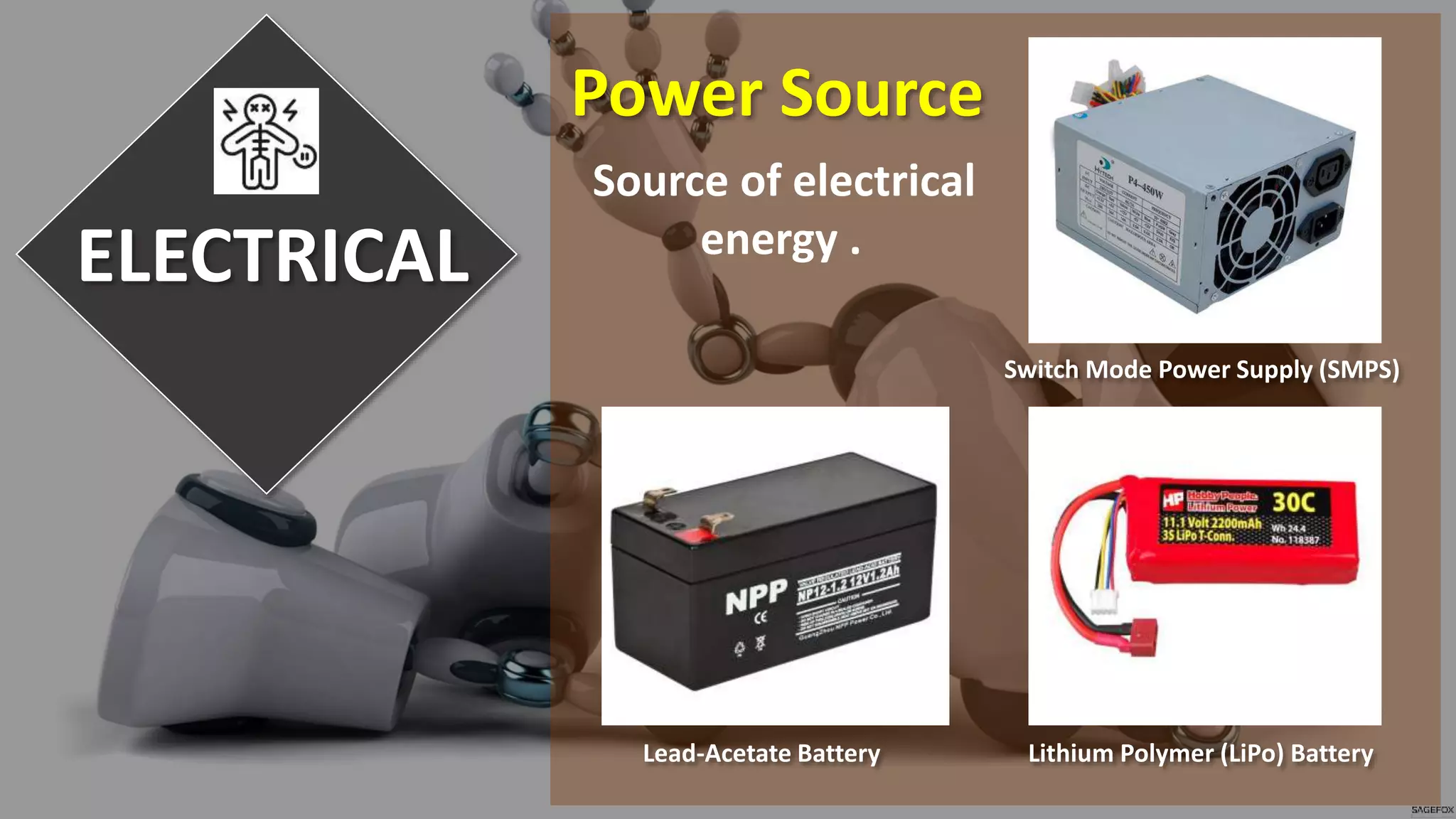
Power Source
Switch Mode Power Supply (SMPS)
Lithium Polymer (LiPo) BatteryLead-Acetate Battery
Source of electrical
energy .
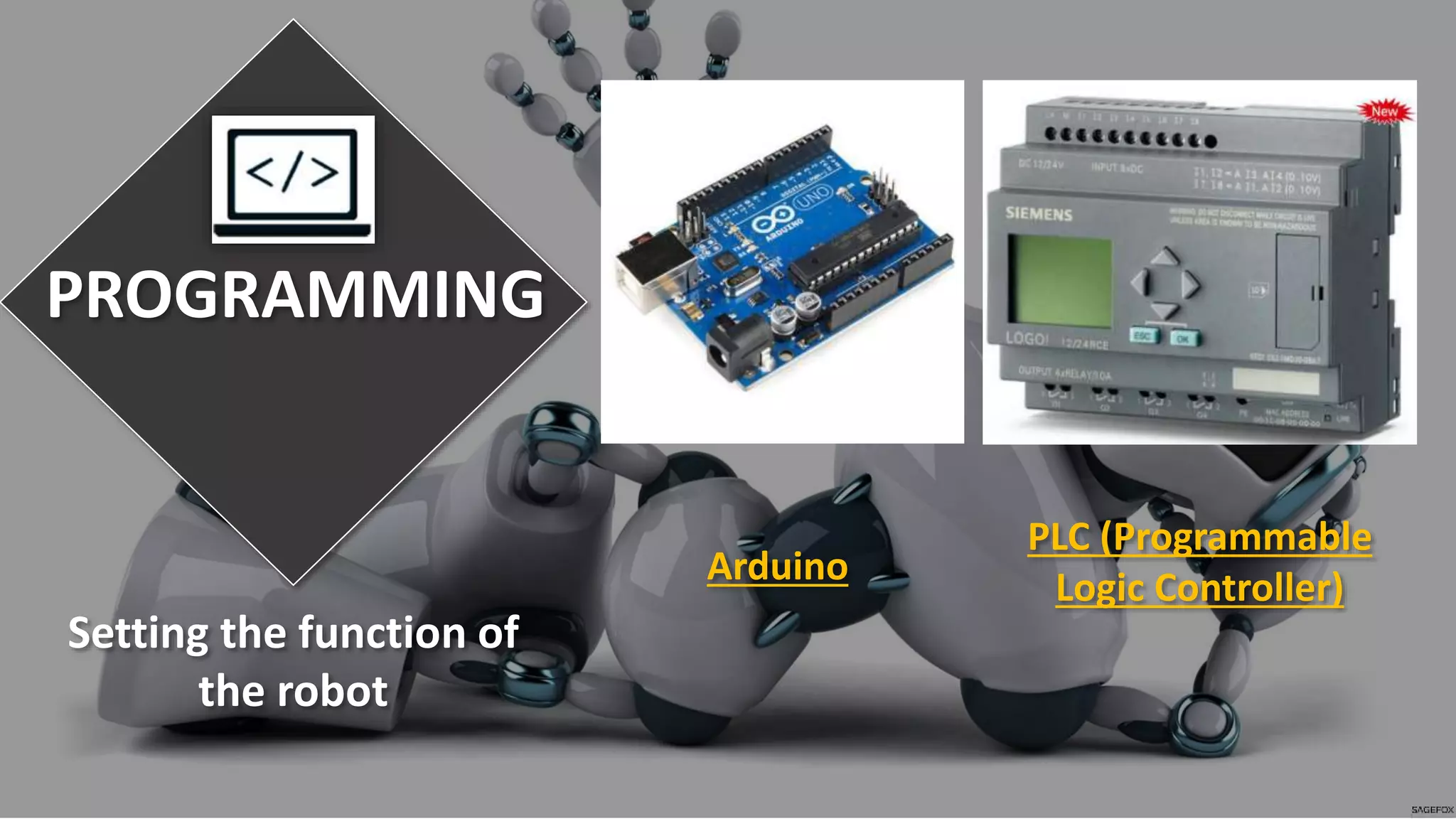
PROGRAMMING
Arduino
PLC (Programmable
Logic Controller)
Setting the function of
the robot

Robot Concepts

  • 2.
    Prepared by: Gil NiñoB. Agnabo -- BS ECE 3A
  • 3.
  • 4.
    • Word robot wascoined by a Czech novelist Karel Capek(1920) • Robot in Czech is a word for worker or servant • In a broad sense, any autonomous machine can be called a robot. What is Robot?
  • 5.
    A robot isa reprogrammable, multifunctional manipulator designed to move material, parts, tools or specialized devices through variable programmed motions for the performance of a variety of tasks: Robot Institute of America, 1979
  • 6.
    To be calleda robot, a machine must possess some or all of the following essential characteristics: ◦Movement ◦Sensing and manipulating the environment ◦Display some kind of ‘intelligence’ (galileo.org/robotics)
  • 7.
    patented in 1954(granted in 1961) by American inventor George Devol, the Unimate was developed as a result of the foresight and business acumen of Joseph Engelberger - the Father of Robotics. Unimate was the very first industrial robot. Conceived from a design for a mechanical arm
  • 10.
    Stationary robots arerobots those work without changing their positions. Referring the robot as “stationary” does not mean that the robot actually is not moving. What “stationary” means is the base of the robot does not move during operation. 1.Stationary Robots
  • 11.
    Wheeled robots arerobots which change their positions with the help of their wheels. Wheeled motion for a robot can be achieved easily in mechanical terms and its cost is pretty low. Additionally control of wheeled movement is generally easier. 2.Wheleed Robots
  • 12.
    Legged robots aremobile robots, similar to wheeled robots, but their locomotion methods are more sophisticated and complicated compared to their wheeled counterparts. As their name suggests they use their legs to control their locomotion and they perform much better than wheeled robots on uneven terrain. 3. Legged Robots
  • 13.
    Swimming robots arerobots which move underwater. These robots are generally inspired by fish and they use their fin-like actuators to maneuver in water.. 4.Swimming Robots – Robot Fish
  • 14.
    Flying robots arerobots that float and maneuver on air using their plane- like or bird/insect-like wings, propellers or balloons. Examples of these robots are airplane robots, bird/insect inspired wing flapping robots, propeller based multicopters and balloon robots. 5.Flying Robots
  • 15.
    6.Rolling Robotic Balls(Mobile Spherical Robots)
  • 16.
    Swarm robots arerobotic systems which consist of multiple small robots. These robots structurally does not create a single united robot, but operates as their robot modules operate cooperatively. Although similar to modular robotic systems, elements of swarm robots have much less functionality and herd configurations does not create new robots. 7.Swarm Robots
  • 17.
    Similar to swarmrobots, modular robotic systems also have multiple robots in their configurations. Modules of these systems are more functional compared to a robotic herd. For example a single module of a modular robotic system can have self-mobility and it can operate alone. The power of modular robotics comes from its versatility in its configurations. Modules of a modular robotic system can create very different configurations and the robots created this way can have very distinct abilities. 8.Modular Robots
  • 18.
    By definiton microrobots term is used to specify both robots that have dimensions on micrometer scale and robots that can operate on micrometer resolution. Therefore both possibly very big stationary robots that can manipulate their environment on a micrometer scale and small robots that are actually measured by micrometers are called micro motors. 9.Micro Robots
  • 19.
    Similar to microrobots nano robots also defined a bit vaguely. The term nano robot both defines very small robots which have nano meter scaled dimensions and robots those can manipulate their environment with a nano meter scale resolution regardless of their actual sizes. 10.Nano Robots
  • 20.
    Soft/elastic robots, are newintroductions to robotics. These robots are generally bio-inspired. Most applications are inspired from squids or inchworms both structurally and functionally. 11.Soft Elastic Robots
  • 21.
  • 22.
  • 23.
  • 24.
    The Robot Jointsis the important element in a robot which helps the links to travel in different kind of movements. JOINTS
  • 25.
    Rotational joint can alsobe represented as R – Joint. This type will allow the joints to move in a rotary motion along the axis, which is vertical to the arm axes. Linear joint can be indicated by the letter L – Joint. This type of joints can perform both translational and sliding movements. These motions will be attained by several ways such as telescoping mechanism and piston. The two links should be in parallel axes for achieving the linear movement. Twisting joint will be referred as V – Joint. This joint makes twisting motion among the output and input link. During this process, the output link axis will be vertical to the rotational axis. The output link rotates in relation to the input link. Rotational Joint: Linear Joint: Twisting Joint:
  • 26.
    The O –joint is a symbol that is denoted for the orthogonal joint. This joint is somewhat similar to the linear joint. The only difference is that the output and input links will be moving at the right angles. Revolving joint is generally known as V – Joint. Here, the output link axis is perpendicular to the rotational axis, and the input link is parallel to the rotational axes. As like twisting joint, the output link spins about the input link. Orthogonal Joint: Revolving Joint:
  • 28.
    Actuators are essentiallythe prime movers providing linear force and motion. ACTUATORS
  • 29.
    Conventional: Pneumatics, hydraulics Permanent magnetmotors and stepper motors Pneumatic valve system Pneumatic Cylinder Servo Motor 300 RPM Side Shaft DC Gear Motor
  • 30.
    Linear motors actuators Linearmotor drive actuator
  • 31.
    It is usedto distribute the force or connect actuators to every part of the robot. TRANSMISSION SYSTEM
  • 32.
    the lighter thegear the better motion, less torque and higher speed. Some of this model is spur helical, bevel, worm, rack and pinion, and many others. (Paul 2003, 108). Timing belts: have some kind of teeth and these teeth go around with some kind of pulley that drives this belt around it to transfer motion. It is used nowadays with robot walking machine (Paul 2003, 113). Gears: Timing belt: Timing belt connected with a pulley
  • 33.
    Chains: Metal belts, cables andpulleys: Linkages: Robot example of linkages between a servo motor and pulleys are very important to create linear motion backward and forward with low speed. We can use some kind of nuts, by tightening the nut we control the speed of motion. Ball screws:
  • 34.
    Chassis is thebase frame of any robot on to which other components are mounted. CHASSIS/ FRAME & BODY
  • 35.
    Two wheeled robotchassis Chassis Frame and rails
  • 36.
    ELECTRICAL Power Source Switch ModePower Supply (SMPS) Lithium Polymer (LiPo) BatteryLead-Acetate Battery Source of electrical energy .
  • 37.