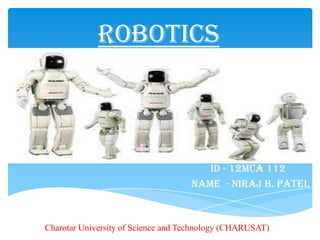
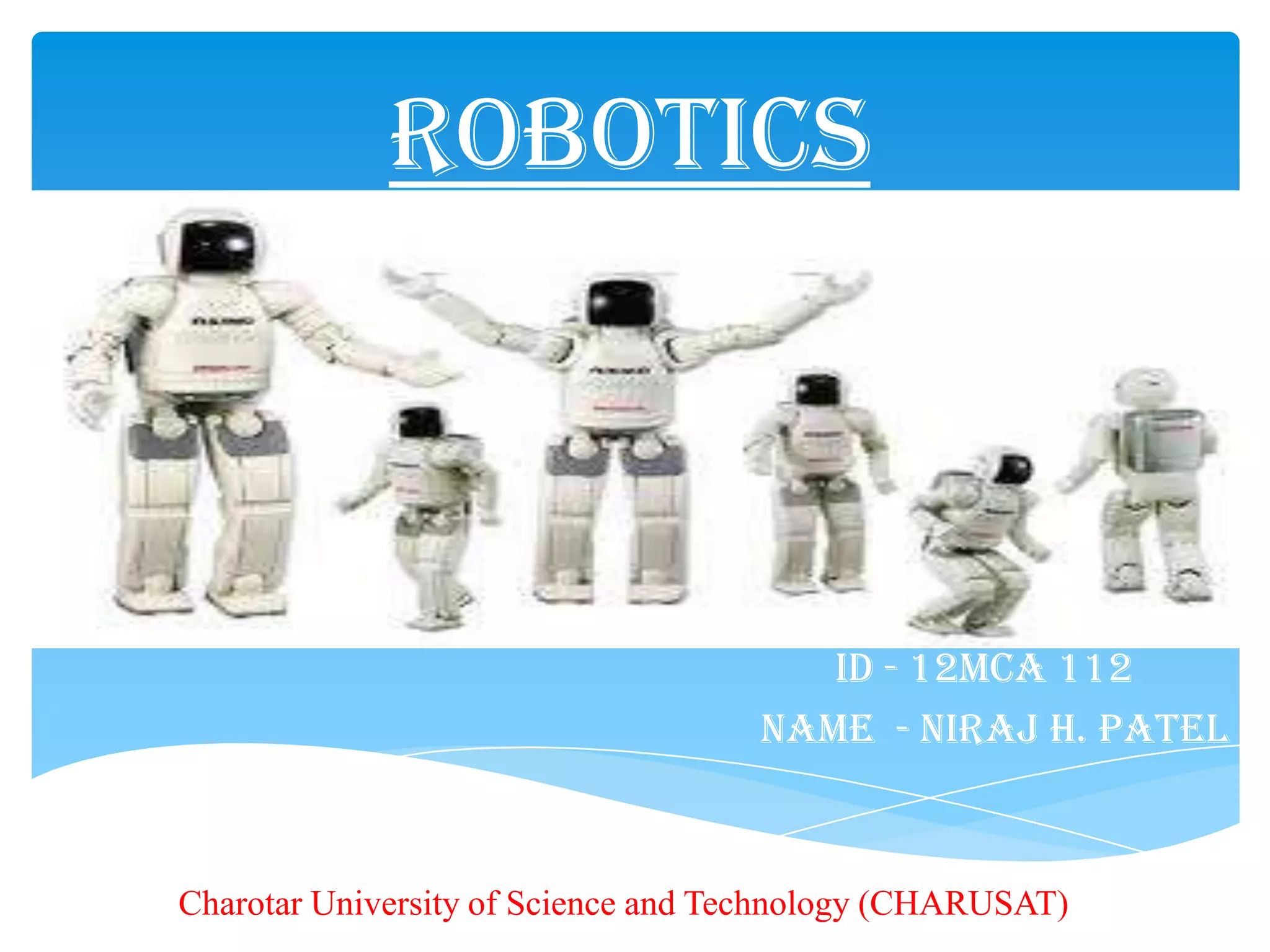
ROBOTICS

ID - 12MCA 112
NAME - NIRAJ H. PATEL

Charotar University of Science and Technology (CHARUSAT)
CONTENTS
Introduction
What is ROBOTICS?
History
Architecture
Components
Advantages
Disadvantages
Applications
Types of Robots
Conclusion

2

1/6/2014
INTRODUCTION

 In the past few decades the use of robots has increased to a great
extent.
 The various challenges for making really working robots are
being overcome and variety of robots ranging from industry to a
households are available in the market.
 This makes the concept of robotics a very important one.
 Let’s start with definition of robot , what is robotics etc.

3

1/6/2014
WHAT IS ROBOTICS ?

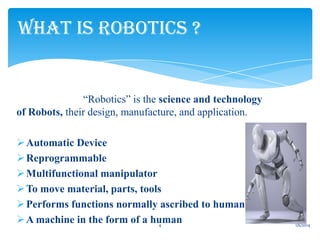
“Robotics” is the science and technology
of Robots, their design, manufacture, and application.

 Automatic Device
 Reprogrammable
 Multifunctional manipulator
 To move material, parts, tools
 Performs functions normally ascribed to humans
 A machine in the form of a human
4

1/6/2014
HISTORY

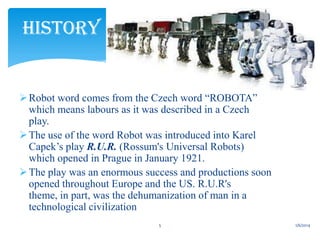
 Robot word comes from the Czech word “ROBOTA”
which means labours as it was described in a Czech
play.
 The use of the word Robot was introduced into Karel
Capek’s play R.U.R. (Rossum's Universal Robots)
which opened in Prague in January 1921.
 The play was an enormous success and productions soon
opened throughout Europe and the US. R.U.R's
theme, in part, was the dehumanization of man in a
technological civilization
5

1/6/2014
ROBOT ARCHITECTURE

 A robot 'architecture' primarily refers to the software and
hardware framework for controlling the robot.
 A VME board running C code to turn motors doesn't really
constitute an architecture by itself.
 The development of code modules and the communication
between them begins to define the architecture.
 Robotic systems are complex and tend to be difficult to develop.
 They integrate multiple sensors with effectors, have many degrees
of freedom and must reconcile hard real-time systems with
systems which cannot meet real-time deadlines [Jones93].
6
1/6/2014
MATERIALS
 A steel plate - which is used in covering of coolers.
 Gears - from the toys.
 Small rods – cycle spokes.
 Motor(2400r.p.m).
 Motor(300r.p.m).
 Wires.
 Switches.
 Screws.
7

1/6/2014
PROCEDURE USED
First of all we took a steel plate and cut it into the required
shape.

The length of the shafts used for connecting the wheels was
predetermined.
We used clamps on both the sides to support the shaft and
to let the shaft mesh with the gears.
And then with the help of gears we connected the motor
with the shaft to transmit the motion.
8

1/6/2014
PROCEDURE USED
 This was the easier part of our robot, the main challenge was to
perfectly design a mechanism for turning of the front wheels.
 We used Ackerman’s mechanism for this purpose.
 We used a 300r.p.m motor for transmitting power to the
Ackerman’s wheel as with 2400r.p.m motor we were not able to
get sufficient torque to rotate the wheels.
 And finally with the help of wires we connected the motors with
the power supply.
9

1/6/2014
10

1/6/2014
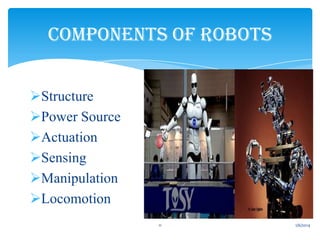
COMPONENTS OF ROBOTS
Structure
Power Source
Actuation
Sensing
Manipulation
Locomotion
11

1/6/2014
STRUCTURE
• The structure of a robot is usually mostly mechanical and can be
called a kinematic chain.
• The chain is formed of links (its bones),
• actuators (its muscles), and joints which can allow one or more
degrees of freedom.

12

1/6/2014
POWER SUPPLY
• Suitable power supply is needed to run the motors and
associated circuitry
• Typical power requirement ranges from 3V to 24V DC
• 220V AC supply must be modified to suit the needs of our
machine
• Batteries can also be used to run robots

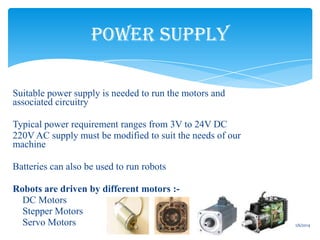
• Robots are driven by different motors :o DC Motors
o Stepper Motors
o Servo Motors
13

1/6/2014
ACTUATION
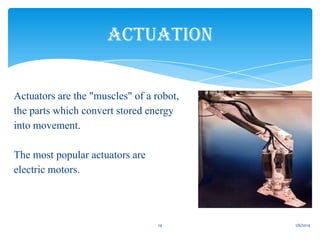
Actuators are the "muscles" of a robot,
the parts which convert stored energy
into movement.
The most popular actuators are
electric motors.

14

1/6/2014
ADVANTAGES

 Revolution in medical science and health care systems.
 New and Wide scope in Education & Training.
 A good help in nuclear industry.
 Used in sports activity.
 Play the role of an assistance in Research and Development
sciences.
 Can very well handle household business.

15

1/6/2014
DISADVANTAGES
 Are not creative or innovative
 Do not think independently
 Do not make complicated decisions
 Do not learn from mistakes
 Do not adapt quickly to changes in their surroundings
16

1/6/2014
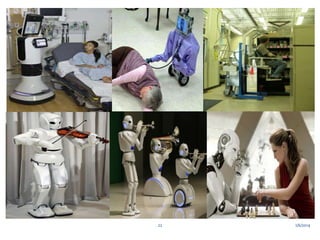
APPLICATIONS

 Industrial Automation
 Services for the Disabled
 Vision Systems
 Planetary Exploration
 Mine Site Clearing
 Law Enforcement
 And Many Others…
17

1/6/2014
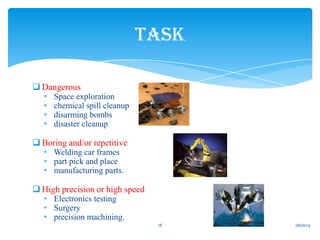
TASK
 Dangerous
•
•
•
•

Space exploration
chemical spill cleanup
disarming bombs
disaster cleanup

 Boring and/or repetitive
• Welding car frames
• part pick and place
• manufacturing parts.

 High precision or high speed
• Electronics testing
• Surgery
• precision machining.

18

1/6/2014
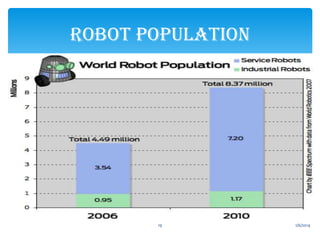
ROBOT POPULATION

19

1/6/2014
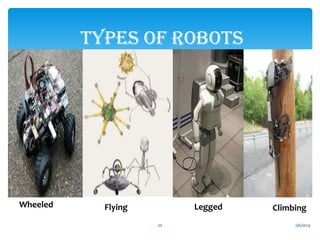
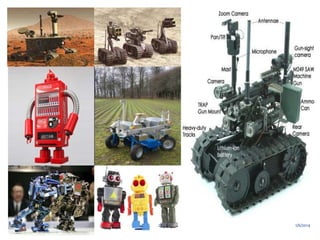
TYPES OF ROBOTS

Wheeled

Legged

Flying
20

Climbing
1/6/2014
21

1/6/2014
22

1/6/2014
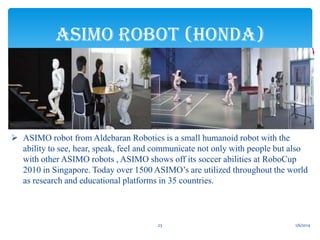
ASIMO ROBOT (HONDA)

 ASIMO robot from Aldebaran Robotics is a small humanoid robot with the
ability to see, hear, speak, feel and communicate not only with people but also
with other ASIMO robots , ASIMO shows off its soccer abilities at RoboCup
2010 in Singapore. Today over 1500 ASIMO’s are utilized throughout the world
as research and educational platforms in 35 countries.

23

1/6/2014
CONCLUSION

 Our bodies are critical to the representations that we use
for internal thought and language
 If a robot is looks like a human then it will be natural for
humans to interact with it in a human-like way
 To develop similar task constraints

24

1/6/2014
ANY
QUESTIONS
25

1/6/2014
ROBOTICS

26

1/6/2014

Robotics

  • 1.
    ROBOTICS ID - 12MCA112 NAME - NIRAJ H. PATEL Charotar University of Science and Technology (CHARUSAT)
  • 2.
  • 3.
    INTRODUCTION  In thepast few decades the use of robots has increased to a great extent.  The various challenges for making really working robots are being overcome and variety of robots ranging from industry to a households are available in the market.  This makes the concept of robotics a very important one.  Let’s start with definition of robot , what is robotics etc. 3 1/6/2014
  • 4.
    WHAT IS ROBOTICS? “Robotics” is the science and technology of Robots, their design, manufacture, and application.  Automatic Device  Reprogrammable  Multifunctional manipulator  To move material, parts, tools  Performs functions normally ascribed to humans  A machine in the form of a human 4 1/6/2014
  • 5.
    HISTORY  Robot wordcomes from the Czech word “ROBOTA” which means labours as it was described in a Czech play.  The use of the word Robot was introduced into Karel Capek’s play R.U.R. (Rossum's Universal Robots) which opened in Prague in January 1921.  The play was an enormous success and productions soon opened throughout Europe and the US. R.U.R's theme, in part, was the dehumanization of man in a technological civilization 5 1/6/2014
  • 6.
    ROBOT ARCHITECTURE  Arobot 'architecture' primarily refers to the software and hardware framework for controlling the robot.  A VME board running C code to turn motors doesn't really constitute an architecture by itself.  The development of code modules and the communication between them begins to define the architecture.  Robotic systems are complex and tend to be difficult to develop.  They integrate multiple sensors with effectors, have many degrees of freedom and must reconcile hard real-time systems with systems which cannot meet real-time deadlines [Jones93]. 6 1/6/2014
  • 7.
    MATERIALS  A steelplate - which is used in covering of coolers.  Gears - from the toys.  Small rods – cycle spokes.  Motor(2400r.p.m).  Motor(300r.p.m).  Wires.  Switches.  Screws. 7 1/6/2014
  • 8.
    PROCEDURE USED First ofall we took a steel plate and cut it into the required shape. The length of the shafts used for connecting the wheels was predetermined. We used clamps on both the sides to support the shaft and to let the shaft mesh with the gears. And then with the help of gears we connected the motor with the shaft to transmit the motion. 8 1/6/2014
  • 9.
    PROCEDURE USED  Thiswas the easier part of our robot, the main challenge was to perfectly design a mechanism for turning of the front wheels.  We used Ackerman’s mechanism for this purpose.  We used a 300r.p.m motor for transmitting power to the Ackerman’s wheel as with 2400r.p.m motor we were not able to get sufficient torque to rotate the wheels.  And finally with the help of wires we connected the motors with the power supply. 9 1/6/2014
  • 10.
  • 11.
    COMPONENTS OF ROBOTS Structure PowerSource Actuation Sensing Manipulation Locomotion 11 1/6/2014
  • 12.
    STRUCTURE • The structureof a robot is usually mostly mechanical and can be called a kinematic chain. • The chain is formed of links (its bones), • actuators (its muscles), and joints which can allow one or more degrees of freedom. 12 1/6/2014
  • 13.
    POWER SUPPLY • Suitablepower supply is needed to run the motors and associated circuitry • Typical power requirement ranges from 3V to 24V DC • 220V AC supply must be modified to suit the needs of our machine • Batteries can also be used to run robots • Robots are driven by different motors :o DC Motors o Stepper Motors o Servo Motors 13 1/6/2014
  • 14.
    ACTUATION Actuators are the"muscles" of a robot, the parts which convert stored energy into movement. The most popular actuators are electric motors. 14 1/6/2014
  • 15.
    ADVANTAGES  Revolution inmedical science and health care systems.  New and Wide scope in Education & Training.  A good help in nuclear industry.  Used in sports activity.  Play the role of an assistance in Research and Development sciences.  Can very well handle household business. 15 1/6/2014
  • 16.
    DISADVANTAGES  Are notcreative or innovative  Do not think independently  Do not make complicated decisions  Do not learn from mistakes  Do not adapt quickly to changes in their surroundings 16 1/6/2014
  • 17.
    APPLICATIONS  Industrial Automation Services for the Disabled  Vision Systems  Planetary Exploration  Mine Site Clearing  Law Enforcement  And Many Others… 17 1/6/2014
  • 18.
    TASK  Dangerous • • • • Space exploration chemicalspill cleanup disarming bombs disaster cleanup  Boring and/or repetitive • Welding car frames • part pick and place • manufacturing parts.  High precision or high speed • Electronics testing • Surgery • precision machining. 18 1/6/2014
  • 19.
  • 20.
  • 21.
  • 22.
  • 23.
    ASIMO ROBOT (HONDA) ASIMO robot from Aldebaran Robotics is a small humanoid robot with the ability to see, hear, speak, feel and communicate not only with people but also with other ASIMO robots , ASIMO shows off its soccer abilities at RoboCup 2010 in Singapore. Today over 1500 ASIMO’s are utilized throughout the world as research and educational platforms in 35 countries. 23 1/6/2014
  • 24.
    CONCLUSION  Our bodiesare critical to the representations that we use for internal thought and language  If a robot is looks like a human then it will be natural for humans to interact with it in a human-like way  To develop similar task constraints 24 1/6/2014
  • 25.
  • 26.