Unleash Business Innovation with the
Next Generation of Cloud Computing
Robert LeBlanc
Senior Vice President, IBM Software


                                       1
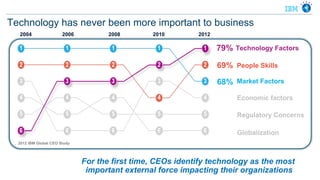
Technology has never been more important to business
  2004                 2006          2008       2010        2012

                                                                   79% Technology Factors

                                                                   69% People Skills

                                                                   68% Market Factors
                                                                        Economic factors

                                                                        Regulatory Concerns

                                                                        Globalization
  2012 IBM Global CEO Study


                              For the first time, CEOs identify technology as the most
                               important external force impacting their organizations       2
CIOs turn to innovative technologies to deliver outcomes
                            Big
                           Data                                  83%

                          Mobile                            74%

                         Cloud                             68%

                           BPM                       60%

                         Security                    58%

                                                                       3
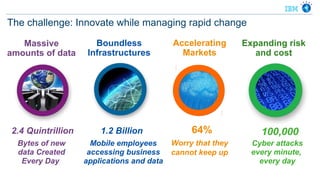
The challenge: Innovate while managing rapid change

   Massive            Boundless            Accelerating      Expanding risk
amounts of data     Infrastructures          Markets            and cost


2.4 Quintrillion       1.2 Billion              64%              100,000
  Bytes of new       Mobile employees      Worry that they     Cyber attacks
  data Created      accessing business     cannot keep up      every minute,
   Every Day       applications and data                         every day
                                                                           4
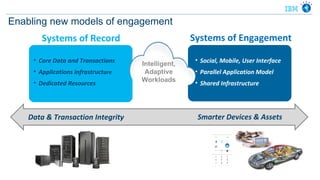
Enabling new models of engagement
        Systems of Record                           Systems of Engagement

     • Core Data and Transactions                    • Social, Mobile, User Interface
                                     Intelligent,
     • Applications Infrastructure    Adaptive       • Parallel Application Model
     • Dedicated Resources           Workloads       • Shared Infrastructure


    Data & Transaction Integrity                     Smarter Devices & Assets


                                                                                        5
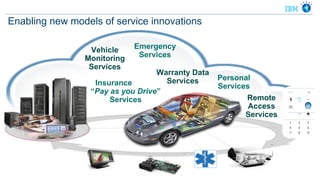
Enabling new models of service innovations

                    Vehicle     Emergency
                   Monitoring    Services
                    Services
                                     Warranty Data
                                       Services      Personal
                     Insurance                       Services
                    “Pay as you Drive”
                         Services                           Remote
                                                             Access
                                                            Services

     Data Center


                                                                       6
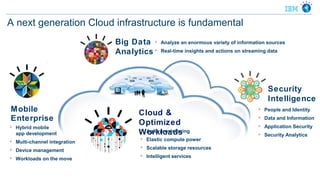
A next generation Cloud infrastructure is fundamental
                                Big Data       Analyze an enormous variety of information sources
                                Analytics      Real-time insights and actions on streaming data


                                                                                             Security
                                                                                             Intelligence
Mobile                               Cloud &
                                                                                           People and Identity
Enterprise                                                                                 Data and Information
                                     Optimized                                              Application Security
   Hybrid mobile                                                                       

    app development
                                      Agile provisioning
                                     Workloads                                             Security Analytics
   Multi-channel integration
                                        Elastic compute power
   Device management
                                        Scalable storage resources
   Workloads on the move
                                        Intelligent services


                                                                                                          7
Characteristics of an enterprise-class Cloud infrastructure


      Intelligent Workload Optimization         Build upon a
                                                common Cloud
                                                management
            Patterns of Expertise               standards
                                                architecture
      Dynamically Orchestrated Services

                                                               8
Cloud Service Orchestration is an emerging need


                      Intelligent, adaptive Cloud workloads …


       Resource                 Workload Orchestration                    Service Orchestration
                                                                          Llifecycle of business cloud services
      Orchestration             Workload aware placement / optimization
   Onboard, provision, manage


                                                                                                           9
An Enterprise Cloud architectural direction driven by standards
                                                                                       Intelligent, Hybrid
                                                                                         Cloud Services
           Common Cloud Management Services
            built on a standards reference model
                                                               Cloud Workload
                                                                 Orchestration
                                           Cloud Service
                                           Management
                     Cloud Service
  Virtualization
                        Delivery

                    Service Visibility   Image Management                        Service Orchestration

                    Service Control      Patch Management                     Storage Service Automation
                   Service Automation      VM Protection                      Network Service Automation


                                                    Open Service
                                                    Lifecycle Collaboration
                                                                                                             10
Delivering flexibility in consuming & integrating hybrid clouds


    Evolve existing             Accelerate                  Immediate access
    infrastructure               adoption with                to a managed
       to Cloud                expert integrated                 platform
                                   systems

         Common Cloud Management Services  open standards reference model

                                                                               11
IBM remains committed to Cloud, actively participating in the
Open community and addressing client challenges

                                                                  IBM SmartCloud
     200+ Million daily Cloud transactions
     1 Million application users working in IBM Cloud   IBM PureSystems

     13 Billion+ security events managed per day
     Over 60 SaaS solutions for immediate access
     5,000+ private Cloud client engagements
     1,000s participating in the Open community
     Strong partner ecosystem
                                                                               12
ibm.com/cloud

                13

Unleash Business Innovation with the Next Generation of Cloud Computing

  • 1.
    Unleash Business Innovationwith the Next Generation of Cloud Computing Robert LeBlanc Senior Vice President, IBM Software 1
  • 2.
    Technology has neverbeen more important to business 2004 2006 2008 2010 2012 79% Technology Factors 69% People Skills 68% Market Factors Economic factors Regulatory Concerns Globalization 2012 IBM Global CEO Study For the first time, CEOs identify technology as the most important external force impacting their organizations 2
  • 3.
    CIOs turn toinnovative technologies to deliver outcomes Big Data 83% Mobile 74% Cloud 68% BPM 60% Security 58% 3
  • 4.
    The challenge: Innovatewhile managing rapid change Massive Boundless Accelerating Expanding risk amounts of data Infrastructures Markets and cost 2.4 Quintrillion 1.2 Billion 64% 100,000 Bytes of new Mobile employees Worry that they Cyber attacks data Created accessing business cannot keep up every minute, Every Day applications and data every day 4
  • 5.
    Enabling new modelsof engagement Systems of Record Systems of Engagement • Core Data and Transactions • Social, Mobile, User Interface Intelligent, • Applications Infrastructure Adaptive • Parallel Application Model • Dedicated Resources Workloads • Shared Infrastructure Data & Transaction Integrity Smarter Devices & Assets 5
  • 6.
    Enabling new modelsof service innovations Vehicle Emergency Monitoring Services Services Warranty Data Services Personal Insurance Services “Pay as you Drive” Services Remote Access Services Data Center 6
  • 7.
    A next generationCloud infrastructure is fundamental Big Data  Analyze an enormous variety of information sources Analytics  Real-time insights and actions on streaming data Security Intelligence Mobile Cloud &  People and Identity Enterprise  Data and Information Optimized Application Security  Hybrid mobile  app development  Agile provisioning Workloads  Security Analytics  Multi-channel integration  Elastic compute power  Device management  Scalable storage resources  Workloads on the move  Intelligent services 7
  • 8.
    Characteristics of anenterprise-class Cloud infrastructure Intelligent Workload Optimization Build upon a common Cloud management Patterns of Expertise standards architecture Dynamically Orchestrated Services 8
  • 9.
    Cloud Service Orchestrationis an emerging need Intelligent, adaptive Cloud workloads … Resource Workload Orchestration Service Orchestration Llifecycle of business cloud services Orchestration Workload aware placement / optimization Onboard, provision, manage 9
  • 10.
    An Enterprise Cloudarchitectural direction driven by standards Intelligent, Hybrid Cloud Services Common Cloud Management Services built on a standards reference model Cloud Workload Orchestration Cloud Service Management Cloud Service Virtualization Delivery Service Visibility Image Management Service Orchestration Service Control Patch Management Storage Service Automation Service Automation VM Protection Network Service Automation Open Service Lifecycle Collaboration 10
  • 11.
    Delivering flexibility inconsuming & integrating hybrid clouds Evolve existing Accelerate Immediate access infrastructure adoption with to a managed to Cloud expert integrated platform systems Common Cloud Management Services  open standards reference model 11
  • 12.
    IBM remains committedto Cloud, actively participating in the Open community and addressing client challenges IBM SmartCloud  200+ Million daily Cloud transactions  1 Million application users working in IBM Cloud IBM PureSystems  13 Billion+ security events managed per day  Over 60 SaaS solutions for immediate access  5,000+ private Cloud client engagements  1,000s participating in the Open community  Strong partner ecosystem 12
  • 13.

Editor's Notes

  • #3 Since our CEO Study series began, technology – in its widest sense – has progressively risen on CEOs ’ radar and now ranks as the #1 factor impacting organizations. From 2004 – 2012, we ’ve interviewed more than 6,500 CEOs 2012 Study: 1700 CEOs interviewed: 64 countries, 18 industries This year, CEOs told us that technology will be the top driver of change in the next three years, surpassing “market forces” for the first time. Most surprising, however, is its expected impact. They told us that what will be most critical and potentially differentiating will be how they engage people – connecting employees, customers and partners both to organizations and to each other in new ways. CEOs – told us that they will simplify their operations and products to better manage complexity. In fact, simplifying needless complexity was seen by many CEOs as a critical element to better coping with the increasing complexity in their environment.
  • #4 Similar to our CEO Study, we also survey CIOs and produce a regular IBM CIO study In 2011, we interviewed more than 3,000 CIOs and learned that CIOs and business leaders believe Analytics, Mobility, Virtualization, Cloud and Security are the most important technologies The CIO study reveals an unprecedented shift toward these technologies to innovate and solve specific business challenges   Analytics is the foundation for driving better insights and decision making across these key technologies   Mobility solutions deliver applications and data to their users when they need it, and on the device they choose   Virtualization is more mainstream and integrated into every day workloads   Cloud computing offers the potential for more efficient access to data, disaster recovery, and the ability to process large amounts of data quickly   Security intelligence solutions address key threats and compliance challenges and enable secure business
  • #5 --------------------------- Big Data will join mobile and cloud as the next "must have" competency as the volume of digital content grows to 2.7ZB (1ZB = 1 billion terabytes) in 2012, up 48% from 2011, rocketing toward 8ZB by 2015. IDC Top 10 Predictions for 2012. Competing for 2020 33% of cloud developers, more than half their cloud development involves mobility Cloud Developer Study, Evans Data OR 85 billion mobile apps will be downloaded, and mobile data network spending will exceed fixed data network spending for the first time. IDC Top 10 Predictions for 2012. Competing for 2020 While private Cloud deployments remain the top choice for most enterprises, some 40% of businesses are now adopting hybrid Cloud platforms. A study by IDC on behalf of Infosys http://www.businesscloud9.com/content/idc-study-hybrid-clouds-rise 62% of respondents rated Security as one of the top-three most important areas to their organization overall in the next two years. IBM Tech Trends, 2012
  • #6 In this hypothetical example, an electrical utility might exploit a Systems of Engagement model to extend the reach of their traditional IT applications to customers and other utility workers to   gather outage information, prioritize responses, communicate with temporary workers form other utility companies dispatched to help, and update customers with status on work priorities, locations an estimated times for resumptions of services.   Over time the company learns form the applications they needed to develop and deploy quickly to coordinate their response by integrating them more deeply into their traditional IT systems.   Cloud technology and polyglot development tools and services allowed the utility to quickly develop and deploy the systems of engagement in response to the disaster, bridging them to their systems of record to help in response and customer communication. .
  • #9 Optimize the dynamic provisioning of new services and workloads Workloads need to understand the business metrics..infusing business gaols into workload and have an environment that can understand is key It's more than having tools We need to start with business objectives guaranteed services level performance meeting performance levels (quality of service) If you can do the above, then vendors are just playing around...like competitors who take monolithic things and try to repackage it All workloads are not the same IBM's competitive advantage: It's the intelligence that looks at the key requirements of various workloads and understands those requirements....that's what being workload aware is all about
  • #10 Setup Backup Setup Monitoring Large Systems Quota Changes Open Service Request Add NAS Volume Firewall Ports Load Balance Update CMDB
  • #12 There are 3 delivery models for infrastructure and platform capabilities: Using core technologies from IBM SmartCloud Foundation to build and manage private clouds; Using PureSystems to accelerate deployment of private clouds; Consuming infrastructure as a service and platform as a service from IBM, providing immediate access to managed services in the IBM SmartCloud Services portfolio