Using big data and
predictive analysis
Robert Brooks &
Matthew Tomlinson
www.pwc.com
PwC
Agenda
The Background
The Key Requirements
What is it?
What is needed to make it work?
The Application
How have we used in the past?
PwC
Background
What is Data and Predictive
Analytics?
Data mining
Future probabilities and trends
3
PwC
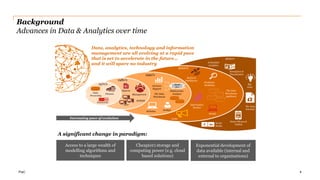
Data, analytics, technology and information
management are all evolving at a rapid pace
that is set to accelerate in the future…
and it will spare no industry
1980’s
1990’s
2000’s
2010+
1970’s
Reports
OLTP
Punchcards
Data
Processing
Decision
Support
Websites
Audio
Finance Management
Analyst
Model
f(x)
X1
X2
X3
Y1
Y2
Multivariate
Analysis
Business
Intelligence
Predictive
Modeling
Information
Worker
Simulation &
Visualization
Social
Media
The Data
Scientist
Embedded
Analytics
Mobile
The Data
Warehouse
The Data
Warehouse
Appliance
Big
Data
RDBMS
Smart Phones &
Tablets
Increasing pace of evolution
Background
Advances in Data & Analytics over time
Access to a large wealth of
modelling algorithms and
techniques
Cheap(er) storage and
computing power (e.g. cloud
based solutions)
Exponential development of
data available (internal and
external to organisations)
A significant change in paradigm:
4
PwC
Background
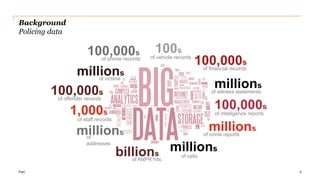
Policing data
5
of staff records
1,000s
of
addresses
millions
of victims
millions
of ANPR hits
billions
of vehicle records
100s
of phone records
100,000s
of financial records
100,000s
of offender records
100,000s of witness statements
millions
of intelligence reports
100,000s
of calls
millions
of crime reports
millions
PwC
Background
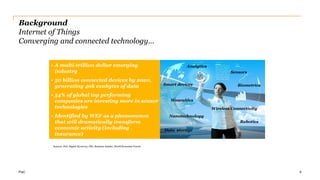
Internet of Things
Converging and connected technology…
6
Smart devices
Sensors
Biometrics
Wireless Connectivity
Nanotechnology
Analytics
Robotics
• A multi-trillion dollar emerging
industry
• 50 billion connected devices by 2020,
generating 40k exabytes of data
• 54% of global top performing
companies are investing more in sensor
technologies
• Identified by WEF as a phenomenon
that will dramatically transform
economic activity (including
insurance)
Wearables
Sources: PwC Digital IQ survey, IDC, Business Insider, World Economic Forum
Data storage
PwC
Background
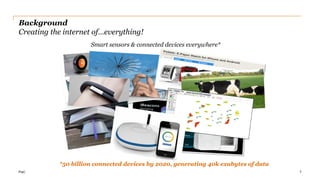
Creating the internet of…everything!
7
*50 billion connected devices by 2020, generating 40k exabytes of data
Smart sensors & connected devices everywhere*
PwC
Background
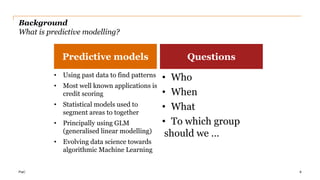
What is predictive modelling?
• Using past data to find patterns
• Most well known applications is
credit scoring
• Statistical models used to
segment areas to together
• Principally using GLM
(generalised linear modelling)
• Evolving data science towards
algorithmic Machine Learning
• Who
• When
• What
• To which group
should we …
8
Predictive models Questions
PwC
Background
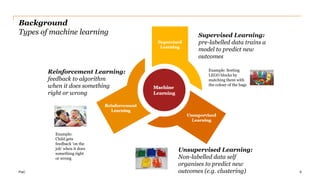
Types of machine learning
9
Supervised Learning:
pre-labelled data trains a
model to predict new
outcomes
Example: Sorting
LEGO blocks by
matching them with
the colour of the bags
Unsupervised Learning:
Non-labelled data self
organises to predict new
outcomes (e.g. clustering)
Reinforcement Learning:
feedback to algorithm
when it does something
right or wrong
Example:
Child gets
feedback ‘on the
job’ when it does
something right
or wrong
PwC
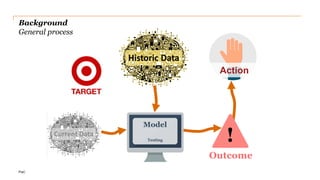
Model
Testing !
Outcome
Action
Background
General process
PwC
Key requirements
What is needed to make it work?
The question you are try to answer
Data
Tools and systems
11
PwC
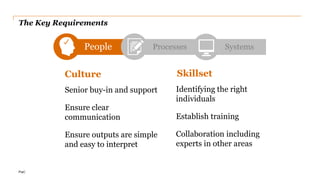
People
Culture
Senior buy-in and support
Ensure clear
communication
Ensure outputs are simple
and easy to interpret
Skillset
Processes
Identifying the right
individuals
Establish training
Collaboration including
experts in other areas
The Key Requirements
Systems
PwC
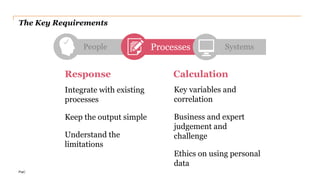
Response
Integrate with existing
processes
Keep the output simple
Understand the
limitations
Calculation
Key variables and
correlation
Business and expert
judgement and
challenge
Ethics on using personal
data
The Key Requirements
People Processes Systems
PwC
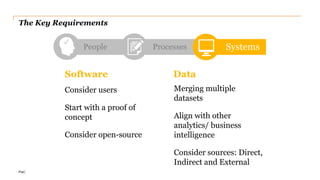
Software
Consider users
Start with a proof of
concept
Consider open-source
Data
Merging multiple
datasets
Align with other
analytics/ business
intelligence
Consider sources: Direct,
Indirect and External
The Key Requirements
People Processes SystemsPeople
PwC
The Application
How have we used in the past?
15
PwC
The Application
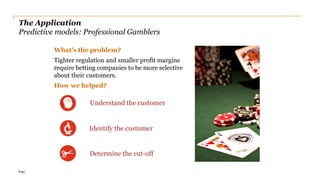
Predictive models: Professional Gamblers
What’s the problem?
Tighter regulation and smaller profit margins
require betting companies to be more selective
about their customers.
How we helped?
16
Identify the customer
Determine the cut-off
Understand the customer
PwC
The Application
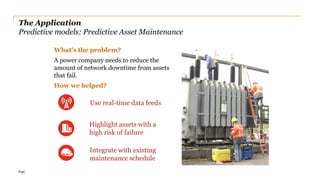
Predictive models: Predictive Asset Maintenance
What’s the problem?
A power company needs to reduce the
amount of network downtime from assets
that fail.
How we helped?
17
Highlight assets with a
high risk of failure
Integrate with existing
maintenance schedule
Use real-time data feeds
PwC
The Application
Predictive models: Talent retention
What’s the problem?
A media company wanted to understand
and manage the loss of talent in the
organisation.
How we helped?
18
Predict those at high risk
of leaving
New performance
management system
Targeted interventions
PwC
The Application
Policing
Questions?
This publication has been prepared for general guidance on matters of interest only, and does not constitute professional
advice. You should not act upon the information contained in this publication without obtaining specific professional advice. No
representation or warranty (express or implied) is given as to the accuracy or completeness of the information contained in this
publication, and, to the extent permitted by law, PricewaterhouseCoopers LLP, its members, employees and agents do not
accept or assume any liability, responsibility or duty of care for any consequences of you or anyone else acting, or refraining to
act, in reliance on the information contained in this publication or for any decision based on it.
© 2016 PricewaterhouseCoopers LLP. All rights reserved. In this document, “PwC” refers to PricewaterhouseCoopers LLP
which is a member firm of PricewaterhouseCoopers International Limited, each member firm of which is a separate legal
entity.
Robert Brooks
T: 020 7212 2311
M: 07725 706822
robert.j.brooks@pwc.com
Rob Brooks FIA
Associate Director,
Actuarial Services
Matthew Tomlinson
T: 0117 309 2538
M: 07843 372011
matthew.x.Tomlinson@pwc.com
Matthew Tomlinson
Senior Associate,
Data Assurance &
Analytics

Robert Brooks, PwC

  • 1.
    Using big dataand predictive analysis Robert Brooks & Matthew Tomlinson www.pwc.com
  • 2.
    PwC Agenda The Background The KeyRequirements What is it? What is needed to make it work? The Application How have we used in the past?
  • 3.
    PwC Background What is Dataand Predictive Analytics? Data mining Future probabilities and trends 3
  • 4.
    PwC Data, analytics, technologyand information management are all evolving at a rapid pace that is set to accelerate in the future… and it will spare no industry 1980’s 1990’s 2000’s 2010+ 1970’s Reports OLTP Punchcards Data Processing Decision Support Websites Audio Finance Management Analyst Model f(x) X1 X2 X3 Y1 Y2 Multivariate Analysis Business Intelligence Predictive Modeling Information Worker Simulation & Visualization Social Media The Data Scientist Embedded Analytics Mobile The Data Warehouse The Data Warehouse Appliance Big Data RDBMS Smart Phones & Tablets Increasing pace of evolution Background Advances in Data & Analytics over time Access to a large wealth of modelling algorithms and techniques Cheap(er) storage and computing power (e.g. cloud based solutions) Exponential development of data available (internal and external to organisations) A significant change in paradigm: 4
  • 5.
    PwC Background Policing data 5 of staffrecords 1,000s of addresses millions of victims millions of ANPR hits billions of vehicle records 100s of phone records 100,000s of financial records 100,000s of offender records 100,000s of witness statements millions of intelligence reports 100,000s of calls millions of crime reports millions
  • 6.
    PwC Background Internet of Things Convergingand connected technology… 6 Smart devices Sensors Biometrics Wireless Connectivity Nanotechnology Analytics Robotics • A multi-trillion dollar emerging industry • 50 billion connected devices by 2020, generating 40k exabytes of data • 54% of global top performing companies are investing more in sensor technologies • Identified by WEF as a phenomenon that will dramatically transform economic activity (including insurance) Wearables Sources: PwC Digital IQ survey, IDC, Business Insider, World Economic Forum Data storage
  • 7.
    PwC Background Creating the internetof…everything! 7 *50 billion connected devices by 2020, generating 40k exabytes of data Smart sensors & connected devices everywhere*
  • 8.
    PwC Background What is predictivemodelling? • Using past data to find patterns • Most well known applications is credit scoring • Statistical models used to segment areas to together • Principally using GLM (generalised linear modelling) • Evolving data science towards algorithmic Machine Learning • Who • When • What • To which group should we … 8 Predictive models Questions
  • 9.
    PwC Background Types of machinelearning 9 Supervised Learning: pre-labelled data trains a model to predict new outcomes Example: Sorting LEGO blocks by matching them with the colour of the bags Unsupervised Learning: Non-labelled data self organises to predict new outcomes (e.g. clustering) Reinforcement Learning: feedback to algorithm when it does something right or wrong Example: Child gets feedback ‘on the job’ when it does something right or wrong
  • 10.
  • 11.
    PwC Key requirements What isneeded to make it work? The question you are try to answer Data Tools and systems 11
  • 12.
    PwC People Culture Senior buy-in andsupport Ensure clear communication Ensure outputs are simple and easy to interpret Skillset Processes Identifying the right individuals Establish training Collaboration including experts in other areas The Key Requirements Systems
  • 13.
    PwC Response Integrate with existing processes Keepthe output simple Understand the limitations Calculation Key variables and correlation Business and expert judgement and challenge Ethics on using personal data The Key Requirements People Processes Systems
  • 14.
    PwC Software Consider users Start witha proof of concept Consider open-source Data Merging multiple datasets Align with other analytics/ business intelligence Consider sources: Direct, Indirect and External The Key Requirements People Processes SystemsPeople
  • 15.
    PwC The Application How havewe used in the past? 15
  • 16.
    PwC The Application Predictive models:Professional Gamblers What’s the problem? Tighter regulation and smaller profit margins require betting companies to be more selective about their customers. How we helped? 16 Identify the customer Determine the cut-off Understand the customer
  • 17.
    PwC The Application Predictive models:Predictive Asset Maintenance What’s the problem? A power company needs to reduce the amount of network downtime from assets that fail. How we helped? 17 Highlight assets with a high risk of failure Integrate with existing maintenance schedule Use real-time data feeds
  • 18.
    PwC The Application Predictive models:Talent retention What’s the problem? A media company wanted to understand and manage the loss of talent in the organisation. How we helped? 18 Predict those at high risk of leaving New performance management system Targeted interventions
  • 19.
  • 20.
    Questions? This publication hasbeen prepared for general guidance on matters of interest only, and does not constitute professional advice. You should not act upon the information contained in this publication without obtaining specific professional advice. No representation or warranty (express or implied) is given as to the accuracy or completeness of the information contained in this publication, and, to the extent permitted by law, PricewaterhouseCoopers LLP, its members, employees and agents do not accept or assume any liability, responsibility or duty of care for any consequences of you or anyone else acting, or refraining to act, in reliance on the information contained in this publication or for any decision based on it. © 2016 PricewaterhouseCoopers LLP. All rights reserved. In this document, “PwC” refers to PricewaterhouseCoopers LLP which is a member firm of PricewaterhouseCoopers International Limited, each member firm of which is a separate legal entity. Robert Brooks T: 020 7212 2311 M: 07725 706822 robert.j.brooks@pwc.com Rob Brooks FIA Associate Director, Actuarial Services Matthew Tomlinson T: 0117 309 2538 M: 07843 372011 matthew.x.Tomlinson@pwc.com Matthew Tomlinson Senior Associate, Data Assurance & Analytics