The Future of
Forecasting and
BudgetingJames Myers, Founder and CEO, FP&A Strategy
Consulting
Introduction
History of Planning
Corporate Investment
Model
Discounted cash flow model to
stack rank R&D/Capex
investments
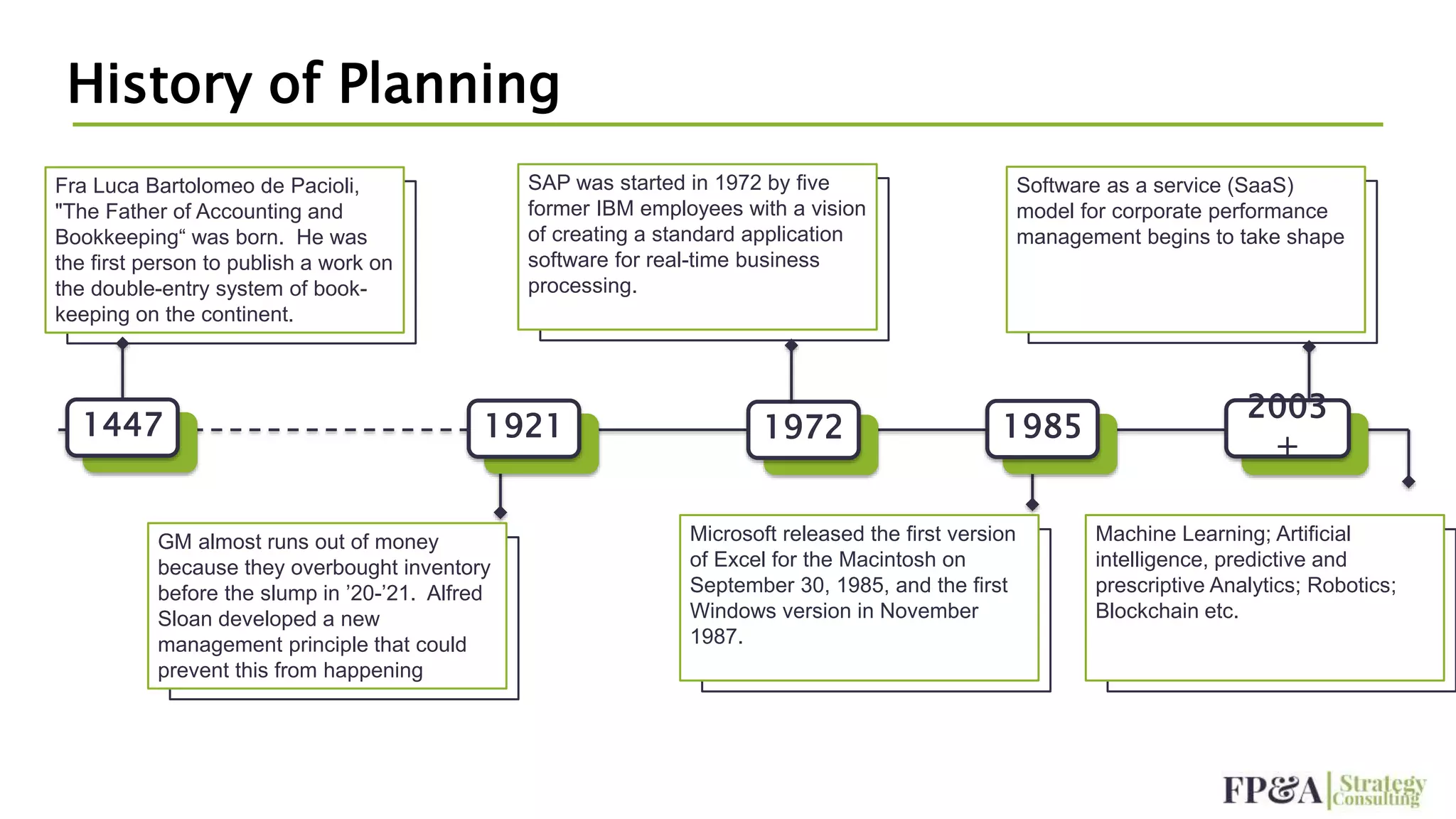
Fra Luca Bartolomeo de Pacioli,
"The Father of Accounting and
Bookkeeping“ was born. He was
the first person to publish a work on
the double-entry system of book-
keeping on the continent.
1447 1921
Corporate Investment
Model
Discounted cash flow model to
stack rank R&D/Capex
investments
GM almost runs out of money
because they overbought inventory
before the slump in ’20-’21. Alfred
Sloan developed a new
management principle that could
prevent this from happening
1972
Corporate Investment
Model
Discounted cash flow model to
stack rank R&D/Capex
investments
SAP was started in 1972 by five
former IBM employees with a vision
of creating a standard application
software for real-time business
processing.
Corporate Investment
Model
Discounted cash flow model to
stack rank R&D/Capex
investments
Microsoft released the first version
of Excel for the Macintosh on
September 30, 1985, and the first
Windows version in November
1987.
Corporate Investment
Model
Discounted cash flow model to
stack rank R&D/Capex
investments
Software as a service (SaaS)
model for corporate performance
management begins to take shape
1985
2003
+
Corporate Investment
Model
Discounted cash flow model to
stack rank R&D/Capex
investments
Machine Learning; Artificial
intelligence, predictive and
prescriptive Analytics; Robotics;
Blockchain etc.
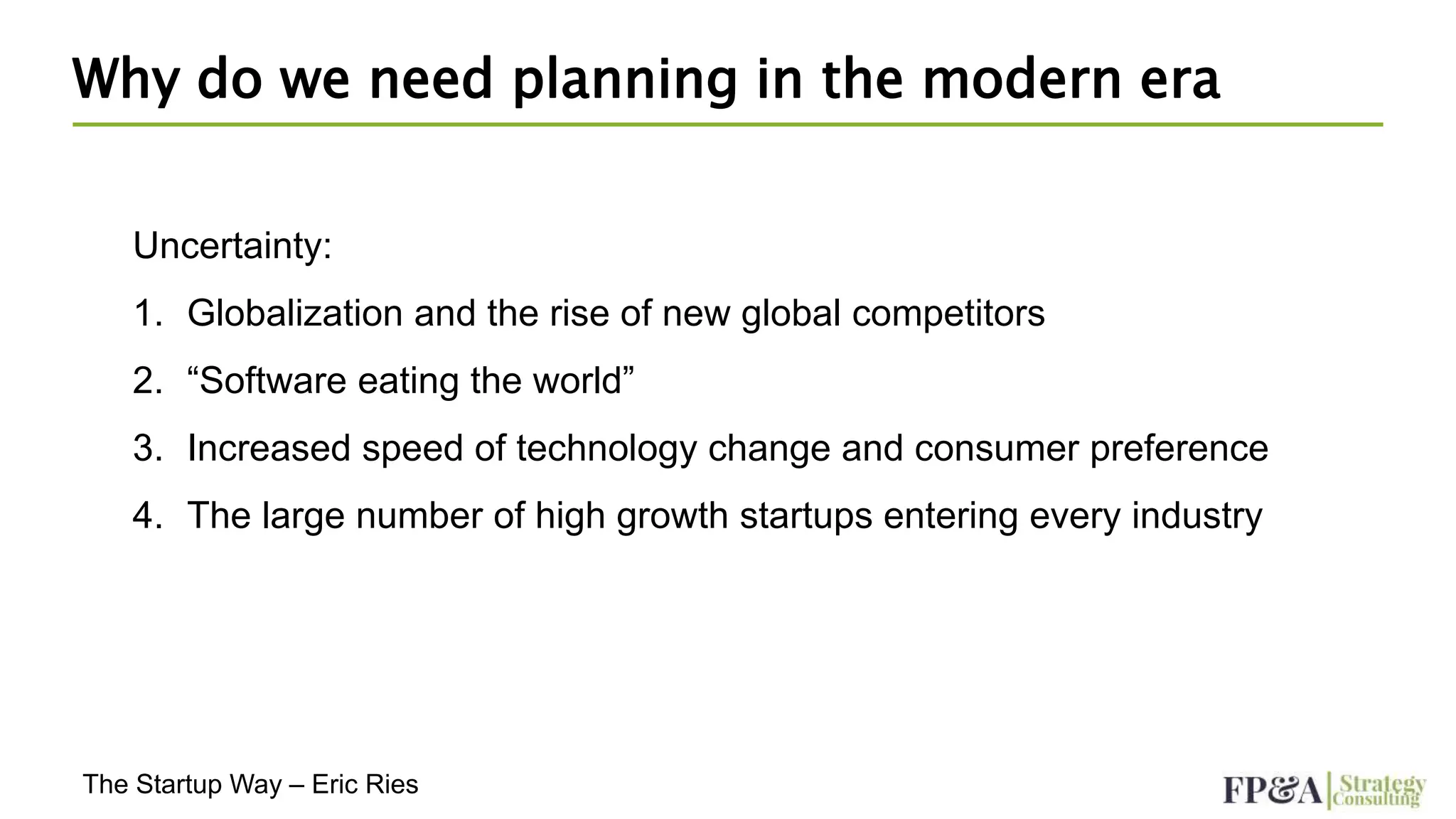
Why do we need planning in the modern era
Uncertainty:
1. Globalization and the rise of new global competitors
2. “Software eating the world”
3. Increased speed of technology change and consumer preference
4. The large number of high growth startups entering every industry
The Startup Way – Eric Ries
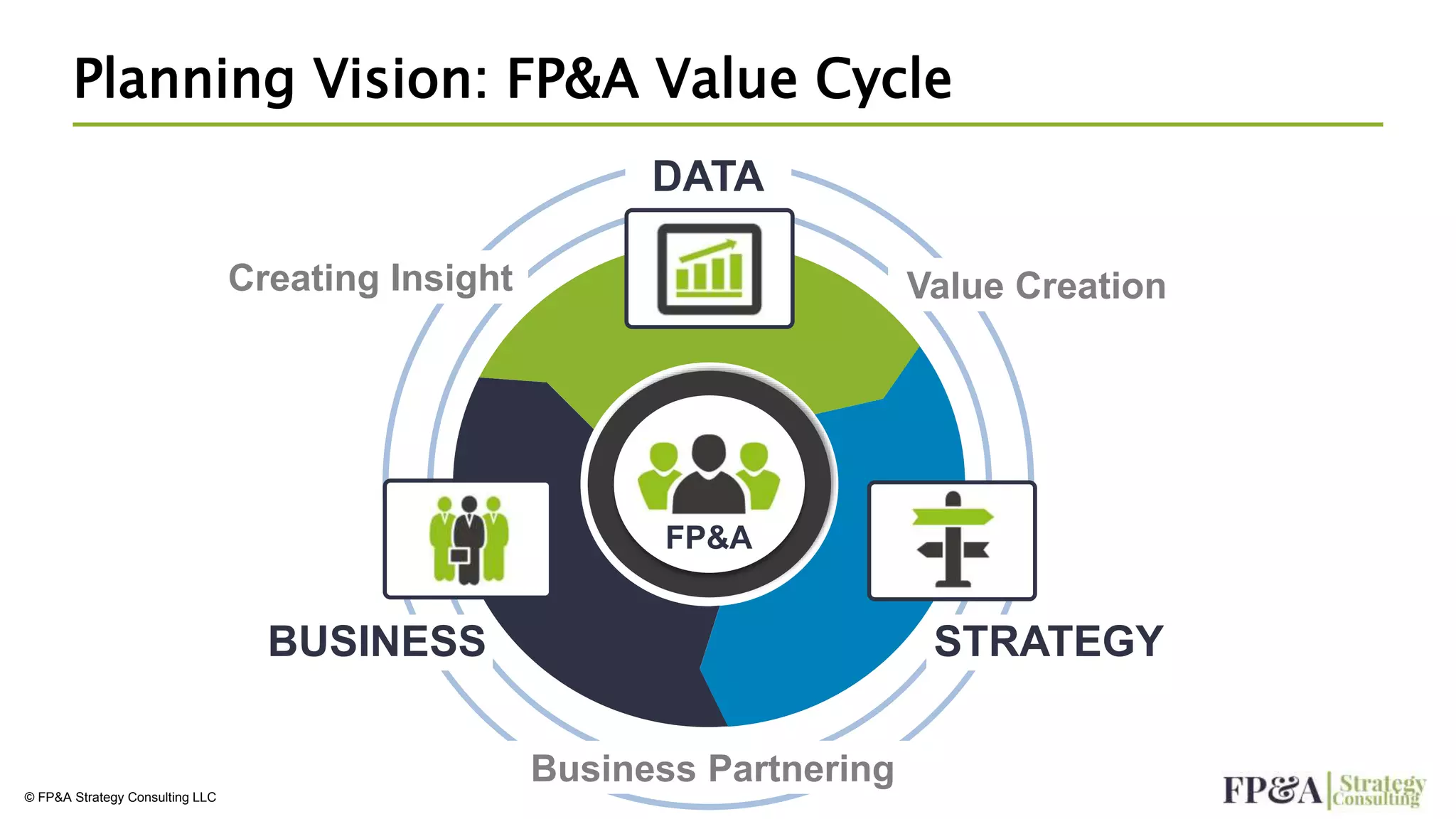
Planning Vision: FP&A Value Cycle
© FP&A Strategy Consulting LLC
DATA
FP&A
STRATEGYBUSINESS
Business Partnering
Creating Insight Value Creation
Align to Your Strategy
1. Diagnosis
What is the challenge
2. Guiding Policy
Overall approach to
overcoming or coping with the
obstacle in the diagnosis
3. Coherent Actions
Designed to carry out the
guiding principle
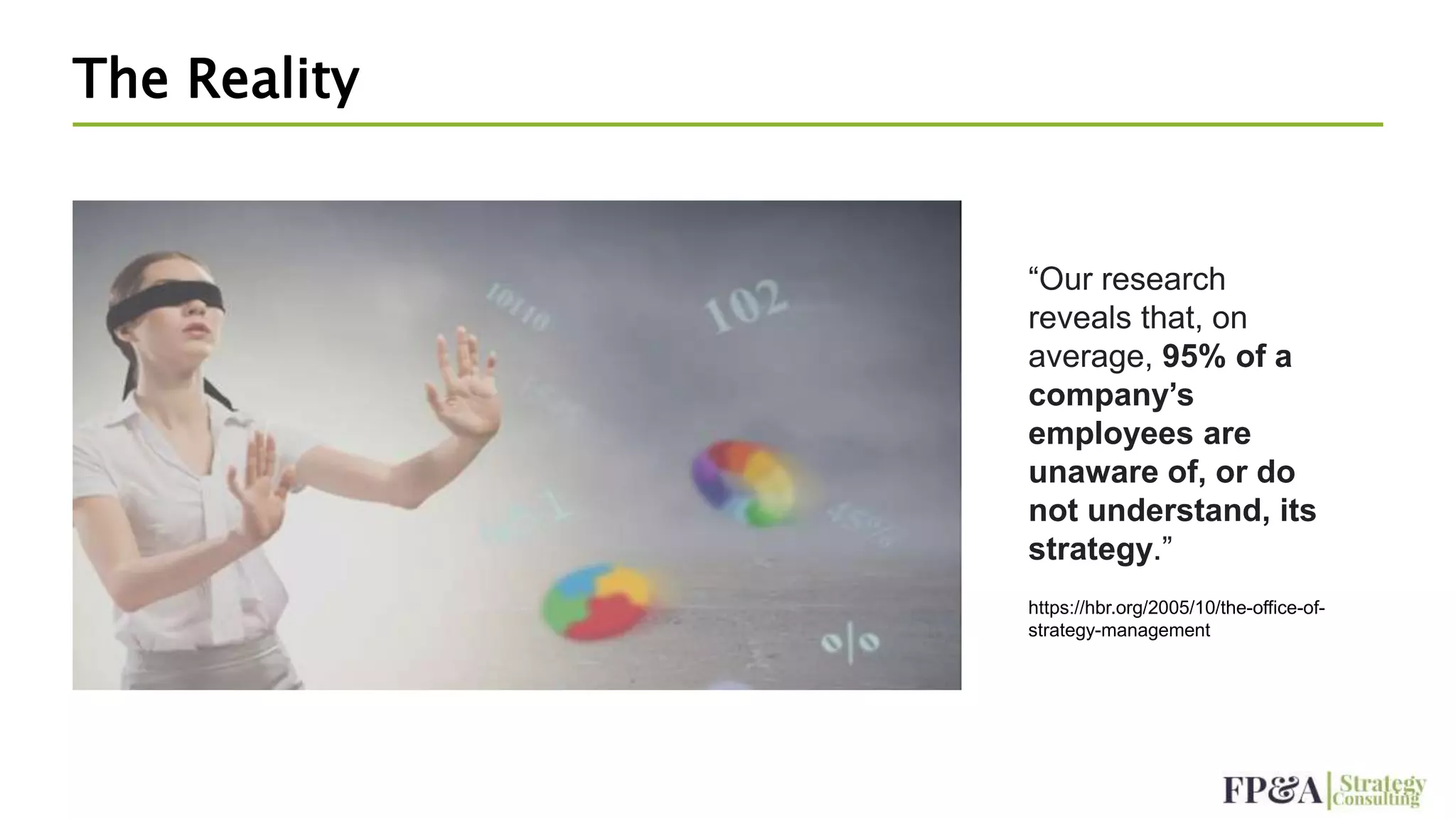
The Reality
“Our research
reveals that, on
average, 95% of a
company’s
employees are
unaware of, or do
not understand, its
strategy.”
https://hbr.org/2005/10/the-office-of-
strategy-management
The reality… FP&A Empowerment Survey 2017
FP&A Empowerment Survey: 311 respondents (Due for release Nov’17) – Survey opening soon
Time on the Budget Process Time on the Forecast Process
The reality… FP&A Empowerment Survey 2017
Forecast Frequency
Not Applicable
Forecast Accuracy
FP&A Empowerment Survey: 311 respondents (Due for release Nov’17) – Survey opening soon
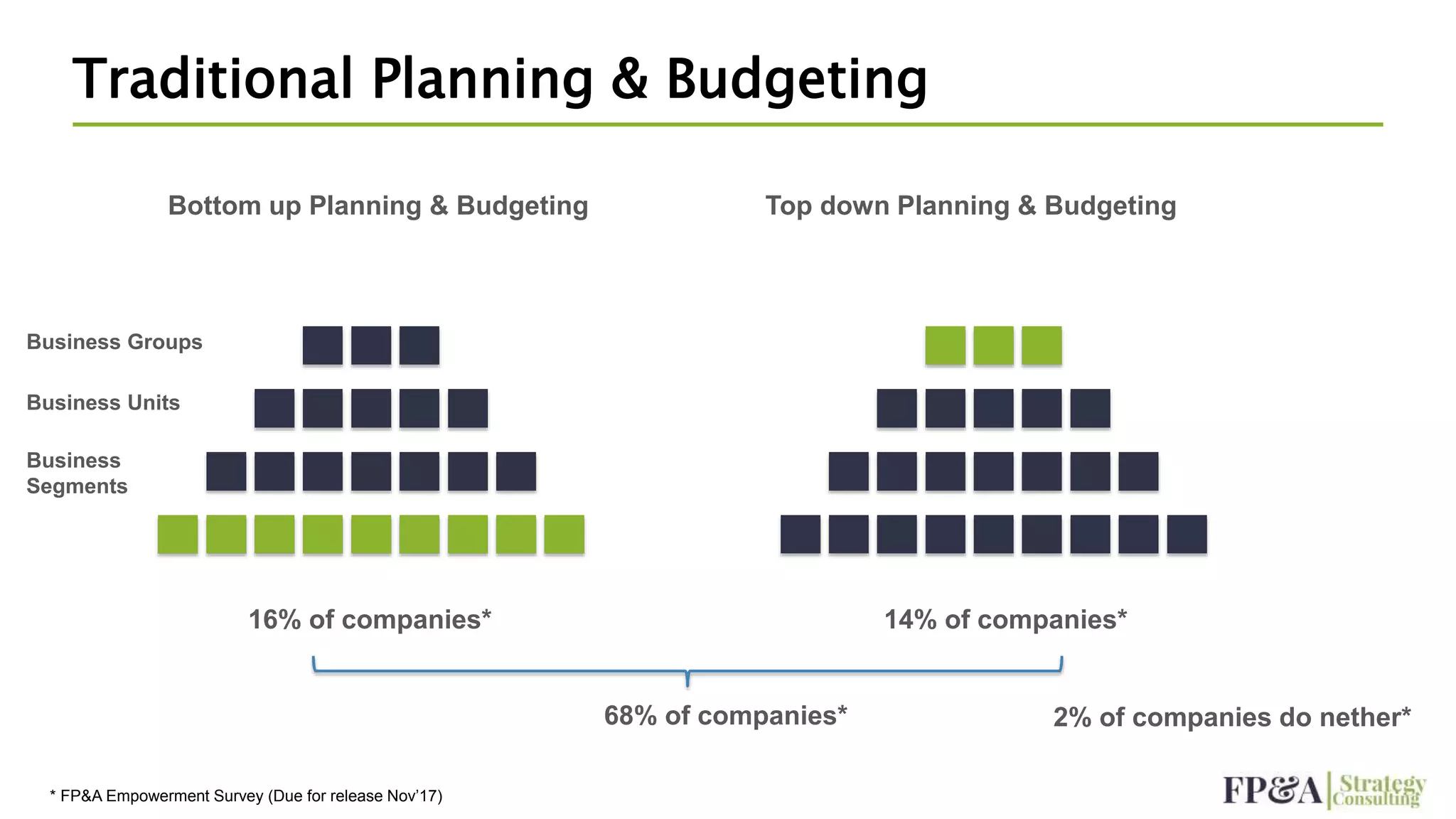
Traditional Planning & Budgeting
Bottom up Planning & Budgeting Top down Planning & Budgeting
16% of companies*
* FP&A Empowerment Survey (Due for release Nov’17)
14% of companies*
68% of companies* 2% of companies do nether*
Business Groups
Business Units
Business
Segments
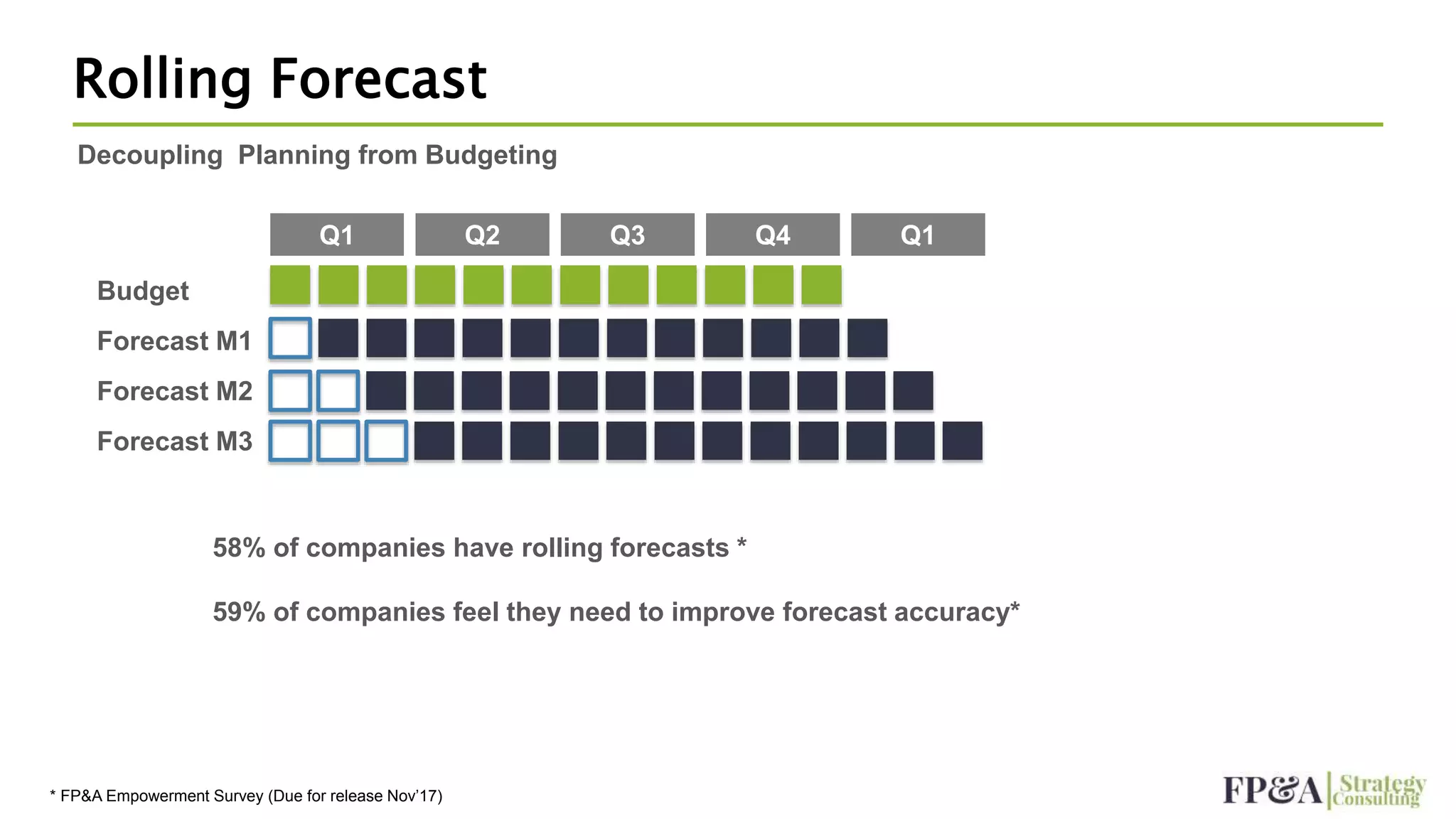
Rolling Forecast
Decoupling Planning from Budgeting
Q1
* FP&A Empowerment Survey (Due for release Nov’17)
Q2 Q3 Q4 Q1
Budget
Forecast M1
Forecast M2
Forecast M3
58% of companies have rolling forecasts *
59% of companies feel they need to improve forecast accuracy*
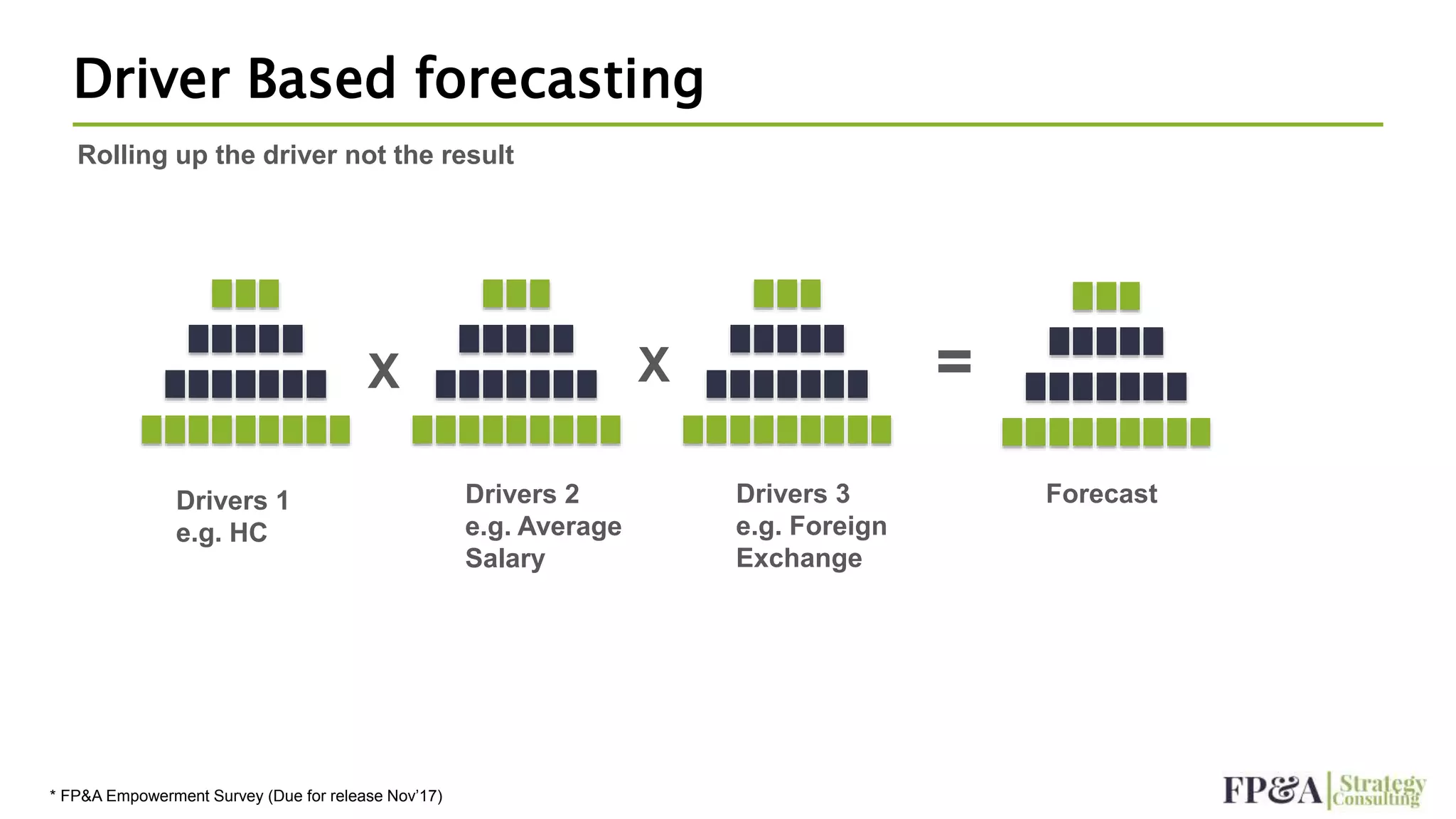
Driver Based forecasting
Rolling up the driver not the result
* FP&A Empowerment Survey (Due for release Nov’17)
Drivers 1
e.g. HC
Drivers 2
e.g. Average
Salary
Drivers 3
e.g. Foreign
Exchange
X X =
Forecast
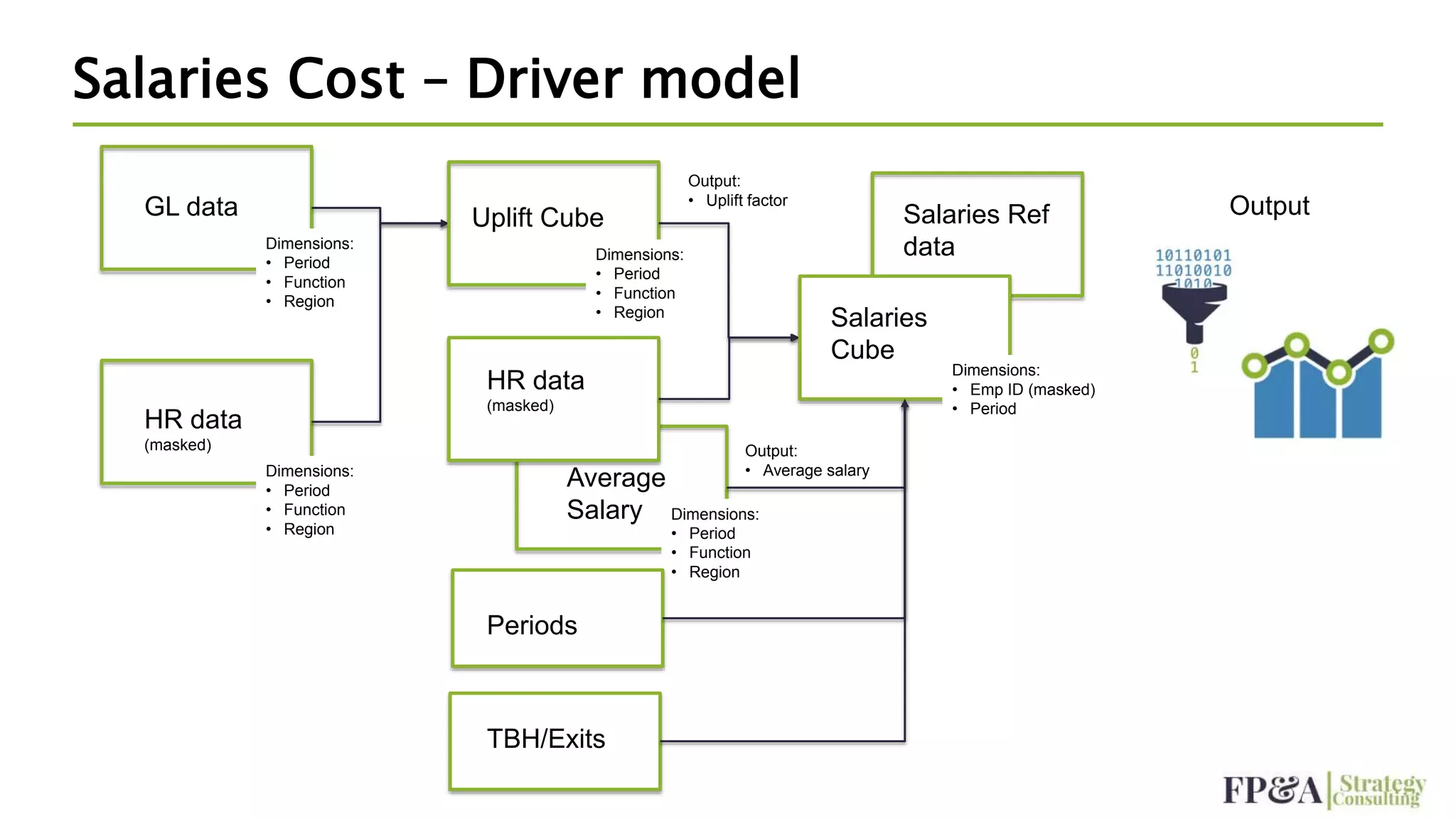
Salaries Cost – Driver model
GL data
HR data
(masked)
Dimensions:
• Period
• Function
• Region
Dimensions:
• Period
• Function
• Region
Uplift Cube
Dimensions:
• Period
• Function
• Region
c
HR data
(masked)
Output:
• Uplift factor
Salaries
Cube
Dimensions:
• Emp ID (masked)
• Period
Salaries Ref
data
Average
Salary Dimensions:
• Period
• Function
• Region
cPeriods
Output:
• Average salary
cTBH/Exits
Output
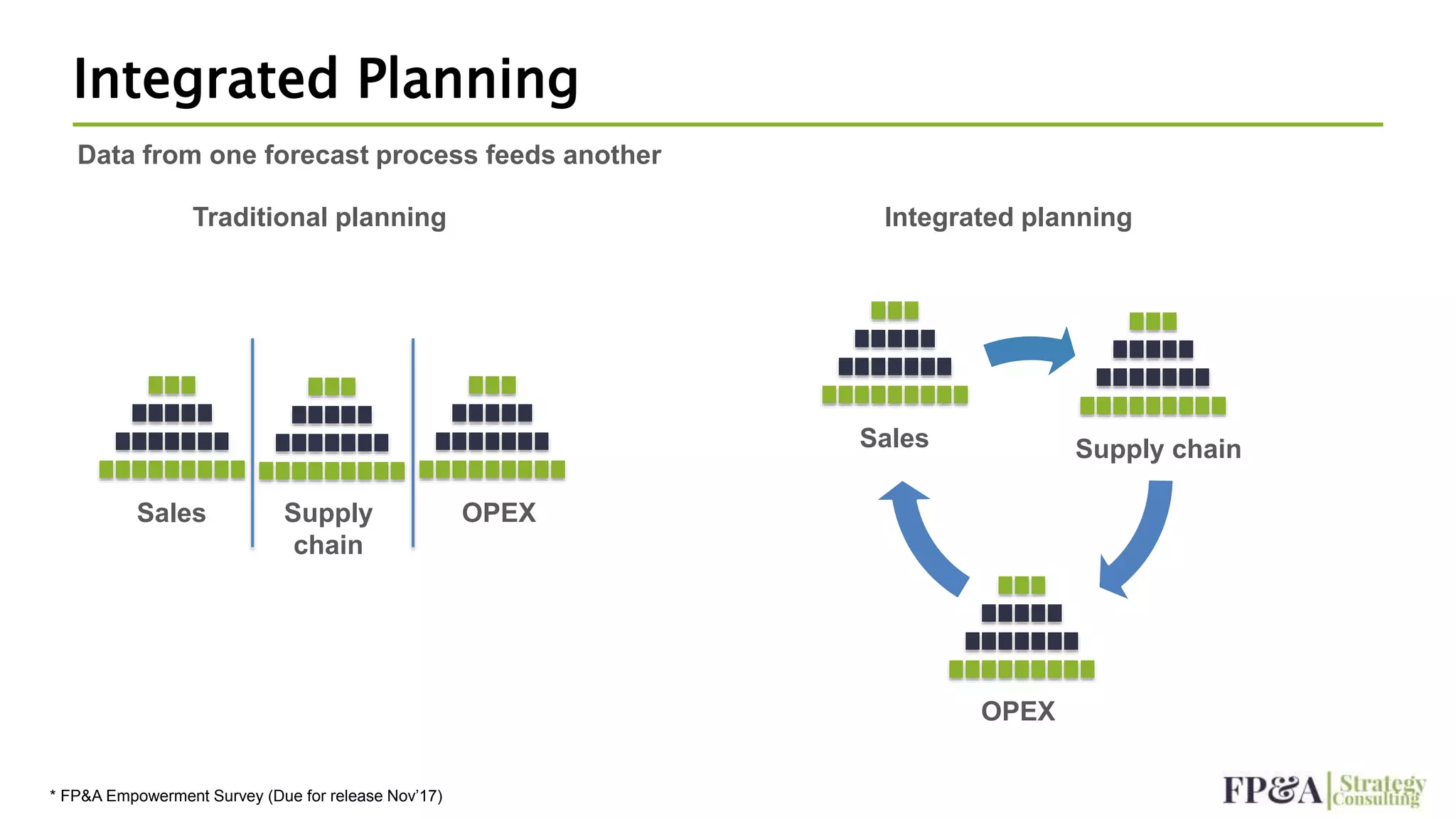
Integrated Planning
Traditional planning
* FP&A Empowerment Survey (Due for release Nov’17)
Sales Supply
chain
OPEX
Integrated planning
Sales
OPEX
Supply chain
Data from one forecast process feeds another
Business Planning Transformation
Current challenges
Business Planning currently performed
off-line and the processes differs by
Geo and Business Group
Cross BU, Cross Geo data analysis is
currently not possible until it is
consolidated in the corporate tool
Difficult to perform any business
analysis on internal and external
drivers
Future State
Business Planning performed in a single
solution, managed by a Center of
Excellence to ensure consistency
across Geo’s and BU’s
Business planning results are loaded
into the data lake on a near real time
basis to enable visibility across BU’s
and Geo’s
Solution to capture current underlying
assumptions, to enable more detail
understanding of how the numbers were
derived
Benefits
Standardized process ensure
efficiencies of scale and less
repetitive work reducing time
spent on forecasting
Improved decision making
across Geo’s and BU’s as all the
data is available in on place
Analysis can be done on
underlying assumptions, driving
more analytical forecasting and
improving forecast accuracy
Excel – The good, the bad and the ugly
https://www.forbes.com/sites/metabrown/2017/12/31/3-reasons-why-replacing-microsoft-excel-is-worth-money-to-a-boss/#2b61466737a9
Reasons to switch (Forbes):
• Hands-on involvement sucks up expensive labor
• Spreadsheet error leaves business open to risk and liability
• When spreadsheet creators leave, knowledge leaves with them
My reason’s to switch (Planning Focus):
• Valuable information is stored off line
• Data capture by multiple people & consolidation is prone to error
• Versioning is very difficult to manage
• Data is not secure
Excel – Why it’s here to stay
1. The ease and speed you can create a model
2. The barriers to entry are low – no IT involvement, no PO required
3. Accessible training online
4. Excel has advanced:
• PowerQuery – connects, shape and/or cleanses data
• Power Pivot – data modelling
• Power BI – data vizualization
Building the perfect Excel model
Data Source
e.g. ERP
Power
Query
Power
Pivot
Excel Pivot
Table
Pivot data
Build cubes
Filter data
Error checks
Formulas
Link tables
Lookup’s
Sum
GetPivotData
Options
Technology Pro’s Con’s
Excel based
solutions
• Easy to build and maintain
• Low Cost solution
• Data collection prone to error and requires it to be
consolidated
• Requires multiple emails and co-ordination to collect all
submissions
• Security could be a challenge
Database with web
interface solutions
• Data loads inputs directly into SQL
• Interface is online reducing emails
• Integrated reporting - real time feedback
• Highly customizable
• IT Support required for setup
• Risk of loosing data if there are no proper backups
• Interface may be difficult to change easily
Cloud purpose built
planning solutions
• Interface is online reducing emails and tighter
control over access
• Low IT requirements and easy setup
• Low cost
• All online, so instant feedback on results
• Limited ability to customization – typically your processes
need to fit into their solution
• Limited scenario modeling capability
Cloud planning/
modelling solutions
• Interface is online reducing emails and tighter
control over access
• Low IT Support Required
• Strong Modelling capabilities
• Strong audit capabilities
• Model maintenance requires expertise
• Data size limitations
• SaaS application so data controlled by someone else
ERP solutions
• Data is captured in batch, but updates speeds are
within seconds
• Enterprise ready – Audit etc.
• Most Expensive
• Highly dependent on IT support and set up
• Deployment times slow
• Limited or costly customization
• Limited scenario modeling capability
Rise of the Machine – AI and the impact of
Finance
Technology accessibility matrix
Available
Accessible
Excel
ERP
Key:
Availability = is ease to get
Accessibility = is ease to use
The Jobs Landscape in 2022
Moravec Paradox
Moravec Paradox states that while "it is comparatively
easy to make computers exhibit adult level
performance on intelligence tests or playing checkers,
and difficult or impossible to give them the skills of a
one-year-old when it comes to perception and
mobility".
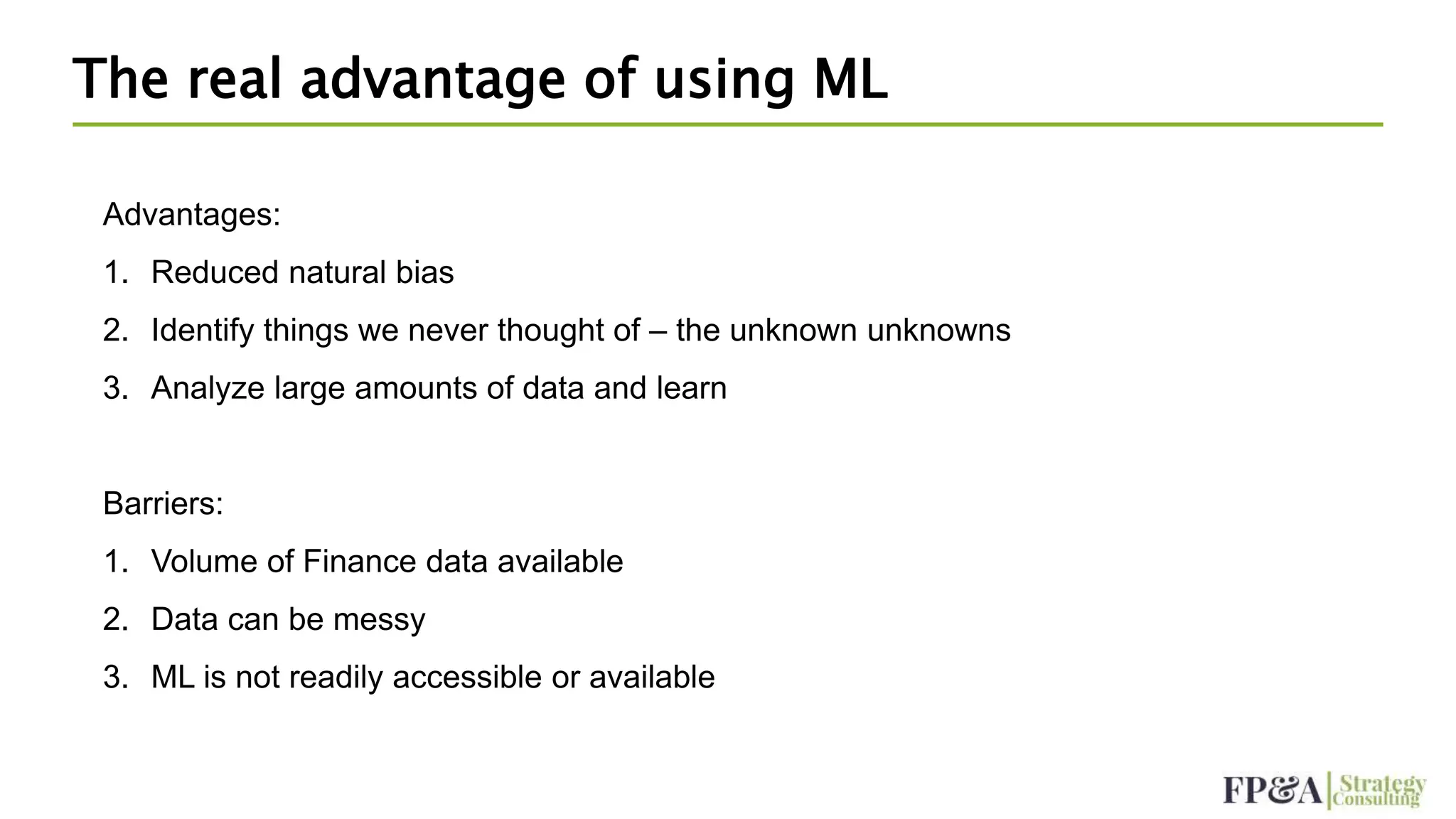
The real advantage of using ML
Advantages:
1. Reduced natural bias
2. Identify things we never thought of – the unknown unknowns
3. Analyze large amounts of data and learn
Barriers:
1. Volume of Finance data available
2. Data can be messy
3. ML is not readily accessible or available
Readily available types of machine learning
Sentiment Analysis
Scale 0-1
(0 being 100% negative and
1 being 100% positive)
Key word
Identifies the key words in a
set of text
Boolean prediction
Predicts if an event will
happen or not e.g. a pipeline
deal won or lost
Forecasting
Linear time based forecast
AutoML is a suite of machine learning products that enables users with limited machine learning
expertise to train high-quality models specific to their business needs
Interpredictive Planning – The future of financial
planning
Sales
OPEX
Supply chain
Human
Machine
Accountability
Interpredictive planning focuses time and
accountability driver inputs. These drivers form
the inputs into the forecasting model. Once
entered, the model in then optimized according
to specific requirements e.g. Revenue growth;
EBITDA
The advantages are:
1. More responsive change to the P&L driven by
changes in drives e.g. demand
2. Faster planning cycles, driving better decision
making
3. Improved forecast quality as the solution
learns over time and improves
Reducetime
Machine
ExternalfactorsOptimization, refers to the study of decision problems in which one seeks to minimize (min) or maximize (max) a
function by systematically choosing the values of variables within their allowed sets.
Optimization
Thank You
For blogs – link in at:
www.linkedin.com/in/jamesmyersw
3 Key Predictions for 2019 for FP&A
How can finance leaders really embrace their role as a strategic
advisor, connecting business to strategy and data?
Artificial Intelligence and the Future of Finance
Bibliography
1. FP&A Empowerment Survey: http://bit.ly/FPAEmpower
2. The Startup Way – Eric Ries
3. To be a Machine – Mark O’Connell
4. https://www.forbes.com/sites/metabrown/2017/12/31/3-reasons-why-replacing-microsoft-excel-is-
worth-money-to-a-boss/#2b61466737a9
5. Wikipedia

The Future of Forecasting and Budgeting

  • 1.
    The Future of Forecastingand BudgetingJames Myers, Founder and CEO, FP&A Strategy Consulting
  • 2.
  • 3.
    History of Planning CorporateInvestment Model Discounted cash flow model to stack rank R&D/Capex investments Fra Luca Bartolomeo de Pacioli, "The Father of Accounting and Bookkeeping“ was born. He was the first person to publish a work on the double-entry system of book- keeping on the continent. 1447 1921 Corporate Investment Model Discounted cash flow model to stack rank R&D/Capex investments GM almost runs out of money because they overbought inventory before the slump in ’20-’21. Alfred Sloan developed a new management principle that could prevent this from happening 1972 Corporate Investment Model Discounted cash flow model to stack rank R&D/Capex investments SAP was started in 1972 by five former IBM employees with a vision of creating a standard application software for real-time business processing. Corporate Investment Model Discounted cash flow model to stack rank R&D/Capex investments Microsoft released the first version of Excel for the Macintosh on September 30, 1985, and the first Windows version in November 1987. Corporate Investment Model Discounted cash flow model to stack rank R&D/Capex investments Software as a service (SaaS) model for corporate performance management begins to take shape 1985 2003 + Corporate Investment Model Discounted cash flow model to stack rank R&D/Capex investments Machine Learning; Artificial intelligence, predictive and prescriptive Analytics; Robotics; Blockchain etc.
  • 4.
    Why do weneed planning in the modern era Uncertainty: 1. Globalization and the rise of new global competitors 2. “Software eating the world” 3. Increased speed of technology change and consumer preference 4. The large number of high growth startups entering every industry The Startup Way – Eric Ries
  • 5.
    Planning Vision: FP&AValue Cycle © FP&A Strategy Consulting LLC DATA FP&A STRATEGYBUSINESS Business Partnering Creating Insight Value Creation
  • 6.
    Align to YourStrategy 1. Diagnosis What is the challenge 2. Guiding Policy Overall approach to overcoming or coping with the obstacle in the diagnosis 3. Coherent Actions Designed to carry out the guiding principle
  • 7.
    The Reality “Our research revealsthat, on average, 95% of a company’s employees are unaware of, or do not understand, its strategy.” https://hbr.org/2005/10/the-office-of- strategy-management
  • 8.
    The reality… FP&AEmpowerment Survey 2017 FP&A Empowerment Survey: 311 respondents (Due for release Nov’17) – Survey opening soon Time on the Budget Process Time on the Forecast Process
  • 9.
    The reality… FP&AEmpowerment Survey 2017 Forecast Frequency Not Applicable Forecast Accuracy FP&A Empowerment Survey: 311 respondents (Due for release Nov’17) – Survey opening soon
  • 10.
    Traditional Planning &Budgeting Bottom up Planning & Budgeting Top down Planning & Budgeting 16% of companies* * FP&A Empowerment Survey (Due for release Nov’17) 14% of companies* 68% of companies* 2% of companies do nether* Business Groups Business Units Business Segments
  • 11.
    Rolling Forecast Decoupling Planningfrom Budgeting Q1 * FP&A Empowerment Survey (Due for release Nov’17) Q2 Q3 Q4 Q1 Budget Forecast M1 Forecast M2 Forecast M3 58% of companies have rolling forecasts * 59% of companies feel they need to improve forecast accuracy*
  • 12.
    Driver Based forecasting Rollingup the driver not the result * FP&A Empowerment Survey (Due for release Nov’17) Drivers 1 e.g. HC Drivers 2 e.g. Average Salary Drivers 3 e.g. Foreign Exchange X X = Forecast
  • 13.
    Salaries Cost –Driver model GL data HR data (masked) Dimensions: • Period • Function • Region Dimensions: • Period • Function • Region Uplift Cube Dimensions: • Period • Function • Region c HR data (masked) Output: • Uplift factor Salaries Cube Dimensions: • Emp ID (masked) • Period Salaries Ref data Average Salary Dimensions: • Period • Function • Region cPeriods Output: • Average salary cTBH/Exits Output
  • 14.
    Integrated Planning Traditional planning *FP&A Empowerment Survey (Due for release Nov’17) Sales Supply chain OPEX Integrated planning Sales OPEX Supply chain Data from one forecast process feeds another
  • 15.
    Business Planning Transformation Currentchallenges Business Planning currently performed off-line and the processes differs by Geo and Business Group Cross BU, Cross Geo data analysis is currently not possible until it is consolidated in the corporate tool Difficult to perform any business analysis on internal and external drivers Future State Business Planning performed in a single solution, managed by a Center of Excellence to ensure consistency across Geo’s and BU’s Business planning results are loaded into the data lake on a near real time basis to enable visibility across BU’s and Geo’s Solution to capture current underlying assumptions, to enable more detail understanding of how the numbers were derived Benefits Standardized process ensure efficiencies of scale and less repetitive work reducing time spent on forecasting Improved decision making across Geo’s and BU’s as all the data is available in on place Analysis can be done on underlying assumptions, driving more analytical forecasting and improving forecast accuracy
  • 16.
    Excel – Thegood, the bad and the ugly https://www.forbes.com/sites/metabrown/2017/12/31/3-reasons-why-replacing-microsoft-excel-is-worth-money-to-a-boss/#2b61466737a9 Reasons to switch (Forbes): • Hands-on involvement sucks up expensive labor • Spreadsheet error leaves business open to risk and liability • When spreadsheet creators leave, knowledge leaves with them My reason’s to switch (Planning Focus): • Valuable information is stored off line • Data capture by multiple people & consolidation is prone to error • Versioning is very difficult to manage • Data is not secure
  • 17.
    Excel – Whyit’s here to stay 1. The ease and speed you can create a model 2. The barriers to entry are low – no IT involvement, no PO required 3. Accessible training online 4. Excel has advanced: • PowerQuery – connects, shape and/or cleanses data • Power Pivot – data modelling • Power BI – data vizualization
  • 18.
    Building the perfectExcel model Data Source e.g. ERP Power Query Power Pivot Excel Pivot Table Pivot data Build cubes Filter data Error checks Formulas Link tables Lookup’s Sum GetPivotData
  • 19.
    Options Technology Pro’s Con’s Excelbased solutions • Easy to build and maintain • Low Cost solution • Data collection prone to error and requires it to be consolidated • Requires multiple emails and co-ordination to collect all submissions • Security could be a challenge Database with web interface solutions • Data loads inputs directly into SQL • Interface is online reducing emails • Integrated reporting - real time feedback • Highly customizable • IT Support required for setup • Risk of loosing data if there are no proper backups • Interface may be difficult to change easily Cloud purpose built planning solutions • Interface is online reducing emails and tighter control over access • Low IT requirements and easy setup • Low cost • All online, so instant feedback on results • Limited ability to customization – typically your processes need to fit into their solution • Limited scenario modeling capability Cloud planning/ modelling solutions • Interface is online reducing emails and tighter control over access • Low IT Support Required • Strong Modelling capabilities • Strong audit capabilities • Model maintenance requires expertise • Data size limitations • SaaS application so data controlled by someone else ERP solutions • Data is captured in batch, but updates speeds are within seconds • Enterprise ready – Audit etc. • Most Expensive • Highly dependent on IT support and set up • Deployment times slow • Limited or costly customization • Limited scenario modeling capability
  • 20.
    Rise of theMachine – AI and the impact of Finance
  • 21.
  • 22.
  • 23.
    Moravec Paradox Moravec Paradoxstates that while "it is comparatively easy to make computers exhibit adult level performance on intelligence tests or playing checkers, and difficult or impossible to give them the skills of a one-year-old when it comes to perception and mobility".
  • 24.
    The real advantageof using ML Advantages: 1. Reduced natural bias 2. Identify things we never thought of – the unknown unknowns 3. Analyze large amounts of data and learn Barriers: 1. Volume of Finance data available 2. Data can be messy 3. ML is not readily accessible or available
  • 25.
    Readily available typesof machine learning Sentiment Analysis Scale 0-1 (0 being 100% negative and 1 being 100% positive) Key word Identifies the key words in a set of text Boolean prediction Predicts if an event will happen or not e.g. a pipeline deal won or lost Forecasting Linear time based forecast AutoML is a suite of machine learning products that enables users with limited machine learning expertise to train high-quality models specific to their business needs
  • 26.
    Interpredictive Planning –The future of financial planning Sales OPEX Supply chain Human Machine Accountability Interpredictive planning focuses time and accountability driver inputs. These drivers form the inputs into the forecasting model. Once entered, the model in then optimized according to specific requirements e.g. Revenue growth; EBITDA The advantages are: 1. More responsive change to the P&L driven by changes in drives e.g. demand 2. Faster planning cycles, driving better decision making 3. Improved forecast quality as the solution learns over time and improves Reducetime Machine ExternalfactorsOptimization, refers to the study of decision problems in which one seeks to minimize (min) or maximize (max) a function by systematically choosing the values of variables within their allowed sets. Optimization
  • 27.
    Thank You For blogs– link in at: www.linkedin.com/in/jamesmyersw 3 Key Predictions for 2019 for FP&A How can finance leaders really embrace their role as a strategic advisor, connecting business to strategy and data? Artificial Intelligence and the Future of Finance
  • 28.
    Bibliography 1. FP&A EmpowermentSurvey: http://bit.ly/FPAEmpower 2. The Startup Way – Eric Ries 3. To be a Machine – Mark O’Connell 4. https://www.forbes.com/sites/metabrown/2017/12/31/3-reasons-why-replacing-microsoft-excel-is- worth-money-to-a-boss/#2b61466737a9 5. Wikipedia

Editor's Notes

  • #4 In Alfred Sloan’s My years with General Motors (1963), he describes how GE almost ran out of cash Co-ordinated control of decentralized operation – rigorous production estimates for each division manager of the precise number of car the GM should sell in an ideal year. Using these estimated in combination with internal targets and external macro economic factors, the company would product a forecast of how many car each division was responsible for selling
  • #7 Step 1: Align to the business Strategy Step 2: Break these down into strategic Priorities Step 3: Define the Key Objectives for each of the priorities Step 4: Define what the measures of success Step 5: Identify the key drivers of the measures Step 6: Create actionable metrics around the key drivers
  • #11 Issues with traditional planning Strategy is not integrated Multiple level – each with non standardized process Difficult to get ownership of the numbers if there is no bottoms up Too much time rolling up the numbers and not enough time on the analytics
  • #15 Issues with traditional planning Strategy is not integrated Multiple level – each with non standardized process Difficult to get ownership of the numbers if there is no bottoms up Too much time rolling up the numbers and not enough time on the analytics
  • #17 Hands-on involvement sucks up expensive labor Building and maintain spreadsheets cost time and money Spreadsheet error leaves business open to risk and liability Most conservative research-based estimate indicates that at least 1 in every 100 spreadsheet cells contains an error $6 billion dollar loss attributed to the London Whale was partly due to a spreadsheet error When spreadsheet creators leave, knowledge leaves with them Spreadsheets are created informally, and they lack elements that make professionally-developed software desirable, such as: Designers with a solid understanding of user needs Design review, to prevent problems before the software is built Programmers who are well-trained and use appropriate processes to work efficiently and minimize flaws in the end product Quality assurance, to ensure the program does what it’s supposed to do User testing to detect and correct problems in the product before it gets into general circulation Documentation, both internal documents used by developers and documents such as manuals and training guides for end users.