Road Safety Audits* * Assessments, Reviews, etc.
Background Road Safety Audits/Assessments (RSAs) are a valuable tool used to evaluate road safety issues and to identify opportunities for improvement Road Safety Audits have been widely used around the world Road Safety Audits are applicable throughout the highway design and performance cycle.
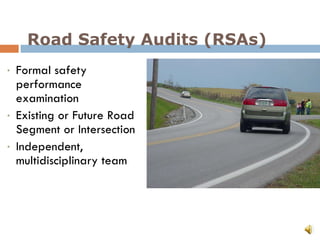
Road Safety Audits (RSAs) Formal safety performance examination  Existing or Future Road Segment or Intersection Independent, multidisciplinary team
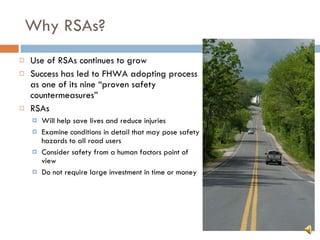
Why RSAs? Use of RSAs continues to grow Success has led to FHWA adopting process as one of its nine “proven safety countermeasures” RSAs Will help save lives and reduce injuries Examine conditions in detail that may pose safety hazards to all road users Consider safety from a human factors point of view Do not require large investment in time or money
Traditional Road Safety Review  versus   Road Safety Audit reactive in-house team field review? standards compliance proactive independent team field reviews comprehensive, with human factors Traditional Road  Safety Review Road Safety Audit
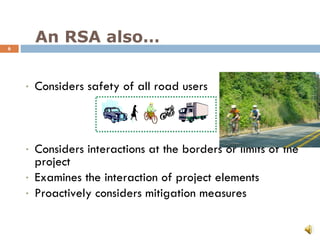
An RSA also… Considers safety of all road users Considers interactions at the borders or limits of the project Examines the interaction of project elements Proactively considers mitigation measures
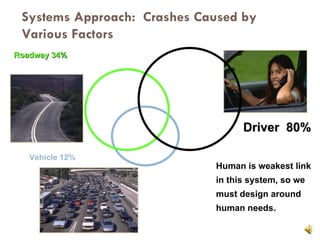
Systems Approach:  Crashes Caused by Various Factors Vehicle 12% Roadway 34% Driver  80% Human is weakest link  in this system, so we  must design around  human needs.
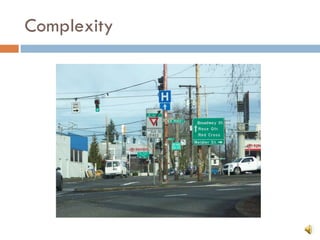
Complexity
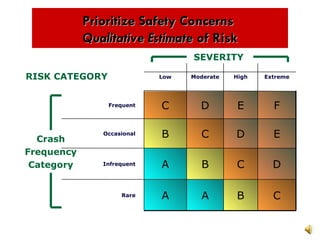
RISK CATEGORY Prioritize Safety Concerns  Qualitative Estimate  of Risk Low Moderate High Extreme Frequent Occasional Infrequent Rare C D E F B C D E A B C D A A B C Crash Frequency Category SEVERITY
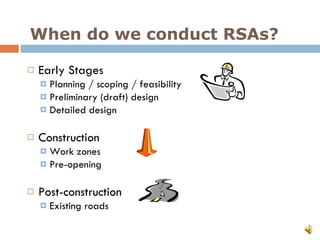
When do we conduct RSAs? Early Stages Planning / scoping / feasibility Preliminary (draft) design Detailed design Construction Work zones Pre-opening Post-construction Existing roads
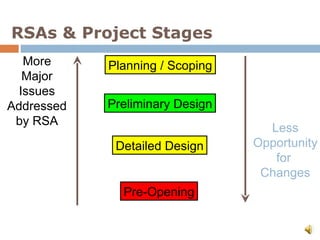
RSAs & Project Stages Planning / Scoping Preliminary Design Detailed Design Pre-Opening More Major Issues Addressed by RSA Less Opportunity for  Changes
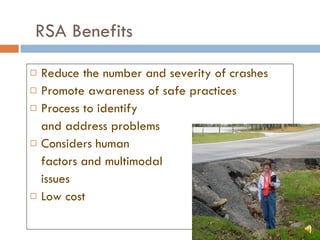
RSA Benefits Reduce the number and severity of crashes Promote awareness of safe practices Process to identify  and address problems Considers human  factors and multimodal  issues Low cost
RSA PROCEDURES The 8-step Process
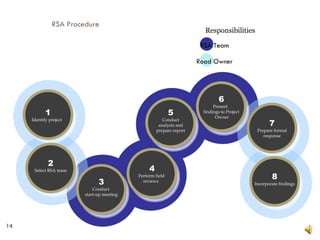
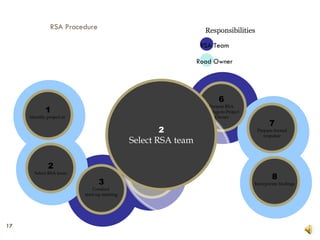
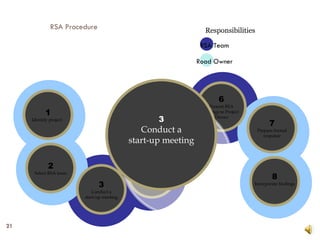
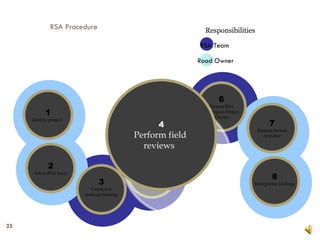
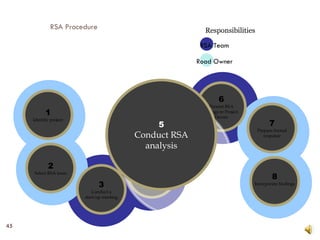
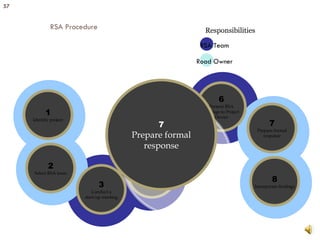
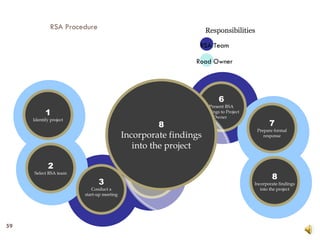
1 Identify project   2 Select RSA team 3 Conduct  start-up meeting 4 Perform field  reviews   5 Conduct analysis and prepare report 6 Present  findings to Project Owner 7 Prepare formal response 8 Incorporate findings RSA Team Road Owner RSA Procedure Responsibilities
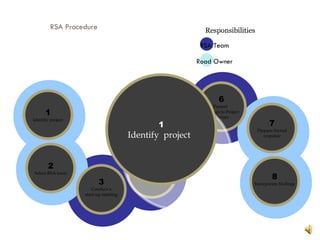
1 Identify  project   RSA Procedure RSA Team Road Owner Responsibilities 1 Identify project 2 Select RSA team 3 Conduct a start-up meeting 4 Perform field  reviews under  various  conditions 5 Conduct audit analysis and prepare report of findings 6 Present  findings to Project Owner 7 Prepare formal response 8 Incorporate findings
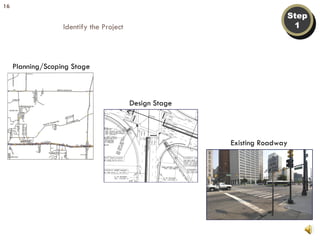
Step 1 Identify the Project Planning/Scoping Stage Design Stage Existing Roadway
2 Select RSA team RSA Team Road Owner Responsibilities RSA Procedure 1 Identify project or  2 Select RSA team 3 Conduct  start-up meeting 4 Perform field  reviews under  various  conditions 5 Conduct audit analysis and prepare report of findings 6 Present RSA findings to Project Owner 7 Prepare formal response 8 Incorporate findings
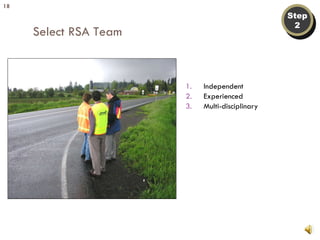
Step 2 Select RSA Team Independent Experienced Multi-disciplinary
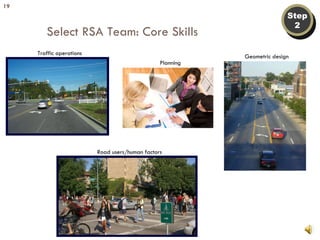
Traffic operations Step 2 Geometric design Road users/human factors Select RSA Team: Core Skills Planning
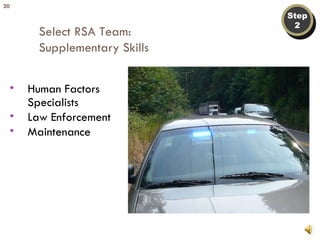
Step 2 Select RSA Team:  Supplementary Skills Human Factors Specialists Law Enforcement Maintenance
3 Conduct a start-up meeting RSA Team Road Owner Responsibilities RSA Procedure 1 Identify project  2 Select RSA team 3 Conduct a start-up meeting 4 Perform field  reviews under  various  conditions 5 Conduct audit analysis and prepare report of findings 6 Present RSA findings to Project  Owner 7 Prepare formal response 8 Incorporate findings
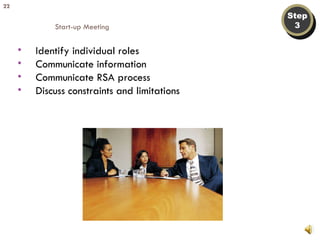
Step 3 Start-up Meeting Identify individual roles Communicate information Communicate RSA process Discuss constraints and limitations
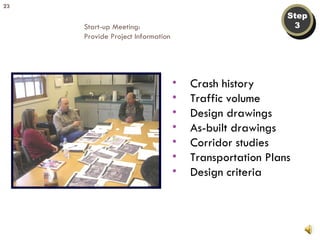
Step 3 Start-up Meeting:  Provide Project Information Crash history Traffic volume Design drawings As-built drawings Corridor studies Transportation Plans Design criteria
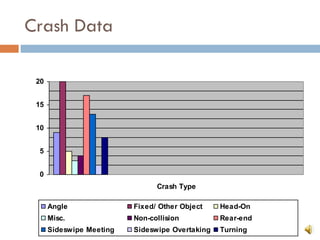
Crash Data
4 Perform field  reviews   RSA Team Road Owner Responsibilities RSA Procedure 1 Identify project   2 Select RSA team 3 Conduct a start-up meeting 4 Perform field  reviews under  various  conditions 5 Conduct audit analysis and prepare report of findings 6 Present RSA findings to Project Owner 7 Prepare formal response 8 Incorporate findings
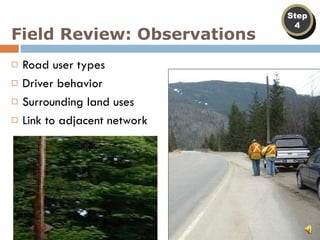
Field Review: Observations Road user types Driver behavior Surrounding land uses Link to adjacent network Step 4
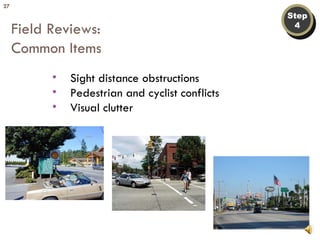
Step 4 Field Reviews: Common Items Sight distance obstructions Pedestrian and cyclist conflicts Visual clutter
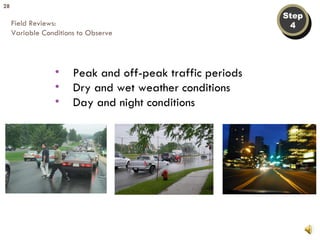
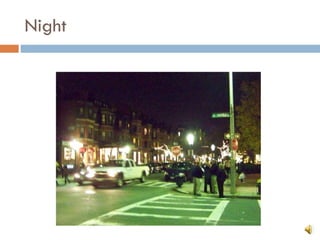
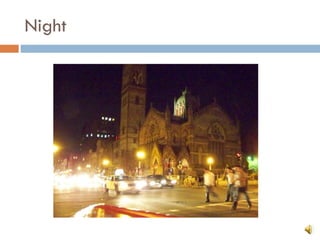
Step 4 Field Reviews: Variable Conditions to Observe Peak and off-peak traffic periods Dry and wet weather conditions Day and night conditions
Night
Night
Pedestrian Prompt List
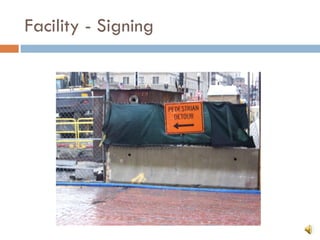
Facility - Signing
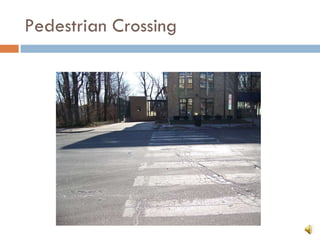
Pedestrian Crossing
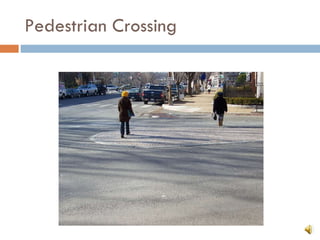
Pedestrian Crossing
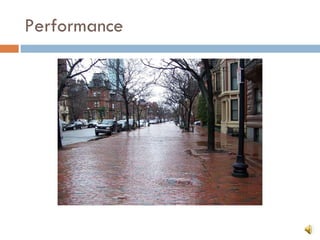
Performance
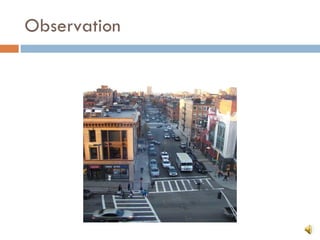
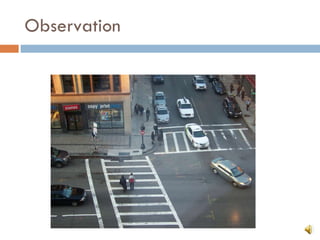
Observation
Observation
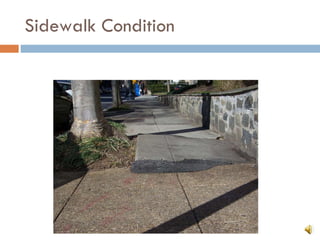
Sidewalk Condition
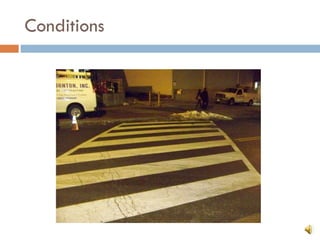
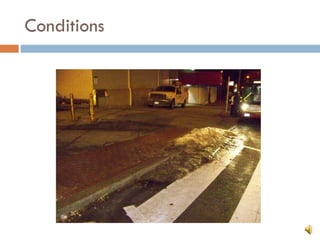
Conditions
Conditions
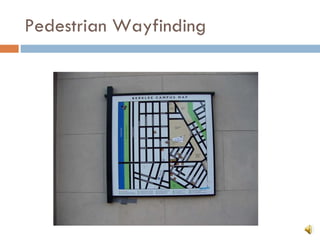
Pedestrian Wayfinding
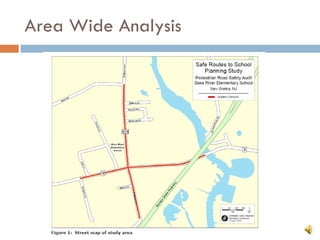
Area Wide Analysis
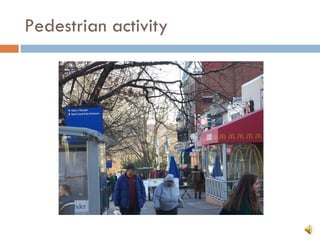
Pedestrian activity
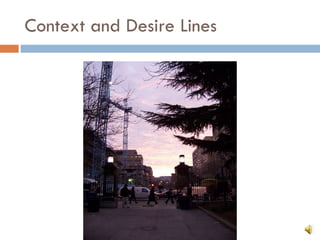
Context and Desire Lines
5 Conduct RSA analysis RSA Team Road Owner Responsibilities RSA Procedure 1 Identify project 2 Select RSA team 3 Conduct a start-up meeting 4 Perform field  reviews under  various  conditions 5 Conduct audit analysis and prepare report of findings 6 Present RSA findings to Project  Owner 7 Prepare formal response 8 Incorporate findings
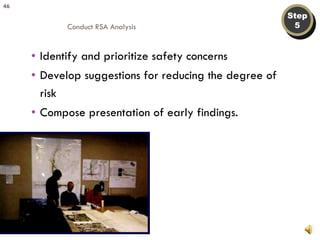
Step 5 Conduct RSA Analysis Identify and prioritize safety concerns Develop suggestions for reducing the degree of risk Compose presentation of early findings.
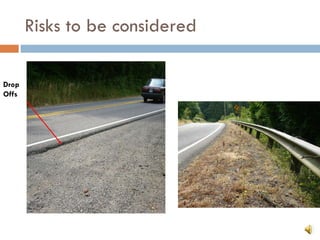
Risks to be considered Drop Offs
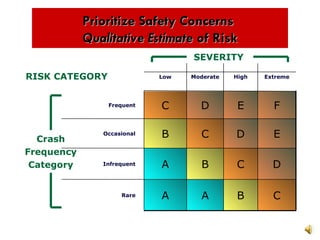
RISK CATEGORY Prioritize Safety Concerns  Qualitative Estimate  of Risk Low Moderate High Extreme Frequent Occasional Infrequent Rare C D E F B C D E A B C D A A B C Crash Frequency Category SEVERITY
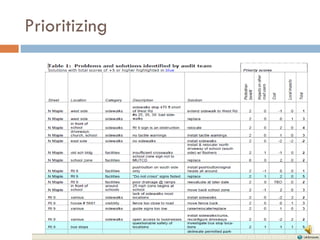
Prioritizing
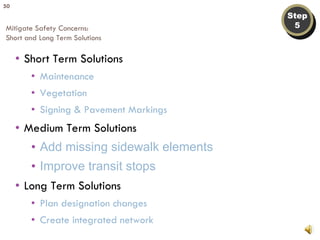
Step 5 Mitigate Safety Concerns: Short and Long Term Solutions Short Term Solutions Maintenance Vegetation Signing & Pavement Markings Medium Term Solutions Add missing sidewalk elements Improve transit stops Long Term Solutions Plan designation changes Create integrated network
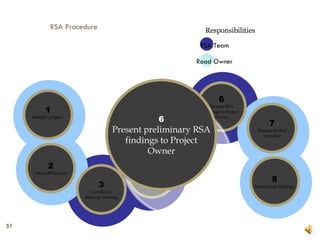
6 Present preliminary RSA findings to Project Owner RSA Team Road Owner Responsibilities RSA Procedure 1 Identify project  2 Select RSA team 3 Conduct a start-up meeting 4 Perform field  reviews under  various  conditions 5 Conduct audit analysis and prepare report of findings 6 Present RSA findings to Project Owner 7 Prepare formal response 8 Incorporate findings
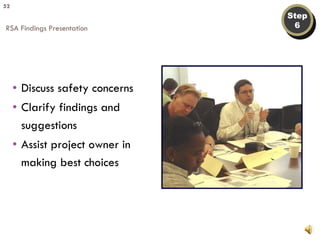
Step 6 RSA Findings Presentation Discuss safety concerns Clarify findings and suggestions Assist project owner in making best choices
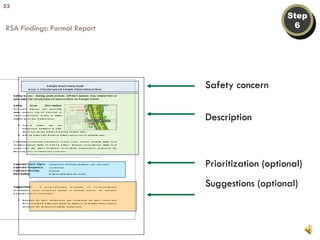
Safety concern Description Prioritization (optional) Suggestions (optional) Step 6 RSA Findings: Formal Report
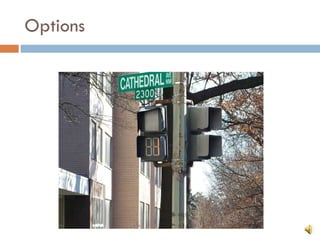
Options
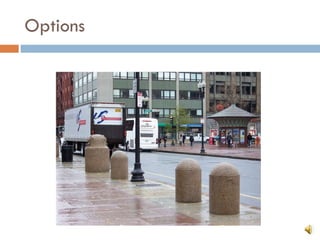
Options
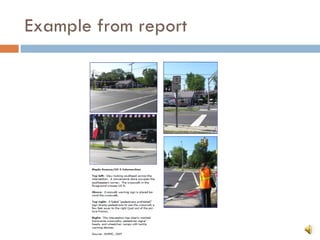
Example from report
7 Prepare formal response RSA Team Road Owner Responsibilities RSA Procedure 1 Identify project 2 Select RSA team 3 Conduct a start-up meeting 4 Perform field  reviews under  various  conditions 5 Conduct audit analysis and prepare report of findings 6 Present RSA findings to Project Owner 7 Prepare formal response 8 Incorporate findings
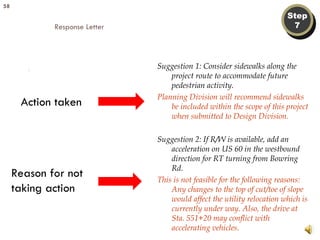
Suggestion 1: Consider sidewalks along the project route to accommodate future pedestrian activity. Planning Division will recommend sidewalks be included within the scope of this project when submitted to Design Division. Suggestion 2: If R/W is available, add an acceleration on US 60 in the westbound direction for RT turning from Bowring Rd. This is not feasible for the following reasons: Any changes to the top of cut/toe of slope would affect the utility relocation which is currently under way. Also, the drive at Sta. 551+20 may conflict with accelerating vehicles. Action taken Step 7 Response Letter Reason for not taking action
8 Incorporate findings into the project RSA Team Road Owner Responsibilities RSA Procedure 1 Identify project 2 Select RSA team 3 Conduct a start-up meeting 4 Perform field  reviews under  various  conditions 5 Conduct audit analysis and prepare report of findings 6 Present RSA findings to Project Owner / 7 Prepare formal response 8 Incorporate findings into the project
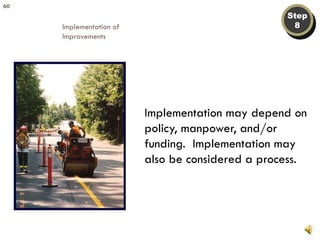
Implementation may depend on policy, manpower, and/or funding.  Implementation may also be considered a process. Step 8 Implementation of  Improvements
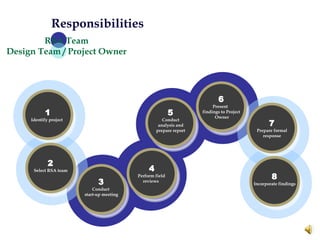
1 Identify project   2 Select RSA team 3 Conduct  start-up meeting 4 Perform field  reviews   5 Conduct analysis and prepare report 6 Present  findings to Project Owner 7 Prepare formal response 8 Incorporate findings Responsibilities RSA Team Design Team / Project Owner

Road safety audit presentation with special application to pedestrian issues

  • 1.
    Road Safety Audits** Assessments, Reviews, etc.
  • 2.
    Background Road SafetyAudits/Assessments (RSAs) are a valuable tool used to evaluate road safety issues and to identify opportunities for improvement Road Safety Audits have been widely used around the world Road Safety Audits are applicable throughout the highway design and performance cycle.
  • 3.
    Road Safety Audits(RSAs) Formal safety performance examination Existing or Future Road Segment or Intersection Independent, multidisciplinary team
  • 4.
    Why RSAs? Useof RSAs continues to grow Success has led to FHWA adopting process as one of its nine “proven safety countermeasures” RSAs Will help save lives and reduce injuries Examine conditions in detail that may pose safety hazards to all road users Consider safety from a human factors point of view Do not require large investment in time or money
  • 5.
    Traditional Road SafetyReview versus Road Safety Audit reactive in-house team field review? standards compliance proactive independent team field reviews comprehensive, with human factors Traditional Road Safety Review Road Safety Audit
  • 6.
    An RSA also…Considers safety of all road users Considers interactions at the borders or limits of the project Examines the interaction of project elements Proactively considers mitigation measures
  • 7.
    Systems Approach: Crashes Caused by Various Factors Vehicle 12% Roadway 34% Driver 80% Human is weakest link in this system, so we must design around human needs.
  • 8.
  • 9.
    RISK CATEGORY PrioritizeSafety Concerns Qualitative Estimate of Risk Low Moderate High Extreme Frequent Occasional Infrequent Rare C D E F B C D E A B C D A A B C Crash Frequency Category SEVERITY
  • 10.
    When do weconduct RSAs? Early Stages Planning / scoping / feasibility Preliminary (draft) design Detailed design Construction Work zones Pre-opening Post-construction Existing roads
  • 11.
    RSAs & ProjectStages Planning / Scoping Preliminary Design Detailed Design Pre-Opening More Major Issues Addressed by RSA Less Opportunity for Changes
  • 12.
    RSA Benefits Reducethe number and severity of crashes Promote awareness of safe practices Process to identify and address problems Considers human factors and multimodal issues Low cost
  • 13.
    RSA PROCEDURES The8-step Process
  • 14.
    1 Identify project 2 Select RSA team 3 Conduct start-up meeting 4 Perform field reviews 5 Conduct analysis and prepare report 6 Present findings to Project Owner 7 Prepare formal response 8 Incorporate findings RSA Team Road Owner RSA Procedure Responsibilities
  • 15.
    1 Identify project RSA Procedure RSA Team Road Owner Responsibilities 1 Identify project 2 Select RSA team 3 Conduct a start-up meeting 4 Perform field reviews under various conditions 5 Conduct audit analysis and prepare report of findings 6 Present findings to Project Owner 7 Prepare formal response 8 Incorporate findings
  • 16.
    Step 1 Identifythe Project Planning/Scoping Stage Design Stage Existing Roadway
  • 17.
    2 Select RSAteam RSA Team Road Owner Responsibilities RSA Procedure 1 Identify project or 2 Select RSA team 3 Conduct start-up meeting 4 Perform field reviews under various conditions 5 Conduct audit analysis and prepare report of findings 6 Present RSA findings to Project Owner 7 Prepare formal response 8 Incorporate findings
  • 18.
    Step 2 SelectRSA Team Independent Experienced Multi-disciplinary
  • 19.
    Traffic operations Step2 Geometric design Road users/human factors Select RSA Team: Core Skills Planning
  • 20.
    Step 2 SelectRSA Team: Supplementary Skills Human Factors Specialists Law Enforcement Maintenance
  • 21.
    3 Conduct astart-up meeting RSA Team Road Owner Responsibilities RSA Procedure 1 Identify project 2 Select RSA team 3 Conduct a start-up meeting 4 Perform field reviews under various conditions 5 Conduct audit analysis and prepare report of findings 6 Present RSA findings to Project Owner 7 Prepare formal response 8 Incorporate findings
  • 22.
    Step 3 Start-upMeeting Identify individual roles Communicate information Communicate RSA process Discuss constraints and limitations
  • 23.
    Step 3 Start-upMeeting: Provide Project Information Crash history Traffic volume Design drawings As-built drawings Corridor studies Transportation Plans Design criteria
  • 24.
  • 25.
    4 Perform field reviews RSA Team Road Owner Responsibilities RSA Procedure 1 Identify project 2 Select RSA team 3 Conduct a start-up meeting 4 Perform field reviews under various conditions 5 Conduct audit analysis and prepare report of findings 6 Present RSA findings to Project Owner 7 Prepare formal response 8 Incorporate findings
  • 26.
    Field Review: ObservationsRoad user types Driver behavior Surrounding land uses Link to adjacent network Step 4
  • 27.
    Step 4 FieldReviews: Common Items Sight distance obstructions Pedestrian and cyclist conflicts Visual clutter
  • 28.
    Step 4 FieldReviews: Variable Conditions to Observe Peak and off-peak traffic periods Dry and wet weather conditions Day and night conditions
  • 29.
  • 30.
  • 31.
  • 32.
  • 33.
  • 34.
  • 35.
  • 36.
  • 37.
  • 38.
  • 39.
  • 40.
  • 41.
  • 42.
  • 43.
  • 44.
  • 45.
    5 Conduct RSAanalysis RSA Team Road Owner Responsibilities RSA Procedure 1 Identify project 2 Select RSA team 3 Conduct a start-up meeting 4 Perform field reviews under various conditions 5 Conduct audit analysis and prepare report of findings 6 Present RSA findings to Project Owner 7 Prepare formal response 8 Incorporate findings
  • 46.
    Step 5 ConductRSA Analysis Identify and prioritize safety concerns Develop suggestions for reducing the degree of risk Compose presentation of early findings.
  • 47.
    Risks to beconsidered Drop Offs
  • 48.
    RISK CATEGORY PrioritizeSafety Concerns Qualitative Estimate of Risk Low Moderate High Extreme Frequent Occasional Infrequent Rare C D E F B C D E A B C D A A B C Crash Frequency Category SEVERITY
  • 49.
  • 50.
    Step 5 MitigateSafety Concerns: Short and Long Term Solutions Short Term Solutions Maintenance Vegetation Signing & Pavement Markings Medium Term Solutions Add missing sidewalk elements Improve transit stops Long Term Solutions Plan designation changes Create integrated network
  • 51.
    6 Present preliminaryRSA findings to Project Owner RSA Team Road Owner Responsibilities RSA Procedure 1 Identify project 2 Select RSA team 3 Conduct a start-up meeting 4 Perform field reviews under various conditions 5 Conduct audit analysis and prepare report of findings 6 Present RSA findings to Project Owner 7 Prepare formal response 8 Incorporate findings
  • 52.
    Step 6 RSAFindings Presentation Discuss safety concerns Clarify findings and suggestions Assist project owner in making best choices
  • 53.
    Safety concern DescriptionPrioritization (optional) Suggestions (optional) Step 6 RSA Findings: Formal Report
  • 54.
  • 55.
  • 56.
  • 57.
    7 Prepare formalresponse RSA Team Road Owner Responsibilities RSA Procedure 1 Identify project 2 Select RSA team 3 Conduct a start-up meeting 4 Perform field reviews under various conditions 5 Conduct audit analysis and prepare report of findings 6 Present RSA findings to Project Owner 7 Prepare formal response 8 Incorporate findings
  • 58.
    Suggestion 1: Considersidewalks along the project route to accommodate future pedestrian activity. Planning Division will recommend sidewalks be included within the scope of this project when submitted to Design Division. Suggestion 2: If R/W is available, add an acceleration on US 60 in the westbound direction for RT turning from Bowring Rd. This is not feasible for the following reasons: Any changes to the top of cut/toe of slope would affect the utility relocation which is currently under way. Also, the drive at Sta. 551+20 may conflict with accelerating vehicles. Action taken Step 7 Response Letter Reason for not taking action
  • 59.
    8 Incorporate findingsinto the project RSA Team Road Owner Responsibilities RSA Procedure 1 Identify project 2 Select RSA team 3 Conduct a start-up meeting 4 Perform field reviews under various conditions 5 Conduct audit analysis and prepare report of findings 6 Present RSA findings to Project Owner / 7 Prepare formal response 8 Incorporate findings into the project
  • 60.
    Implementation may dependon policy, manpower, and/or funding. Implementation may also be considered a process. Step 8 Implementation of Improvements
  • 61.
    1 Identify project 2 Select RSA team 3 Conduct start-up meeting 4 Perform field reviews 5 Conduct analysis and prepare report 6 Present findings to Project Owner 7 Prepare formal response 8 Incorporate findings Responsibilities RSA Team Design Team / Project Owner

Editor's Notes

  • #4 What is a Road Safety Audit? A road safety audit (RSA) is a formal safety performance examination of an existing or future road or intersection by an independent, multidisciplinary team. RSAs are a step further than traditional safety reviews that are currently done.
  • #7 It is also important to note that the RSA team may need to consider the safety performance of the project from the perspective of all road users. The graphic shows a passenger car, pedestrian, pedal cyclist, motorcyclist, and large truck. Participants may be able to name other possible road users, such as public safety vehicles (police or fire), maintenance vehicles, older drivers, etc. The RSA team examines connections to existing infrastructure beyond the project limits, and looks at the segment/intersection from the point of view of users entering and exiting it. For example, is signing adequate for drivers approaching from adjacent road segments (are approaching drivers correctly positioned for turn-only lanes, and is signing consistent with similar facilities upstream and downstream)? How do various project elements interact, especially combinations of minimum standards? For example, what are the implications of providing a minimum-radius curve on an approach to an intersection where the minimum stopping sight distance is provided? Can vehicles (especially trucks) safely brake? An RSA does not simply identify potential problems – it may also identify potential solutions. Some questionable elements may be unavoidable in a design, such as where there are constraints (geometric, fiscal, etc.) that limit the project. An RSA can identify possible mitigation measures to address these risks. For example, limited land availability may result in the need to incorporate a horizontal curve having a radius below the minimum design value for anticipated speeds. The RSA can identify potential measures to identify this hazard (appropriate signing) and induce lower approach speeds (narrower lanes or transverse rumble strips), which can be implemented at reasonable expense during construction.
  • #11 RSAs can be done at any stage of a project’s life. For simplicity’s sake, we have grouped them into three categories: The Early State (Planning or early-design) RSA looks at a roadway before it is built, at the planning/feasibility stage or the design (preliminary or detailed design) stage. The earlier a pre-construction RSA is conducted, the more potential it has to identify potential safety issues before they cause collisions. Construction RSAs are work-zone audits to examine temporary traffic management plans associated with construction or other roadworks, and can also be conducted when construction is completed but before the roadway is opened to traffic. The post-construction or operational (existing road) RSA looks at a road that has been built and is operating.
  • #48 Examples
  • #59 77
  • #61 FHWA RSA Train-the-Trainer Course Part 2 (RSA Procedures)