TRAFFIC SIGNS AND MARKINGS
Submitted To: Submitted By:
Dr. Pritikana Das Tanupriya Patel
222111515
Outline
 Road Signs and its types
 Road Markings and its types
 Literature Review
 References
Traffic Signs
The purpose of road signs is to promote road safety and efficiency by providing
for the orderly movement of all road users on the roads . These are erected at the
side of or above roads to give instructions or provide information to road users.
Classification
 Regulatory Signs
 Informatory Signs
 Warning Signs
Mandatory/Regulatory Signs
• Mandatory/Prohibitory Signs are to indicate the
prohibition upon certain kind of vehicle maneuver.
• They are with red circular ring and diagonal bars
with black symbols or arrows or letters on white
background.
• These signs need to be complied with and any
violation of the rules and regulations conveyed by
these signs is a legal offence.
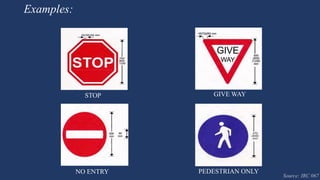
The exceptions in shape are the octagonal red STOP sign and the triangular GIVEWAY or YIELD sign.
These two signs provide indication about right of way to drivers.
Source: IRC 067
Examples:
STOP GIVE WAY
NO ENTRY PEDESTRIAN ONLY
Source: IRC 067
Informatory/Guide Signs
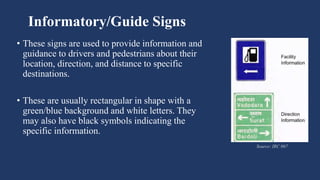
• These signs are used to provide information and
guidance to drivers and pedestrians about their
location, direction, and distance to specific
destinations.
• These are usually rectangular in shape with a
green/blue background and white letters. They
may also have black symbols indicating the
specific information.
Source: IRC 067
Cautionary/Warning Signs
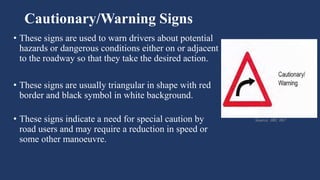
• These signs are used to warn drivers about potential
hazards or dangerous conditions either on or adjacent
to the roadway so that they take the desired action.
• These signs are usually triangular in shape with red
border and black symbol in white background.
• These signs indicate a need for special caution by
road users and may require a reduction in speed or
some other manoeuvre.
Source: IRC 067
Road markings
Road markings are defined as lines, patterns, words except road signs which
are applied or attached to the carriageway or to objects within or adjacent to
the carriageway for controlling, warning, guiding and informing the road
users.
Longitudinal markings
Transverse markings
Object markings
Word messages
Markings for parking
Hazard Marking
Classification
The road markings are classified as :
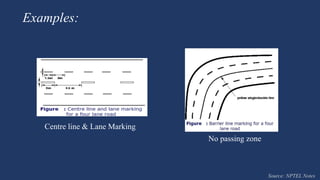
Longitudinal markings
• These are placed along the direction of traffic on the roadway surface, for
the purpose of indicating to the driver, his proper position on the roadway.
• Longitudinal markings are provided for separating traffic flow in the same
direction.
• The lines can be either broken, solid or double solid.
• Broken lines are permissive in character and allows crossing with discretion, if traffic
situation permits.
• Solid lines are restrictive in character and does not allow crossing except for entry or
exit from a side road or premises or to avoid a stationary obstruction.
• Double solid lines indicate severity in restrictions and should not be crossed except in
case of emergency.
Examples:
Centre line & Lane Marking
No passing zone
Source: NPTEL Notes
Transverse markings
• Transverse markings are marked across the direction of traffic. They
are marked at intersections etc.
• The type of road marking for a particular intersection depends on
several variables such as speed characteristics of traffic, availability of
space etc.
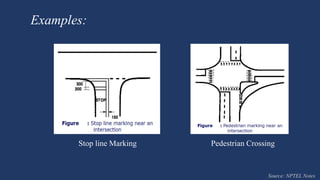
• Stop line markings, markings for pedestrian crossing, direction arrows,
etc. are some of the markings on approaches to intersections.
Examples:
Stop line Marking Pedestrian Crossing
Source: NPTEL Notes
Object marking
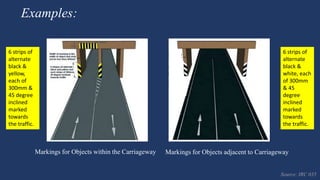
• Object Markings are used to mark physical obstructions in a
carriageway like traffic island, kerb or obstructions near carriageway
like signal posts, pier etc.
• Object markings are of the following categories:
• Objects within the carriageway
• Objects adjacent to carriageway etc.
Markings for Objects adjacent to Carriageway
6 strips of
alternate
black &
white, each
of 300mm
& 45
degree
inclined
marked
towards
the traffic.
Markings for Objects within the Carriageway
6 strips of
alternate
black &
yellow,
each of
300mm &
45 degree
inclined
marked
towards
the traffic.
Examples:
Source: IRC 035
Word Messages
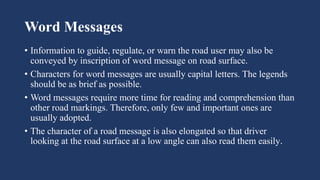
• Information to guide, regulate, or warn the road user may also be
conveyed by inscription of word message on road surface.
• Characters for word messages are usually capital letters. The legends
should be as brief as possible.
• Word messages require more time for reading and comprehension than
other road markings. Therefore, only few and important ones are
usually adopted.
• The character of a road message is also elongated so that driver
looking at the road surface at a low angle can also read them easily.
Source: IRC 035
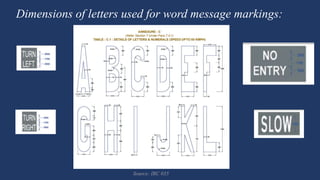
Dimensions of letters used for word message markings:
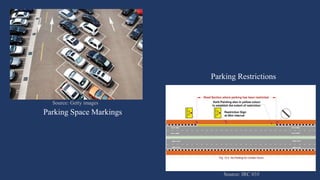
Parking
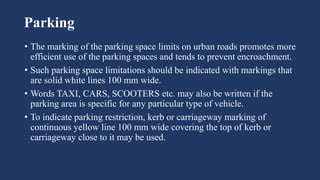
• The marking of the parking space limits on urban roads promotes more
efficient use of the parking spaces and tends to prevent encroachment.
• Such parking space limitations should be indicated with markings that
are solid white lines 100 mm wide.
• Words TAXI, CARS, SCOOTERS etc. may also be written if the
parking area is specific for any particular type of vehicle.
• To indicate parking restriction, kerb or carriageway marking of
continuous yellow line 100 mm wide covering the top of kerb or
carriageway close to it may be used.
Parking Space Markings
Parking Restrictions
Source: Getty images
Source: IRC 035
Hazard Marking
• These markings are used to warn the road user about the upcoming
hazards on the road.
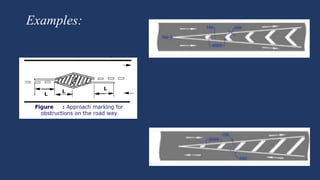
• Wherever there is a change in the width of the road, or any hazardous
location in the road, the driver should be warned about this situation
with the help of suitable road markings.
• Road markings showing the width transition in the carriageway should
be of 100 mm width.
Examples:
Literature Review
S.
No.
Paper Title Authors and
Year
Inferences
1.
Effect of Road Markings
and Traffic Signs
Presence on Young
Driver Stress Level, Eye
Movement and
Behaviour in Night-
Time Conditions: A
Driving Simulator Study
Darko Babić et al
11 May 2020
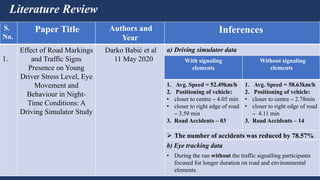
a) Driving simulator data
With signaling
elements
Without signaling
elements
1. Avg. Speed = 52.49km/h
2. Positioning of vehicle:
• closer to centre – 4.05 min
• closer to right edge of road
– 3.59 min
3. Road Accidents – 03
1. Avg. Speed = 58.63km/h
2. Positioning of vehicle:
• closer to centre – 2.78min
• closer to right edge of road
– 4.11 min
3. Road Accidents – 14
 The number of accidents was reduced by 78.57%
b) Eye tracking data
• During the run without the traffic signalling participants
focused for longer duration on road and environmental
elements.
S. No. Paper Title Authors and
Year
Inferences
1. Effect of Road
Markings and
Traffic Signs
Presence on Young
Driver Stress Level,
Eye Movement and
Behaviour in Night-
Time Conditions: A
Driving Simulator
Study
Darko Babić et al
11 May 2020
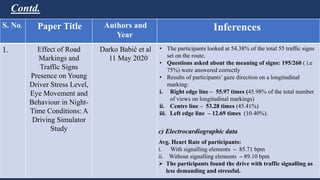
• The participants looked at 54.38% of the total 55 traffic signs
set on the route.
• Questions asked about the meaning of signs: 195/260 ( i.e
75%) were answered correctly
• Results of participants’ gaze direction on a longitudinal
marking:
i. Right edge line – 55.97 times (45.98% of the total number
of views on longitudinal markings)
ii. Centre line – 53.28 times (45.41%)
iii. Left edge line – 12.69 times (10.40%).
c) Electrocardiographic data
Avg. Heart Rate of participants:
i. With signalling elements – 85.71 bpm
ii. Without signalling elements – 89.10 bpm
 The participants found the drive with traffic signalling as
less demanding and stressful.
Contd.
S. No. Paper Title Authors and
Year
Inferences
2. Challenges on the
exposition of traffic
signs and symbols
to Lagos state road
users
Udeme Imoh et al
September 2021
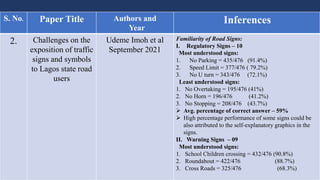
Familiarity of Road Signs:
I. Regulatory Signs – 10
Most understood signs:
1. No Parking = 435/476 (91.4%)
2. Speed Limit = 377/476 ( 79.2%)
3. No U turn = 343/476 (72.1%)
Least understood signs:
1. No Overtaking = 195/476 (41%)
2. No Horn = 196/476 (41.2%)
3. No Stopping = 208/476 (43.7%)
 Avg. percentage of correct answer – 59%
 High percentage performance of some signs could be
also attributed to the self-explanatory graphics in the
signs.
II. Warning Signs – 09
Most understood signs:
1. School Children crossing = 432/476 (90.8%)
2. Roundabout = 422/476 (88.7%)
3. Cross Roads = 325/476 (68.3%)
S. No. Paper Title Authors and
Year
Inferences
2. Challenges on the
exposition of traffic
signs and symbols to
Lagos state road
users
Udeme Imoh et al
September 2021
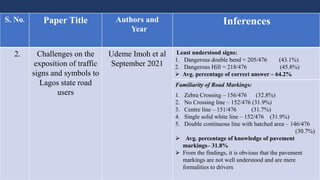
Least understood signs:
1. Dangerous double bend = 205/476 (43.1%)
2. Dangerous Hill = 218/476 (45.8%)
 Avg. percentage of correct answer – 64.2%
Familiarity of Road Markings:
1. Zebra Crossing – 156/476 (32.8%)
2. No Crossing line – 152/476 (31.9%)
3. Centre line – 151/476 (31.7%)
4. Single solid white line – 152/476 (31.9%)
5. Double continuous line with hatched area – 146/476
(30.7%)
 Avg. percentage of knowledge of pavement
markings– 31.8%
 From the findings, it is obvious that the pavement
markings are not well understood and are mere
formalities to drivers
References
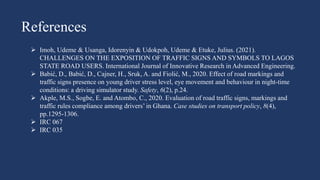
 Imoh, Udeme & Usanga, Idorenyin & Udokpoh, Udeme & Etuke, Julius. (2021).
CHALLENGES ON THE EXPOSITION OF TRAFFIC SIGNS AND SYMBOLS TO LAGOS
STATE ROAD USERS. International Journal of Innovative Research in Advanced Engineering.
 Babić, D., Babić, D., Cajner, H., Sruk, A. and Fiolić, M., 2020. Effect of road markings and
traffic signs presence on young driver stress level, eye movement and behaviour in night-time
conditions: a driving simulator study. Safety, 6(2), p.24.
 Akple, M.S., Sogbe, E. and Atombo, C., 2020. Evaluation of road traffic signs, markings and
traffic rules compliance among drivers’ in Ghana. Case studies on transport policy, 8(4),
pp.1295-1306.
 IRC 067
 IRC 035

Traffic signs.pptx

  • 1.
    TRAFFIC SIGNS ANDMARKINGS Submitted To: Submitted By: Dr. Pritikana Das Tanupriya Patel 222111515
  • 2.
    Outline  Road Signsand its types  Road Markings and its types  Literature Review  References
  • 3.
    Traffic Signs The purposeof road signs is to promote road safety and efficiency by providing for the orderly movement of all road users on the roads . These are erected at the side of or above roads to give instructions or provide information to road users. Classification  Regulatory Signs  Informatory Signs  Warning Signs
  • 4.
    Mandatory/Regulatory Signs • Mandatory/ProhibitorySigns are to indicate the prohibition upon certain kind of vehicle maneuver. • They are with red circular ring and diagonal bars with black symbols or arrows or letters on white background. • These signs need to be complied with and any violation of the rules and regulations conveyed by these signs is a legal offence. The exceptions in shape are the octagonal red STOP sign and the triangular GIVEWAY or YIELD sign. These two signs provide indication about right of way to drivers. Source: IRC 067
  • 5.
    Examples: STOP GIVE WAY NOENTRY PEDESTRIAN ONLY Source: IRC 067
  • 6.
    Informatory/Guide Signs • Thesesigns are used to provide information and guidance to drivers and pedestrians about their location, direction, and distance to specific destinations. • These are usually rectangular in shape with a green/blue background and white letters. They may also have black symbols indicating the specific information. Source: IRC 067
  • 7.
    Cautionary/Warning Signs • Thesesigns are used to warn drivers about potential hazards or dangerous conditions either on or adjacent to the roadway so that they take the desired action. • These signs are usually triangular in shape with red border and black symbol in white background. • These signs indicate a need for special caution by road users and may require a reduction in speed or some other manoeuvre. Source: IRC 067
  • 8.
    Road markings Road markingsare defined as lines, patterns, words except road signs which are applied or attached to the carriageway or to objects within or adjacent to the carriageway for controlling, warning, guiding and informing the road users. Longitudinal markings Transverse markings Object markings Word messages Markings for parking Hazard Marking Classification The road markings are classified as :
  • 9.
    Longitudinal markings • Theseare placed along the direction of traffic on the roadway surface, for the purpose of indicating to the driver, his proper position on the roadway. • Longitudinal markings are provided for separating traffic flow in the same direction. • The lines can be either broken, solid or double solid. • Broken lines are permissive in character and allows crossing with discretion, if traffic situation permits. • Solid lines are restrictive in character and does not allow crossing except for entry or exit from a side road or premises or to avoid a stationary obstruction. • Double solid lines indicate severity in restrictions and should not be crossed except in case of emergency.
  • 10.
    Examples: Centre line &Lane Marking No passing zone Source: NPTEL Notes
  • 11.
    Transverse markings • Transversemarkings are marked across the direction of traffic. They are marked at intersections etc. • The type of road marking for a particular intersection depends on several variables such as speed characteristics of traffic, availability of space etc. • Stop line markings, markings for pedestrian crossing, direction arrows, etc. are some of the markings on approaches to intersections.
  • 12.
    Examples: Stop line MarkingPedestrian Crossing Source: NPTEL Notes
  • 13.
    Object marking • ObjectMarkings are used to mark physical obstructions in a carriageway like traffic island, kerb or obstructions near carriageway like signal posts, pier etc. • Object markings are of the following categories: • Objects within the carriageway • Objects adjacent to carriageway etc.
  • 14.
    Markings for Objectsadjacent to Carriageway 6 strips of alternate black & white, each of 300mm & 45 degree inclined marked towards the traffic. Markings for Objects within the Carriageway 6 strips of alternate black & yellow, each of 300mm & 45 degree inclined marked towards the traffic. Examples: Source: IRC 035
  • 15.
    Word Messages • Informationto guide, regulate, or warn the road user may also be conveyed by inscription of word message on road surface. • Characters for word messages are usually capital letters. The legends should be as brief as possible. • Word messages require more time for reading and comprehension than other road markings. Therefore, only few and important ones are usually adopted. • The character of a road message is also elongated so that driver looking at the road surface at a low angle can also read them easily.
  • 16.
    Source: IRC 035 Dimensionsof letters used for word message markings:
  • 17.
    Parking • The markingof the parking space limits on urban roads promotes more efficient use of the parking spaces and tends to prevent encroachment. • Such parking space limitations should be indicated with markings that are solid white lines 100 mm wide. • Words TAXI, CARS, SCOOTERS etc. may also be written if the parking area is specific for any particular type of vehicle. • To indicate parking restriction, kerb or carriageway marking of continuous yellow line 100 mm wide covering the top of kerb or carriageway close to it may be used.
  • 18.
    Parking Space Markings ParkingRestrictions Source: Getty images Source: IRC 035
  • 19.
    Hazard Marking • Thesemarkings are used to warn the road user about the upcoming hazards on the road. • Wherever there is a change in the width of the road, or any hazardous location in the road, the driver should be warned about this situation with the help of suitable road markings. • Road markings showing the width transition in the carriageway should be of 100 mm width.
  • 20.
  • 21.
    Literature Review S. No. Paper TitleAuthors and Year Inferences 1. Effect of Road Markings and Traffic Signs Presence on Young Driver Stress Level, Eye Movement and Behaviour in Night- Time Conditions: A Driving Simulator Study Darko Babić et al 11 May 2020 a) Driving simulator data With signaling elements Without signaling elements 1. Avg. Speed = 52.49km/h 2. Positioning of vehicle: • closer to centre – 4.05 min • closer to right edge of road – 3.59 min 3. Road Accidents – 03 1. Avg. Speed = 58.63km/h 2. Positioning of vehicle: • closer to centre – 2.78min • closer to right edge of road – 4.11 min 3. Road Accidents – 14  The number of accidents was reduced by 78.57% b) Eye tracking data • During the run without the traffic signalling participants focused for longer duration on road and environmental elements.
  • 22.
    S. No. PaperTitle Authors and Year Inferences 1. Effect of Road Markings and Traffic Signs Presence on Young Driver Stress Level, Eye Movement and Behaviour in Night- Time Conditions: A Driving Simulator Study Darko Babić et al 11 May 2020 • The participants looked at 54.38% of the total 55 traffic signs set on the route. • Questions asked about the meaning of signs: 195/260 ( i.e 75%) were answered correctly • Results of participants’ gaze direction on a longitudinal marking: i. Right edge line – 55.97 times (45.98% of the total number of views on longitudinal markings) ii. Centre line – 53.28 times (45.41%) iii. Left edge line – 12.69 times (10.40%). c) Electrocardiographic data Avg. Heart Rate of participants: i. With signalling elements – 85.71 bpm ii. Without signalling elements – 89.10 bpm  The participants found the drive with traffic signalling as less demanding and stressful. Contd.
  • 23.
    S. No. PaperTitle Authors and Year Inferences 2. Challenges on the exposition of traffic signs and symbols to Lagos state road users Udeme Imoh et al September 2021 Familiarity of Road Signs: I. Regulatory Signs – 10 Most understood signs: 1. No Parking = 435/476 (91.4%) 2. Speed Limit = 377/476 ( 79.2%) 3. No U turn = 343/476 (72.1%) Least understood signs: 1. No Overtaking = 195/476 (41%) 2. No Horn = 196/476 (41.2%) 3. No Stopping = 208/476 (43.7%)  Avg. percentage of correct answer – 59%  High percentage performance of some signs could be also attributed to the self-explanatory graphics in the signs. II. Warning Signs – 09 Most understood signs: 1. School Children crossing = 432/476 (90.8%) 2. Roundabout = 422/476 (88.7%) 3. Cross Roads = 325/476 (68.3%)
  • 24.
    S. No. PaperTitle Authors and Year Inferences 2. Challenges on the exposition of traffic signs and symbols to Lagos state road users Udeme Imoh et al September 2021 Least understood signs: 1. Dangerous double bend = 205/476 (43.1%) 2. Dangerous Hill = 218/476 (45.8%)  Avg. percentage of correct answer – 64.2% Familiarity of Road Markings: 1. Zebra Crossing – 156/476 (32.8%) 2. No Crossing line – 152/476 (31.9%) 3. Centre line – 151/476 (31.7%) 4. Single solid white line – 152/476 (31.9%) 5. Double continuous line with hatched area – 146/476 (30.7%)  Avg. percentage of knowledge of pavement markings– 31.8%  From the findings, it is obvious that the pavement markings are not well understood and are mere formalities to drivers
  • 25.
    References  Imoh, Udeme& Usanga, Idorenyin & Udokpoh, Udeme & Etuke, Julius. (2021). CHALLENGES ON THE EXPOSITION OF TRAFFIC SIGNS AND SYMBOLS TO LAGOS STATE ROAD USERS. International Journal of Innovative Research in Advanced Engineering.  Babić, D., Babić, D., Cajner, H., Sruk, A. and Fiolić, M., 2020. Effect of road markings and traffic signs presence on young driver stress level, eye movement and behaviour in night-time conditions: a driving simulator study. Safety, 6(2), p.24.  Akple, M.S., Sogbe, E. and Atombo, C., 2020. Evaluation of road traffic signs, markings and traffic rules compliance among drivers’ in Ghana. Case studies on transport policy, 8(4), pp.1295-1306.  IRC 067  IRC 035